
Musing Out Loud...
I complained recently about the tedium of filing.
But there can be an upside—finding nuggets in the form of newspaper clippings and viewpoints I’ve expressed in the past, and since forgotten about, that synchronize with what’s happening in the news or just suit my present state of mind.
A disturbing trend that I’m noticing more frequently is the tinkering with the generally accepted record, and established historic reputations, by those demanding that names be expunged from our maps, from our schools, from our street signs, to name just three...
Please make no mistake, I have no interest in defending the damned.
It has always been my approach as an historian to let the men and women of our past stand on their own records. You know, the Good, the Bad and the Ugly. How sad it is that the villains have always been more newsworthy than the legions of honest, hardworking men and women who built this country with their blood, sweat and tears, and who’ve been, for the most part, forgotten.
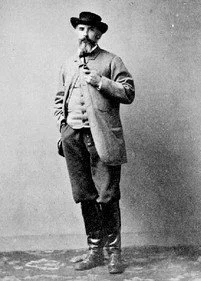
BC’s so-called ‘Hanging Judge,’ M.B. Begbie. —Wikipedia
One legendary BC pioneer who I believe has been given a bum rap in recent years is Sir Matthew Baillie Begbie. I wrote this piece for the Cowichan Valley Citizen 26 years ago, and I stand by it now:
BC’s ‘Hanging Judge’ Was a Man of Contrasts
"...He, probably more than anyone else, established the rule of law for the province of British Columbia."
"To insinuate that one of our judges was a short-tempered beast who would hang a man from the branch of a tree at a drop of the hat is a disgrace. In actuality, Begbie was one of the kindest judges who ever graced a B.C. court. He hanged men for murder because that was the penalty for murder. But the hangings always took place after a fair trial by 12 jurors."
The subject of this heated defence is Sir M.B. Begbie, the larger-than-life lawmaker whom history has cast in the role of, as implied, the 'Hanging Judge.' Or ‘Rope Tyee,’ as he supposedly was called by some First Nations peoples.
The man behind this introductory protest was the late Vancouver City Archivist, Maj. J.S Matthews, whose ire had been provoked by a National Film Board production. And, despite the legends that are popular today concerning this towering magistrate, Maj. Matthews' view is closer to the mark.
Hanging Judge? It's a harsh judgment of a man who’d declined to enter the army because he abhorred the idea of taking a human life
A B.C. Centennial release described the man who brought British justice to the brawling frontier as "a struggling young London barrister with a trim Van Dyke and luminous eyes [who’d] been a top student at Cambridge and an all-round athlete, and a singer of repute. But he was firm in the law and fierce in his application of it.
“Hot-tempered, autocratic, stubborn he certainly was.
“But a monster who enjoyed sentencing men to death? No, despite the fact that, between 1859 and 1872, 27 of 52 men who appeared before him on murder charges-and one for attempted murder—were ultimately hanged. He'd recommended clemency 11 times and opposed it for 20.”
It must be remembered that, in 1858, the frenzied cry of “Gold!” drew as many as 30,000 men and women of all nationalities and backgrounds to wilderness BC. Few of them succeeded in striking it rich; many remained to settle, and some died, naturally and otherwise.
Over this motley army of adventurers, not to overlook the 10s of 1000s of First Nations peoples who had their own ideas as to what is justice, presided the formidable Judge Begbie. On horseback, he rode the circuit from mining camp to boom town
His life, holding circuit court, became coloured with legends of the bully he flattened with one blow; of the plotters he quelled with a bucket of dirty water; of the floggings and hangings he ordered.
In truth, he had a horror of taking a human life, contemporaries wrote. But he “kept the peace by his very presence on his horseback circuit."
Ironically, interest in the number of convicted murderers Begbie dispatched to eternity seems to have been sparked in recent years. During the handsome, lifelong bachelor’s lengthy career as a circuit judge and as chief justice of the united colonies of Vancouver Island and BC, Most of the harsh criticisms of his professional ability and impartiality were directed at his handling of civil suits—600 miners at Williams Creek once having campaigned for his dismissal.
They failed but, more than once, a disgusted newspaper editor railed against Begbie’s perceived arrogance and predilection for intemperate language.
“The Chief Justice’s law may sometimes be bad, but his manners are always worse [raged the Victoria Times in 1889]—public opinion has been aroused during the last few days as it was never aroused before, and it will be strange indeed if a determined line of action be not decided upon to curb [Begbie’s] propensity…for promiscuous abuse.”
But Begbie continued to insult dissenting juries and journalists with impunity.
Knighted in 1875, he remained in office until his death of cancer, aged 75, in 1894. By then, Begbie and his surviving opponents had mellowed. The tall old man (six-foot-four), his trim Van Dyke beard streaked with grey, was a familiar sight on Victoria streets and along its waterfront as he enjoyed his daily walks, usually accompanied by several spaniels. He continued to enjoy duck shooting, croquet and tennis and, every Sunday, he sang in St. John’s Church.
Some of his controversial views and jury addresses make for fascinating reading in this age of watered-down justice. In a letter to Gov. James Douglas he wrote, “My idea is that, if a man insists upon behaving like a brute, after fair warning, and won’t quit the Colony, beat him like a brute and flog him.”
To a man charged with murder and his jurors: “You deserve to be hanged! Had the jury performed their duty, I might now have the painful satisfaction of condemning you to death, and you, gentlemen of the jury, you are a pack of...horsethieves, and permit me to say, it would give me great pleasure to see you hanged, each and every one of you, for declaring a murderer guilty only of manslaughter.”
To a man acquitted of burglary, Begbie suggested that he show his jury a preference when next he felt the urge to commit a break-in.
To a man acquitted of manslaughter, his most-quoted admonition: “You are discharged. Go and sandbag some of those jurymen. They deserve it.” Once, in lighter vein, he advised a man acting as his own counsel to, in lieu of a credible defence, to “Keep the jury in good humour.”
Dr. David M.L, Farr, placed Begbie in historical context for the UBC Law Review thus: The truth of the matter seems to be that if sometimes Begbie’s judgments were biased or coloured the general character of his decisions was sound and efficient. He made the principles of British justice known and respected throughout a vast and underdeveloped colony and in this service lies his contribution to B.C.”
This was the man we call the Hanging Judge.
* * * * *

Have a question, comment or suggestion for TW? Use our Contact Page.