
Musing Out Loud...
You don’t need me to tell you that time and the world around us are in a constant state of change. There’s even a saying to that effect, ‘The only thing constant is....”
Sometimes, however, it isn’t really a change per se, but a matter of degree. In other words, the stories are mostly the same, even when they’re decades apart, only the numbers vary. (Blame it on inflation.)To make my point, and for a change of pace in my weekly meandering, I offer this editorial on what we now know as the Old Age Pension. It appeared in the Vancouver News-Herald in July 1950.
Compare it with your OAP/CPP.
* * * * *
$40 at 70 Without Means Test
The parliamentary committee on old age security has come up with a report on pensions that is a credit to its members.
It calls for a lowering of the pensionable age to 65 and the broadening of the benefits to persons over 70 by elimination of the means test.
The committee made a thorough study of pension schemes in other countries and of the social and economic factors involved in improving the Canadian plan. It received proposals from 22 associations and individuals and from seven provinces. It had advice from five governments. It held 52 sittings.
British Columbia senator J.H. King, one of the two chairman, and Vancouver's Arthur Laing, M.P., share the credit for the committee's great work.
Its report will get plenty of mileage over the next few months. The plan will obviously be a major item for consideration at the federal-provincial conference next fall. Unless a grave international situation develops, legislation should be submitted at next year's session of parliament.
The committee's proposal is in two parts. It suggests that the federal government assume full responsibility for financing pensions to persons over 70. Ottawa would would share equally with the provinces the cost of pensions at the age of 65 to 70.
The federal share of the program would require an additional $250 million revenue now. Cost to the provinces would be slightly less than it is now.
Two points will be especially debatable. One is the method of financing. Some form of contributory plan is essential, not only to cover the cost, but to link contribution with benefits in the mind of the citizen.
The other is the amount of pension. Various amounts were suggested to the committee, varying from $30 to $60 a month. The committee recommends $40. In this connection it is well to bear in mind bear in mind what Hon. Paul Martin told the Commons recently:
“As we go forward with our Social Security program we will want to make sure that every step is taken responsibly and carefully in the light of all circumstances in order to avoid retrenchment or abandonment of programs later on, which might prove disastrous.”
That was in 1950, a time when Canada was riding the post Second World War boom, perhaps the greatest ever, before or since. Over the past 76 years, the OAP has long been established.
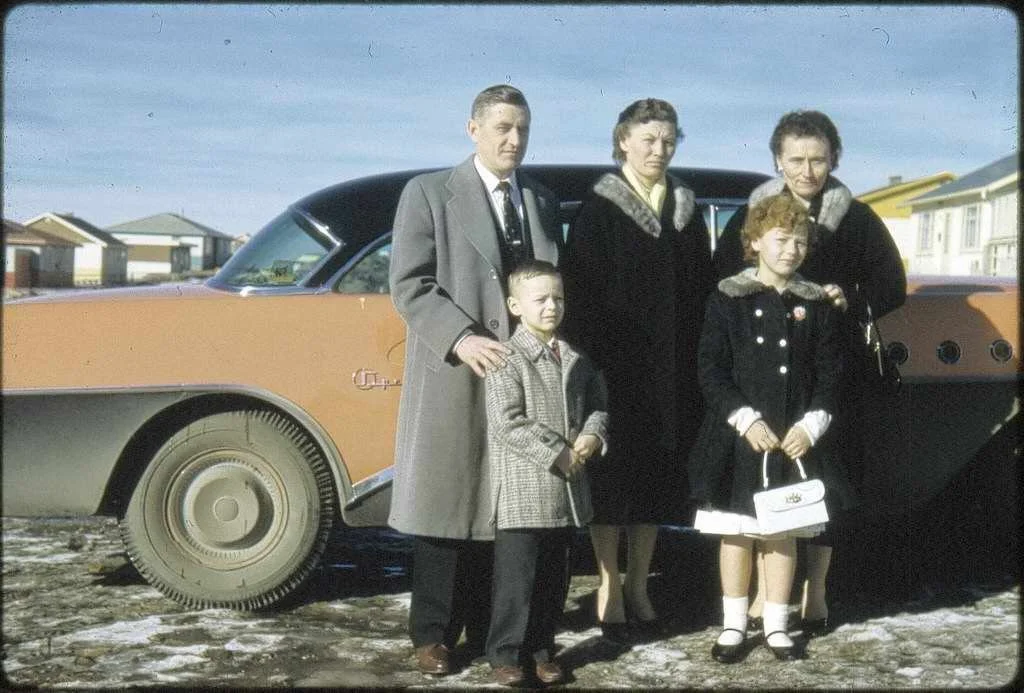
Canada was on an economic roll in the 1950s. But personal income for the elderly was a concern then, too. --www.Pinterest
Think about this for a moment, compare it to your own monthly government stipend, and remember how the federal government has downloaded so many programs and costs to the provinces.
Looking around, you’ll see what has every aspect of a prosperous economy and society: new and large homes with two and three expensive vehicles in the driveway and on the street, maybe a travel trailer, a boat and/or a camper.
Yet I recently read that almost one Canadian in six lives below the poverty level.
I’m not an economist and the Chronicles aren’t a sounding board for social comment. But I do try to be observant, and constant exposure to old newspapers certainly keeps my mental wheels turning. (Sometimes, churning.)
That’s a problem with history, BTW, it tends to make one think—the surest, shortest way to depression that I know of!
* * * * *

Have a question, comment or suggestion for TW? Use our Contact Page.