
Musing Out Loud...
I forgot to mention in last week’s Chronicle about pit ponies that, years ago when they were building the Nanaimo Expressway, workers exposed an underground stable. According to my informant, who lives nearby, the stable was intact—a virtual time capsule of the greater Nanaimo area’s coal mining.
The contractors, alarmed lest word get out and historians want to get involved and hold up work, couldn’t bury it fast enough.
Ironically, on the flip side, there have been several occasions in recent years where Nanaimo streets, built atop abandoned and flooded coal mines, have collapsed and required expensive back filling.
* * * * *
I know that I glorify coal mining. Story-wise, I love everything about it. Which explains my newest book, the first of four volumes that, over the next three years, will tell the story of greater Nanaimo area coal mining as it hasn’t been done by previous historians.
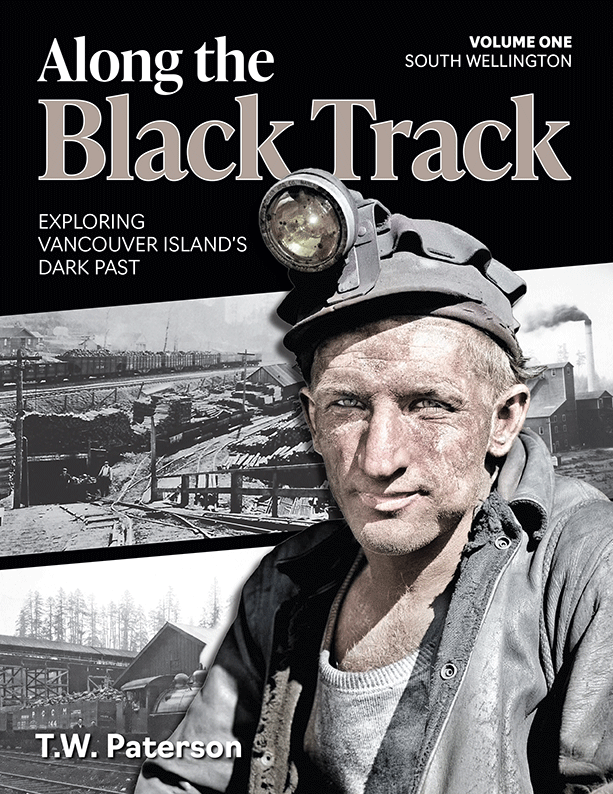
Book number 38! My first on Island coal mining, it won’t be my last, as this is Volume One of what will be a four-volume series.
Some weeks ago, on the 60th anniversary of the Aberfan, Wales disaster, the airwaves were filled with sad newsreels of this horrific tragedy that destroyed a village. Here’s the sad story according to Wikipedia:
“The Aberfan disaster was the catastrophic collapse of a colliery spoil tip on 21 October 1966. The tip had been created on a mountain slope above the Welsh village of Aberfan, near Merthyr Tydfil, and overlaid a natural spring.
Heavy rain led to a build-up of water within the tip which caused it to suddenly slide downhill as a slurry, killing 116 children and 28 adults as it engulfed Pantglas Junior School and a row of houses. The tip was the responsibility of the National Coal Board (NCB), and the subsequent inquiry placed the blame for the disaster on the organization and nine named employees.
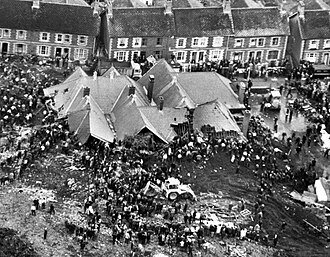
Rescuers searching the remains of the school. —Wikipedia
There were seven spoil tips on the hills above Aberfan; Tip 7—the one that slipped onto the village—was started in 1958 and, at the time of the disaster, was 111 feet (34m) high. In contravention of the NCB's procedures, the tip was partly on ground from which springs emerged. After three weeks of heavy rain the tip was saturated and approximately 140,000 cubic yards (110,000m) of spoil slipped down the side of the hill and onto the Pantglas area of the village.
The main building hit was the local junior school, where lessons had just begun; 5 teachers and 109 children were killed.”
My God.
For almost a century, coal mining was Vancouver Island’s greatest single employer. A dozen communities, from whistle stops to metropolis, were built on coal mining. The industry killed 1,000 men and maimed how many more. Yet here we are, just, 70 years later, and other than some museum displays and a signboard, it’s gone, gone, gone.
Our ‘black past’ should be taught in our schools. But it isn’t.
So, for what’s it’s worth to posterity, I do my modest part to keep our coal mining history alive. In November, we honour our war dead and our veterans. In April, it’s the turn of forest workers killed on the job. I think it’s about time that we acknowledge the men o’ the deep and their families who, like policemen and other first responders, never knew if they’d come home at the end of a work shift.
Is that asking so much?
* * * * *
For those Chronicles readers who live in the Cowichan Valley, Belinda and I will be four days (November 12-15) at Christmas Chaos, in the Community Centre, Duncan. On November 21st, we’ll have a table at the 2nd Annual Ladysmith Winter Book Fest in the Eagles Hall. Please drop by and say hi. Most of you readers are invisible to me and it’s always nice to actually meet a subscriber and a reader as I rarely do author events or public speaking events anymore.
* * * * *

Have a question, comment or suggestion for TW? Use our Contact Page.