
Editorially speaking…
Last week, inspired by the remarkable Rev. Henry “Father Pat” Irwin, the subject of last and this week’s Chronicle, I told you about A.G. Marsh, a pioneer I originally wrote about for the Victoria Colonist 35 years ago. He, too, seems to have thrived on physical and spiritual challenge.
He, too, was doomed to disappointment. For Irwin, the loss of wife and baby then illness and premature death; for Marsh the labour of half a lifetime unfulfilled.
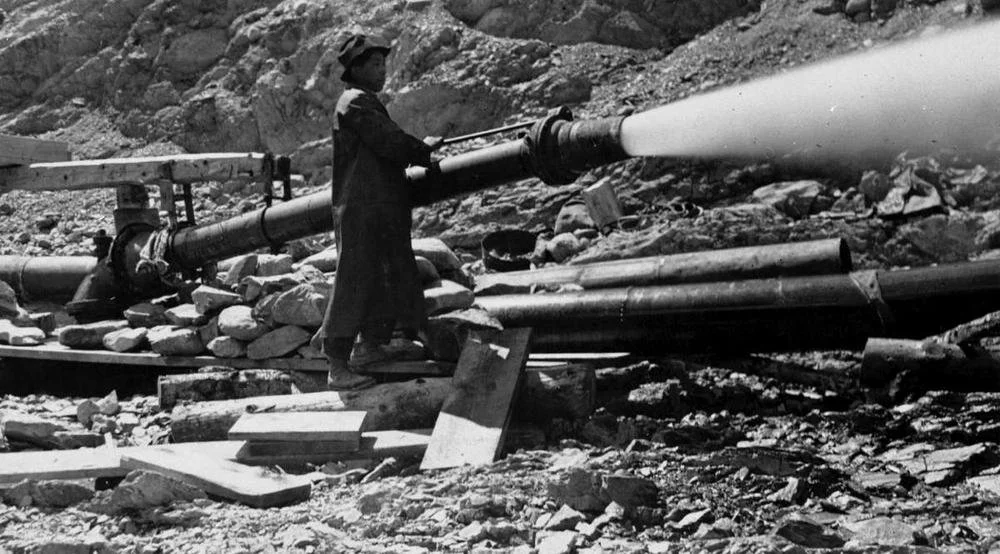
For every successful mine, how many broken dreams? —BC Archives
How many other pioneers gave themselves body and soul to their goals, only to be denied? It’s the human drama that makes history so fascinating, and Marsh reminded me of another Nevada veteran who courted Dame Fortune.
H.C. Pollock had also tired of the heat and dust of the Nevada silver rush and worked his way northward through the stampedes of Oregon and Washington. In 1898, rather than follow the wheel of fortune to the fabled Klondike, Pollock opted for B.C. After trying his luck in the Arrow Lakes and West Kootenay districts, he moved to the Similkameen, camped on the future site of Hedley and explored Nickel Plate Mountain, soon to become one of the province’s richest gold producers.
His investigation let him to believe that the pay streak extended across the Similkameen River and, two miles upstream, near the mouth of Sterling Creek, he found evidence of gold and silver-bearing ore.
He had to suspend operations for the winter but, come the spring and summer, he staked the Maple Leaf, Martin, Daisy, Pine Knot and Minnehaha claims, and set to work to expose the veins. Upon finding promising indications of ore throughout, Pollock began the age-old miners’ quest for capital.
Like 1000s before and since, he found financiers to be extremely reluctant to gamble. They insisted that he develop his claims further.
Because, to quote an old record, Pollock’s own capital consisted of nothing more than muscles and a stout heart, he continued to seek funding and he finally interested C.E. Oliver in bonding the properties. A shaft was sunk on the Martin and Maple Leaf leads. Immediate results were encouraging and further work exposed more ore, ranging in value from $15 to $59 in gold to the ton.
This was sufficient to warrant serious development and Pollock Mines Ltd. was organized and promoted shares on the open market.
Throughout, Pollock had refused to sell his own interest. After years of unremitting work and unbounded faith in himself and in his claims, he’d brought them to the production stage. In 1905 it was reported that he enjoyed every expectation of at last winning his race with Lady Luck, prominent mining engineers having praised his mine’s potential.
“With careful and economical management, ample funds for development and the installation of the necessary machinery, the Pollock mines...give great promise of a successful career,” and A.C. Pollock, it would seem, finally had the world by the tail.
It wasn’t to be. The 1908 Annual Report of the Department of Mines lists him as supervisor of the Kingston properties for the Kingston Gold Copper Mining Co. He continued to work hard, Gold Commissioner James Brown commenting on the amount of work accomplished under his direction.
Assay reports as high as $35 to the ton attracted renewed interest in the Pollock Group in 1927, and sporadic attempts were made until the late ‘30s to make the Maple Leaf and adjoining claims a paying proposition. They had long since passed from the ownership of the pioneering R.C. Pollock.
He, like Father Pat and fellow miner A.L. Marsh, truly believed that their faith, be it in God or in themselves, could move mountains. Instead, for Father Pat, a broken heart and broken body; for Marsh and Pollock, dreams unfulfilled.
For them, and for legions of others, Hollywood endings, it seems, happen only in the movies. As we kids used to cry when we felt aggrieved or deprived, ‘It ain’t fair.”
But there we are.
* * * * *
Have a question, comment or suggestion for TW? Use our Contact Page.