
Editorially speaking…
War is Hell – But to Die After You Come Home is Worse
I still recall the shock, followed by rage, all these years later.
The shock that a former soldier had just died in a veteran's hospital where he'd been laid up since the First World War, some 40-odd years before. And rage at the thought that he’d spent two-thirds of his lifetime disabled and suffering in a hospital word, far, far from the trenches of Europe and long, long after Armistice Day.
It wasn't right! It was so unfair!
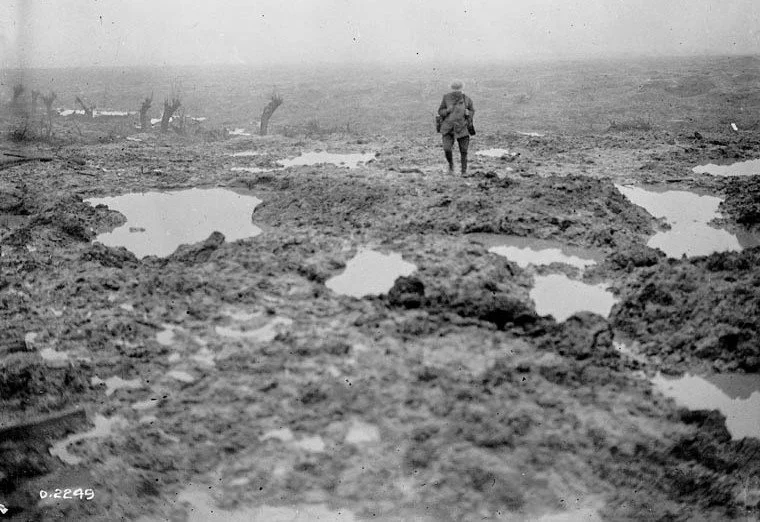
Men were ordered to charge massed machine-guns in this mud; some of them drowned in the shell holes without ever reaching the enemy. —https://thecanadianencyclopedia.ca/en/article/battle-of-passchendaele
I was, obviously, young and very naive to think, first, that this couldn't possibly be, then, since it must be so, that it was nothing less than unspeakable and prolonged cruelty.
Only later, as I matured, as I observed, as I learned more not just about history but about life, did I come to realize that he was just one of 10s of 1000s of servicemen of all nations whose devastating injuries had been beyond healing, whose daily medical needs could only be met in a hospital.
But the discovery that he and the others were still lingering under medical care from a war that ended well before I was born truly distressed me.
How sad, I thought then; how sad, I think now. And my research of the Cowichan Valley's contribution of young men—Duncan had the highest enlistment rate per capita in all of Canada—has only deepened my sense of sadness for those names on the Duncan Cenotaph.
For some, there was the bitter irony of making it home only to die later as a direct result of their war service. Talk about adding insult to injury!
Let me introduce you to Sapper Harry Parker, 9th Canadian Railway Troops (First Canadian Platoon), formerly of the 10th battalion, C.E.F. and, previous to that, a printer and linotype operator with the Cowichan Leader.
Handsome, with wavy hair, he was the youngest child of Mr. and Mrs. A. W. J. Parker of Duncan. For all his youth he was the Leader’s senior employee, having joined the firm during its previous incarnation as the Duncans Enterprise. But, with war he, too, as had so many others, enlisted and, in March 1915, he was off with the 50th Regiment then reassigned to the 48th Battalion and, in July, dispatched to England.
After less than 10 weeks’ training the 48th was sent to the front.
For a year Harry served in the front lines, until the Third Battle of Ypres in June 1916 when he was wounded in the foot, then gassed. Both times he required hospitalization and both times he returned to active duty, latterly with the 1st Canadian Pioneers with whom he fought at the Somme and Arras.
But the gassing had done its work and his health wasn't the same. Given leave on compassionate grounds, he returned home in time for Christmas 1918, a month after Armistice. By this time a corporal (sapper in the engineering corps) he took his discharge from the army.
“For a time he appeared to be quite well,” a friend at the Leader wrote later, “and engaged in various open-air tasks [no more print shop for Harry Parker, obviously], but last summer the effects of the gas and the tuberculosis sent him to hospital in Victoria. He spent last Christmas in Duncan and subsequently was removed to [the provincial sanitarium] at Balfour.”
A member of the Typographical Union, of the Duncan Court of the A.O.F. and of the Duncan volunteer Fire Brigade, he’d “exercised a beneficial influence” in the local Great War Veterans Ass. and had been appointed to the provincial executive at its provincial convention in the spring of 1919.
His workmates remembered him as an excellent craftsman with a “genial, sunny nature which won him friends everywhere..."
All five Parker boys had answered the call. Brother's Shircliffe, Hugh and George were in various units of the Canadian Army and Frank was with the American Expeditionary Force. None could make it home for the funeral.
Ten days after his death, Harry Parker was given a military funeral at St. Mary's, Somenos. A detachment of Canadian Engineers from Victoria paid honour to one of their own who’d been wounded twice and served 14 months in the hellish trenches.
As a gun carriage to bear the casket wasn't available, a specially prepared wagon was pressed into service and a lengthy cortege or cars and mourners slowly made their way from Duncan to Somenos where the Revs. Christmas and Bagshaw waited to officiate in a church filled to overflowing.
The Leader glumly noted that Harry Parker was the Valley's first soldier to die since returning home, that he “truly gave his life for his country as if he’d fallen overseas".
One of the more poignant wreaths was that of the Nanaimo branch of the ITU with ‘30’ spelled out in flowers—the universal newspaper sign-off for The End.
Have a question, comment or suggestion for TW? Use our Contact Page.