
Editorially speaking…
Welcome to another year and another ramble of the BC Chronicles.
For years, I’ve devoted much of the week between Christmas and New Year’s Day to ‘housekeeping’ in my library/office by sorting through files that didn’t find their way home after use during the year, while reflecting on this and that that chances to mind from the year gone by, or beyond. An annual introspection, if you will.
The two go hand-in-hand, by the way, as files and stories I’ve forgotten about turn up; some of them bring old memories to the fore and some can be put to use further use.
So it was last week that I struck gold, of sorts. To explain:
When I began writing the Cowichan Chronicles as a twice-weekly historical column in the Cowichan Valley Citizen in 1997, I deliberately broke one of my few cardinal rules by injecting more of myself editorially (as I’m doing here), something I’d always tried to avoid.
“Just the facts, ma’am, nothing but the facts,” sort of thing was my working credo. I actually abhorred historical writers whose offerings were more about themselves than the supposed subject.
So began my 23 years of entertaining (and, hopefully, informing) the Citizen’s 20,000-plus readers about the Valley and BC’s rich and colourful past. By far most columns were in the third person, with just an infrequent change of pace. What resulted over the next several years was a sporadic “series”—columns that were historically grounded but had a pronounced personal slant.
Like today’s “editorial”.
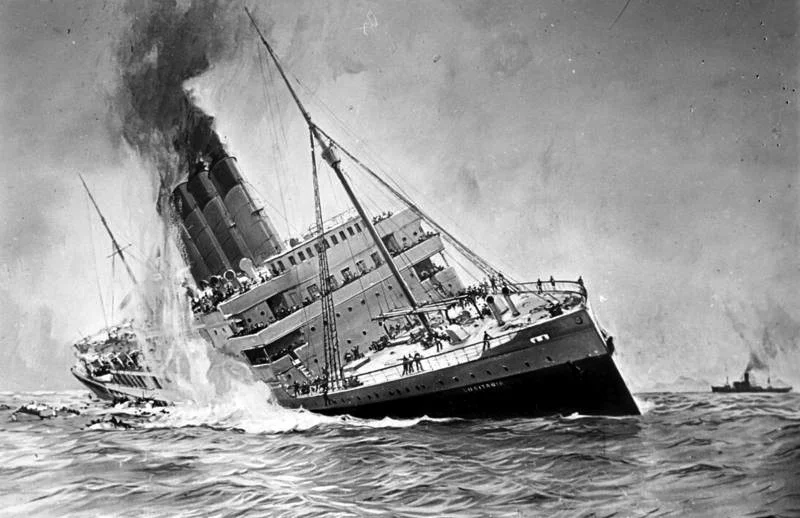
The torpedoed RMS Lusitania as she’s about to disappear forever after being torpedoed off the southern tip of Ireland. More than half a century after, I’d interview one of her survivors. —Wikipedia
To get to my point: while rearranging the deck chairs in my library last week I found a file that had, literally, fallen between the cracks. It contained a dozen quarter-century-old columns that I’d probably set aside because they were so unlike my regular fare, which was 104 columns a year in those days.
Fast-forward to the present; if you haven’t already turned the page, today I present you with this goldie oldie from 2002. Twenty-four years later, I still think it has relevance.
No Generation Gap for Cowichan Chronicler
I didn't always record Cowichan Valley history before the BC Chronicles. For more than 10 years I met a weekly deadline to fill two pages in the weekend magazine section of what was then The Daily Colonist, focusing mainly on Victoria and Vancouver Island personalities subjects and local health.
In that role of researcher and recorder, I have sailed aboard the ill-fated passenger liner Lusitania, pulled survivors from another torpedoing in another war in the North Atlantic, tracked an ‘Eskimo’ murderer across the high Arctic, survived the great explosion of Halifax, and helped to blow up Ripple Rock.
I have gone where no others would go before me—because none of the senior reporters wanted to do it and because, as humble copy boy aspiring to be a reporter, I couldn't get out of it–to interview an “Old Fogie”. That first interview by default was one of the most rewarding of the many that have followed over the years because it opened my eyes to, among other things, the fact that ‘old age’ truly is just a state of mind.
Mind you, this revelation didn't come to me with a thunderclap. i was, after all, 17, green and shy (an almost lethal combination for a would-be journalist). But I also had the arrogance of innocence, that lack of understanding of the world about me that blinkers youth. It took firm prodding from the city desk and several visits to the “old folks home,” to open my eyes and thus encourage me on my fledgling career path.
Charles Taylor lived in Victoria's Kiwanis Villa, a residence for elderly singles. I'll never forget that first visit. One-storey and built on a concrete slab, it was rocking that day. I mean, really. As we sat in Charles's tiny room, consisting of little more than a bed, a closet, a dresser and two chairs, I could feel the floor vibrating beneath my feet. Way down the hallway, after lunch was finished, the tables and chairs had been pushed aside, the piano fired up and the dining room transformed into a lively dance hall.
It was really popping. So much for any preconceived notions about old folks in rocking chairs in the sun room!
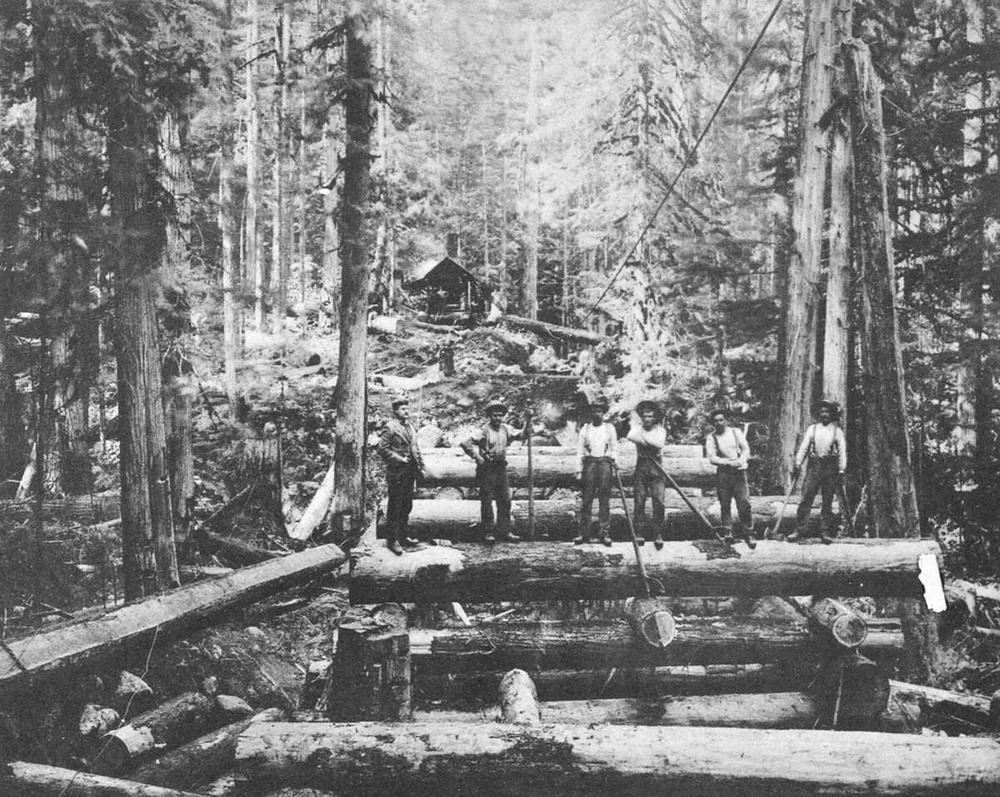
Charles Taylor began his career in the woods as a timber cruiser. —BC Archives
Although hard of hearing and a little stiff in the joints, there was nothing ancient about my subject’s brain. With sparkling eye and with great recall he spoke of his growing up in Port Alberni. It's just as well I'd invested in a portable tape recorder (not yet having learned a form of shorthand) as I I'd never have been able to keep up with him. I hardly asked a question—just sat back and listened as the years fell away.
He talked about what it was like to grow up on the Island’s West Coast before the turn of the last century, of his life as a timber cruiser, of the Indian legends of a monster in Sproat Lake, of the many colourful characters he’d known, and of the numerous tragedies which seem to have cursed this region for many years.
This was pioneer life in the raw, as told in living colour by an old man of firsthand experience to a young man with none of his own.
Charles Taylor died not long after my several interviews. I regret to say that I didn't attend his funeral, despite the telephone company invitation from his son. I begged off, saying I had a dental appointment. Just another of youth’s foibles. I didn't “believe” in funerals then. (I've since changed my mind.)
There were other interviews in the years that followed, each as unique in story content as their tellers. Florence Padley had survived the 1915 torpedoing of the S.S. Lusitania that claimed the lives of 1201 men women and children, and contributed to the United States entering the war against Germany.
W.O. Douglas not only told of having join the North West Mounted Police (predecessor to the RCMP) but wrote it out for me in longhand—more than 100 pages of neat script detailing how he’d chased an ‘Eskimo’ murderer for 100s of miles and for more than a year across the Arctic, and how he’d battled bootleggers in northern Manitoba,
All this, years before he’d joined the Hudson’s Bay Company and pioneered Canadian mink farming.
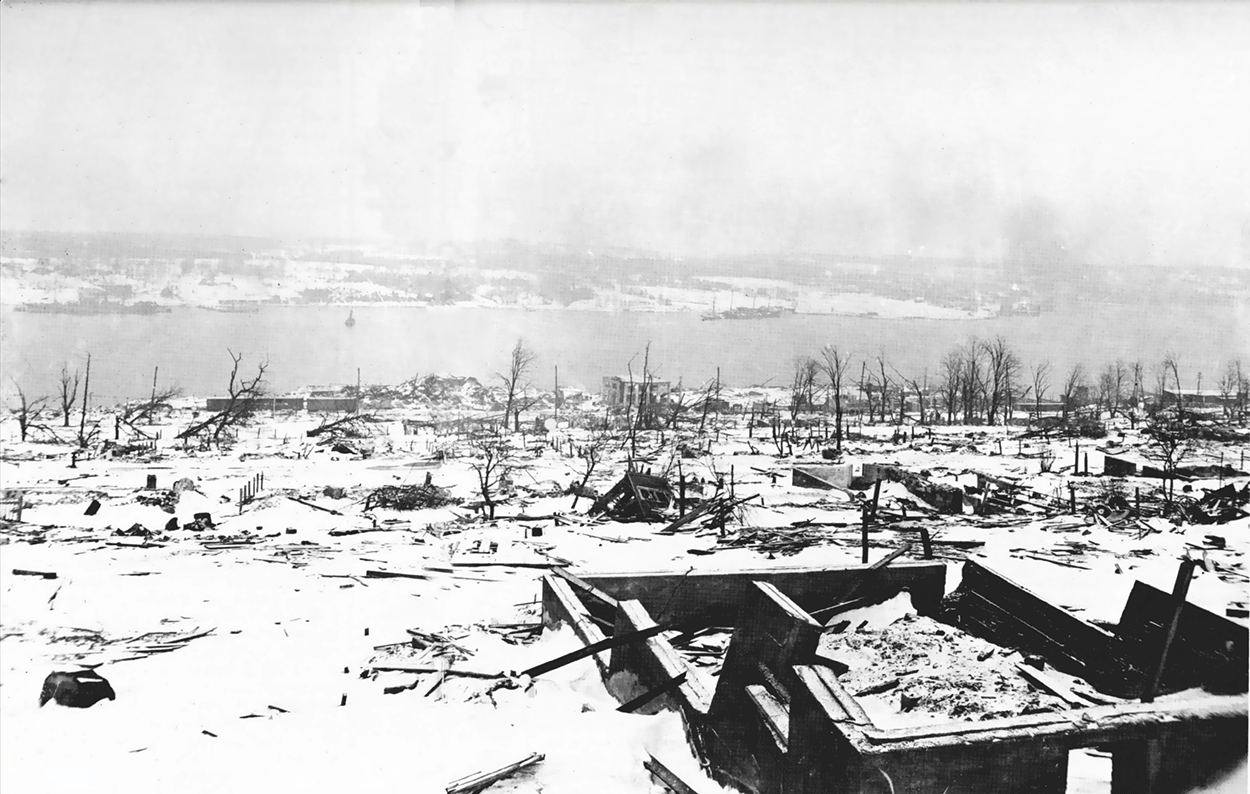
Through the eyes of Jock Hamilton, I vicariously experienced the horror of the Halifax explosion. — William James (Toronto) - Wikipedia
Glaswegian John Lawson ‘Jock’ Hamilton survived the great Halifax explosion of 1917 that saw almost the entire city levelled when two ships collided in the harbour. It's one of Canada's worst disasters ever. But my favourite anecdote is of when, as a professional portrait photographer before he came to Canada, he was commissioned to photograph the Prince of Wales.
When His and Her Highness appeared for the sitting, it was immediately apparent that the royal heir was so drunk he couldn't stand straight or still. These, in that age of slow camera shutters, were prerequisites for a successful shooting.
After several failed attempts to capture the prince on film, Jock turned to Her Highness and gently told her that it was useless to proceed.
Obviously practised in such matters, she instructed Jock to reload his camera and, when ready to release the shutter, to give her the signal. Jock burrowed under the camera's cape and rechecked his focus as she again steered the befuddled prince before the staged backdrop.
At Jock's signal, she stood back, just out of frame, and with all of her might, kicked her husband square in the shin!
With a shriek of pain and rage he bolted upright, Jock snap[ed the shutter and—poof!—it was done.
Jock Hamilton was 81 when I interviewed him, although he looked and acted much younger. He attributed his good health to the pint of whisky he downed daily for medicinal purposes. A habit he’d acquired at his grandmother's knee.
* * * * *
Have a question, comment or suggestion for TW? Use our Contact Page.