
Editorially speaking…
If you write historical posts for social media as I do, it can be surprising which subjects resonate most with readers, judging by the volume of comments.
Some subjects that you’re sure will draw a response, don’t; and some that you think are so-so, ring a bell. Go figure.
Twice lately, I’ve written about the Westholme Giant, a fir tree so tall that it could be seen by ships at sea who used it as a landmark.
Its name comes from its location in the Chemainus River Valley, east of the Island Highway as you drive north towards the turnoff to Crofton.
The late Alan Gadsden who grew up in the area showed me what was left of it, about 30 feet of its top section, about 20 years ago. When I stopped to look for it some weeks back, I couldn’t see it. I guess nature—finally—has reclaimed it.
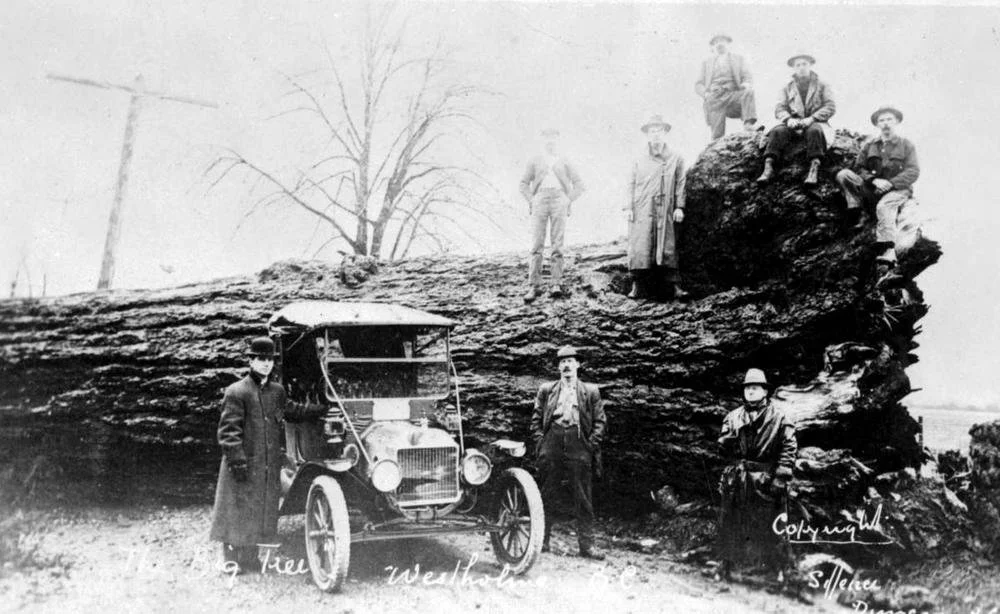
This 1913 photo shows it after it was felled by a windstorm and before it was bucked up by the pioneering Richards family. They really had no choice—it came down across Westholme Road at the head of their driveway.—BC Archives
The last time I wrote about this, I was surprised by the number of comments and emails it inspired. Some people are really serious about the known timber giants which have been photographed and recorded over the years.
February 2—Colin P. identified himself as a member of the BC Big Tree Committee. He’s working to locate the original, exact sites of British Columbia’s lost giant trees. :Of all the examples I’ve encountered,” he wrote, “the Westholme Giant is the one for which you appear to have the most detailed information.
“I was particularly interested in your remark that part of the tree you observed was still decomposing along the side of the road. I was wondering whether you might be able to share the exact location of this remaining log. I understand that today it may only be a mound of soil or a subtle ground feature, but I am hoping to document the site for historical and dendrological research, including factors such as hydrology and soil conditions.
“Thank you very much for your work in preserving and sharing the history of BC. I would also be glad to meet one day to discuss anything you know about these now-lost giant trees. Kind regards, Colin P.
February 5—TWP: Hi, Colin, I made a point of looking for what remains of the Westholme Tree when I was in the area a couple of years ago. It's on private property and, after 15 or more years since my visit with Alan Gadsden, I couldn't find it. During our visit, 20-30 feet of what I took to be the top part was still visible. I had to trust Alan that it was, in fact, the tree of legendary repute.
“I've never made a study of large trees per se, being more of a social historian (if I may say so in modesty) so don't have much to offer you in your research. Speaking of which, you've chosen a fascinating field. Photos of some of these giants of the past always amaze me. Cheers, TW
“PS: You mention wanting to document the actual site of the WT. I can, next time I go up-Island, give it another try to find it if you wish. At the very least, my friend Belinda could GPS it for you.”
February 12—Colin P: Hello my friend! “Just wanted to let you know I think this morning I figured out a puzzle I was trying to solve for a while about one of the tallest firs ever recorded and supposedly Stanley Park’s biggest tree.
“This morning I had a little light bulb go off in my head about how to verify many, many photos I believe are of a 325 ft fir in Stanley Park. There are maybe only 3 to 5 full tree photos in existence of different Douglas fir trees that size.
“For about four years now I’ve noticed a particular fir tree in old photos of English Bay looking toward Stanley Park. In early photos where the beach is photographed toward the park, in every image there’s this extremely tall fir in the distance. I’d read in Al Carder’s book and from Micah about a giant fir near the Barclay Street entrance of Stanley Park that stood 325 ft and was removed for safety reasons and because it was dead in 1916.
“Although it’s not right near Barclay Street, it could easily be considered near the entrance of Stanley Park at Barclay Street, since Barclay terminates into Lagoon Rd, which went right by this big fir you see in the photos.
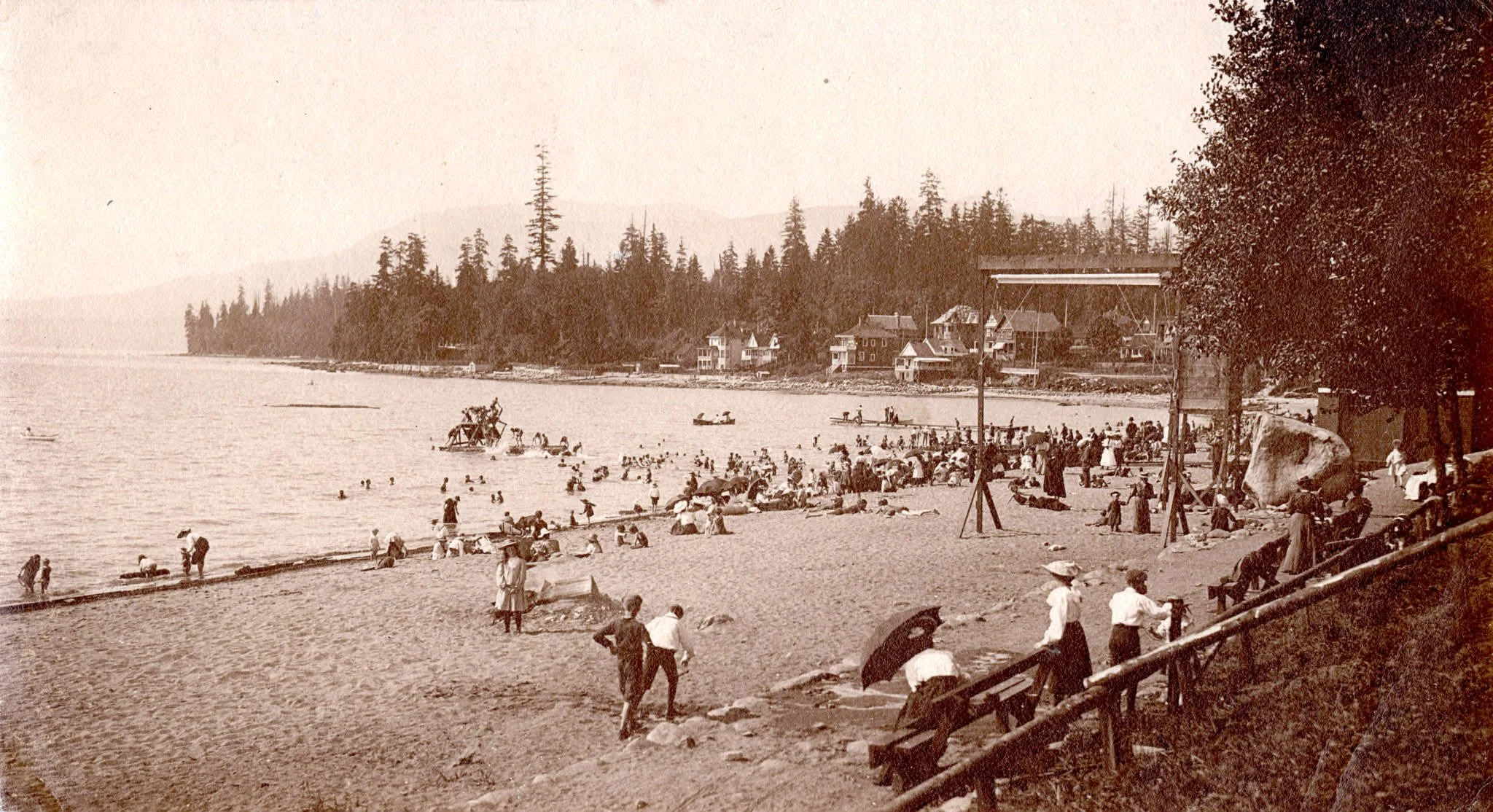
The 324-foot-tall fir that Colin is referring to is just left of the middle of this old photo of Stanley Park. —Courtesy of Colin Pratt
“The fir in these photos always seemed extraordinary in size. The surrounding forest the fir dwarfs in those images is already much taller than anything growing there today, and this particular fir is another 40 percent taller, totally singular.
“Micah and I were discussing the 325 ft tree last night. I told him I guessed I had photos of it but couldn’t confirm. Then this morning the idea popped into my head: to confirm if it’s in fact the tree, I just need to go check all my saved photos and the local archive English Bay beach photos and see if the tree actually disappears in 1916, as stated by Al Carder from the source, Lumberman Canada magazine 44.
“In the magazine, the Vancouver park board said it was removed for safety because it was dead. They also said the tree had been dead for 200 years and was 2500 years old, while the timber crews cutting it up said it was closer to 1500 years old, 10 feet wide and 325 feet long measured on the ground.
“Remarkably, this morning as I went in chronological order in the Vancouver archive from the 1890s into the 1910s, the giant tree in the distance slowly starts dying and by the early 1910s appears fully dead. Then, just like clockwork with the story, in the year 1916 it vanishes from the horizon. You can literally follow it year by year and watch this 325 ft giant slowly die, then be removed.
“I am personally fully convinced that this is most definitely the 325 ft tree mentioned a few times as being felled in 1916.
“What’s amazing is it’s the only historical tree I am convinced we could possibly check the height of based on photos, because we have dozens and dozens of angles from English Bay and Second Beach of the tree, plus many of the areas the photos were taken, like the English Bay washrooms, are exactly the same today. We can match the camera locations, buildings, and tree line and distance to the tree, and likely figure out how tall it was from the photos since there’s a small hill it grew on. I am fairly certain I can find the stump and generally it’s pretty obvious where it stood and the area it occupied.
“So 1916 adds up, its being dead adds up, but the only thing that doesn’t is it being dead for 200 years. But to me, a fir standing dead for 200 years doesn’t make much sense either. Maybe it’s a typo and they meant 20 years.
“So we’ve now gone from only a few photos of 325 ft historical firs to what is probably hundreds of images of this particular tree at many angles over roughly three decades.
“I’ve attached a bunch of photos of the tree 325 ft for I think I’ve verified is likely the 325 ft tree mentioned in text near English Bay/Lagoon Rd. You can see it’s alive, then it dies, and then it’s removed in the 1916 photo.
“Thanks again for saying you’ll check up on the Westholme tree for me, Colin.”
PS: We did GPS where I think the top of the Westhlme Giant was when Alan Gadsden showed it to me, BTW.
* * * * *
Have a question, comment or suggestion for TW? Use our Contact Page.