
Musing Out Loud...
Writing about Derby’s doomed reach for stardom as the capital of the Crown Colony of BC, reminded me of New Westminster’s equally unsuccessful joust with the ultimate winner, Victoria—and one of my favourite historical anecdotes.
I wrote this years ago and it still makes me laugh...
“When I went up the Hooghly 40 years ago...”
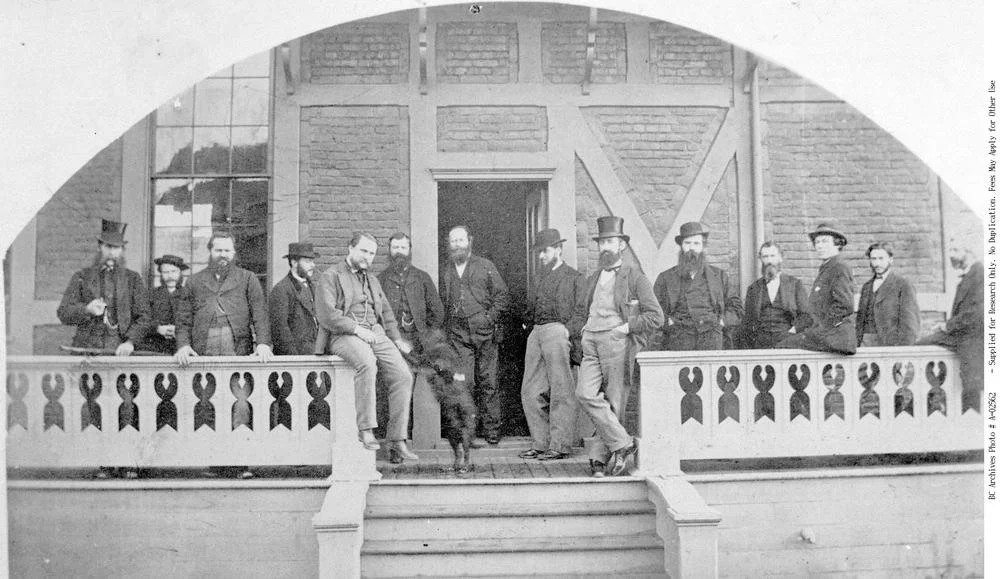
BC legislators pose in front of the Bird Cages (Victoria’s legislative buildings) in 1870. But Capt. Franklyn isn’t among them, having lost his Nanaimo seat for being drunk in the House, two years before! —BC Archives
Originally, Vancouver Island and BC were separate Crown Colonies; on July 20, 1871, they joined Confederation as the Pacific province, a union that wasn’t to everyone’s satisfaction, having presented the problem of choosing a capital, New Westminster or Victoria.
Passions ran high but it's not for that reason that Capt. William Hales Franklyn's speech has been fondly recalled by some political history students. It's because his aborted address in the House of Assembly of Vancouver Island finished his political career and helped tip the scales of history.
But, first, meet the man known as the ‘British Lion’. Kentish-born in 1816, he arrived on the Island in 1859 after a distinguished career in the merchant marine and Crimean War,
His settling, with family, in Nanaimo in 1860 was, in the words of Capt. George Richards, RN, “the first step towards civilization” for that community, then having a white population of just 151.
Richards was referring to Franklyn's appointment as stipendiary magistrate (which included all of ‘Cowichan’), in which capacity he was (to quote Capt. John Walbran) “a fearless and impartial magistrate, did much to check the unruly and lawless element, among both Europeans and Indians, during his official career at Nanaimo”.
Elected to the Legislative Council in February 1867, he participated in the struggle between new Westminster and Victoria for selection as capital city of the combined colonies of mainland BC and Vancouver Island.
Posterity is indebted to Dr. John S. Helmcken for the story-behind-story of how Victoria won out as provincial capital.
As leader of the pro-Victoria movement, he feared that the two factions were matched evenly, that the Mainland's Governor Frederick Seymour (who was believed to favour the Mainland) would act as tie-breaker.
Franklyn—“he was all British—bristled with it all over”—favoured New Westminster. He also favoured strong drink and, during the final debate, fortified himself at a nearby saloon, not appearing in the house until mid-day. When it came time for him to address the Assembly, he brandished a sheet of foolscap and Helmcken settled back for the duration.
It soon became apparent that the Hon. Member for Nanaimo, who was near- sighted, was unsteady on his feet. Dawning his spectacles and flattening his notes on the table with a heavy hand, he began: “When I went up the Hooghly 40 years ago...”
He wanted to counter the argument that the Fraser River was unsafe for navigation, hence new Westminster inaccessible to deep sea shipping, by showing that, just as India's Hooghly River had been tamed, so, too, would the Fraser. The Royal City he predicted, “will be as easily reached as Calcutta is now...”
This brought him to the bottom of the first page, which he set aside and, momentarily distracted, turned away. Victoria proponent William Cox saw his opportunity. In the twinkling of an eye, he slipped the page just recited atop the others. Franklyn, unaware, picked up where he thought he’d left off: “When I went up the Hooghly River 40 years ago...”
Again and again and again, Franklyn would finish the same page, pause to look about and the quick-fingered Cox would replace the first sheet atop the others. By this time, of course, all present (except Franklyn) were onto the joke and all beside themselves with constrained laughter.
When the speaker removed his glasses to wipe his brow, placing them on the table beside his speech, Cox poked out the lenses!
Suddenly unable to see a thing, Franklyn wiped the empty frames with his handkerchief and replaced them on his head, only (surprise) to find that he was still all but blind, and he paused in complete bewilderment. This was too much for those present. Because laughter was forbidden in the Legislative Chambers, Helmcken, “afraid that we must burst,” proposed a half-hour recess.
By this time, Franklin needed a drink and didn’t protest when a Victoria supporter obligingly provided him with water and whisky. Back in the Chambers, he tried to resume his speech, but was shouted down with “No! No!” and sulkily retired without casting his vote.
Upon being put to the vote, Victoria won handily over the Royal City as capital of British Columbia.
The hapless Franklyn, charged with being “intoxicated when in attendance at the Council Chamber and [using] excitable language during the debates,” was dismissed from civic office with three months’ pay. After a short attempt at business in Victoria, influential friends found him a sinecure as Chief Civil Commissioner of the Seychelles Islands, in which office he died in 1874.
Today he's remembered by Nanaimo's Franklyn Street and, for those who know their BC history, for his speech, “When I went up the Hooghly...”
* * * * *

Have a question, comment or suggestion for TW? Use our Contact Page.