
Musing Out Loud...
How I spent my summer vacations(s).
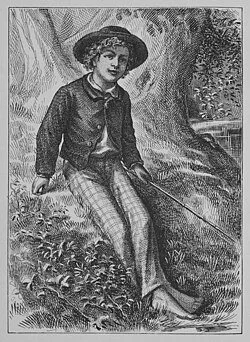
Mark Twain’s legendary Tom Sawyer was a piker compared to us kids.—Wikipedia - Frontispiece ofThe Adventures of Tom Sawyer, 1876, first edition.
Looking back, these too many years after, I have to wonder. Was it really as good then as I remember it? Or have I fallen into that trap of old age, of gilding those memories of summers spent on and about Swan Lake?
It seems almost Tom Sawyeresque now. It wasn't of course, because it couldn't possibly have been in civilized Saanich suburbia, which was hardly the playground of Mark Twain's hero. Yet...there were moments... As there were Bigs and Littles in our young world, it struck me the other day.
Big Rock, Little Rock, Lennard’s Rock and Short Rock, Big Pond, Little Pond, Big Trestle and Little Trestle. Just as, two doors up and across the street, lived Big and Little Gordie, so designated as to distinguish father from son, even when the latter ultimately became the taller of the two by a head.
Which, by the same meandering thought process, recalls another nuance of childhood. Mr. Reid was old, but he was Mr. because he was nice and we liked him (despite his handing out sour green grapes every Halloween). Mr. Martin, on the other hand, was old but mean, so he was Old Man Martin. Such are the finer distinctions of of youth.
The Little Trestle at the foot of our street, just two doors down, was where the neighbourhood kids experimented with smoking, first buckshit, then the real thing, even as we mimicked our (mostly smoking) parents’ warnings that these cancer sticks and coffin nails would stunt our growth and subtract a minute-and-a-half from our lives for each one we smoked.
It was under the Little Trestle that two jars of maraschino cherries, liberated from Parkdale Grocery, made several of us sick. And it was there that, alone on several summer evenings, a future newspaper columnist first put pen to paper. The Mystery of Twilight Island, inspired by the Hardy Boys, never did become a bestseller.
Mind you, it never did get beyond the first chapter, either.
A maple or willow pole, some line, a hook and a worm almost guaranteed a batch of sun and catfish one from in the ponds, Big and Little, which were fed small creeks that trickled into the lake. The latter would yield an occasional trout but only if you had a boat. Little Pond provokes a rare twinge of conscience for the muskrat we drowned with Alex dad's trap, for no good reason other than to try it.
The real fun was had at Jimmy Little's place, the next street over. His dad was a handy man-junk man, his backyard and adjoining lot a boys’ paradise of old car bodies, building materials, military bits’n’pieces, and just about every other kind of paraphernalia one could think of.
We could dress up in World War 2 army tunics, arm ourselves with a genuine Colt .45 and a derringer (if Jimmy's parents weren't home) and, atop Lennard's Rock, watch for the enemy through an antique telescope that, when extended, was almost as long as we were.
In the evenings, there were potatoes roasted until they were blackened cinders (no sissy tinfoil for us) and a campfire in Jimmy's backyard. Or we'd use one of the kitchen wood stoves that were abandoned there, although we much preferred these as launching pads for gallon cans of paint.
Readers who’ve never tried it might be surprised at how high, how wide (and how loud) paint can spatter when it's heated in a sealed can until it explodes. The lower boughs of the nearest fir trees were multi-hued pastels—any colour but green.
Such unrestrained exuberance, ultimately, had to exceed even the senior Littles’ patience.
The final straw was the clothing store mannequin which was hauled from a junk pile and dressed from one of the many chests of clothing. It took no time at all to find a likely victim, a door-to-door salesman.
Once he was invited inside by a neighbour (an unsuspecting adult, not an accomplice), it took only moments to tie the ‘body’ to the undercarriage of his car, jump back into the bushes, then impatiently await the drama that we were sure would follow.
The script was a simple one: he’d return to his car, spot the body of a woman beneath his bumper and jump to the conclusion that he’d run her down before—if he didn't faint or have a heart attack—realizing that he’d been had. Then, cursing, he’d look about for the perpetrators who were well concealed 100 or so feet away and having a great laugh at his expense.
But he didn't follow the script.
He didn't see the dummy, got in his car and slowly drove down the block. Just as Mrs. Marks, groceries in her arms, baby in a carriage and a toddler at her feet, crested the hill. From her lower vantage point she had a clear view of the underside of the oncoming car and—there was a shriek, a launching of groceries into the air, and frantic gesturing as the salesman, startled and bewildered by the hysterical woman, continued his slow approach.
There never was any laughing from the bushes. From the first moment it was obvious that things weren't unfolding as they were supposed to. There could be no mistaking, even by pre-teen philistines, Mrs. Mark's distress. Or the salesman's rage. It was no longer funny; It was frightening. Even more so when the police, then our parents became involved.
That was a summer to remember!
* * * * *

Have a question, comment or suggestion for TW? Use our Contact Page.