
Musing Out Loud...
As readers will see, Roger Hannagan stole the show for most of the Great Centennial Air Race. He later made a tearful apology but organizers and some of his fellow competitors were unforgiving. By hogging the limelight, albeit inadvertently for the most part, he’d left them out of the public glare.
The damage was done.
The best example of media myopia to some of the real drama of the trans-Atlantic race was told to the Victoria Colonist by second-place winner Timothy Philips after he landed in Victoria.
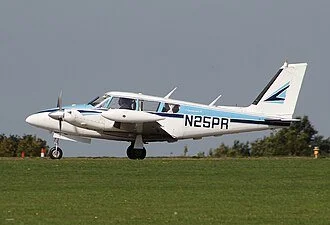
This Piper Twin-Comanche is similar to that flown by Philips and Mitchell. —Wikipedia
‘We just shouldn’t be here; race runner-up piloted time-bomb.’ reads the front-page headline. Here’s how reporter Barbara McLintock told how close Philips and his co-pilot had come to disaster:
“Anyway you look at it, we just shouldn't be here,” the second-place finisher in the London-to-Victoria air race said Friday. “We should be a little cloud of smoke somewhere between Thunder Bay and Winnipeg.
“We flew all the way from Winnipeg in a plane so dangerous that when the officials found out about it, they wouldn't even let me start the engine to taxi it to the hangar,” said Timothy Phillips of his Piper Twin-Comanche sponsored by the Irish Hospital Sweepstakes and co-piloted by Vyrell Mitchell.
“Everywhere we landed along the way, reporters asked us what exciting had happened on that leg of the race and every time we had to say nothing, no trouble,” Phillips laughed. “Then they weren't interested in us anymore.”
When they arrived in Victoria, they handed over the keys to the plane to the scrutineers whose job was to check every plane over. “The next I knew I got a message from the scrutineers saying they were worried about an ‘unauthorized modification they had found on the plane.
“I was completely mystified. I didn't know what they were talking about. When I got to the airport I found it was their idea of a joke.”
At the airport, he said, they showed him that a piece of exhaust pipe about six inches long and two inches in diameter had somehow broken off from his plane in mid-air. The pipe had gone out through the engine, “and why it didn't completely cut the fuel lines, I'll never know.”
Worse, he said, after the pipe had broken off, all the plane’s hot exhaust was expelled through a hole about “that far”—he spread his thumb and forefinger about an inch apart—from the fuel lines. “When we looked at the plane, the lines were burned but they were still intact.”
Thinking back over the flight, he realized the mishap must have occurred in heavy turbulence between Thunder Bay and Winnipeg. Since then, he said, they had been losing a little speed and power—“we beat the third place finisher (P.W.) Reames all the way to Winnipeg, but he beat us all the time after that.”
As well, they had had trouble lifting off with the one engine since the Manitoba stop.
The idea, in retrospect, of crossing the Rockies in such a plane was “a frightening thought,” he said. If they had discovered the damage at a stop before Victoria, they would have stopped the race immediately, said Phillips, a chicken farmer from Ireland on his first visit to Canada.
“We’d never have won any of the prize money, we'd never have finished the race, we'd never even have got to Victoria. We’d just have been another also-ran, another left-behind. We thought it was the luck of the Irish that we got here fast enough to get some of the prize money.
“Now we think it was the luck of the Irish that we got here at all.”
* * * * *
Remembrance Day is still a month away but I’m already working, for the 24th straight year, on the annual special edition for the Cowichan Valley Citizen. I can’t imagine anything more satisfying that researching and writing about our veterans in the Citizen and here, beginning next week, in the Chronicles.
* * * * *

Have a question, comment or suggestion for TW? Use our Contact Page.