
Editorially speaking…
I know, I’ve said it before: They’re not making the good old days any more.
But it’s true.
Earlier this month, a front-page story of the Victoria Times-Colonist heralded the almost certainty that the Capital Iron lands project on Victoria’s waterfront will be approved by city council. It’s to be one of the greatest developments in the capital’s history—as many as 14 buildings constructed on a seven-acre parcel bounded by two whole blocks.
It’s massive, it’ll take years to complete, and is expected to inject vitality into a quiet area of downtown Victoria.
All well and good, of course, who am I to play doomsdayer?
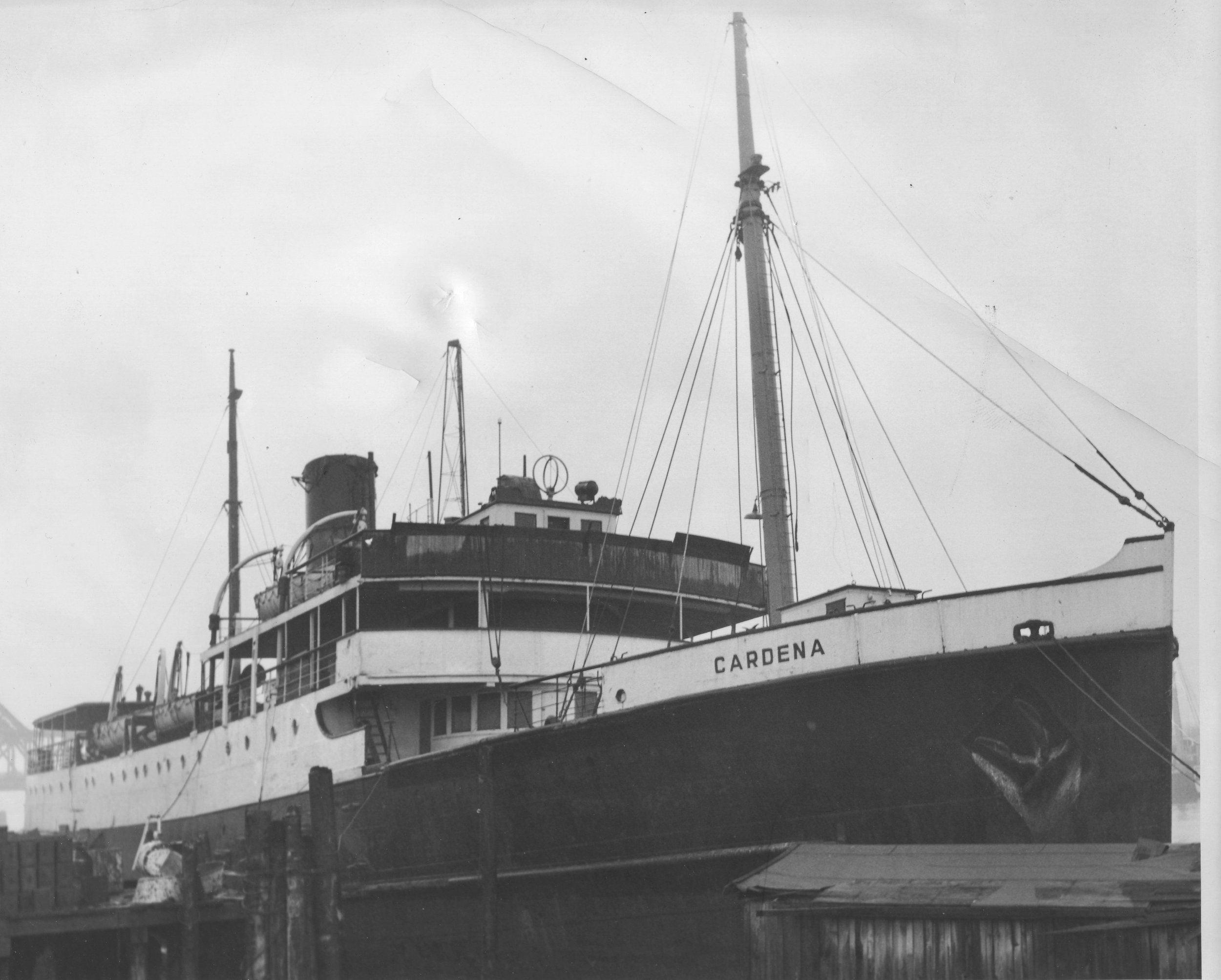
The coastal liner S.S. Cardena awaiting her turn at Capital Iron. —Author’s Collection
But, ah, the good old days when I was a kid, when going to the show each Saturday at one of the several theatres on Yates Street was the highlight of my and my friends’ week.
But the show was only the beginning. The afternoon matinee let us out early enough to wander down to Spencer’s War Surplus on Government Street (where I bought my first hunting knife, camping hatchet and pup tent, and began my military collection with a WW1 bayonet for all of $2—four weeks’ allowance!—then on to Capital Iron & Metals on Store Street.
There, I was in my glory.
As the son of a WW2 vet, grandson of two WW1 veterans, I’d grown up steeped in the glory of Canada’s wartime achievements. Whereas you could buy real Crown Assets army, navy and some air force memorabilia at Spencer’s, Capital Iron’s treasure was maritime—gear and goodies stripped from one of the dozens of ships that the company had cut up for salvage over the years.
This, to me, was heaven!
I can smell the tarpaulin in my mind and see the ropes and anchors and floats and... But it was the photo gallery near the front of the store that resonated most with me: photos of each of the ships that had died, one piece at a time, at the company’s dock, which was separated from the two stores by a driveway through a heaped-high junkyard.
Not really junk, but various pieces of ships that could be recycled, before that word entered our lexicon.
When I came to know Ron Greene, manager and son of the company’s founder Maurice Green, it got even better. He told me how the company cast a souvenir from the brass of each scrapped ship: paperweights, a door knocker, ashtrays... Marine collectors’ prizes, for sure.
But that was after my childhood cinema days; I was writing for the Colonist by then. About ships, of course.
In between, I’d suffered two years as an office boy at the Colonist. But it hadn’t been all misery; a perk was being sent to town each day to pick up the stock market reports. That could be done in an hour—but the editor didn’t know that. So, by taking another half hour, I could swing by Wharf and Store streets, then the heart of the Victoria waterfront which was still a working waterfront in those days. (Restaurants, bars, tourists and street people came later.)
Meaning, of course, a visit to Capital Iron with the ships tied up, awaiting their turn at the shipbreaker. I remember the wooden-hulled tug Salvor, the iron sailing ship Star of England, the Union Steamship Company’s pocket liner Cardena, and, much later, the world-famous Sudbury’s, 1 and 2.
But all that was back then, in those good old days they’re not making any more. Today, Capital Iron sells appliances, it’s a whole different world from the halcyon days of my youth. Sigh......
* * * * *
Finally, this thought for today, courtesy of legendary Canadian author Lucy Maud Montgomery:
“I am simply a book drunkard. Books have the same irresistible temptation for me that liquor has for its devotees. I cannot withstand them.”
* * * * *
Have a question, comment or suggestion for TW? Use our Contact Page.