
Editorially speaking…
There aren’t many rules to writing for an audience any more. I mean, since the arrival of social media, particularly cell phones, people say just about whatever comes to mind and to h- with spelling, grammar, punctuation, syntax and all that other boring stuff they tried to teach you in English.
Here at the BC Chronicles we do attempt to write real good, ha ha. This is brought to mind by my own local newspaper, which shall remain nameless, having twice lately referred to the seven-month-long work stoppage of our bus system as being the longest in B.C. history.
I’ve learned the hard way to be careful when using “est.”
The longest, the cheapest, the best... How can we be so sure? The answer is, of course, we can’t. So we shouldn’t go there. Because if we’re talking about lengthy strikes, let’s take as a single example the Great Strike of Vancouver Island coal miners, 1912-1914.
That one lasted all of two years, and I’m willing to bet you there were other work stoppages of greater longevity, if one wants to take the trouble to research.
This is not meant as criticism, you understand, just an observation based on most of a lifetime of historical research, most but not all of it written by professional authors, historians and journalists.
In short, I’ve learned to never say never...because no matter how rare something might be, no matter how imaginative or outrageous it is, you can count on its having been surpassed by someone or something bigger or better or cheaper or, or, or...in this ever changing world of ours.
Except here at the Chronicles, of course, where we deliver the best darn history to your email box every Thursday morning.
* * * * *
I’ll spare you further blather today...
On a truly serious note, this sad headline from the Maple Ridge News: Children’s cemetery keepsakes trashed in cleanup.
I’ve visited 100s of cemeteries throughout lower B.C. over the years, doing historical research by taking photos and notes, all the while savouring the calm and peace that seems to prevail. Even the sounds of passing traffic all but fade away; it’s as if you’re in an oasis of peace.
And why, not? Cemeteries are places of love. Those headstones, many of them works of art, and their inscriptions, are all expressions of that love. And they’re never more poignant for visitors than when they mark a child’s final resting place.
So when we sometimes read of cemetery vandalism it’s with mixed outrage and incomprehension. How could anyone defile a grave? A child’s grave to boot!
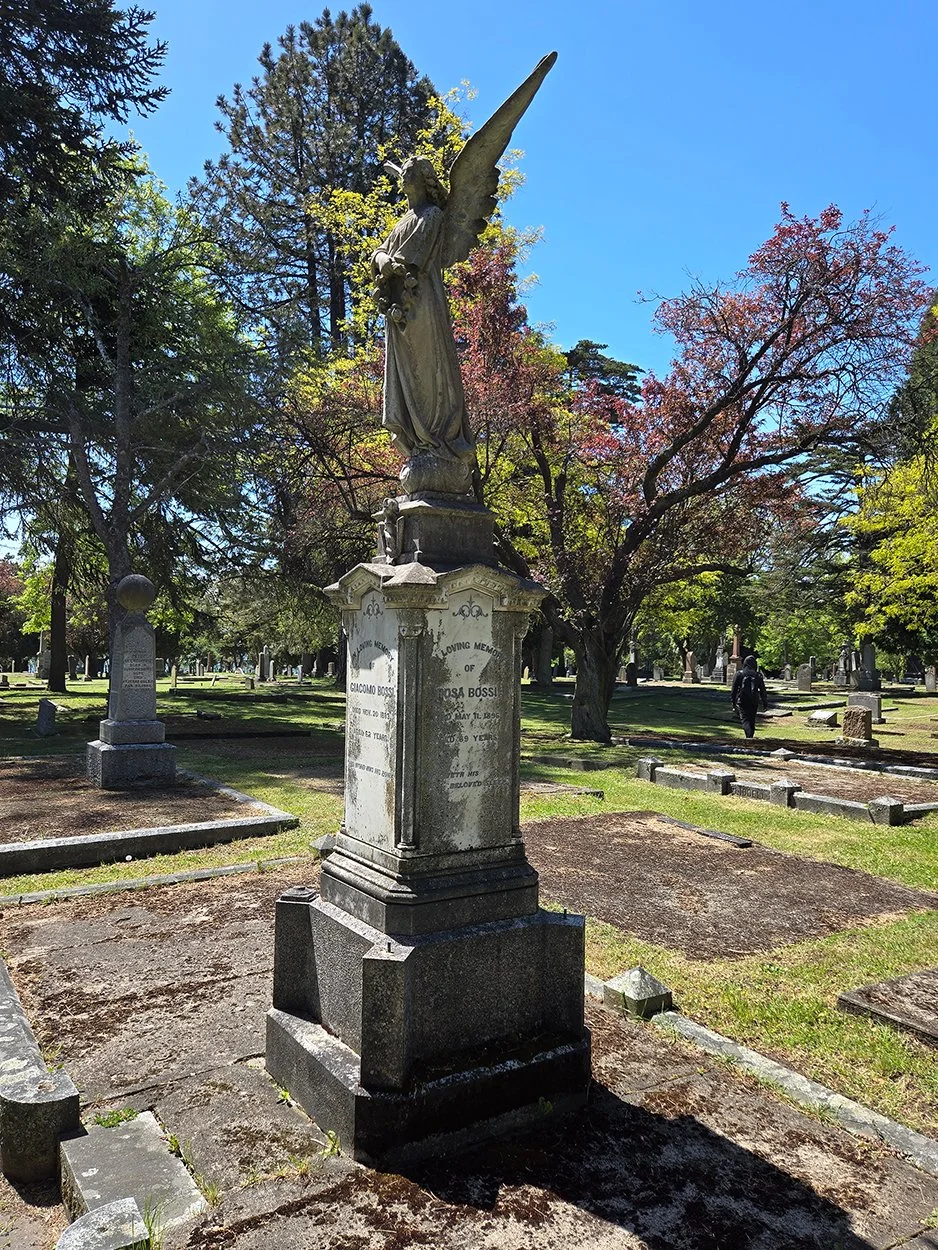
Why would anyone desecrate a cemetery? —Author’s Collection
Well, in the case of the Maple Ridge Cemetery, it wasn’t the work of vandals but of City crews performing a “cleanup” aka “regular maintenance” by removing all those unsightly plastic flowers, toys, candles and other mementos that grieving families place on children’s graves.
Contacted by the News a City spokesperson acknowledged “the need to handle these situations with greater care and sensitivity,” and stated that the City would do better in the future.
Cemeteries do require maintenance: cutting the grass for one. And the safety of workers is paramount. But even if some graves have to be tidied up, Cemetery authorities should be obliged to post notice of graveside limitations and give adequate notice of a coming “cleanup” before they unnecessarily distress mourners even more.
Even in this battered world of ours, some things are still sacred. And cemeteries should be one of them.
* * * * *
For a complete change of subject, another news item, this one from the Victoria Daily Times, May 1897.
A common source of complaint these days is our legal system’s seeming lack of teeth, what many of us sarcastically call its “catch-and-release” policy of repeat offenders being charged, arrested then let back on the street in just a few short hours.
It wasn’t always this way, I can tell you!
For stealing a man’s pair of shoes (a man of God at that) Frank Wilson, who had a criminal record, was given six months in jail. And you can bet he didn’t serve his sentence lying on his bunk. Although Victoria no longer had the chain gang in 1897, a sentence of “hard labour” was still at a magistrate’s discretion.
I’m sure there are Chronicles readers who’d welcome a return to those (so-called) good old days.
* * * * *
Have a question, comment or suggestion for TW? Use our Contact Page.