
Editorially speaking…
We’re heading into BC Heritage Week, February 16-22. This year’s theme is "Stir the Pot," a celebration of the history, culture, and stories behind food.
Aligned with BC's Family Day on February 16, Heritage Week will, focus on food as a shared, inter-generational, and cultural tradition featuring events, workshops, and community activities province-wide.
All well and good, but when I think ‘heritage,’ I don’t think of food.
While shuffling files recently, I found a column I wrote for the Cowichan Valley Citizen for Heritage Week of 2007. At that time I and others were battling on two fronts: to save the Valley’s Kinsol Trestle and South Wellington’s Morden Colliery tipple/head frame from destruction.
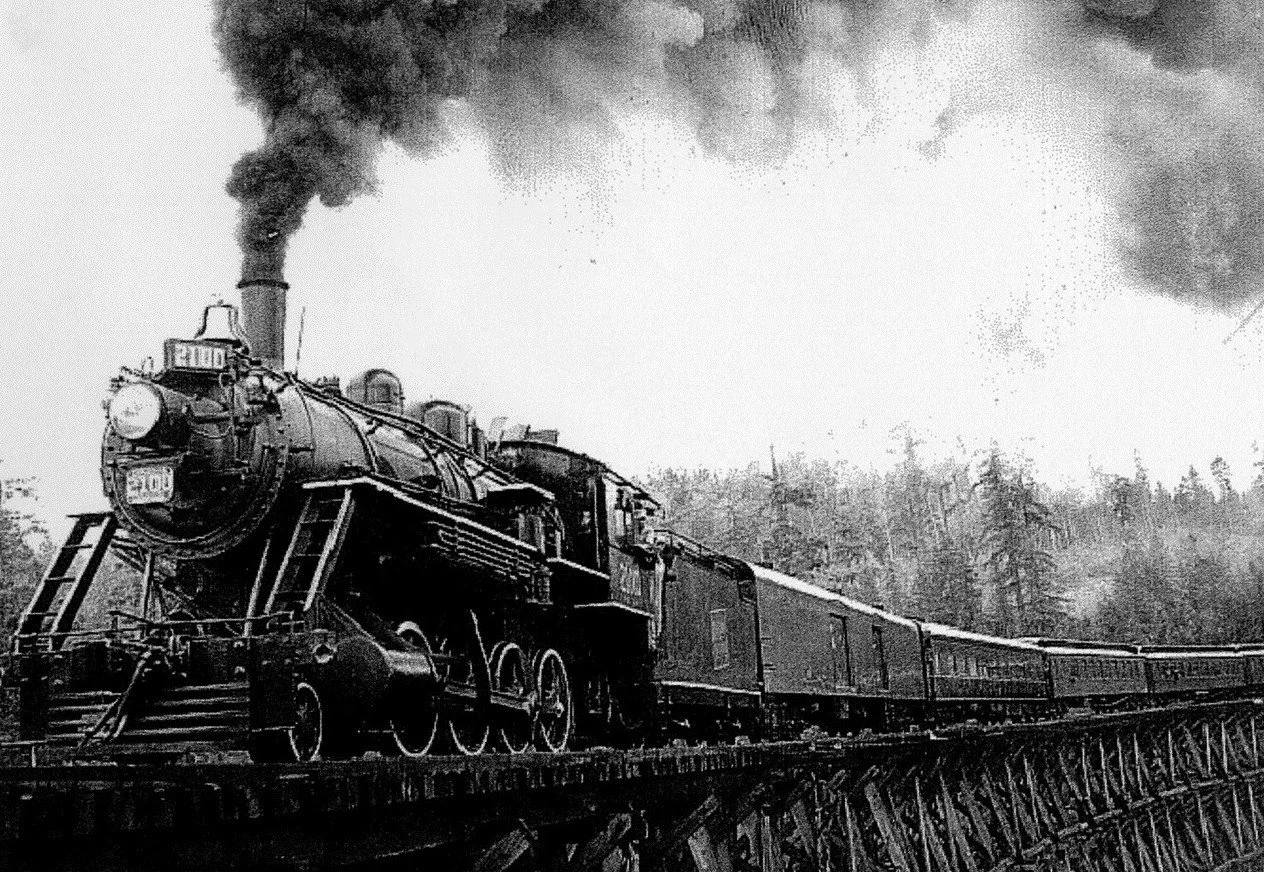
Elwood White’s great photo of a CNR freight train crossing the Kinsol Trestle. He told me he often hitched a ride. —Courtesy of Elwood White
The irony was that both the trestle and the tipple were “wards of the state,” so to speak—the Kinsol under the domain of the provincial Department of Highways, Morden under BC Parks. Both were in a state of years-long neglect and faced with demolition in the case of the Kinsol, and inevitable failure for Morden.
The trestle had also endured two attempts at arson.
What made the increasingly derelict state of Morden all the more galling was that it was—on paper—a Class A Heritage Park. Meaning that it was supposed to be fully maintained by BC Parks.
The reality was, Parks had never spent a dime on conservation, just capped off the air shaft and fenced in the concrete head frame. That was some heritage park!
So I used my column in the Citizen to vent...
* * * * *
B.C. Heritage Week is coming up. But why wait?
What is that our governments, regional, municipal, provincial and federal, don’t—won’t—can’t—seem to understand about heritage?
They treat it like it’s an illegitimate child, a nuisance to be slipped a crumb from time to time (usually in response to direct pressure from the community) but otherwise to be treated as of inconsequential value when weighed against other major concerns of society.
Will they ever come to realize heritage is as indispensable—and therefore as un-disposable—as the creation and maintenance of our schools, streets, hospitals and, dare I say it, the Olympics?
Heritage is our national DNA. It’s the fabric that binds Canadians—all of us—from the first of the First Nations to the arrival of Europeans to our present-day multi-cultural society. Quite simply, it’s where we’re from, who we are, and where we’re going.
But if the dismal record of government response to heritage issues is any true measure of who we are and where we’re going, we’re unequal to the task; we continue to demonstrate that we don’t recognize or respect what should be the lasting contributions of our forebears.
People coming to live in Canada bring with them their own sense of self, their own social and cultural backgrounds and values. These eventually become part of our national heritage. But what of the pioneers who built this country?
We elect a new government in Ottawa and what do we get? Multi-million dollar cuts to museums which were already underfunded. Almost weekly, we read of another heritage landmark threatened or lost to neglect or development. Two weeks ago I reported on the loss of the Princess Mary Restaurant. A Victoria landmark for 60 years, it was the last tangible connection (other than some artifacts scattered about in museums and private collections) with the world-famous CPR fleet of Princess ships.
Nanaimo recently lost its historic Foundry. This week, a front-page story in the Times Colonist told of the rapidly deteriorating state of Race Rocks lighthouse, one of the two oldest lighthouses in the province (and, as such, probably the two oldest structures in Western Canada) which is still in service as an automated light.
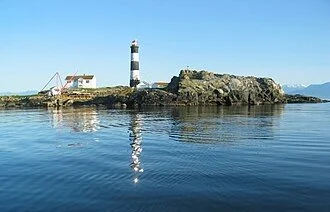
Race Rocks lighthouse is one of the two oldest structures in Western Canada. —Wikipedia
It was assembled on-site in 1859-60 from pre-cut stones shipped out from England. It’s of the period when Vancouver Island was a Crown colony. That’s before there was a British Columbia and as far back as European settlement goes in this province.
A frugal federal government turned off the heat in the 1990s and the wind and salt spray are taking their toll.
Fort Rodd Hill Historic Park, which coincidentally includes Race Rocks, Fisgard lighthouse, and is one of our few success stories, was created in the 1960s. But neighbouring Cole Island which served as a Royal Navy powder magazine has been left to the tender mercies of vandals and—get this—the cannibalism of many of its bricks for Fort Rodd Hill.
Last summer Dept. Of National Defence officials made a great play of saving several historic buildings from demolition at CFB Esquimalt. Coincidentally, at nearby Work Point Barracks, the architecturally outstanding 1890s Officers Quarters and Mess of the Royal Canadian Artillery Garrison was razed.
DND officials had admitted that there was no immediate need to remove the structure which was no longer in use but in good repair, nor had they any other plans for the site. They just wanted it down.
Despite protests from Esquimalt Municipality and heritage societies, it’s gone.
As the Dept. of National Defence isn’t bound by heritage statutes it could ignore pleas to save the building. However, even had the Officers’ Quarters been under civilian authority, it’s unlikely that anything could have saved it once the powers-that-be made their decisions.
We have the perfect example here in the Cowichan Valley with the impending demolition of our greatest man-made landmark and icon by the Ministry of Transportation. That’s the very ministry whose neglect over the past 20 years of public ‘stewardship’ has condemned the Kinsol Trestle, largest wooden structure of its kind in the British Commonwealth, to decay without a nickel’s worth of maintenance.
It’s even worse, one could argue, in the case of Morden Colliery at South Wellington. The last surviving tipple of Vancouver Island’s great coal mining industry has been a Class A provincial heritage park for 30 years, for crying out loud.
But it’s crumbling because the provincial government has greater priorities than our—our—heritage. For several years a group of dedicated volunteers have worked to finance engineering studies which have confirmed that the structure is doomed to catastrophic failure if efforts are not made soon to reinforce its concrete. According to those engineers Morden can be saved. And what a tribute to the 1000s of coal miners and their families it would be. If we cared.
I could go on but I’m beginning to sound like a broken record, I know. But I make no apology for raging in defence of our heritage and history. It’s our legacy from those who’ve gone before us, who built this country that many of us take for granted.
Perhaps that’s part of the problem. We should be honouring them and ourselves by saving the best of the past and the present for the future.
* * * * *
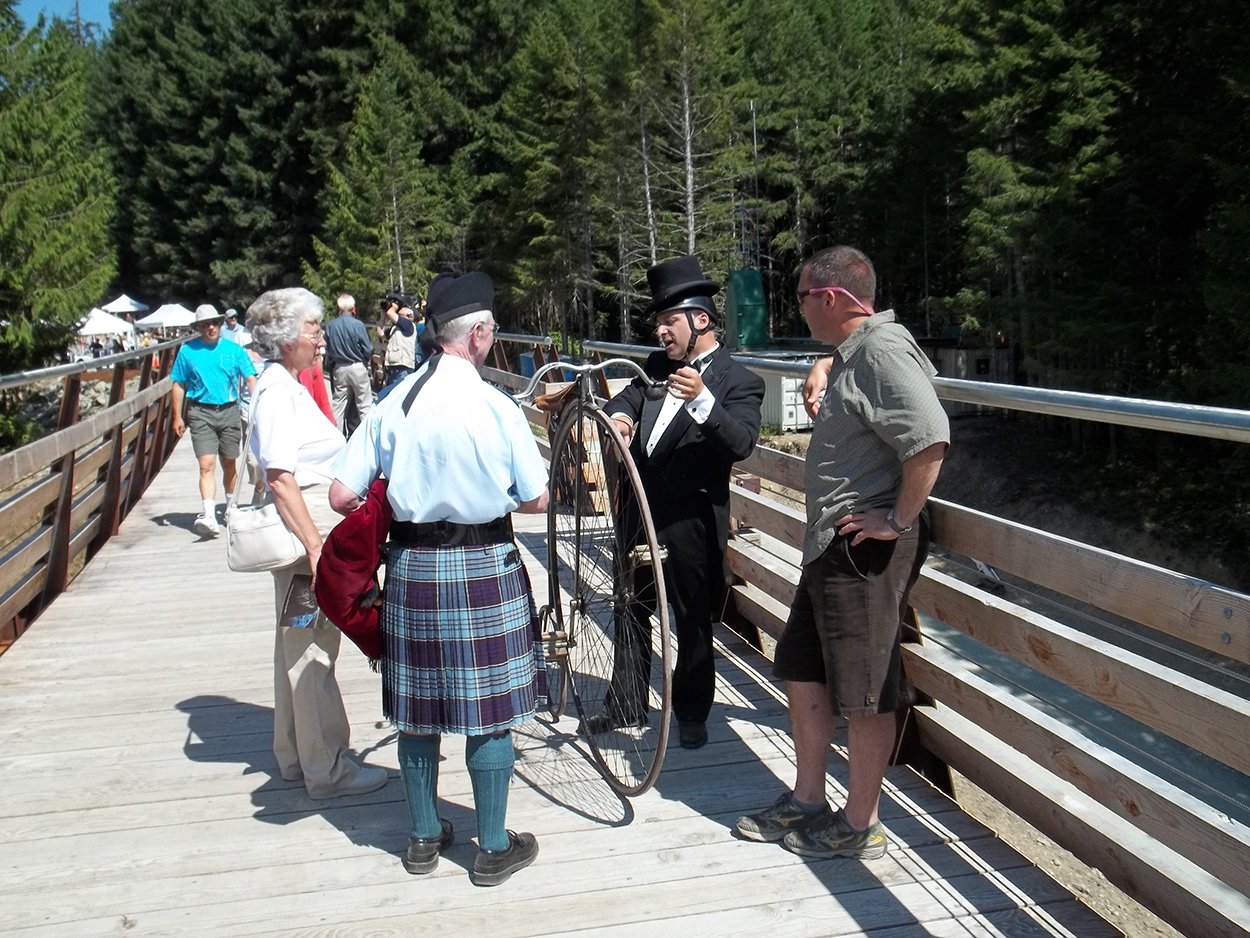
Opening day of the rehabilitated Kinsol Trestle. —Author’s photo
Fast-forward to the present. The Kinsol was “rehabilitated” after a years-long battle by what one newspaper sneeringly dismissed as historical purists. Last year, according to the CVRD, the trestle had over 300,000 visitors.
Morden Colliery has also been saved, at least as a shell, as it was way too late to do more than that. And hopes of its becoming an interpretative centre to tell the story of Island coal mining will never be realized.
But there I go, quibbling. The Kinsol Trestle still stands. So does the Morden Colliery tipple/head frame, so, yes, I’m grateful. But still mystified after all these years.
Why did individual citizens have to fight to get the government to do its job?
* * * * *
Have a question, comment or suggestion for TW? Use our Contact Page.