
Editorially speaking…
Vancouver Island’s Mount Sicker, the scene of a short lived but extremely rich copper boom at the turn of the last century, has been in the news again. Modern day miners are examining the ore dumps from the Lenora, Tyee and Richard III mines for overlooked treasure.
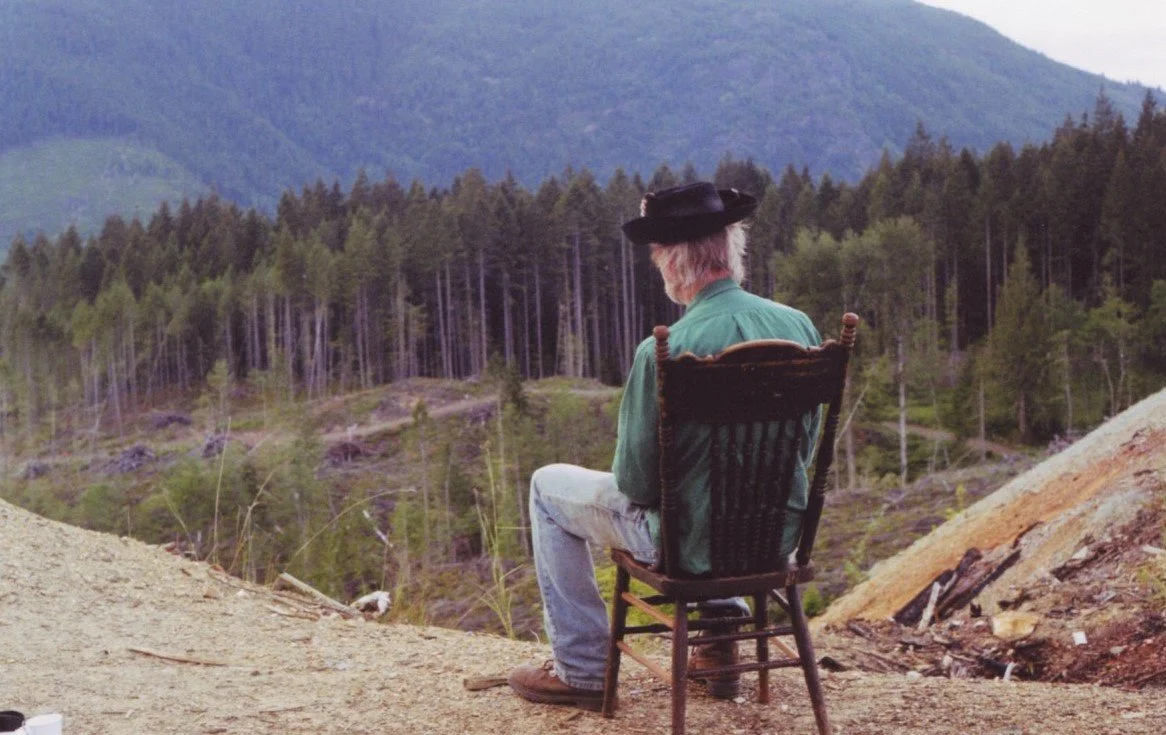
The Mount Sicker ore dump on which I’m sitting in a chair from the Mount Sicker Hotel, courtesy of the late George Compton, is likely going to be reworked for its copper, gold and silver residues overlooked by the original mine owners. —Author’s Collection
Coincidentally, friend and avid prospector Blake MacKenzie has been doing some scratching of his own about Mount Sicker.
He recently informed me that he has re-staked the historic Sullins claims. Back in 1897, F.T. Sullins was one of a group of fortune hunters from Port Townsend who first noted promising signs of copper on Little Sicker Mountain.
Legend has it that he was “shooting” on Sicker in the spring of 1895 when he noticed promising signs of minerals and took some quartz samples home to Townsend with him. Next year, Sullins, Henry Buzzard and Harry Smith began scouring the slopes of Little Sicker and...the rest, as they say, is history.
I’ll be watching further mining developments on Mount Sicker with interest.
Better yet, the logging gates are open again so I’m hoping to get back there for the first time in three years.
* * * * *
A nice gentleman named Steven Henslow wrote to suggest that I write about George French, the famous tugboat Sea Lion and Capt. Ralph ‘Hurricane’ Smith. According to Steve, “few could match his skill. He was regularly in the papers in the 50s and 60s....”
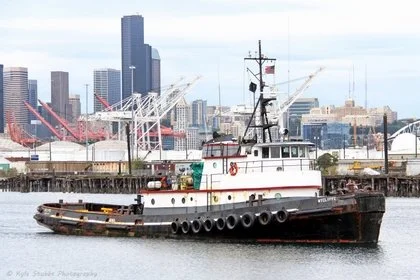
BC’s oldest working tug, the Sea Lion, went to the breakers just a few years ago. —tugboatinformation.com
Steve, who wasn’t a tugboat man himself, grew up in Vancouver where his family settled in 1890. He used to watch the ships, large and small, as they came and went. Among his golden memories: “I listened to Capt. Smith playing ‘How Dry I Am’ as he entered First Narrows. I really got to know about him from ‘Hurricane’ - that is what most of the waterfront workers called him.
“Captain Ralph 'Hurricane’ Smith was my wife's Grandfather. She really loved him. I met him when he was in Calgary–Skipper of the Moyie replica in Calgary Heritage Park. He had a life few could imagine. How many Captains earn 3 world records for seamanship?
“His incredible skill is mentioned in From the Wheelhouse by Harbour Press. His family were world famous boat builders—Smith and Rhuland—to this day. I don't think any company has or had a fleet of ships—clipper ships at that time. He went to sea on clippers age 12—made his first cruise and many more around the Horn.
Vancouver newspapers used to be full of stories. He met George French when they both worked for Davis Lumber. Ralph conceived the idea of the Davis [log] boom. George was the first to use and took credit. Ralph never forgave him. He still respected him. The origin of the variable pitch steam whistle is unknown. After George was forced to remove it [it] was used on a chain puller. I suspect it is in a private collection. I can give you more of Captain Smith's history. He was one of a kind....”
Alas, I had to inform him that my writing/publishing cup runneth over. I’m committed to completing four new books over the next two years. There just isn’t time or energy to take on the research that would be required to do justice to the nautical pioneers he suggested. Dang....
* * * * *
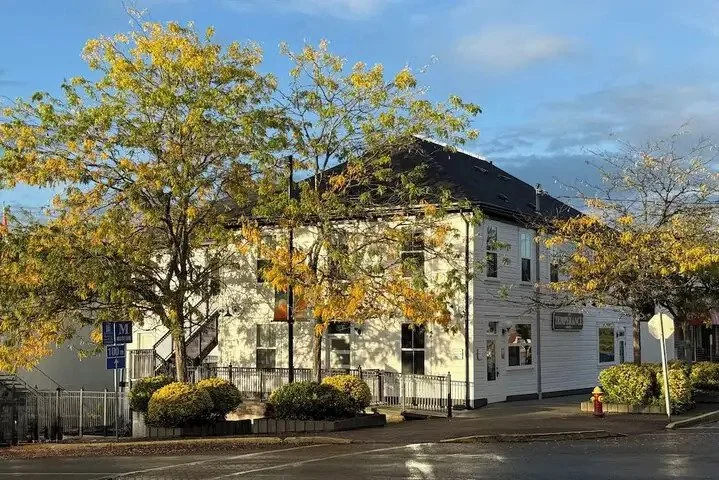
Ladysmith’s historic Temperance Hotel is up for two heritae awards. — https://temperancehotelladysmith.bookonline.com/hotel
Even on a main street lined with heritage buildings, Ladysmith’s Temperance Hotel stands out. First, it sits on a prominent and exposed corner. Secondly, it looks like something you’d see in the preserved Hudson’s Bay Co.’s Fort Langley.
Fully “rehabilitated,” it has received two heritage awards after being rescued from being on “the verge of collapse”. It’s one of Ladysmith’s few surviving structures that were moved from Wellington, north of Nanaimo, when James Dunsmuir switched the family coal mine from there to Extension.
Bravo to all concerned!
* * * * *
Have a question, comment or suggestion for TW? Use our Contact Page.