
Editorially speaking…
As you read this, I’m beavering away on my latest book. Not just another book, my 39th, but my grand opus. Twenty-five years in the making, in various archives and in the field, are going into what’s to be a four-part series.
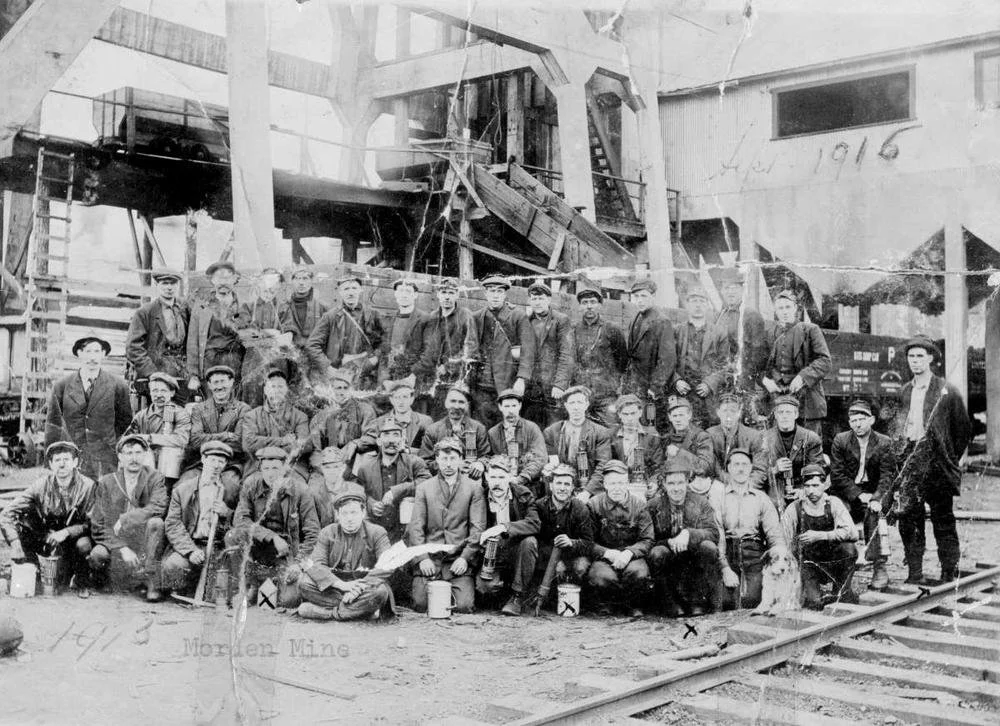
The men of South Wellington’s Morden Colliery. We don’t even know their names. —Courtesy of Helen Tilley
Others have written about Vancouver Island coal mining, but never the way I’m doing it. And this one is from the heart. (All of my books are my babies, so to speak, but this one is most special of them all.)
I don’t know if I owe it to my maternal great-grandfather for my lifelong interest in coal mining (he went down in the coal mines of Country Durham at the age of 10), or if it’s the natural drama that appeals to me as a professional storyteller. Whatever the irresistible draw, the rest is hard work, sometimes unintentionally in torrential downpour, other times just plain stubbornly under a blazing sun. (One can plan but one sure can’t control the weather.)
And I’ve sure learned a lot about coal mining and miners along the way. Which, not surprisingly, has led me to draw some conclusions. One of the foremost is that we don't do our coal mining pioneers justice paragraph.
In 1930 a Vancouver Island coal miner risked life and limb for 92.5 cents to $1.08 per ton of coal he wrested from the deep. And when I say he risked life and limb, I’m not whistling Dixie! One hundred and 39 years ago, Nanaimo was the scene of the second worst mining disaster in Canadian history: 150 men who didn’t go home to their families at day’s end.
But, many would say with a shrug, that was long ago, ancient history, right?
We have far greater things to occupy our thoughts: wars, politics, sports, what's on TV. I agree that world events in the daily news are depressing, but I've come to believe that this lack of knowledge, this lack of respect and understanding of our biological and cultural roots is one of our greatest sins and omissions.
We Canadians just don't seem to want to honour our pioneers—the countless unsung men and women who built this country with their blood (often literally), sweat and tears that we Johnny's-and Jenny's-come lately take as our right. For starters, that would require that we learn something about our collective past.
But Canadian history of the kind that I have in mind isn't in any school curriculum that I’m aware of.
Initially, I tried giving the tours more meaning by noting the workplace deaths which had occurred at various minesites. In 2012, I decided to take a different tack. Instead of simply citing the lost miners at each mine visited numerically, i.e., three men killed here, I researched each miner's name and the circumstances of his death.
This didn't quite put a face to those men but it helped to give those on the tours greater appreciation of the dangers these miners faced in the deep.
Today, for many people, coal mining has become a dirty word. That doesn't change the fact that, for 90 years, coal mining was Vancouver Island's economic backbone, that 10 Island communities which exist today got their start with coal mining. To rewrite our history is to deny our DNA, even when it fails modern-day standards and sensibilities.
We can and should learn from our history but we can't change it and shouldn't even try.
So I beaver away, on my tribute to those forgotten miners, shooting for a Spring publication. I can hardly wait.
* * * * *
Have a question, comment or suggestion for TW? Use our Contact Page.