
Editorially speaking…
After years of public agonizing, the NDP government has dropped the shoe: Daylight Saving Time will become permanent as of the morning of Monday, March 8th.
That’s when DST will become law—not for just seven months of the year but for all 12.
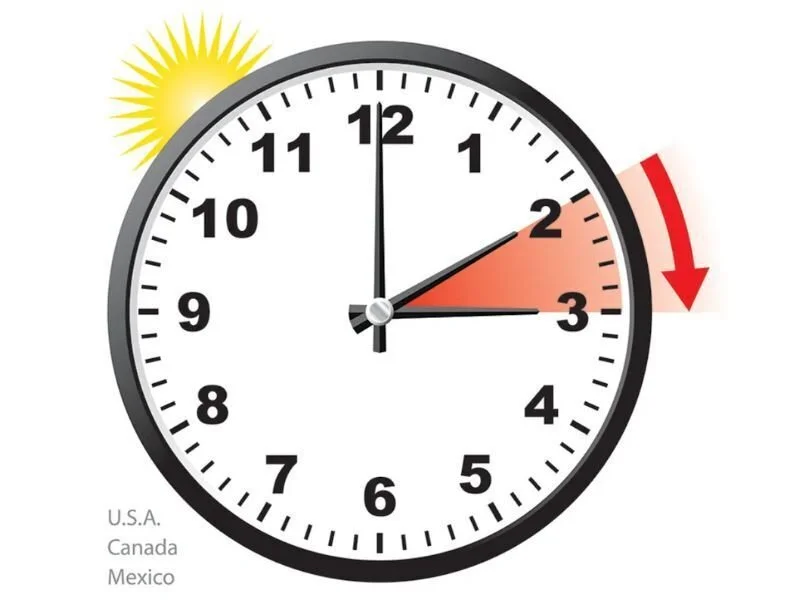
Just think. Come November you won’t have to “fall back” by setting your clocks back an hour to return to Pacific Standard Time. —DrydenWire.com
Wikipedia tells us that, in Canada, DST is observed in nine of the 10 provinces and two of the three territories—though with exceptions in parts of several provinces and Nunavut.
Because laws related to timekeeping are a provincial and territorial matter, it gets confusing—but nothing like it is in the U.S. where all 50 states can opt in—or out of—DST. Probably the most extreme example is a 35-mile stretch of highway (Route 2) between Moundsville, W.V., and Steubenville, Ohio, where drivers pass through seven time zones!
Closer to home, most of Saskatchewan, despite its being, geographically, in the Mountain Time Zone, observes year-round Central Standard Time (CST). In other words, the province is effectively on year-round DST. In 2020, Yukon abandoned seasonal time change and moved to permanently observe year-round Mountain Standard Time.
Where DST is observed in Canada, it begins on the second Sunday of March at 2 a.m. and ends on the first Sunday in November at 2 a.m. As a result, DST lasts in Canada for a total of 34 weeks (238 days) every year, about 65 percent of the entire year.
Except here in BC, once again Canada’s odd man out; courtesy of the provincial government, we’re about to go to Daylight Saving Time full time.
As a point of interest, Port Arthur, ON (now part of Thunder Bay) was the first municipality in the world to enact DST, on July 1, 1908, and Germany later became the first country to adopt the time change, on April 30, 1916.
* * * * *
On those occasions that I find myself in the local A&W (I’m a man of simple and predictable pleasures: teenburger, fries and root beer, please), I always check out the framed photos on a back wall of a 1950s A&W.
Ah, the good old days of my teens, when drive-in restaurants were the destination hang-outs for anyone with a car, or anyone who had a friend with a car.
By far the best of my experience, living in Saanich, was the Bright Spot on Quadra Street. Fried chicken and fries to die for!
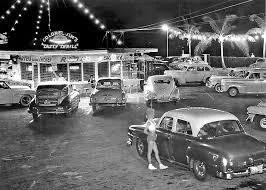
An American 1950s drive-in. Ah, the good old days... —Facebook
But those days are long gone and so are the drive-ins with their car hops who served your meal on a tray that attached to the driver’s window. Yes, A&W is still around, as is the White Spot, to name but two of the oldtime drive-ins, but they’re regular restaurants now.
It’s in this week’s news that Langley’s last “car hop restaurant” is closing.
As it happens, Langley’s dinosaur diner is a White Spot, which will close December 30th after 44 years to make way for a Skytrain Station. Some of the existing staff have been with the restaurant all those years!
Such is progress. A White Spot spokesperson said the company would have been pleased to carry on business at that location but there’s no getting around Skytrain’s greater need to use the site.
When I first came to Duncan, the A&W was just over the Silver Bridge, on the TC Highway, about where Save On Foods is today. It continued to be a favoured stop long after I’d passed from my teens because it was a real drive-in, with covered parking slots and car hops.
You can still eat in your car at a drive-through today, but you’re going to have to find a parking spot out of everyone’s way to eat.
Not the same thing at all; drive-ins used to serve as gathering places for young people in those halcyon days of my youth—and those of some Chronicles readers, I bet.
* * * * *
Have a question, comment or suggestion for TW? Use our Contact Page.