
Editorially speaking…
Last week’s Chronicle on the legendary Crowsnest Pass bootlegger Emilio Piciarello drew this response from reader Steven H:
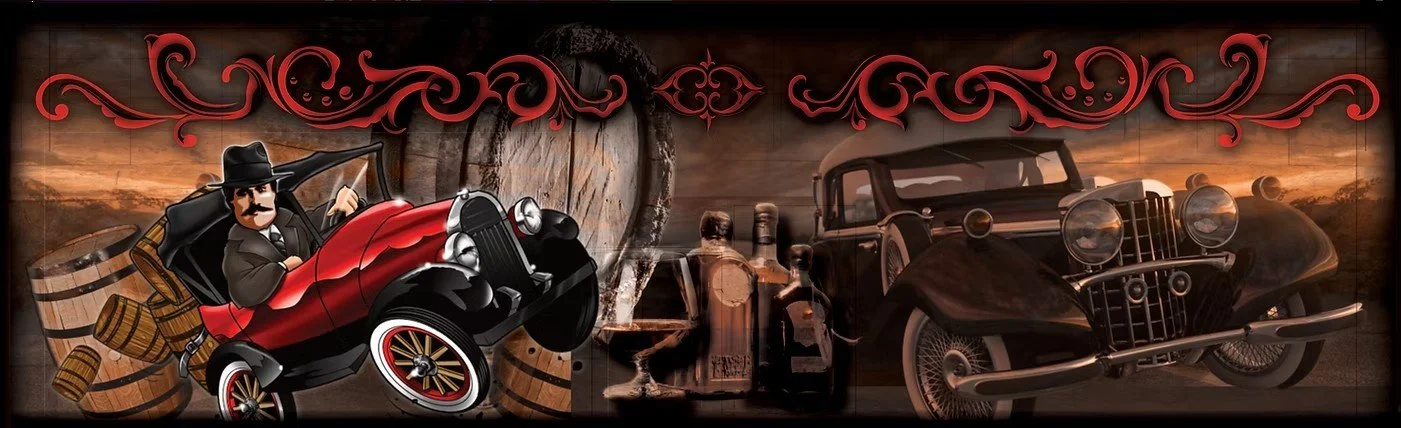
This mural in the Rum Runner Restaurant & Pub celebrates 1920s bootlegger Emilio Picariello. —Rum Runner Restaurant
“Johnny Schnarr was Vancouver's top Rum Runner. He worked for the McCoy Syndicate whose offices were in the Marine Building; his full story can be found in Libraries. He always had to build a new boat every time the Americans built faster Coast Guard boats.
“The syndicate financed the construction of several boats which at the end of [Prohibition] didn't leave him a rich man. The Reifels bought one of his boats. They and E P. Taylor made fortunes by making and selling [their] products. The delivery people took most of the risk and didn't [to] come out that far ahead. Johnny's boats had two 600 [h.p.] airplane engines that made him 10 knots faster than the American Coast Guard.
“Sumas Lake was also a popular delivery route which provide income to First Nations in the Fraser Valley.”
Ah, the good old days. Maybe this is why they’re not making them any more.
* * * * *
On Facebook recently I posted a photo of the Friends of the Morden Mine, of which I was one We were landscaping the new memorial headstone for this provincial heritage park at South Wellington. It honours not just the men who were killed at Morden but all Vancouver Island coal miners who died on the job over the century that coal mining was the Island’s greatest industry.
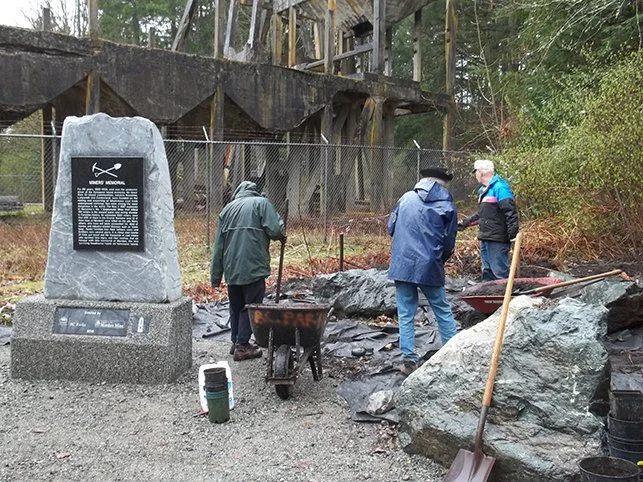
Honouring Vancouver Island’s lost miners with this monument at Morden Colliery Historic Provincial Park. —Author’s Collection
Darren Bradbury wrote, “That’s great to see. I visited the site in 2017 and will be back to check it out. My Great Grandfather was a Coal Miner. He worked the Chicago area after immigrating from England in the 1850s. He moved to Nanaimo and worked the coal there some time before the 1891 Census.
“All his sons joined the trade in Nanaimo. All but one son gave up coal mining after the big disaster in Nanaimo. None perished in that one. The son that stayed in, met his end in the Coalmont Collieries disaster in Coalmont, B.C.”
He’s referring to the Blakeburn Mine disaster of 1934, which I’ve written about here on the Chronicles.
The great great granddaughter of Sam Wardle, who with 18 others, perished in the flooding of the Pacific Coast Coal Mine, South Wellington, in February 1915, also wrote to plug her cousin David Gogo’s tribute to his Great Grandfather Sam Wardle. She’s Breakin’ Through, which earned him a Juno nomination.
You can watch and hear him play it on YouTube.
* * * * *
In an earlier Chronicle, ‘The Second World War is Still With Us,’ I told the story of how live ordnance left in and on the ground from both world wars continues to pose a threat to hikers and livestock. A recent news story reports that Ottawa has reached a deal with the Okanagan Indian Band to clear its lands of outstanding UNO (unexploded ordnance).
It took them (the government) long enough.
* * * * *
Here’s something I can really relate to. A new study has concluded that “experience travel” (touring to museum visits) is booming. This segment of travel generated an amazing US $27B last year and is expected to continue to grow.
Apparently two in three travellers favour cultural or historic sites.
I remember being somewhat surprised years ago when I read that most of those who travel to Europe are going to (among other things, I’m sure) check out cemeteries!
Works for me. If I had a free ticket to anywhere in the world it would be the Canadian battlefields and cemeteries in Europe, specifically the Vimy Ridge Memorial.
* * * * *
Closer to home, it’s reported that Parksville’s E&N Railway water tower is going to get a new home. Where or when, alas, isn’t yet known. Parksville Council is concerned for its structural safety, so it has to go. Removal and restoration is tentatively estimated to cost a third of a million dollars.
It’s the last surviving E&N water tower. Sighhhhhhhhh....
* * * * *
A full page in last week’s Victoria Times Colonist commemorated the 20th anniversary of the sinking of the BC ferry Queen of the North. Ship sinkings have become rare occurrences in BC waters these days—nothing like the old days when Vancouver Island’s west coast was known as the Graveyard of the Pacific.
Now, if they could only get the damn ferries to run on schedule...
* * * * *

Have a question, comment or suggestion for TW? Use our Contact Page.