
Editorially speaking…
Tuesday, April 28th, will mark another Workers Day of Mourning ceremony at the Forest Workers Memorial Park in Lake Cowichan.
The park honours the workers in the forest industry who helped pioneer and develop the communities around the Lake, but has also come to acknowledge all injured and killed forestry workers.
Lest anyone think otherwise, logging has always been—and continues to be—a dangerous job.
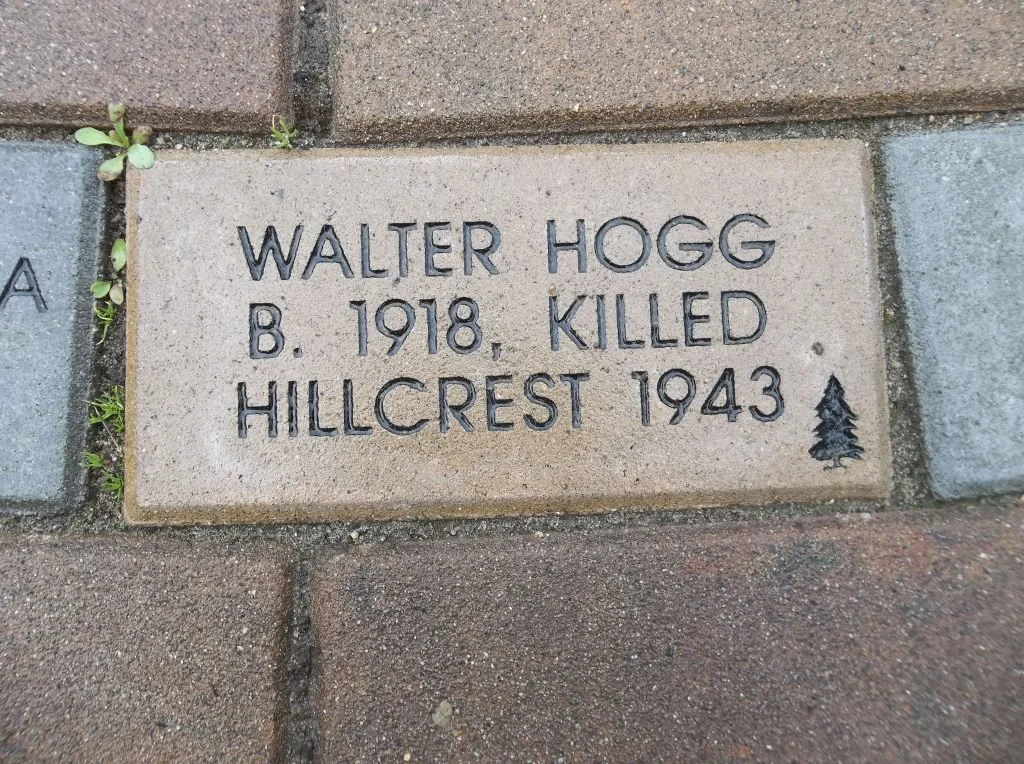
Tom Teer and I had this memorial brick installed in memory of Walter who was killed on the job. Just married, he was only 25. —Author’s Collection
Several years ago, the United Steelworkers, Local 1-80, Cowichan, marked the national day of mourning for industrial workplace deaths with a public display of some 200 logging and sawmilling photographs and archival video footage.
Most of these outstanding photos displayed, the work of the late Youbou photographer Wilmer Gold, depict logging as it was in the 1930s and ‘40s: steam donkeys, steam locomotives, the first logging trucks, hand-falling with a two-man ‘misery whip,’ camp life and the loggers themselves.
Mostly they’re young and fit looking in their soiled Stanfields and cut-off jeans.
Little in the way of safety gear is shown: bulldozers lack roll-bars, and trucks (their driver’s door removed to allow the driver a fast bailout) strain under the weight of monster-sized first-growth cedar, fir and hemlock logs that are secured only by thin chains. Fibreglass hardhats, apparently optional, appear only in photos from the mid-‘40s on.
This was a he-man’s world, and a dangerous one.
For a Cedar couple, the discovery in Nanaimo of a private photo collection with a Cowichan Valley connection served as a poignant and personal reminder that the Canadian industrial workplace has always been a threat to life and limb.
A chance conversation with a dinner guest resulted in Tom Teer, who, for 10 years worked as a mechanic in the forest industry, acquiring 100s of family photos that he never knew existed. More than that, they awakened an interest in a great uncle he’d never met because his life was taken on the job 30 years before Teer was born.
Walter Hogg, Nanaimo, was 25 and married just a year when he was fatally injured, June 18, 1943, while working as a faller for Pigott & McIntyre, contractors for Hillcrest Logging Co. at their logging operations south of Lake Cowichan. A brief front-page report in the Cowichan Leader noted that he’d been struck on the head by a falling snag and that he died in Duncan hospital the next day.
It was stated that he wasn’t wearing a hardhat at the time and a coroner’s jury brought in a verdict of accidental death with no blame attached. Previously employed by the well-known Dollar Lumber Co., he’d been with Pigott & McIntyre just a week. Walter Hogg left his widow, Violet, his parents and two older brothers.
When Violet died in April 2006, Virginia and Ian Jones of Everett, Wash. came to Nanaimo to clear up her estate. City antiques dealer Gerald Gonske, upon being asked to appraise some of the larger items, noticed four boxes of albums and loose photos, mostly of Violet’s family, but some depicting Nanaimo scenes of the previous century. These, he suggested to the Joneses, would be of interest to me for my weekly historical columns in the Citizen and Harbour City Star.
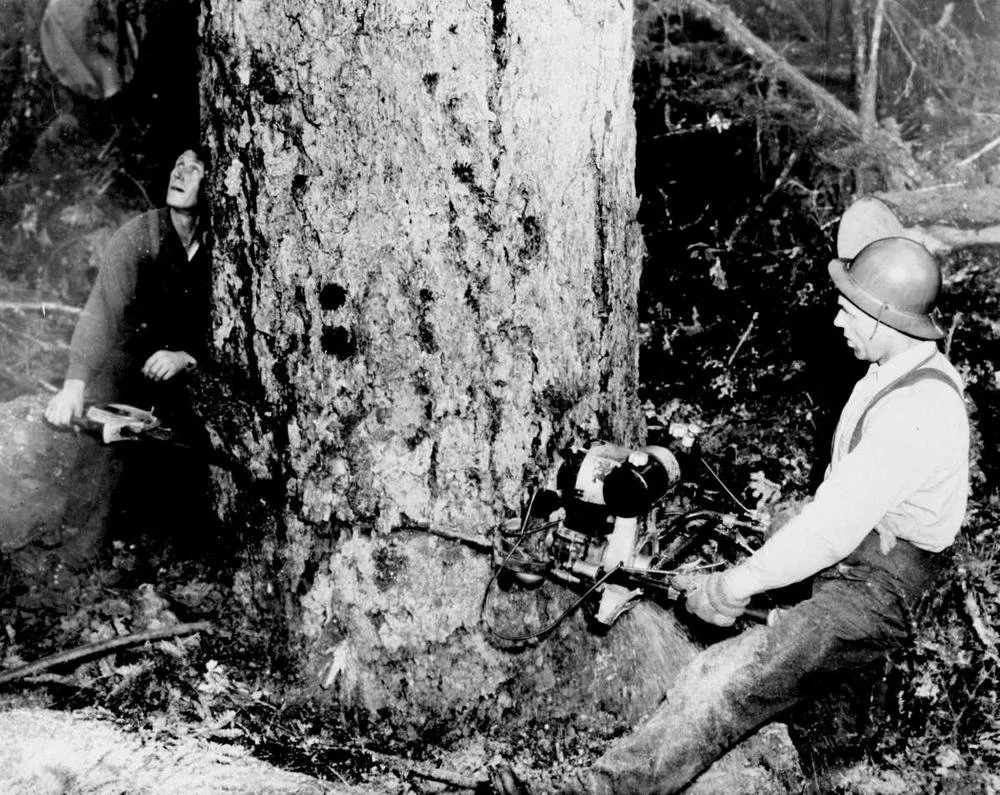
A two-man chainsaw. Logging was not work for the weak. —BC Archives
With the Joneses’ permission I was allowed to see Violet’s collection. She’d kept almost everything, it seems, including invitations, greeting cards, newspaper clippings that mostly dealt with weddings and deaths of family and friends, and personal correspondence.
Among them was a framed black and white enlargement of a tall, lanky man in soiled work clothes and suspenders, narrow-brimmed hardhat, lunchbox under his arm, gloves in hand and a cigarette dangling from his mouth as he stands on a stretch of railway track.
This, Virginia told me, was Violet’s husband, Walter. A five-by-seven shows him, again standing on a railway track, with a large and heavy chainsaw on his shoulder–and a wide-brimmed hardhat on his head. The news account of his accident stated that he wasn’t wearing it when he was hit by a falling limb but that’s likely because he was eating his lunch at the time.
There’s also the dapper, six-foot Walter in suit with a carnation in his lapel beside a very 1940s-attired Violet, another of him in white suit and tie, and looking like a Hollywood leading man, a shot of them on their wedding day, and yet another of Violet still wearing her corsage as they’re about to leave on their honeymoon. They were a handsome couple.
Tom Teer’s mom, Vicki, who was born two years after Walter was killed, says that other family members remembered him as being “nice looking, a good dresser,” shy, gentle, an avid outdoorsman and a member of the local militia.
She believes that he, like his brothers Tom and Edward, left school early to go to work to help family finances. Both his and Violet’s family were from the same Northumberland community in the Old Country and Mrs. Teer thinks it likely that they met through this family network in Nanaimo.
She didn’t meet Violet until her grandmother’s funeral in 1974 and remembers her as being Walter’s alter-image–“very tall, good shape, and a little on the shy side, too”. Mrs. Teer next saw Violet when she was in her 80s in a care facility in Nanaimo and quite infirm. She’d managed to surround herself, in her small room, with almost everything she held dear in this world.
Unfortunately, Mrs. Teer was dealing with her husband’s illness and her mother’s impending death and she couldn’t make allowance for Violet’s obvious wish to connect with her.
Although Violet never remarried it’s known that she had a years-long relationship with an older man whom she cared for in his final years. She left no children.
As it happened, I took possession of all of Violet’s family archives. Virginia Jones had agreed that they should remain on the Island and I’d offered to pass the photos on to the Nanaimo Historical Society. Because Walter was killed while working in the Lake Cowichan area, it was agreed that his framed photo and one of his short-waisted faller’s shirts (one of several still hanging in Violet’s closet) would go to the Cowichan Valley Museum and Archives.
Some time later, while dining with Tom and Cerys Teer, I showed them one of the albums of old Nanaimo photos. Tom noticed a name, Mrs. V. Hogg, written on the back of a hospital menu. Yes, I said, Violet Hogg. Tom and mother Vicki suddenly leaned forward. “Why, that’s my great uncle Walter’s wife, Violet,” he said.
With the exception of the photo now in the Duncan museum, Violet’s treasures are with Walter’s great nephew, Tom, who spent much of the following winter organizing, identifying and mounting the 100s of photos which range from century-old, professionally posed studio prints to fading 1960s Polaroid snapshots. (One, on top in the very first box they opened, was of Vicki Teer in her graduation gown.)
I’m sure that most will agree that this is a better way of remembering Walter and Violet Hogg than storing their photos in an archives’ vault.
* * * * *
Two weeks ago, at a dedication ceremony for Hillcrest Chinese Cemetery, many kind words were said about Neil Dirom who’d devoted years to reclaiming the abandoned graveyard from broom and brush.
Unfortunately, Neil was too ill to attend. This past Saturday, he passed away. I’ll have more to say about this iconic cemetery and Neil Dirom in a future BCChronicle.
* * * * *

Have a question, comment or suggestion for TW? Use our Contact Page.