
Editorially speaking…
For reasons I’ve never understood, we Canadians don’t seem to want to honour our heroes.
I don’t mean “celebrities”—our overnight adulation for, say, rock stars—or notoriety. I mean lasting fame and remembrance for achievements that were above and beyond the call of duty or the norm. Personal acts of heroism and accomplishment that have contributed to the very making of Canada.
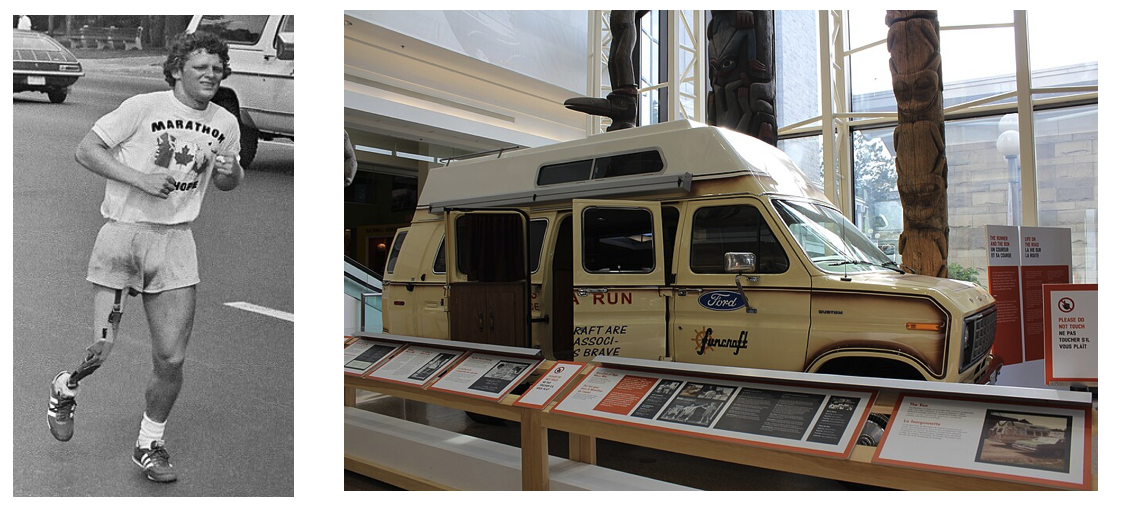
The legendary Terry Fox whose van is on permanent display in the Royal BC Museum, Victoria. —Wikipedia/Jason Zhang
Probably the most notable exception is Terry Fox, whose epic run across Canada to raise awareness of, and funding for, cancer research has become a Canadian institution. The latest total I’ve seen for his and his 10s of 1000s of dedicated followers’ efforts over the past 30 years is $1 billion.
That’s $1 billion.
But, as I say, Terry is the greatest exception to Canadians’ collective amnesia when it comes to our heroes of history. “So soon we forget...” could almost be our national motto, I’m sorry to say.
This where museums and historical societies come in, doing their part trying to keep alive memories and awareness of our past. One of my own favourites is the Malahat Mill Bay Historical Society which, thanks in great part to visionary founding member Maureen Alexander, has continually impressed me with their imaginative and pro-active approach to history.
Some people actually believe that history is about the past, the come and gone, thus worthy of only mild interest. No, history is about here and now, about us. I follow the news. Every day, I read or view stories about people and events, the society in which we live, that are subject to, or bound to, or the direct result of events of the past.
History lives. It walks among us, it impacts almost daily upon many of our personal ambitions, our life choices, decisions and disappointments. It influences government leadership and direction.
It’s sort of like Newton’s Third Law of Motion—for every action there’s an equal reaction. BC is currently a-swim with the sad legacy of colonialism, our courts having become clogged with litigation between the provincial government and First Nations, and land conflicts between First Nations.
That, perhaps, is an extreme example of ghosts from the past coming back to haunt us, and not where I meant to go with today’s ramble.
Rather, I’m trying to emphasize the positive of the past. Which brings me back to the Malahat Mill Bay Historical Society, and its recent post on a local woman who made world history.
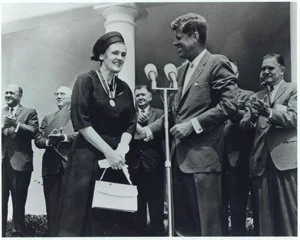
The famous photo of Dr. Kelsey and President John Kennedy. —U.S. Food & Drug Administration
Born in Cobble Hill, Frances Kathleen Oldham Kelsey nee Oldham (1914–2015) was the Canadian-American pharmacologist and physician who, during her 45-year career with the U.S. Food and Drug Administration (FDA) refused to authorize thalidomide for market because she had concerns about the lack of evidence regarding the drug's safety. She was the first woman to receive a PhD in pharmacology and the second woman to receive the President's Award for Distinguished Federal Civilian Service, awarded to her by President John F. Kennedy in 1962.
Here’s what the FDA website has to say about Dr. Kelsey: Frances Oldham Kelsey: Medical reviewer famous for averting a public health tragedy
Frances Oldham Kelsey, recipient of the highest recognition attainable for a U.S. civil servant for her role in saving perhaps thousands from death or life-long incapacitation, had a long an impressive career both before that turning point in medical history and afterwards.
Born in Cobble Hill, Vancouver Island, B. C., she had an early interest in science. In 1934 she earned her B.Sc. from McGill University, and in the following year received the Master’s degree in pharmacology. She continued her work in pharmacology at the University of Chicago, where she earned her Ph.D. in 1938 and also the M.D. in 1950.
During this period she also did editorial work for the American Medical Association, where she reviewed papers on the latest in therapeutics. Beginning in 1954, Dr. Kelsey taught pharmacology at the University of South Dakota and practised general medicine.
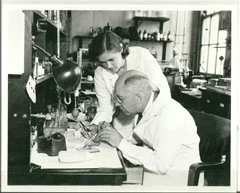
Dr. Kelsey at work in the medical lab. —Wikipedia
Six years later she accepted an offer from the Food and Drug Administration to become one of just a handful of medical officers. Their principal duty was to review new drug applications, a legal requirement in which manufacturers had to provide evidence of a drug’s safety before it could go on the market.
One of the first applications she was assigned was for thalidomide, which was already available in dozens of countries around the world. Dr. Kelsey, despite constant pressure from the company, refused to approve the application because of its inadequate evidence.
The company continued to send in what they believed was proof of thalidomide’s safety, but Dr. Kelsey adamantly insisted on scientifically reliable evidence, which she felt the application sorely lacked.
Approximately a year later, researchers in Germany and Australia linked thalidomide to clusters of rare, severe birth defects—hands and feet projecting directly from the shoulders and hips—that eventually were shown to involve thousands of babies. The drug was never marketed in the U. S., and the impact of the near disaster there here helped to pass a pending bill that fundamentally changed drug regulation, the 1962 Drug Amendments.
Dr. Kelsey moved on to head the Investigational Drugs Branch, and from the late 1960s until the 1990s she led the Division of Scientific Investigations, which oversaw clinical investigators, ensuring the scientific integrity of the data on which the agency’s drug decision-making were largely based.
Her contributions have been widely recognized through Presidential and other awards, honorary academic degrees, and educational facilities named after her. Also, in October 2000 Dr. Kelsey was inducted into the National Women’s Hall of Fame, and in 2010 Commissioner Hamburg conferred the first Dr. Frances O. Kelsey Award for Excellence and Courage in Protecting Public Health on Dr. Kelsey herself.
Dr. Frances Kelsey, like Terry Fox, are exceptions to my premise that Canadians don’t honour their heroes. There have been so many others whose contributions which continue to influence our lives go unsung.
I tip my hat to all those who operate our museums and historical societies, many of them volunteers, who work to keep Canadian history alive.
* * * * *

Have a question, comment or suggestion for TW? Use our Contact Page.