
Musing Out Loud...
The results of a study of the differences, perceived and real, between Canadians and pre-Trump Americans were once published in the Victoria Times Colonist. Apparently, we're more alike than we think. Oh, we're more polite, more restrained (I'd like to think, ‘mature’ and ‘refined’). But when it comes down to the nitty gritty the study suggests, heaven forbid, that we're more akin to Americans than we care to admit.
Well, the study overlooked at least one critical difference, in my view. Americans treasure their history, their heritage. They revel in it. They wear it on their flag, their t-shirts, their bumper stickers. Show me one Canadian who goes around, visibly promoting our equally industrious past. We don't even talk the talk, let alone walk the walk. We'd rather demolish and rebuild then preserve the real thing.
As a case in point, I'm going to cite the tale of William McGregor, manager of the New Vancouver Coal Co.’s No. 1 mine on the Nanaimo waterfront. William who? you ask.
The Victoria-born McGregor began his career in the collieries as a ‘trapper,’ or ‘door boy’, then worked his way up until he was appointed manager in 1884. It was said that he “most conscientiously devoted practically all his time and energies to the duties of his important position,” as well as serving as chairman of the school board. As manager of one of the largest, most productive coal mines on the Island, he “never spared himself, but was always foremost in every needed operation, no matter what the personal risk”.
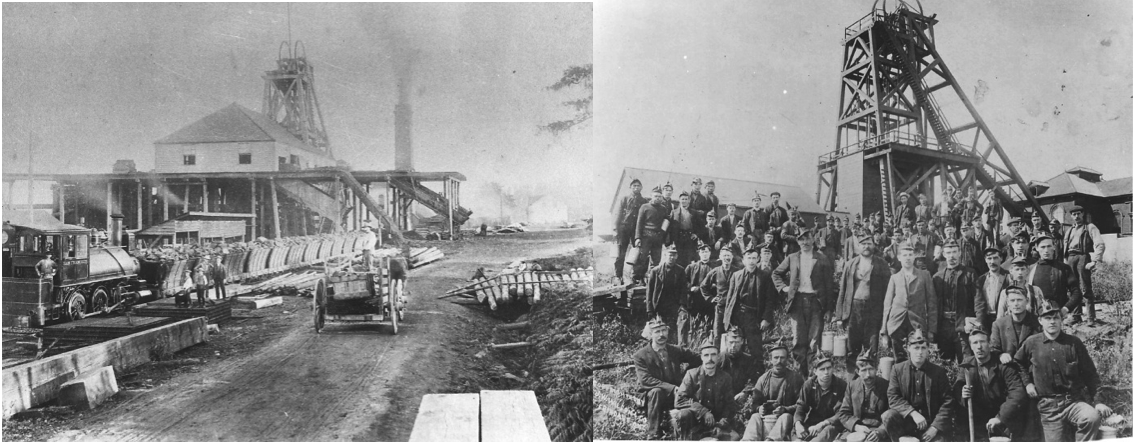
How conscientious was he? When the afternoon shift failed to contain an ignition of gas in Lamb’s Incline on the main level of the No. 1, in mid-November 1898, McGregor, fire bosses James Price and George Lee, timberman Peter Hygh and Donald Ferguson, and miners Fred Hurst, E. Edmunds and H. Sheppard, took charge. As they worked, a second blast of open flame seared their faces and hands, and probably their lungs. Lee was thrown against a wall, his leg broken. As his comrades, in agony from their own injuries, attempted to carry him out, they were overtaken by after-damp and had to abandon Lee to flee for their own lives.
McGregor, first to reach the surface, ignored his own injuries and headed back down with fire boss Robert Adam and miner William Thorpe. By the time they found Lee he was unconscious and had to be carried to the foot of the main shaft. Once topside, Shepherd, Hurst and Edmunds were rushed to the hospital, McGregor, Price, Ferguson, Lee and Hygh being taken to their respective homes. All but Lee were expected to recover in a month to six weeks, according to colliery surgeon Dr. R.E. McKechnie.
The tragedy didn't end there. Next morning, when fire boss Morgan Harris was inspecting the damage, a second blast hurled him against the coal face, burned him and left him in a ‘weakened condition’.
Three days after the first mishap, George Lee died. The-50-year-old from Coventry, England who had worked in the mines for 17 years left a wife and three children.
The next day, William McGregor also succumbed to his injuries. The Nov. 16, 1898, Free Press expressed universal grief felt by citizens – ‘each one individually felt that they were on the eve of parting with a personal friend and that Nanaimo was about [to lose] one of her foremost and most highly esteemed citizens”. William McGregor had yet to reach his 43rd birthday when he gave his life in the mines–one of more than 1000 men known to have died in Vancouver Island collieries over their 90-year-long ‘heyday’.
If McGregor had been in the military he'd have won a Victoria Cross for such an exemplary example of self sacrifice. If he were American... But he was a Canadian, a civilian –just a career colliery man who had seen as much death and destruction as most professional soldiers, and working class heroes were seldom honored back then. Worst, he and so many others have been forgotten. It is to Nanaimo’s shame that no adequate memorial has been erected to the hundreds of its miners who were killed while working in the mines that put the so-called Black Diamond City on the map.
At least, they honored him then. Flags were lowered to half-mast, the NVCCo’s several operations were shut down until after his funeral, which proved to be the largest held in the city’s history up until that time, with an estimated 3,000 people attending from near and far. The procession, four abreast, was a mile long. The E&N had to place extra cars on duty to bring those from outside the city. His five pallbearers were among the city's most prominent citizens.
Then came carriages containing Col. (and future premier) E.G. Prior, MP; H.D. Helmcken, MPP, John Bryden, MPP, Dr. L.T. Davis, James Dunsmuir, competing colliery owner and MPP, Capt. McIntyre and Robert Bryden. They were followed on foot by Major Bate and aldermen, public school trustees, NVCC office staff, friends and general public. There were 91 wreaths and 44 floral crosses and anchors.
In his sermon, Rev. Cummings proved himself (more’s the pity) to be less than a prophet when he said that McGregor's memory, and those of the other miners involved in this, but one of a litany of colliery tragedies, “shall remain with us… because of his sterling worth and character as a man... He was a true hero. When we think of the agony that he and the seven men with him must have endured from the effects of the fire, and that each step in the escape must have been added to their pain, and that amidst this intense suffering they forsook not a comrade, until he was brought into place of safety. When we think of these it makes us feel proud that we have met and known such heroes.”
Today, William McGregor is just one of many unsung heroes of the workplace. The only serious attempt at a memorial in Nanaimo is a privately funded signboard near the site of the No. 1 Mine, off Haliburton Road. You hardly know it's there.
I could go on. Canadians, eh? When it comes to history and heritage, I’ll go with the Yanks.
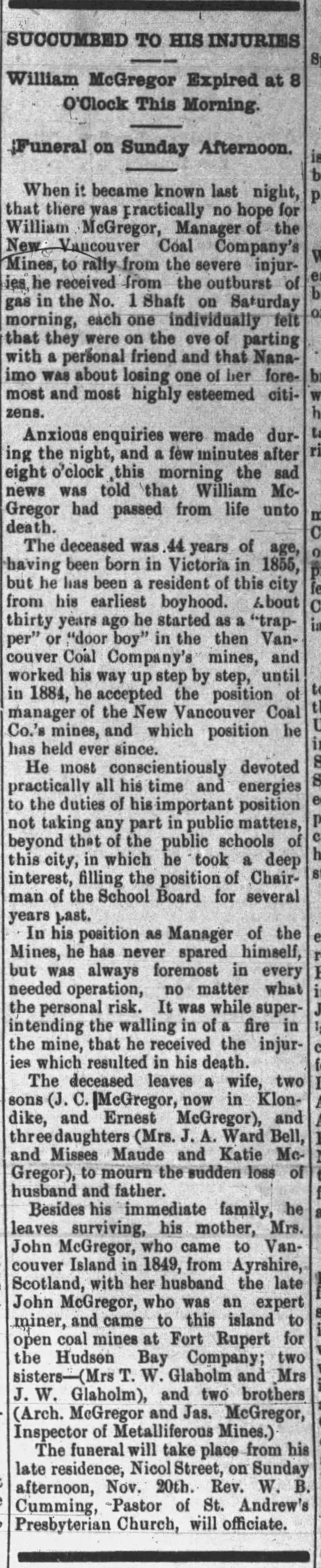
—newspapers.com
* * * * *

Have a question, comment or suggestion for TW? Use our Contact Page.