
Editorially speaking…
On Saturday we attended the annual Times Colonist book sale in Victoria. Organized and operated by a small army of volunteers, the money raised (well over $6 million since the first sale in 1998!) is matched, in part, by provincial government funds.
The money goes towards promoting and improving literacy on Vancouver Island.
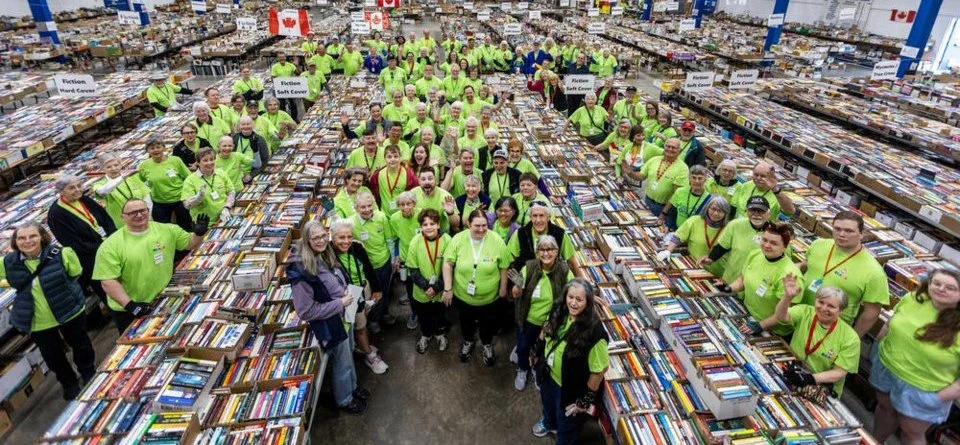
The many volunteers who managed this year’s annual book sale which netted $300,000 for literary. —Times Colonist
I’ve always taken literacy—my own—for granted. As much as I hated school and struggled with arithmetic, among other dismal subjects, English Literature was usually a walk in the park for me.
From that first day when the light came on, reading has been a passion. I can’t imagine what it would be like to have to struggle with the printed word.
It got me to thinking about a man I knew in Victoria years ago. I first came to know of Victor through my brother who shared his interest in country music. Long before I actually met him, I overheard my brother playing tapes Victor had recorded of the golden oldies of country music.
Now Victor didn't just copy songs onto his reel-to-reel recorder, he delivered them with as professional and as entertaining an introduction and patter as ever I'd heard on any commercial radio station. Victor didn't just love country music, he lived and breathed it, and his passion came across on the tapes my brother borrowed.
Which, effectively, was as much as I knew about Victor until the day I met him at his home where we'd been invited for the evening. There, I learned that his day job was as a swamper on a Municipality of Esquimalt garbage truck, he having to be content with his love of music as a hobby.
Why didn't he seek a job with the radio station, you might ask. So did I. To be told, by my brother, that Victor could never hope to be a DJ, he’d probably always have to work as a manual labourer.
Because Victor couldn't read or write.
I don't think I’d ever met anyone before who I knew to be all but illiterate and at first I was astounded. But as the cold hard truth sank in, it made me think of the unknown legions of men and women who were similarly handicapped.
Reading and writing had come naturally give me in grade school, as it likely had for most Canadian students.
But not for Victor and those like him. I consider reading to be one of the greatest joys of life and I shudder when I hear someone actually brag they haven't read a book in years. How sad. For them, ignorance is by choice. But for Victor...
* * * * *

Men of the CLC unloading artillery shells at Boulogne in August 1917. —Imperial War Museum
Last Saturday was a double-header; besides the TC book sale, we attended the second annual Ching Ming Festival to honour the men of the Chinese Workers’ Corps who are interred in a small cemetery on the grounds of the William Head Institution, Metchosin. (The third time in my life behind bars—but we won’t go there.)
Twenty-six of these men, imported by the British to serve as front-line manual labour in France during the First World War, share this beautiful and little-known waterfront cemetery which is lovingly maintained by inmates.

A formal headstone such as this is the exception at William Head, unmarked concrete crosses being the most common. We weren’t allowed to take photos and had to surrender our cell phones, wallets, purses, metal ware, etc., at the office, then undergo a sniff test by a golden lab before being permitted entry. —Wikipedia
Back then, it should be noted, William Head served as a quarantine station.
You’ll learn more of the fascinating, and sad, story of the CWC is an upcoming BC Chronicle.
* * * * *
Today’s Chronicle makes several references to a scaling bar. This is a long pole with which miners deliberately bring down rocks in a mine’s roof which have been loosened by explosives. Years ago, I found one at the Pacific Coast Coal Mine, South Wellington.
Picture a pipe of about about an inch and a-half diameter and about eight feet long, with what looked like a saw-tooth attachment at the end. I brought it home, attached to my roof rack, and upon stopping for groceries, overheard an elderly man inform his wife that it was a harpoon!
Rock-falls were among the most frequently cited cases of mining deaths. Many of those rock-falls were the result of miners prying loose the ceiling rubble over their heads with a scaling bar.
* * * * *
If you don’t know the story of what likely is BC’s most famous ghost town, you can read it here on the Chronicles (see This Phoenix Didn’t Rise From the Ashes). The good folks of the Boundary Historical Society have laboured for years to repair and to maintain its mountainside cemetery. They also operate the Boundary Museum and Archives.
It’s groups of volunteers like those of the BHS who keep BC history alive. Bless them!

Have a question, comment or suggestion for TW? Use our Contact Page.