
It’s Gonna Be Deja Vu All Over Again
In this brave new world of AI, the world needs more copper.
More copper, in fact, than is known to remain in the ground, untapped, after centuries of wholesale extraction!
What to do?
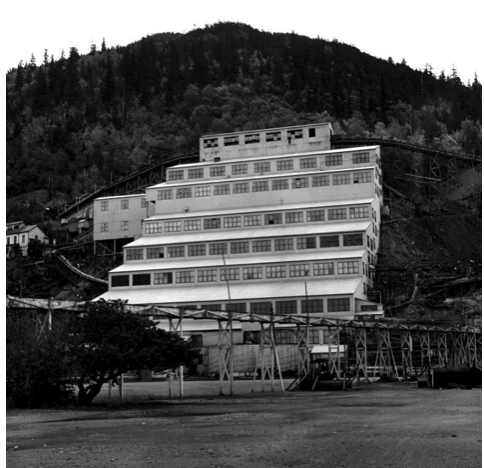
“When most people drive by Britannia Beach today they have little sense of how massive the Britannia Mine was. At the height of production in the late 1920s to early 1930s, it was supplying an impressive 17% of the world's copper. By the time the mine closed, it had 210 km of tunnels and stretched over 1,750 metres of vertical distance (from 1100 metres high in the Britannia mountains to a depth of around 650 metres below sea level). —Wikipedia
A partial solution is to harvest the 100s of millions of tons of low-grade ores from old, long abandoned mines that failed to make the grade the first time round. New smelting processes can now extract what was originally rejected as worthless.
It’s going to spark a whole new copper mining boom in BC.
* * * * *
The 20 years preceding the First World War have been described as B.C’s Golden Age of Copper. That boom was prompted by the phenomenal growth in the use of electricity, industrially and domestically.
Gold and silver hadn’t lost their lustre, of course; but, for the first time, a base metal—in this case, copper—had surged to the fore. Copper was needed—and in incredible volumes.
Potential claims on Howe Sound and Knight Inlet which had been allowed to lie fallow since the 1860s were suddenly looked at with renewed interest. But, even the 1880s, a major impediment was the need to ship all ores to American smelters, primarily at Spokane and, on the coast, to Port Townsend, at great expense.
Thus, only the highest-grade ores reached a smelter.
Millions of tons of hard-won but lesser-value ores remained on waste piles. For a few particularly rich mines, if only for a few years, this could be done profitably. (Two Cowichan Valley mines on Mount Sicker got away with this for a while but, within a decade, the party was over.)
This remained the case as late as the late 1890s, when the Provincial Government offered a bonus and the Dominion Government provided land grants for smelter construction. S.A. Bradford, writing for the Canadian Institute of Mining, Metallurgy and Petroleum in 1991,tells us that it was silver producers who first took the bait.
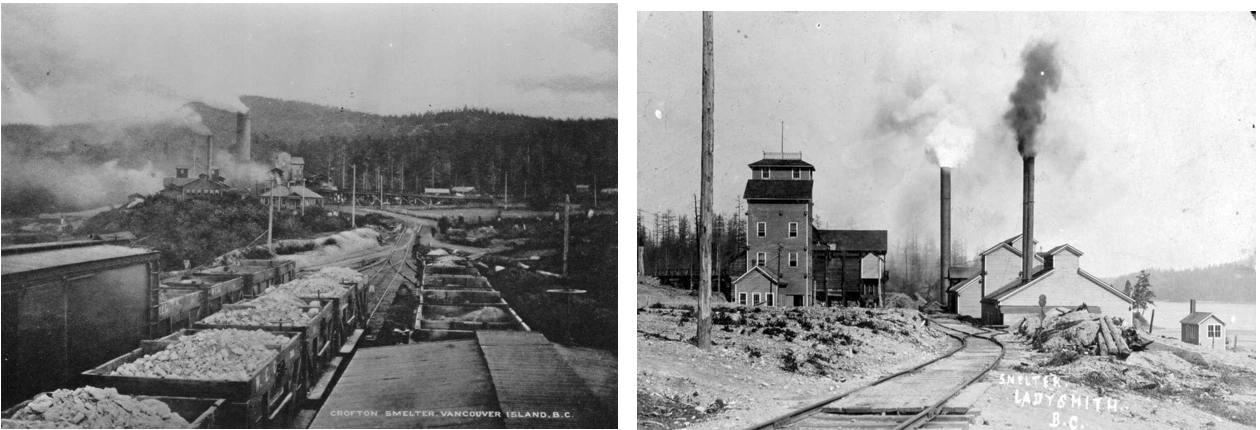
CROFTON: Vancouver Island had two copper smelters, at Crofton (left) and Ladysmith. Both were built to process the rich ores from Mount Sicker. By the time Crofton came online, the Sicker boom had peaked and it relied upon ores from Howe Sound’s famous Britannia Mine, one of the largest producers ever. Ladysmith’s smelting history was even briefer. —BC Archives
The first smelter likely was “the McRae furnace on the Spillimacheen River” in 1883, followed by small smelting works at Vancouver, 1889, Revelstoke in 1891), and Golden in 1901. “They each smelted a few tons of galena and then quickly closed down permanently for lack of ore....”
Smelting, to say the least, was a perilous business model, and an inexact science in those days. For example, the Pilot Bay smelter was built on the east shore of Kootenay Lake between 1891 and 1895.to process silver and lead ore from the nearby Bluebell Mine. In today’s values, it cost millions—all in the expectation of processing Bluebell ore—which proved to be too hard to melt down.
The Pilot Bay smelter ran for less than two years in the 1890s, tried to reopen in 1905, but soon closed forever.
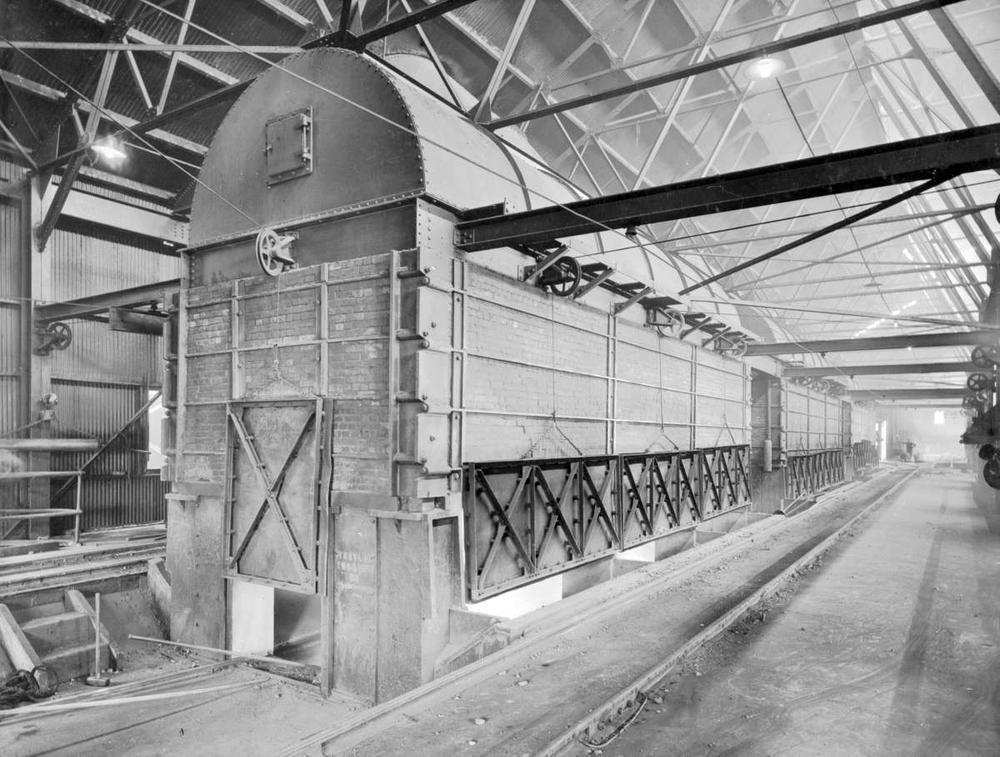
An interior shot of the Anyox smelter. —BC Archives
A slow start for the BC smelting industry, to say the least, but the tempo, sparked by continental-wide demand for copper, and fed by massive discoveries in the Kootenay and Boundary regions, triggered a rush to build regional smelters. Among the stars were those at Greenwood, to smelt copper from Phoenix higher up in the mountains), at Trail (biggest and longest-operating of them all), Anyox and, here on the Island, at Crofton.
Ironically, what service life the Crofton smelter had was in processing ores from Howe Sound’s mega-Britannia Mine rather than the Lenora Mine (already finished) for which it had been intended.
Fast-forward to the present, and we’re right back where we started from.
Although British Columbia produces over half of Canada's copper—we have no active copper smelters. All finely-ground copper concentrate mined in the province is shipped overseas to China and Japan for processing. The last BC copper smelters shut down in the 1980s, and Canada's only survivor is in Quebec.
It’s reported that “governments and industry leaders are now exploring bringing smelting back to BC to secure supply chains and boost the value of local mining.”
Which brings us to AI and the greater than ever need for copper—when governments view critical minerals like copper as essential for national security and the green energy revolution (like EV batteries). The federal and provincial governments have launched initiatives to assess if building a modern, low-emission smelter in Western Canada is economically and environmentally viable.
But that’s in the future and I’m supposed to be writing about history.
Here are a few more photos of BC’s producers from the past—some of whom may again find themselves in production—even it’s mining the waste piles left by the original operators.
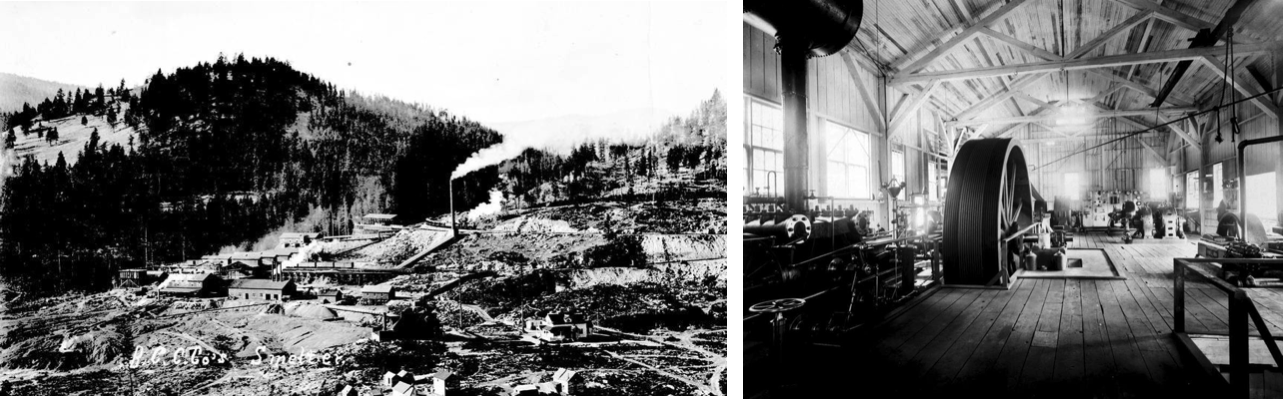
Two views of the Greenwood smelter which operated on electricity—which relied upon copper of course. —BC Archives
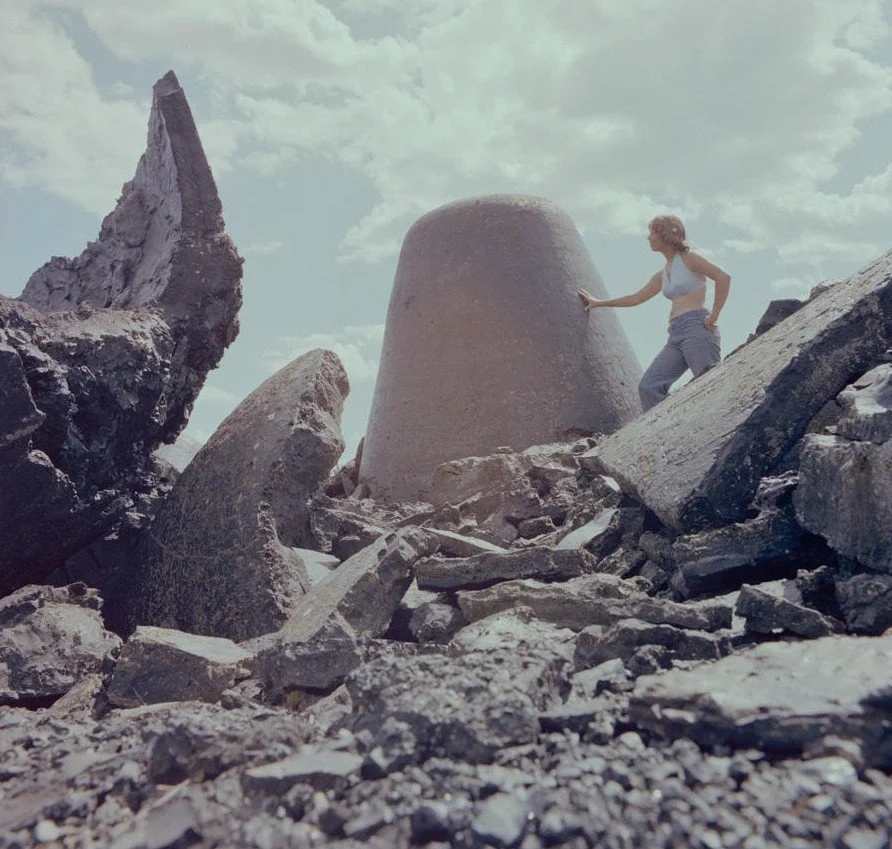
Today, the ruins of the Greenwood copper smelter are a tourist destination. —BC Archives
* * * * *
