
Chinese Labour Corps
Today, it’s William Head Institution, a minimum-security prison, located at the outermost reach of the District of Metchosin. It’s prime waterfront real estate.
Originally, these acres served as western Canada’s quarantine station. Every ship headed for Victoria, Vancouver or other BC ports, had to stop here so that passengers and crews could be examined for infectious diseases.
Those diagnosed as ill were detained under guard, just as though they were incarcerated.
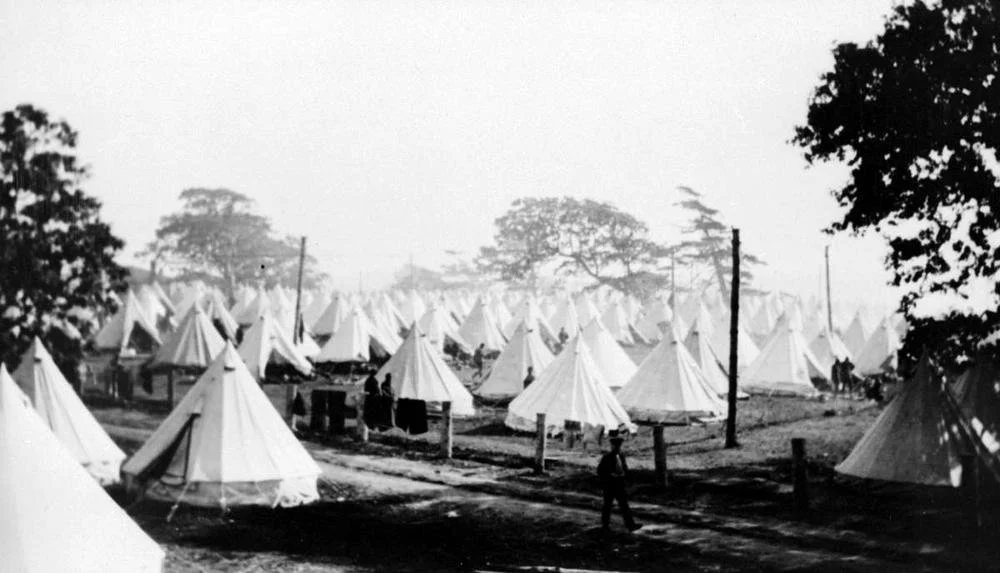
A small city of tents housing CLC workers at Albert Head. —BC Archives
During the First World War, with trench warfare killing soldiers by the millions, the British and French governments conscripted Chinese labourers—as many as 140,000 of them in all—to perform essential manual tasks on the Western Front, often close enough to the front lines that they were subjected to enemy shelling.
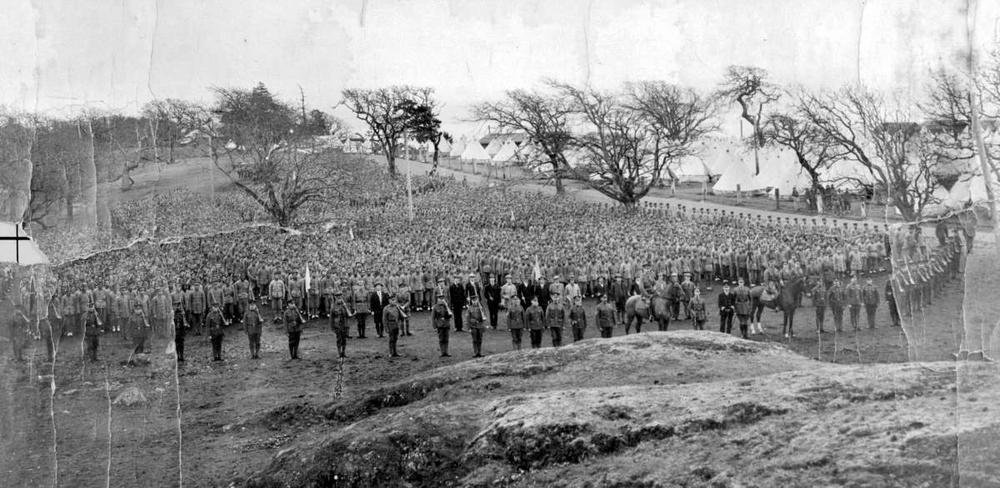
March 28, 1918 – Another detachment of CLC workers embarks for the war from William Head Quarantine Station. —BC Archives
Upon war’s end, those who survived were returned to China, again via Albert Head, after another locked train ride across Canada under the eyes of armed guards.
27 of them died while at Albert Head and they’re there today in unmarked graves of concrete at the water’s edge. Their names, which, thankfully, were recorded, have since been posted on a memorial.
These men were volunteers who contracted with the Allies to fill roles that allowed British and French soldiers to fight. Far from homes and families, in the maelstrom of a war not their own, they deserve to be, at the very least, recognized.
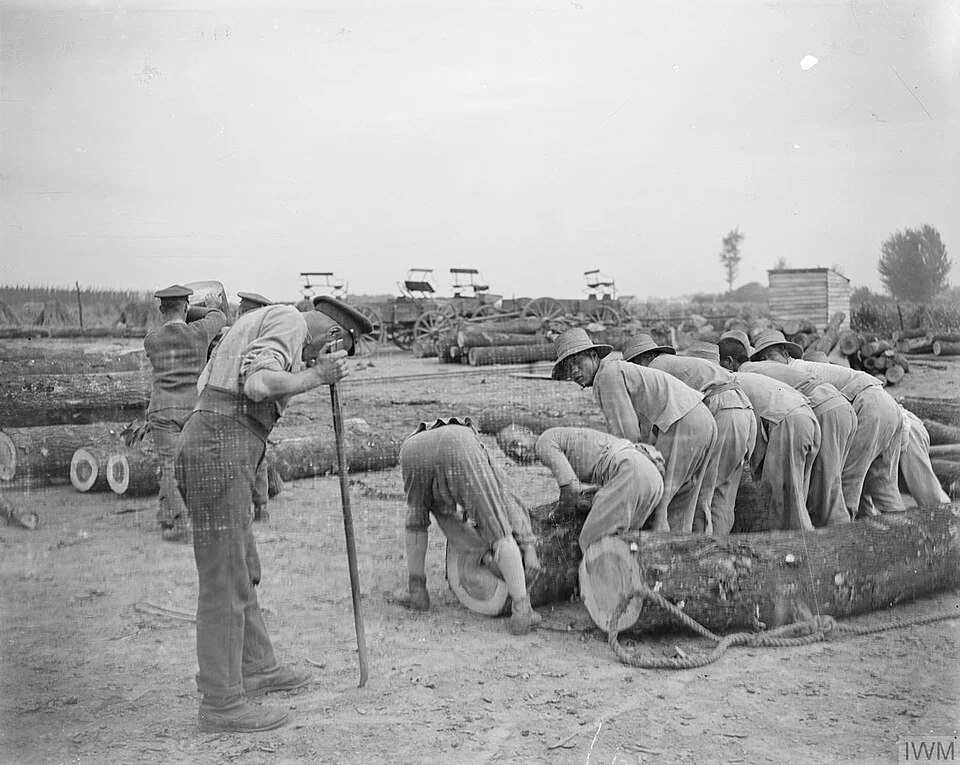
A British non-com directs CLC workers during the infamous Battle of Passchendaele in 1917. —BC Archives
* * * * *
Coincidentally, as I begin to write this week’s Chronicle, William Head Institution is headline news because of another escaped prisoner. But let’s stick to our subject by placing the Chinese Labour Corps in historical perspective.
After revolution ended 2,000 years of dynastic rule, and before world war engulfed Europe in 1914, China was a political basket-case: 80 percent of the country was administered by a mixed bag of foreign nations, Great Britain, France, Italy, the United States, Japan and Germany.
Even the Congo Free State had a concession!
China, with no vested interest in the European conflict, and with more than enough troubles of its own, initially declared its neutrality. This proved to be easier said than done.
It became more complicated when Japan, a British ally, seized control of Qingdao, Germany’s concession, and gained control over the strategic Shandong province. The home of Confucius and the most sacred sites of Daoism and Chinese Buddhism, it was regarded as China’s Holy Land.
But Japan wasn’t finished. In January 1915, taking further advantage of the British and French focus on Europe, Japan presented China with the infamous “Twenty-one Demands.”
These, Britannica tells us, “called for confirmation of Japan’s railway and mining claims in Shandong province; granting of special concessions in Manchuria; Sino-Japanese control of the Han-Ye-Ping mining base in central China; access to harbours, bays, and islands along China’s coast; and Japanese control, through advisers, of Chinese financial, political, and police affairs. Yuan’s forced acceptance of all but the last point greatly increased anti-Japanese feeling in China.”
Caught up in a perfect storm of international intrigue coinciding with the death of its president, a new government convinced itself that Germany’s former possessions would be returned upon that nation’s defeat if China actively sided with the Allies.
At first, however, the Chinese government proposed the formation of a corps of non-combatant labour. But Britain and France rejected the idea as further complicating an already confused and conflicted political situation. Then, alarmed by Japan’s overt territorial ambitions, the Chinese began to favour entering the war as a belligerent, which would gaining them equal status as an ally—the imperialistic Japanese government’s vehement opposition.
This again raised the idea of a Chinese Labour Corps. France was the first to agree to the plan. After all, the Western Front was stalled—despite the cost of 100s of 1,000s of lives, neither they nor the British were making any headway.
After the disastrous Battle of the Somme, with no immediate breakthrough or other hopeful alternative in sight, and desperate for manpower, the Allies now welcomed the possibility of freeing up legions of trained soldiers to actually fight.
Let the Chinese Labour Corps perform the grunt duties so essential to keeping their armies in the field.
The French contracted to take on 50,000 labourers but never exceeded more than 40,000; the British, however, were more ambitious, accepting 96,000 labourers. All of these civilian volunteers would pass through Albert Head while en route to and from Europe.
But not all of them made it. On Feb. 24, 1917, “the French ship Athos was torpedoed by a German submarine while transporting 900 Chinese labourers recruited by the French. 543 Chinese lives are lost—and the Chinese government declared war with Germany, Aug. 14, 1917.
Members of the CLC contracted “for three years, and had to work 10 hours a day, 7 days a week. They would have 3 days holiday a year – one for Chinese New Year, one for the Dragon Boat Festival and one for the Mid-Autumn Festival. When not working the labourers were confined to camp: even if the camp was being shelled by the Germans, the Chinese were forbidden to leave.” (Author’s italics.)
Promised good wages and food by Chinese standards, these jobs included (I’m quoting info@clcmemorial.org):
• Building and repairing roads and railways
• Carrying munitions and supplies to the front lines
• Cleaning and repairing military equipment and vehicles
• Clearing the battlefields
• Digging and maintaining trenches
• Handling supplies, including ammunition, food, and medical equipment
• Laying barbed wire and building fortifications
• Loading and unloading supply ships
• Mine clearance
• Operating horse-drawn transport carts
• Reburying the dead in war graves
• Repairing and refurbishing tanks
(Even after Armistice, the Chinese Labour Corps was kept on to recover bodies and bury them in the numerous war cemeteries.)
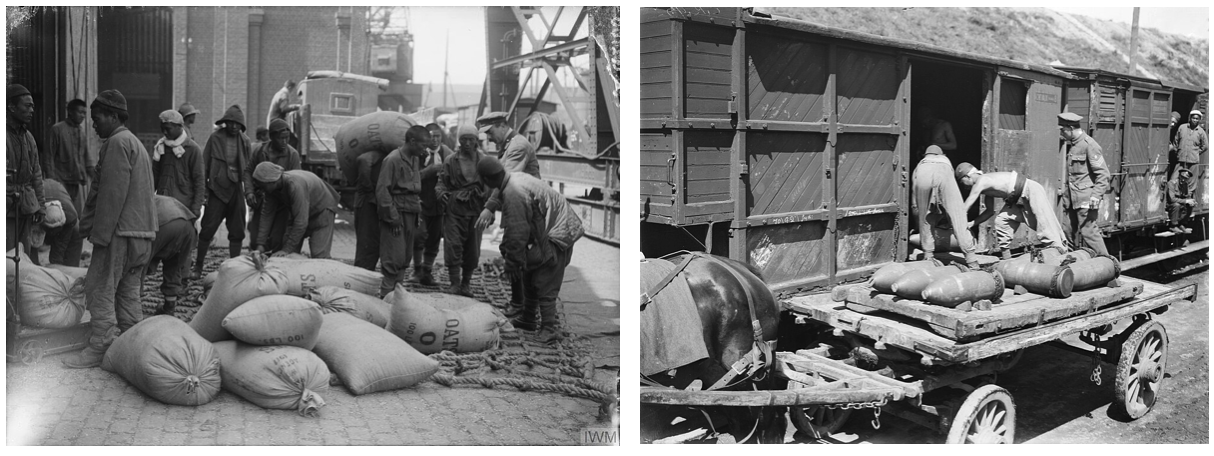
CLC workers on the job, loading or unloading supplies and ammunition for the Allies. —BC Archives
Need it be said that these duties had to be performed in all kinds of weather and often within range of German artillery? There’s one cited instance of the CLC being ordered to repair a runway even as it was being bombed. Other hazards included clearing live ordnance from battlefields.
On top of all these hazards and hardships, they were subjected to racial discrimination and sometimes brutal treatment.
As if living conditions in the trenches—the filth, the mud and disease—weren’t brutal enough for combatants and support workers—always with the threat of enemy artillery and snipers—the members of the CLC were poorly equipped and given overcrowded accommodation.
So it shouldn’t be surprising that, with the outbreak of the Spanish ‘flu epidemic in 1918, 1000s of the Chinese workers fell ill and mortality was high.

A rare moment of rest on the Western Front for members of the CLC. —BC Archives
Not altogether surprisingly, the exact number of Chinese casualties remains unknown. 2,000 CLC workers are buried or commemorated in Commonwealth war graves—some Chinese sources put the figure at 20,000.
And China’s ultimate payoff? Both Britain and the United States went through the motions of supporting Chinese claims to the return of Shandong Province but politics won the day. China wasn’t even allowed to participate in the talks which resulted in Japan, a valuable ally after all, keeping all it wanted.
An embittered China refused to sign the Treaty of Versailles; so great was the general sense of betrayal by the western nations that a new political movement calling itself the Chinese Communist Party gained traction. (And the rest, as they say, is history.)
The tragic story of the CLC had one more card to play. China, which had had successive agricultural surpluses throughout the war and exported vast quantities of food to Europe, suffered three crop failures in a row, creating the North China Famine of 1921-22. It’s estimated that half a million people died.
* * * * *
Only wartime British Prime Minister Lloyd George appears to have taken notice of their invaluable contribution to the Allied war effort, noting in his memoirs the harsh conditions under which they’d had to work, and their “imperturbability”.
Small praise, indeed.
* * * * *
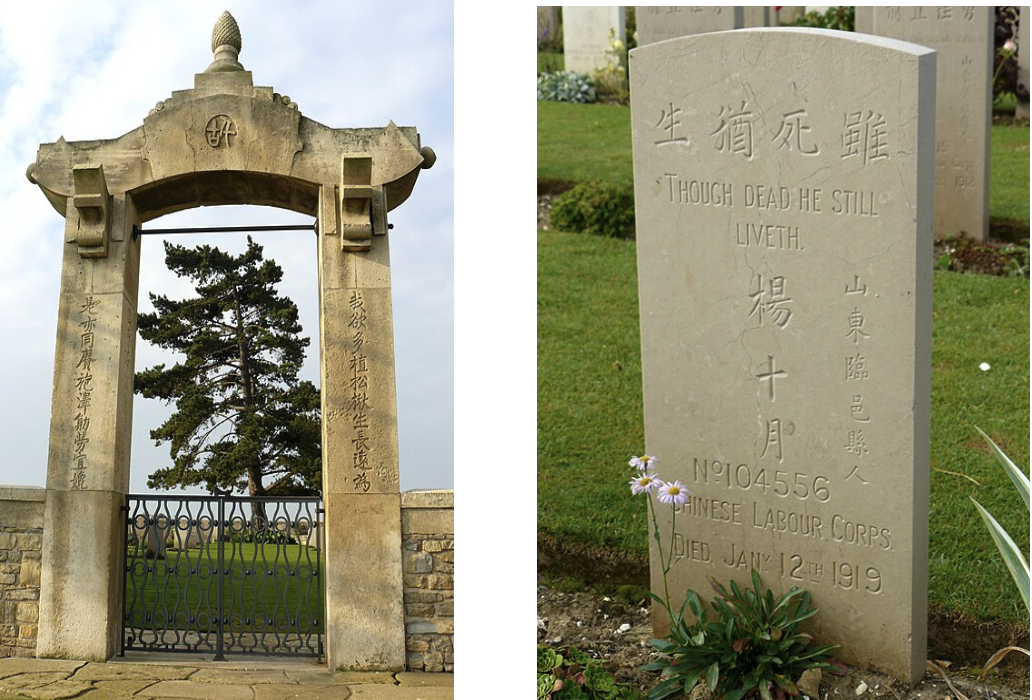
A Chinese memorial gate at Nouvelle, and CLC headstones at Noyellese-sur-Mer. —Wikipedia
On a glorious spring day in April, we attended an Old Cemeteries Society tour of the William Head cemetery which is now tended by prisoners. Alas, there was to be no picture-taking, our cell phones and other metallic personal articles having had to be surrendered at the Admissions office.
The CLC graves are unlike the others, being slabs of concrete with one end raised. There are no names. Fortunately, these have been listed on a memorial in recent years.
The cemetery at the water’s edge is idyllic. Let us hope that these men, so far from home, their worldly labours done, do indeed enjoy eternal rest. God knows they’ve earned it.
