
"Bulldog" Kelly
Had Friends In High Places
(Conclusion)
Alleged murderer Mr. Kelly, it seems, wasn't just an ordinary desperado; he had friends. Important friends. And when they were through pulling strings, creating smokescreens and calling names, B.C. authorities were sorry they'd ever heard of the leering Irishman.
Despite the able and determined efforts of Deputy Attorney-General Paulus Aemilius Irving, assisted by Constable W. McNeill, provincial authorities were stalled at every turn by Kelly's influential allies.
It took seven bitter, aggravating months for the Canadians to even bring Kelly before U.S. Commissioner Spencer in St. Paul. Irving, used to the more polished ways of the British judicial system, couldn't understand the American lack of co-operation and sympathy. After all, Kelly was charged with murdering an American. And didn't B.C. offer concrete evidence and concrete witnesses, such as Harry, the guide?
When, despite their every effort, Kelly's friends couldn't damage Harry's testimony, Commissioner Spencer ordered Kelly surrendered to the Canadians.
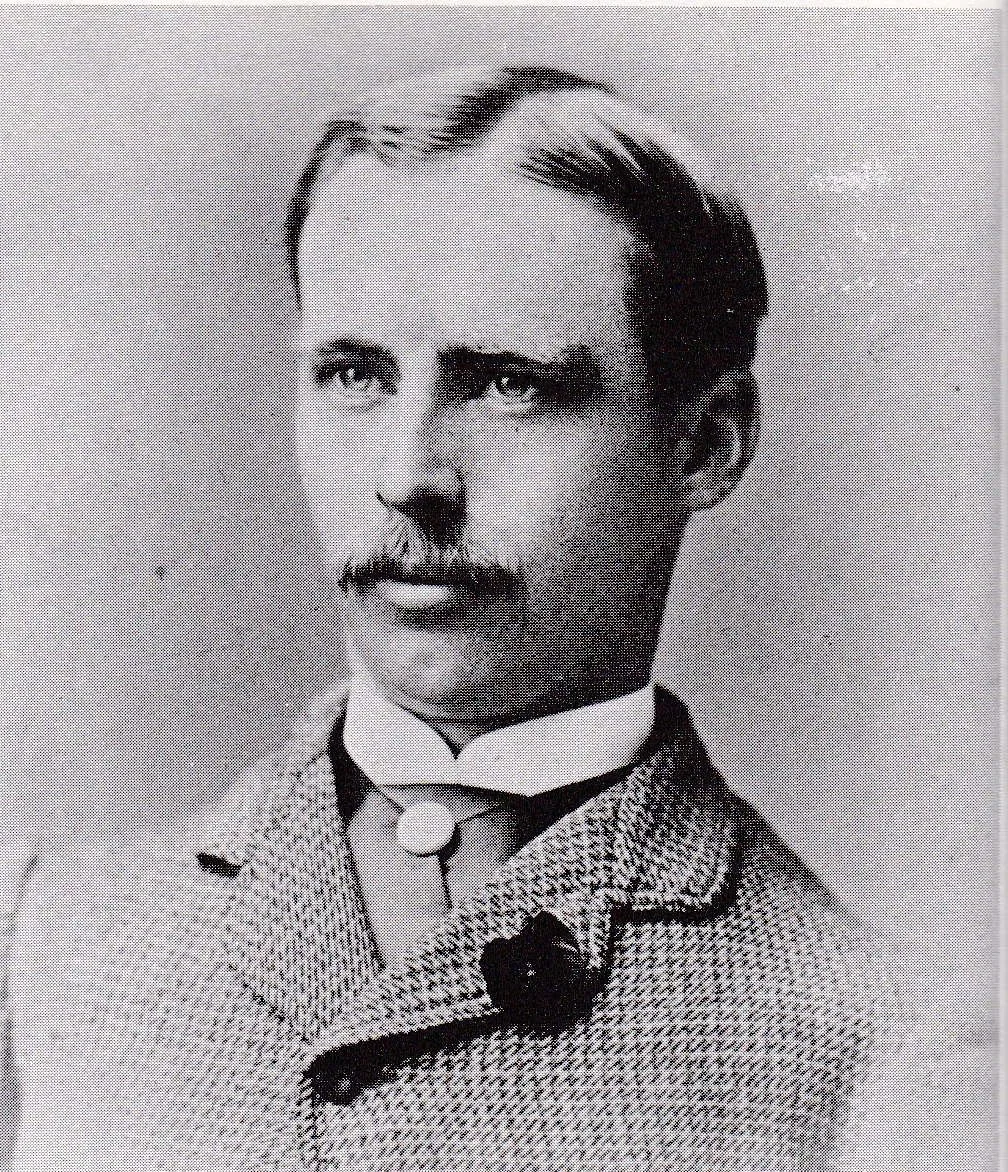
Deputy B.C. Attorney-General P.A. Irving led the legal battle for Kelly’s extradition from his Victoria office
Undaunted, Kelly's lawyer "Big Tom" Ryan caught the next train to Washington, D.C. His intention: Nothing less than a meeting with the Secretary of State Thomas F. Bayard. The new strategy worked: another month dragged by with Ryan deftly manoeuvring and stalling every move the Canadians made.
Raged the Colonist: "The refusal of Washington authorities to make the order for the extradition of Bulldog Kelly does certainly not indicate the existence of that reciprocal feeling which the province has always manifested in assisting the U.S. to bring fugitive criminals to justice.
"In no civilized country is the laxity of its laws so noticeable as in the U.S., where the law's delays too often end in their final evasion. Whether the prisoner Kelly is innocent or guilty, if is evident to all those who have read copies of the deposition of witnesses in the case that there is ample ground to warrant the order for the prisoner's extradition. The fine scrupulousness displayed in this sentence by the American authorities would almost incline one to the belief that extradition on a charge of murder to B.C. meant the prisoner's subsequent conviction of the crime.
"The attitude of the province in these matters displays a striking contrast to that of its powerful neighbour.
“Our local governments have invariably proved themselves as indefatigable in detecting and arresting extraditable fugitives from the States as if the law had been outraged in our own country; thereby observing the true spirit of the treaty—to expedite the administration of justice apart from the consideration in which of the two countries that justice was contravened."
The editors drew scathing attention to the case of a murderer named Morgan who'd been swiftly handed over to the U.S. Which was as good a time as any to draw Montana's attention to the fact it still owed B.C. for legal costs!
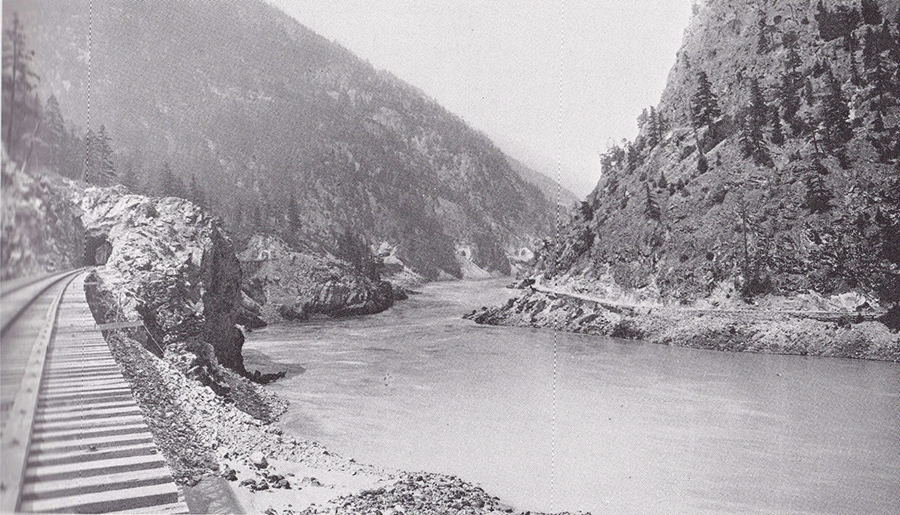
Lower Kicking Horse Canyon, B.C. 1880-1900, showing five railway tunnels. It was in this general vicinity that Kelly ambushed the three men and made off with $4,500.
The editorial concluded with the final remonstration: "...It would be well for [U.S. authorities] to ... recognize the rights belonging to Canada as a party to the existing treaty, and facilitate, not obstruct, a country whose only fault(?) may be that in the administration of justice she is more tenacious in effort, a lesser respector of persons, quicker to try, as slow to condemn, and swifter to execute than any other constitutional government on the American continent."
Finally, Washington was moved to action—but not of the kind B.C. was hoping for.
Instead, convinced by Ryan's gilt arguments, the extradition order was quashed. Stunned but not beaten, Irving's squad immediately countered with another affidavit, this time that of Manvel Drainard.
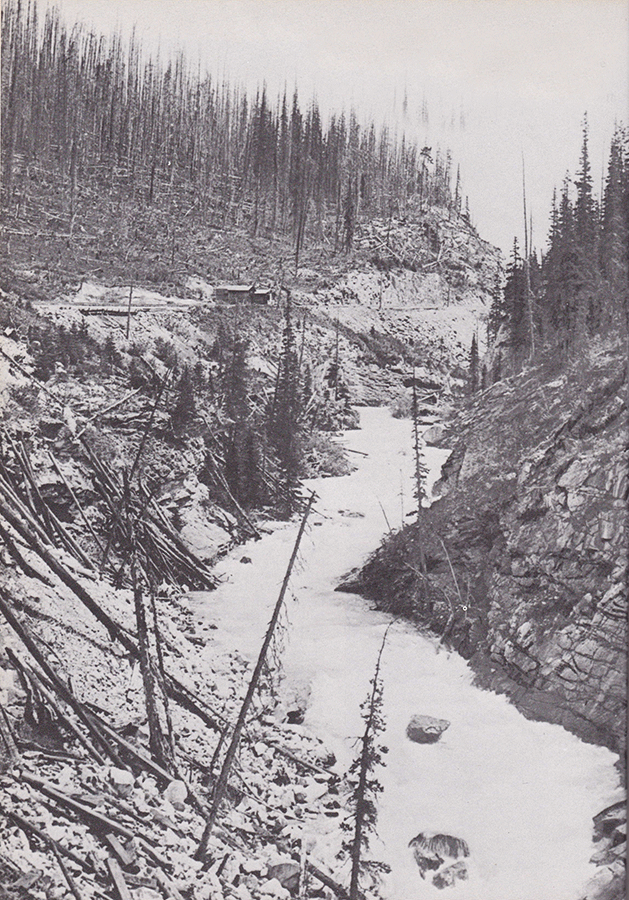
Kicking Horse Canyon
Once again, the Canadians went before Commissioner Spencer, and once again he heard Ryan's tirades and writs of habeas corpus. And once again the weary commissioner accepted B.C.'s case, committing Kelly for extradition. Jubilant with victory at last, Irving and his witnesses headed home, leaving the constables to follow with the prisoner.
This time it had been Ryan's turn to express amazement. He and his two colleagues had constructed what he considered a perfect battery of nine defence witnesses—"four to, prove an alibi and five to impeach the veracity of the witnesses for the Crown.
"These witnesses for the defence had been, in November, 1884, engaged on the construction of the CPR, and in Kootenay district it would have been easy to show the reputations they had earned for themselves, but at St. Paul it was not open for the prosecution to do so. All the prosecution could do was to show by the inconsistencies in their evidence that their story was not worthy of credence. This was undertaken by the prosecution, and, as the commissioner has committed the prisoner, we may presume it was attended with success."
The Colonist ended with a last complaint: "The proceedings were conducted with a licence that would not be tolerated in a magistrate's court in this country—the prisoner enjoying a cigar and conversing with his many sympathizers."
For all that, "towards the close of the case, it was evident that the long strain on his nervous system was beginning to tell, and once the court had to adjourn on account of his ill health".
Then, for the province, disaster. Ryan returned from a second visit to Washington with a final decision—from President Grover Cleveland himself. It was a long story of backroom politics; apparently Ryan had told the president of Kelly's past good work for the Minnesota Democratic Party. Not to mention the fact he was as Irish as the Blarney Stone.
At that time, when rebellion raged in Ireland, the Emerald Isle population of the U.S. had a loud and strong voice, election-wise. And they backed compatriot Kelly to a man. It would be politically unwise, advised Ryan, if Kelly were turned over to the barbarous British in Canada.
The Irish might not have been so loyal to Kelly had they known he was born Edward Loughlin—in Illinois.
At least this was the devious plotting as deduced by the angry British Columbia authorities.
Whatever the case, Kelly was now a free man.
Said the Bulldog: "It is good news...l have no idea as to whether the Canadian authorities will carry the matter further, but I don't propose to stand any more of it. It is a persecution of the worst kind, and ought to stop right here. I've been in confinement eight months for nothing, as the decision shows. The stories of my being well supplied with money are not true. I had $10 when I was arrested, and with the exception of $100 paid Mr. Steenerson for me, that is all the lawyers have received for my case. If the Canadian authorities push it further, I'll bring up stronger evidence than shown yet."
Moaned the Colonist: "Money and political influence have been too potent, and Kelly is now treading the firm soil and breathing the pure air of a country where all are free—free to make justice a travesty, to treat murder as a joke, and to turn a criminal trial and sentence into a mockery—if they do but possess the subtle key to the necessary mechanism...
"Kelly may be legally free, but he goes forth with a red stain on 'his conscience, if he has any, and with a liberty that is conditional upon his never placing his feet upon British soil. Until then his crime rests between himself and his Maker. As it is, the U.S. is responsible...for prostituting its freedom by wrapping its flag around the body of a prima facie murderer..."
The St. Paul Irish Standard editorialized back: "Kelly, the accused, remained for a considerable time in the northwest after the murder, unmolested, and it was not until he had crossed the line into the U.S. that the bloodhounds of the so-called British justice, true to the instincts of their bloodthirsty ancestors, came in pursuit, endeavouring to trample down every vestige of justice and fair play in our midst, and drag the object of their enmity again into their kennels and consign him, as many an honest Irishman has been consigned before, to an ignominious death on the scaffold whose bloodstains, like the blood of Abel, cry aloud for vengeance on the cowardly curs who have so often besmeared it with the heart's blood of the bravest and true.
The Canadian government has already spent $30,000 on the case through the instrumentality of a corduroyed, tight pants dude of a lawyer they sent here, who knew well that the guilty party was not Kelly."
Whew!
Bulldog Kelly drifted back into anonymity for the next two years. His name again graced newspapers from Minnesota to B.C. when it was reported, in January 1888, that he'd been lynched for unstated activities in Colorado. This, however, was but "a case of somebody having been 'stuffed,' as Kelly is leading a peaceful and Christian life in Massachusetts".
But even Kelly's powerful friends couldn't save him from ultimately standing before a greater bar of justice.
In April 1890, he was working as a brakeman on the North Pacific Railway. One afternoon as the freight slowed to enter Helena, Kelly ran along the cars to his post. Suddenly, he tripped, and with a scream, he fell between two cars.
Unlike his leap to freedom from another train, six years before, there was no escaping this time. When his comrades rushed back to him, he was alive but beyond help, both legs having been crushed below the knees; he died on the operating table.
And the $4,500?
Just minutes before the accident, Kelly had been chatting with his crewmen in the caboose. He'd mentioned his retirement; this was his last trip. After Helena, he was heading to British Columbia where he'd come into some money. And he'd winked at the others.
Kelly faced a hangman's noose if he set foot in B.C., suggesting that he'd cached the loot under a log or rock in the Kootenays, back in '84. And there it must be today, if time and weather haven't dispersed it, awaiting some lucky treasure hunter.
But as the police had grimly observed when chasing Kelly so many years ago: It's a big country, and rugged.
