
Jinxed ‘A’ Spelled Disaster
This evil letter appears on the maritime casualty lists with unnerving frequency.
Andalusia, Coolcha, Hera, Rosalia, Walla Walla, Princess Sophia: fishpacker, tugboat and ocean-going liner—from the humble to the mighty—each had at least two things in common: their names ended in the letter ‘a’ and each encountered disaster on the high seas.
There are those, of course, who, like the Bard of Stratford-on-Avon, believe that a rose by any other name would smell as sweet.
Yet, not so long ago, there were many among the nautical fraternity who’d have disputed this point. According to those old salts, to christen a ship with a name beginning or ending in ‘a’ was to condemn that vessel to infamy.
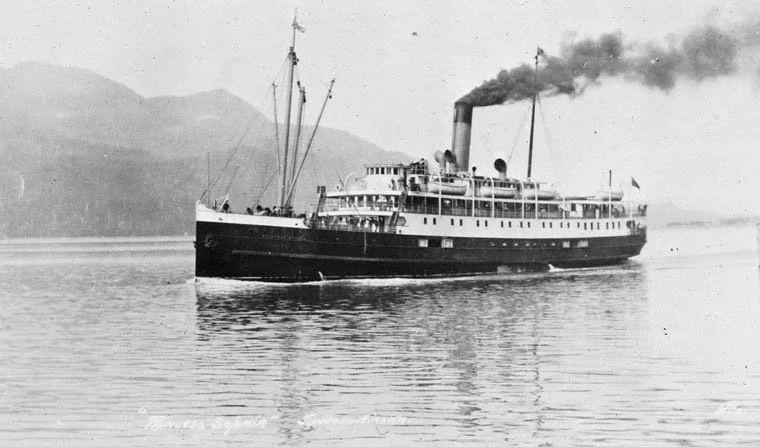
Best known of west coast ships whose names ended in ‘a’ was the coastal liner S.S. Princess Sophia, lost in Alaska’s Lynn Canal in 1918 with all aboard. —Wikipedia
Today, we might dismiss this as being nothing more than sailor’s superstition. But a glance at the record would indicate that—just maybe—there's something to this legend. In our BC waters alone, no fewer than 100 vessels have come to grief over the years, ships whose names began or ended with that initial letter of the alphabet.
On Jan. 22, 1906, S.S. Valencia drove ashore off the west coast of Vancouver Island and 117 men, women and children perished in the breakers before the American steamer vanished beneath the waves.
There have been so many others: Clara Nevada, victim of the Klondike gold rush; the ancient freighter Alpha, gale-wrecked in the Inside Passage; the sailing vessel Atalanta, whose company experienced one of the most harrowing ordeals in provincial history before their almost miraculous rescue; and the Rosalia, cast upon the rocky shores of Discovery Island during a storm.
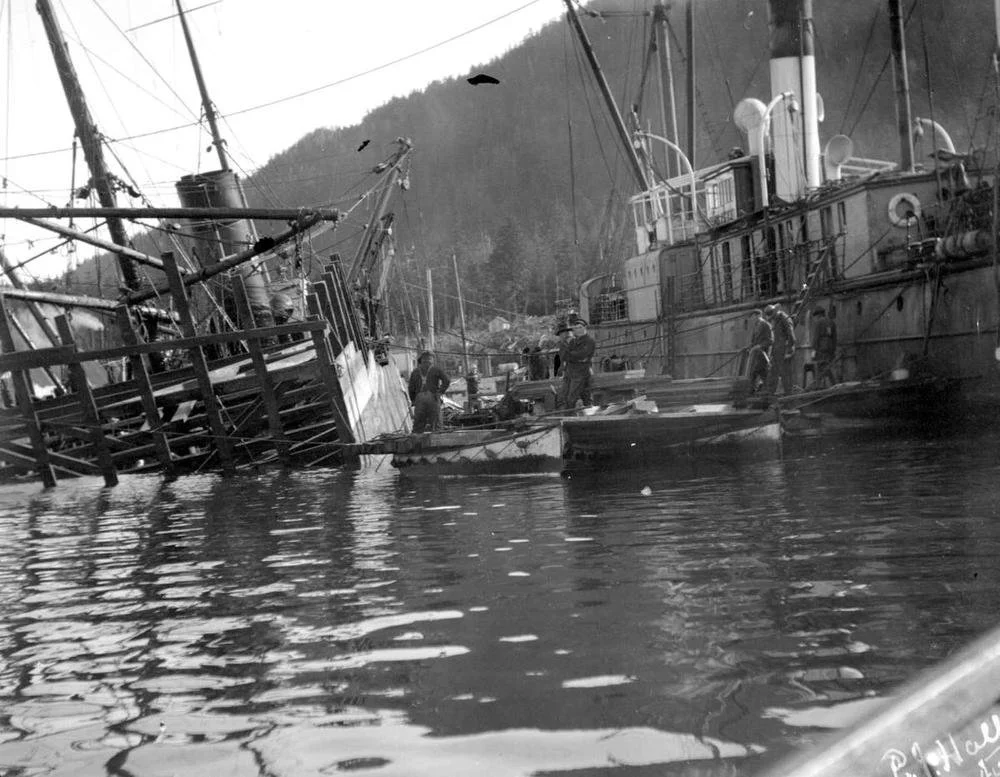
Salvors build cofferdams around the sunken S.S. Admiral Sampson in June 1918. —BC Archives
The fiery story of the S.S. Boobyalla (or Boobyall) is a standout for at least two reasons. First, it happened not on the high seas, but in Victoria’s Inner Harbour—opposite the Parliament Buildings.
You couldn’t choose a more prominent place for a ship to catch on fire if you tried.
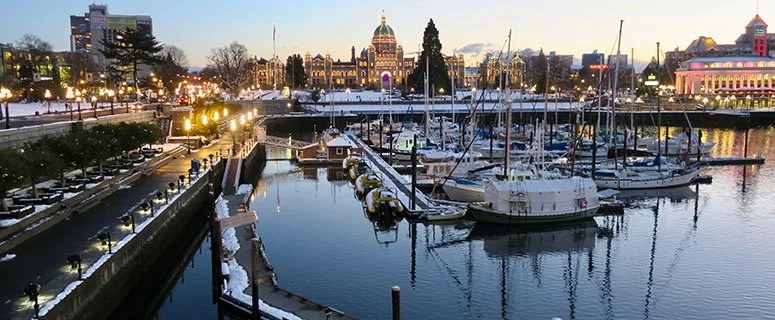
Can you imagine a more unlikely place for shipwreck than Victoria’s scenic Inner Harbour? It happened, not once but twice.— victoriabc.ca
A second aspect of this long-ago tragedy is more outstanding and the Victoria Daily Times of May 13, 1929 headlines certainly grabbed readers’ attention:
INTUITION WARNS BOOBYALL’s CAT OF COMING FIRE
“Martha” Carries Four Kittens By Neck From Engine-Room Night Before Fire
“Premonition of disaster in animals has long been recognized. Rats will leave a doomed ship before disaster comes, and other animals, warned as though by an inner sense, quit the scene of coming tragedy.
So it was that “Martha,” the motherly tabby onboard the ill-fated motorship Boobyall, left the engine-room of the vessel the night before fire broke out.
“Martha” had chosen a nice cosy spot near the motors of the ship in which to rear her litter. There were four soft, furry little kittens. And they purred and lazed in the warm atmosphere of the engine-room.
But on Friday night they had to leave their comfortable home. One by one, the mother took them by the neck, carried them up the steep companionway and out to the for’ard part of the ship. Deep among the deck-load of shingles, forward of the wheelhouse, she made another little nest, and there spent the night.
At 4:30 o'clock the next morning fire broke out with startling suddenness in the engine-room. But “Martha” and her brood were well out of reach of the flames, nestled among the warm, dry shingles.
When the Boobyall reached Esquimalt in tow of the Hopkins and the Salvage King, her kittens were transferred to a more comfortable home in one of the ship’s cabins. Since then they have quit the vessel and signed on the Salvage King.”
There’s further irony to this story. After the Salvage King, at that time the largest, most powerful salvage tug on the Pacific Coast, was lost during the Second World War, she was replaced by another war veteran which was renamed Salvage King II.
In 1948, while moored in Victoria’s Inner Harbour—likely within feet of where the ill-starred Boobyalla had been tied up 19 years before—she, too, caught fire in her forecastle. By the time the flames were extinguished, the damage exceeded viable repair and, razed to her deck, she was towed to the Royston booming grounds breakwater where her hull, still intact and identifiable, remains.
Getting back to ships containing ‘A’ in their names, the list continues. A more recent victim is the African freighter Donna Anita, which vanished in gale-whipped seas, 120 miles west of Vancouver Island in 1972. As had so many others, she shared violent death—and the jinxed letter ‘a’.
Chuckwalla, Colusa, Elisa, Nordica, Tapawinga, Wakena—that evil ‘a’ appears on the casualty lists with unnerving frequency.
Some of these vessels knew disaster more than once. The old sternwheeler Ramona, owned by the Lower Fraser River Navigation Co., ran for many years between New Westminster, Chilliwack and Ladner. Rebuilt so as to meet younger competition, she was off to Fort Langley when her new boiler exploded, killing several of her company.
The force of the blast hurtled several crewmen and passengers into the Fraser as the steamer, aflame and adrift, wallowed downstream until she came to rest on the sandbar where a bucket brigade extinguished the flames and allowed her to be resurrected.
On the ominous date of Oct. 13, 1903, she sheered off most of her upperworks, including her pilot house, when she collided with the Mission bridge. Six years later, while returning to New Westminster, she struck a snag, sank quickly, and became a total loss. She's just another of the many ships which have died miserably, in fresh and salt water, through the jinxing of her name—if one believes in superstition.
Of the Canadian Pacific's famous fleet of white ‘Empresses,’ once familiar faces on this coast, three of four lost during the Second World War were the Empress of Canada, Empress of Asia and Empress of Russia.
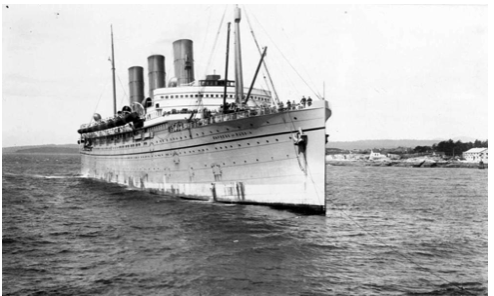
The Empress of Russia, 191-, shared ‘a’ in her name with sisters Canada and Asia—all three were lost during the Second World War. —BC Archives
James A. Gibbs, in his classic work Shipwrecks of the Pacific Coast, recounted the misadventures of another lady whose names (both of them) ended in that hoodooed ‘a’. This was the San Francisco Bay ferry Peralta, built for that once famous harbour system in 1927. All of 300 feet long and equipped with a 2,600-horsepower turbo-electric engine, the double-ended ferry operated between ‘Frisco and Oakland, when she was able to keep out of trouble.
A sister of the Yerba Buena, the Peralta boasted all of the latest innovations of design, including ballast tanks fore and aft which maintained her trim when, during loading and disembarking, passenger surged to either end of the ship. This convenience became a curse; less than a year after she entered service, the forward tank was inadvertently left in ballast. When her passengers crowded forward as the ferry approached her landing, the extra weight buried her nose in the Bay.
In the ensuing panic, dozens of passengers were pitched into the harbour, five being drowned.
Five years later, the now notorious Peralta (minus her ballast tanks) burned to the waterline, almost taking the Oakland terminal with her. This was the final straw for the city authority, which sold what was left of her to Seattle's Puget Sound Navigation Co. Rebuilt and renamed, the ex-Peralta became the distinctive silver shoe box, Kalakala.
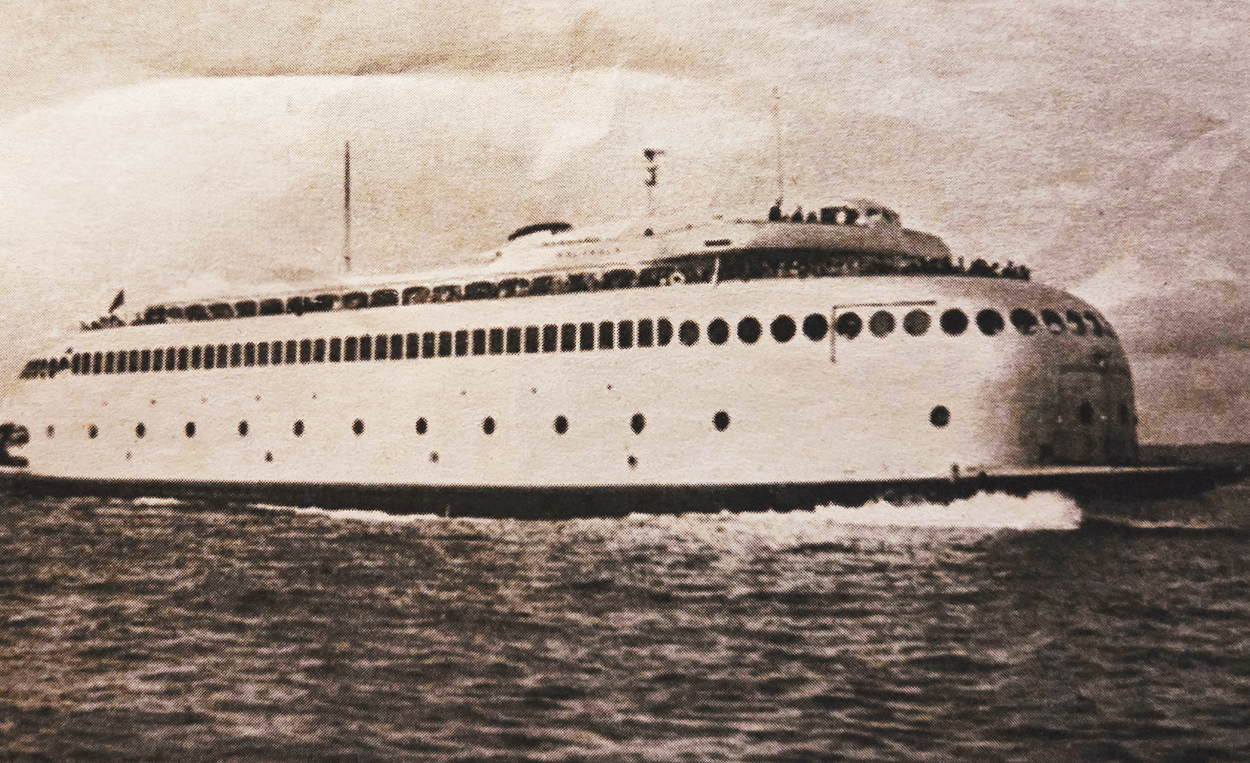
Formerly the San Francisco-Oakland ferry Peralta, the Kalakala’s name ended in ‘a’...and almost spelled her doom.
For many years the Black Ball ferry called regularly at Victoria.
Fortunately, although her new name also ended in an ‘a’, she enjoyed greater fortune as she cruised Puget Sound from 1935 to 1967. Known for her futuristic, streamlined design and luxurious amenities, she served as a beloved Pacific Northwest icon before beinguntil she was scrapped in 2015 after restoration attempts failed.
Is the letter ‘a’ really jinxed? Or is this semen’s superstition? One wonders.
