
The 1971 Centennial Air Race
I bet few Chronicles readers, even those who were around at the time, remember this Centennial event of 55 years ago.
I also bet some Chronicles readers are scratching their heads—we had a centennial in 1971? Wasn’t it in 1958?
Of course, we had a centennial celebration in 1958; that’s when British Columbia celebrated its 100th year as a province. In 1971, we marked our joining Canadian Confederation.
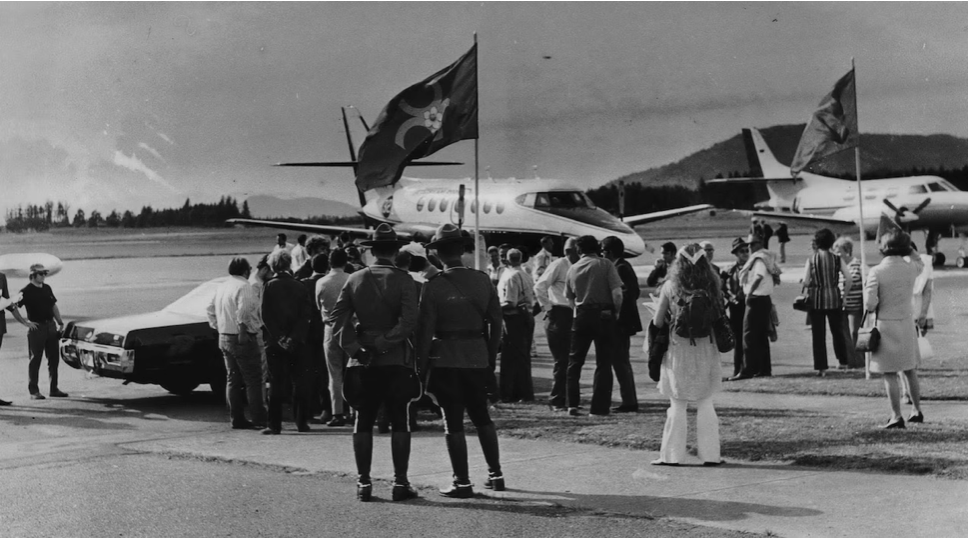
Two Royal Canadian Police watch as Roger Hannagan is put in a car at the Victoria Airport after completing the 1971 air race. —The Oregonian
How better to promote BC internationally, someone suggested, than an air race with a $50,000 first prize? Soon, the entries were coming in from as far as Germany. Competition was fierce and in one instance, as the Oregonian photo indicates, was hotly contested in mid-air.
Who could foresee that the costly and ambitious 1971 Centennial event that was meant to garner international headlines for a week, would be shouldered aside by a history-making aerial hijacking?
* * * * *
Hints of an “air race extravaganza” began with a rumour in both Victoria newspapers, the Victoria Daily Times reporting on July 8, 1970, that such an event was in the works although no official announcement had been made. But the “leak” had come from on high to the effect that Prime Minister Trudeau and Premier Bennett were planning an announcement to this effect. “Informants in England said the race would apparently be open to aircraft flying under a variety of handicaps” with federal and provincial support. “All you can say now is that it is one of the of the projects being considered,” said an apparently surprised Deputy Provincial Secretary L.J. Wallace.
Contestants would fly the north Atlantic route to Canada, then across the country under a series of handicaps for cash prizes.
It took almost two months before the July 1971 Great Air Race was confirmed by an announcement from Premier Bennett. Credit for the idea was given to ex-RCAF flyer Harry Traynor of the federal Information Canada-Expositions. It was expected that 80 “top-flight” flyers from various countries would compete in the contest being financed as part of the federal government’s $10 million centenary gift to the province.
Premier Bennett drew a parallel between the building of the Canadian Pacific Railway a century before (the key to BC’s joining Confederation) and this “very different form of travel entertainment, linking east to west. I see the air race as a renewal of the sentimental ties which join the population of this province with the rest of Canada, and with our ancestral homes across the Atlantic.”
The 5,851-mile race, said to be the third trans-oceanic, trans-continental race in history, would begin in London at 12:01 p.m., July 1st, Victoria time. (The previous contests, in 1934 and 1969, were from England to Australia.) Aircraft allowed to compete (ex-armed military aircraft were excluded) ranged from single-engine, propeller-driven machines to 30,000 pound commercial jets.
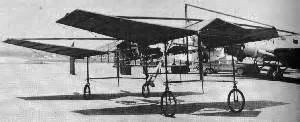
Without formal training, William Wallace Gibson of Victoria designed and built the first successful Canadian aircraft engine in 1910. His airfield, by 1971 a school and subdivision, was to be the race’s finish line.—BC Aviation Hall of Fame
The race would be run in seven stages with planes checking in at Goose Bay, Labrador; Quebec City, Ottawa, Winnipeg, Calgary, Vancouver and, finally, Victoria. The finish line was historically significant: the city’s Lansdowne area where William Wallace Gibson flew the first aircraft designed and manufactured in Canada on Sept. 10, 1910.
Participating aircraft would be categorized by computer and a formula based upon engine power, wingspread and maximum takeoff weight. Initial takeoffs would be staggered so that the aircraft would cross the finish line en masse, weather permitting. The overall winner would receive the Prime Minister’s Trophy and $50,000, and second- and third-place winners, $20,000 and $10,000 respectively. There also would be $10,000 and $5,000 prizes for first and second planes in each division, and further prizes of $5,000 and a trophy, all to be presented at a provincial government dinner.
Jack Knowland, manager of the Victoria International Airport anticipated no problems handling 80 aircraft by traffic control personnel.
Premier Bennett would begin the race by pressing a button at the Victoria Airport and technical administration would be provided by flying clubs in Canada, the United Kingdom, Iceland and Denmark.
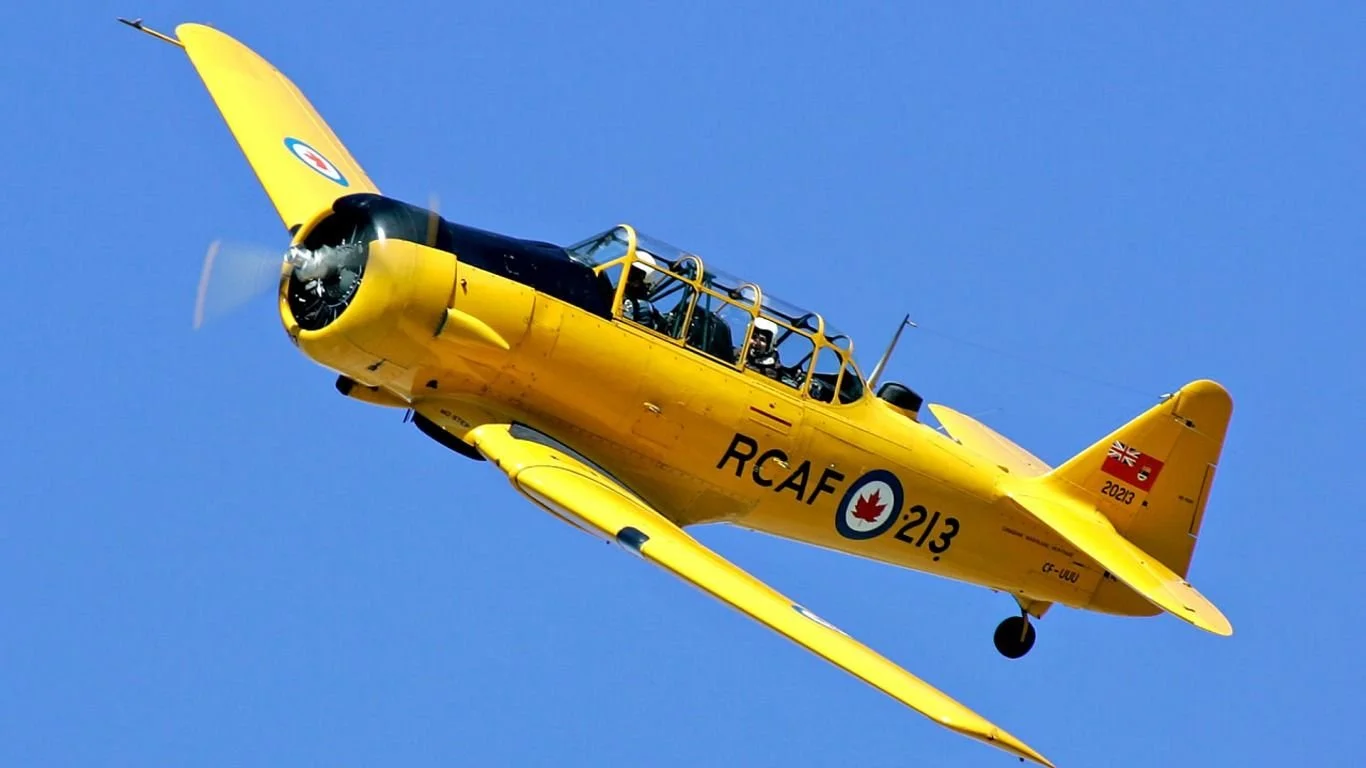
A Harvard such as the one Victorian Rick Cockburn hoped to enter in the race was the most recognizable and successful training aircraft in World War 2. —uk.pinterest.com
First to announce interest in the race were Victoria flying instructor Rick Cockburn, 24. To fly his Harvard, a Second World War military trainer, he’d have to remove the second seat to make room for another gas tank. Noel Ribout, 32, expected to fly a Piper Comanche, and Tony Bruce, 30, his own Piper Cub “if he couldn’t get sponsorship of a more suitable aircraft”. Aerial advertising photographer Roy Parrett, 51, hoped to interest a sponsor in a twin-engine “sophisticated” aircraft.
Despite so many participating aircraft having different pedigrees, it was claimed that “every aircraft will have an equal chance because of a complicated handicapping system which takes into consideration engine power, wing area and maximum take-off weight”.
The $50,000 first prize was large enough, many aviators believed, to attract professional pilots with well-equipped aircraft—but, some grumbled—favoured those with deeper pockets.
Even in 1971, aviation gas wasn’t cheap and Rick Cockburn’s Harvard, for one, burned 20 gallons per hour. Potential participants were advised that they likely were facing a minimum of $5,000 in expenses.
The Vancouver Sun thought the entire event a complete waste of money: “The dumbest, silliest and most wasteful commemorative stunt in the whole hundred years of B.C. history within Confederation that it commemorates. When the first whisper of a London-to-Victora air race was heard back in July nobody screamed in despair because nobody in their right mind believed that two supposedly mature governments would dare, after sober consideration, squander public money so recklessly.
“It was just one of so many nutty ideas offered in an attempt to remove the pall from, what is it, now—the third B.C. ‘centennial’ of one sort or another in the past 21 years?”
There was more: “For the government to disinter this Jules Verne chestnut and subsidize it with hundreds of thousands of the taxpayers’ best—the $175,000 in prizes, some of which may or may not be put up by bountiful private industry, won’t be the total cost by a long shot—was, and remains, beyond belief.”
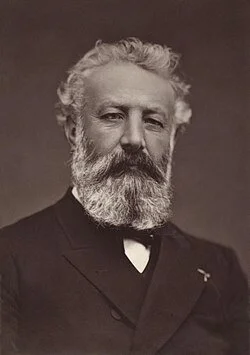
Movies have been made of French futurist author Jules Verne’s story of flight, Around the World in 80 Days, but the Vancouver Sun saw no benefit from a trans-Atlantic air race to mark the latest BC Centennial. —Wikipedia
In a letter to the Times, Mrs. Gladys A. Morton agreed, vociferously: “It is hardly possible to think of a more stupid and useless gimmick as part of the B.C. Centennial... It is staggering that the federal and provincial governments could even consider such a crack-brained idea when both are screaming poverty, hard times and restraint....”
But there were those who thought otherwise, of course, and the show went on with Saanich Council agreeing to endorse A.A. Bruce as the municipality’s official entry. In Duncan, millwright Joe Howse, 40, and plasterer Sam Koffski, 41, threw their hats in the ring by publicly seeking a sponsor for their 12-year-old Cessna 182. Between them, they’d already accumulated 1,000 hours of flying time.
By this time, the finish line had been moved to Mile 0 on the Trans-Canada Highway, Beacon Hill Park.
To fan viewer expectations, it was announced that the Royal Air Force’s supersonic jet aerobatic team, the Red Arrows, would perform at the finish-line ceremonies, and the race would include a member of the royal family in some unspecified role.
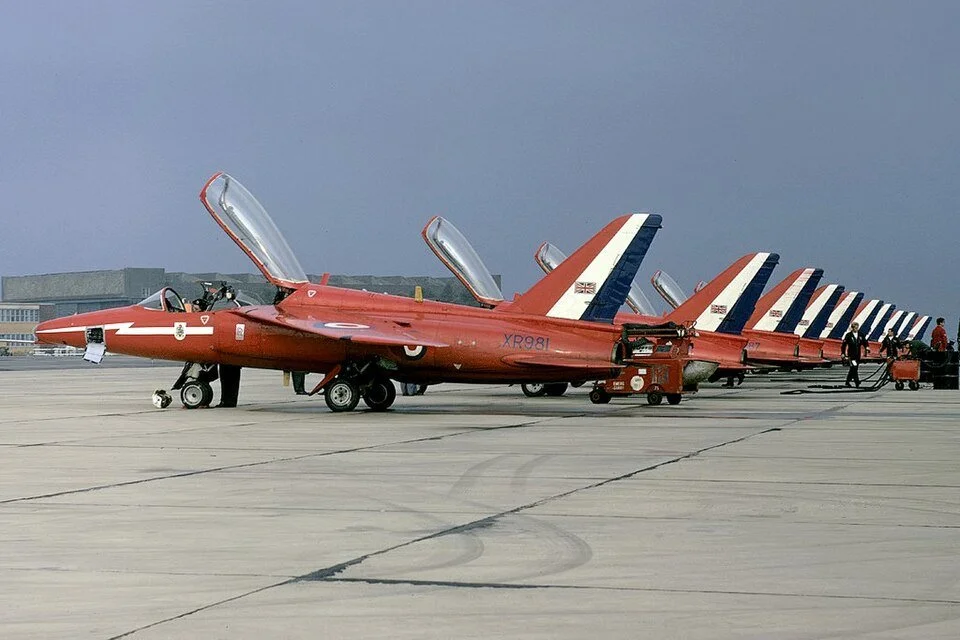
The RAF’s famous jet aerobatic team, the Red Arrows, were to join in the finish line ceremonies over Victoria. —Wikipedia
Then, in November, the first real glitch. International aviation laws allowed entrants to fly the Atlantic to Canada but, once here, stricter Canadian regulations kicked in. Aircraft that didn’t meet Canadian standards for flying in blind weather or lacked high-frequency radio instruments, would be grounded—unable to return home. The Department of Transport had been approached for a resolution to a threat that would discourage European entries.
However, by June, it was all systems go with 200 applications in, including that of Briton Sheila Scott, holder of 93 world records. And Californian Margaret Mead’s co-pilot, Frances Bera, had twice won an all-woman’s air race across the U.S. There was to be a celebrity, too, actor George Kennedy, and pilots from the Soviet Union were a possibility.
Response, in fact, had been so great that officials were now considering limiting entries to 100, depending on the number of entrants in each of the four classes.
By this time pilot Rick Coburn had teamed up with Tony Bruce to take on “an awful long trip”—up to 10 hours and 5,800 miles each way, and compounded by having to buck prevailing headwinds on the return flight to Canada. Cockburn had given up on the idea of flying his Harvard, opting instead to shop for a larger, two-engine aircraft.
Bruce said he wasn’t taking any chances, he was having a local sea captain teach him how to use a sextant which he intended to take along as a backup. They said they hoped their combined initials, B.C., would bring them luck.
But, in February, it was reported that Canadian firms were “shunning” the Great Air Race which was expected to be a seven-day event.
Only 15 had actually registered, but originator Harry Traynor said he wasn’t worried; his office had received 300 expressions of interest and most entrants in such events usually filed in the last 30 hours before deadline. He was disappointed, however, that Canadian corporations weren’t showing the same enthusiasm as American and British firms, one American entrant having received $100,000 from a tobacco company.
Although Traynor couldn’t understand why Canadian companies “kept their handle on the tills” rather than sponsor the third greatest air race in history, he was sure that aspiring pilots would overcome this resistance.
In March, Air Marshal C.L. Annis, who had wartime experience in the skies over the Atlantic, arrived in Victoria to oversee final details of hospitality, entertainment and promotion, as he’d already done in the other cities on the race agenda. He joked that any stragglers in the race were expected to make it to the government dinner “if we have to carry them here”.
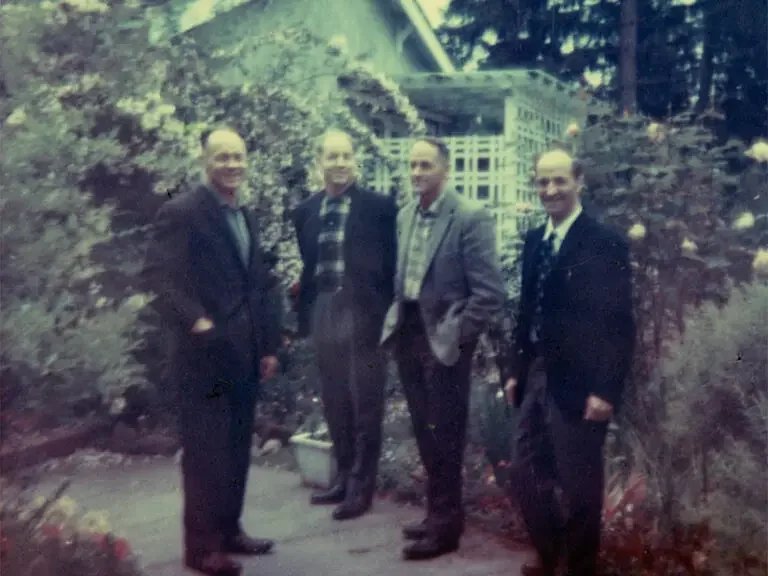
Claude Butler, left, and his brothers operated a gravel pit in Central Saanich. — www.butlerco.ca/about/history/
Of the 23 BC entries so far, only one was local: Claude Butler of Central Saanich who owned a twin-engine Aero Star 600. Again, tightfisted businessmen were blamed, whereas American companies selling soup to chocolate to cosmetics were eager to bankroll American pilots.
From Ottawa, Traynor worked to promote interest by praising Sheila Scott for her flying feats while noting that “everything she undertakes is inadequately financed and, in consequence, inadequately prepared”. He then predicted: “It’s all very secret, but my guess is that in April or May she will fly across the North Pole” and have to make “a mad scramble to complete London-Victoria arrangements.”
For a winner, he was betting on Margaret Mead, “a slick California businesswoman” who’d won the Powder Puff Derby twice.
But he didn’t discount British flyers, many of whom “have trans-Atlantic experience and are used to flying through fog banks similar to those which often enshroud Greenland and the Atlantic seaboard of Canada. Those pilots who competed in the England-Australia race should profit from past errors. Over 5,851 air miles the most important thing may be attention to detail, rather than excellence of equipment.”
But: “Let’s not forget Lady Luck. She’ll tarnish a few reputations, favour the unlikely and savour the emergence of victors who confound all the prophets.”
Just as the Vancouver Sun had trashed the race, in late March, The Victorian praised it in a front-page editorial: “Just what has to be done to get across to those who control the money markets of this country that because of either their timidity or disregard, our so-called ‘identity’ has become a saleable product, and is being purchased by Americans, lock, stock and barrel?
“The National Hockey League, our national pride and joy in the world of professional sport, is gradually slipping from our control. Canadian football, a poor cousin to the NFL behemoth across the line, is threatening to go the same route.
“Now, to a lesser degree the London-Victoria Air Race, one of the outstanding sport events of 1971, which is exclusively ours, will probably become another American victory in the competitive sports world. The reason: refusal of major Canadian business organizations to sponsor Canadian pilots and airplanes.”
American corporations, fumed the editor, were “throwing hundreds of thousands of dollars into sponsorships in an effort to guarantee that someone carrying the Stars and Stripes is first to put his wheels down on the Victoria International Airport runway, Wednesday, July 7th.”
At least the Victorian was willing to put its money where its mouth was, having agreed to help finance Rick Cockburn whose partnership had fallen through and who was back to planning to fly his old Harvard. He expected to leave Victoria on June 1st and be away six weeks.
And Tony Bruce, who’d been endorsed by Saanich Council, found that it was an empty gesture—good luck, but no money. The Saanich Chamber of Commerce flirted with offering him financial support then backed out. Leaving Bruce and Cockburn chasing corporate sponsorships with little success to date.
This, in the words of the disgruntled editor, in spite of “the fact the race is a major international event, that it is a highlight of the [BC] Centennial year and the prestige associated with sponsoring an entry alone would [be] well worth the investment”. No wonder, he grumbled, the Americans had managed to “wrest away the control of our professional sports...in the face of ‘we could care less’ attitude of Canadian industry—it must be like taking candy from a baby....”
With only two months to go before the race, the Victorian foresaw no hope for Canadian entries, predicting that American big business was going to buy what “was supposed to bring Canada, and particularly British Columbia, a little glory in 1971”.
But, what could race organizers do but press on?
(To be continued)
