
The 1971 Centennial Air Race
(Part 2)
The Sun thought it was “The dumbest, silliest and most wasteful commemorative stunt in the whole hundred years of B.C. history within Confederation that it commemorates.”
The Vancouver daily was referring to the “nutty idea” of a proposed London-to-Victoria air race to be held in July 1971 to celebrate the centenary of BC’s joining Confederation.
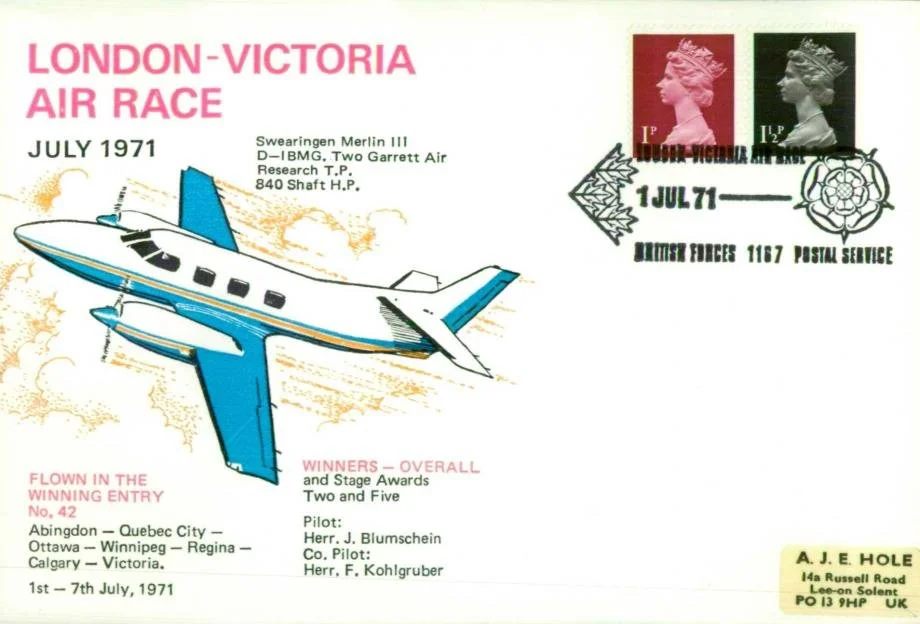
A first day cover celebrating the great air race is now a collector’s item, if it’s remembered at all.
But the organizers of the event, the federal and provincial governments, were convinced that the week-long event that would end in the skies over Victoria, would gain BC international attention.
As indeed it did, if not quite to their expectations.
* * * * *
On the positive side, they’d chosen their trophy, having awarded $1,000 to Ontario art instructor Gray Mills, the balance to be paid upon delivery. Also nailed down was the finish line which was “drawn between the Gonzales Observatory and the radio towers on Trial Island.
All going well, the first plane would arrive about 8:30 or 9:00 a.m., July 7th.
Two race officials arrived in Victoria to “iron out the nitty-gritties,” but, so far, so good. With 51 entries to date, including 22 Canadians (seven of them from BC, with Claude Butler the only local entry), 19 Americans, six British and two from Sweden, organizers were convinced that there’d be a last-minute rush before the cut-off date of May 10th, for a total of 80 aircraft. Three days later, 25-year-old local pilot Rick Cockburn threw his hat in the ring, intending to fly his Second World War Harvard Mark 4 trainer. With nine years’ flying experience, all he needed now was another $3,000 for anticipated expenses.
Even the Department of Defence wanted into the act, entering the business jet class with a Canadian Forces Falcon executive jet transport to be piloted by Lt.-Col. Bob Hallowell. Should he win the race, the prize money would be donated to the Armed Forces central fund.
Hallowell later admitted to having a personal motivation to enter the race. He wanted to “atone for the embarrassment of 1969 when a Canadian Forces Falcon jet clocked the fastest flying time in the London to Sydney air race, only to lose out because of time wasted on refuelling stops”.
Popular American author E.K. Gann (Fate Is the Hunter), the Centennial race could provide material for a new bestseller.
Another late entry was 22-year-old “Vancouver Indian” Rod Dixon with his Piper PA-23-250 and his CP Air co-pilot E.R.C. Radcliffe. Dixon’s sponsor, the First Citizens Fund, had put up $15,000 for his entry. Although an experienced pilot, Dixon admitted that he’d never learned to drive a car.
Also last-minute were “Bennett of Melbourne,” and T.D. Philips, both veterans of the 1969 England-Australia race. A third woman pilot, Irene Laverton, also of California, had joined California pilot Margaret Mead and Sheila Scott of England, both of whom were “warming up,” Mead with a 16-city tour, and Scott awaiting favourable weather to make a flight over the North Pole.
Charles “Chuck” Rathgeb, “one of the world’s most colourful sportsmen,” was going to participate in the race but not as an entry because his military jet trainer didn’t meet the race’s technical requirements.
Among the more unusual entries were the oldest plane in the race, a pre-Second World War vintage DH 90 A Dragonfly, piloted by Californian W.H. Kerr, and a Sea Prince T Mark 1, piloted by a Royal Air Fleet crew. Not to mention three members of the British Peerage and T.D. Phillips, sponsored by the Irish Sweepstakes.
As the cut-off date neared, there were 75 entries composed of four classes of aircraft:
Class A – Single-engine aircraft powered by a piston engine with maximum take-off weight of less than 5,000 pounds.
Class B – Super-charged twin-engine aircraft powered by piston engines with maximum takeoff weight of less than 12,500 pounds.
Class C – Aircraft powered by supercharged piston or propeller turbine engines with maximum takeoff weight not exceeding 12,500 pounds.
Class D – Aircraft powered by jet engines with maximum take-off weight not exceeding 30,000 pounds.
The Canadian Handicap System would be based on published performance information for each aircraft type. Handicap speeds had been established for a number of popular aircraft in standard configuration and provision would be made for meteorological conditions during the race. “The winner in each stage will be the pilot recording the best improvement over his handicap speed. He will score 100 points, with 99 points going to the runner-up, 98 points going to the third man [sic] and so on.
“Over-all winner of the race will be the pilot with the highest total points. The same process will be adopted in establishing class winners.” Jet aircraft wouldn’t be eligible for prizes other than class or special category awards exclusive to pilots of jet aircraft. Contestants were free to choose one of seven routes between the London start and Goose Bay, Labrador. After battling prevailing headwinds across the North Atlantic, they faced the potential of violent summer storms then crossing the 11,000-foot peaks of the Rockies.

Even the Department of Defence wanted into the act, entering the business jet class with a Canadian Forces Falcon executive jet transport to be piloted by Lt.-Col. Bob Hallowell.
Among those who’d greet winners at the Victoria finish line would be Prime Minister Pierre Trudeau and members of his cabinet.
In a telephone interview, Margaret Mead, who’d been flying for 10 years and made her living as a flight instructor and selling aircraft, told a Colonist reporter, “I’ve flown across the States a million times and this will be the first time I have ever flown across Canada. I’m really looking forward to it. It will also be the first time Fran [Bera, her co-pilot who had 18,000 hours’ flight experience] and I have flown across the ocean.”
Her Piper Aztec, “You’ve come a long way baby,” a subtle plug for her tobacco company sponsor, had been specially outfitted for the race with added gas tanks and special navigation aids. “Believe me, the seats are pushed all the way forward,” the cockpit as cramped as a space capsule.
She said he’d make the flight to London in easy stages—”Racing one way will be enough.”
From the steps of the Victoria Legislative Buildings, Prime Minister Trudeau would signal the start of the race by Trans-Atlantic telephone. First to take off from London would be Vancouver pilot Ron Dixon, bound for his first stop at Prestwick, Scotland. His 74 competitors would take off in turn over a period of 20 hours.
The final lineup included 28 Canadian aircraft, 27 American, 12 British, two each from Sweden and Australia, and one each for Ireland, Finland, West Germany and France. Using a computerized handicap system to determine the leaders, the fliers were to make their way across the Atlantic following routes extending as far north as Greenland and as far south as the Azores. From Quebec City they’d begin the trans-Canada stage of race, would take them to Ottawa, Winnipeg, Regina, Calgary and, finally, Victoria—a week after leaving England.
It was reported that “Virtually every plane in the field has been specially modified for the race, often at a cost of several thousand dollars. Additional fuel tanks have been fitted to give them extra range over the Atlantic. At the insistence of the Canadian government, which is financing the competition, special navigation aids have been installed on every plane.
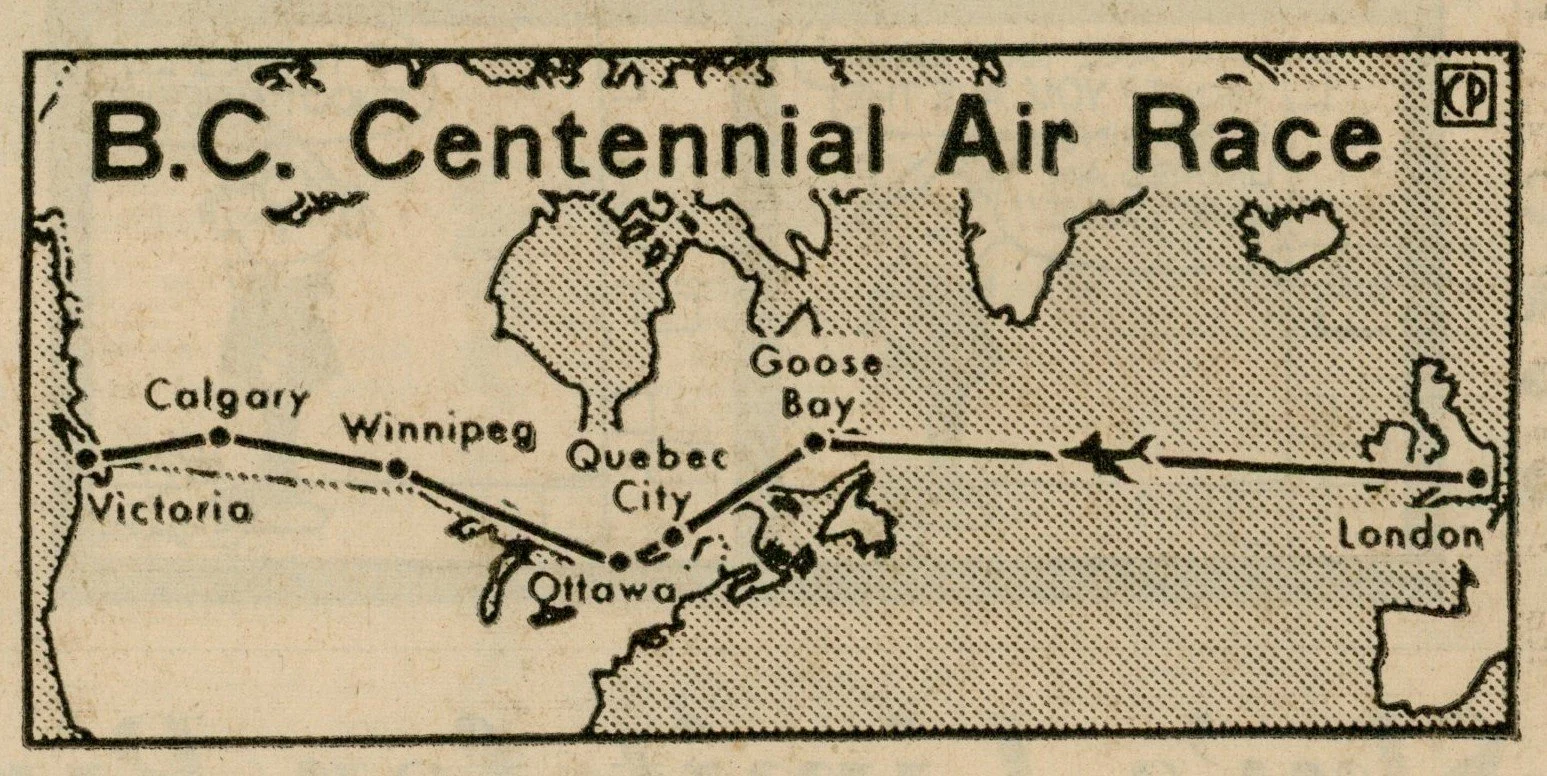
The trans-Atlantic race route looks almost easy on this simplified map. In reality, it was almost 6,000 miles long and presented real dangers for small aircraft. —Author’s Collection
“All competitors are required to carry a rubber dinghy for the North Atlantic phase of the race and to have an axe and a tent on board between the east coast of Canada and Quebec City in case they are forced down in the wilderness regions of Labrador or northern Quebec.”
Among the race’s more newsworthy competitors were the millionaire miner Charles Rathgeb (serving as a crewman on a Canadair jet trainer) “who has never before piloted anything more complex than a balloon; British author, journalist and broadcaster Clement Freud, co-piloting a PA 30 160B turbo-prop as representative for the Daily Telegraph magazine; and the Earl of Shelburne;
Canadian Bruce Fleming’s single-engine Mondaire was the only unproven aircraft in the race—a French prototype its makers hoped would become the aviation equivalent of the old family sedan. “When Fleming takes it off the ground,” it was reported, “the whole future of Mondaire will be hanging in the balance.”
It was said that even the veterans of previous trans-continental races “regard the B.C. Centennial race as the toughest of all because of the combination of North Atlantic flying—always potentially dangerous in a light plane—the vast uninhabited areas on the trans-Canada route, and the tricky 350 mile route across the Rockies.
“It’s not a course to take lightly—as Bruce Fleming’s decision to fly the race dressed in a survival suit clearly shows.”
Passing through Victoria en route to London, Margaret Mead and co-pilot Fran Bera were flying a “brand new plane and it takes about 100 hours to get all the bugs worked out”. Thanks to 15-odd sponsors, local boy Rick Cockburn planned to fly the course to London in reverse so as to see firsthand what he’d face on the return flight.
Although he’d be flying alone (his co-pilot, he joked, was an extra gas tank), he’d always wanted to “take a long flight,” and he thought the race “a perfect time to do it, safest that is. There will be lots of other aircraft around and plenty of rescue and assistance agencies alerted.” While dealing with technical difficulties, Claude Butler, the other local entrant, told reporters that he invested his time in studying charts.
Thanks to increased media promotion, the race promised to be “the most interesting event of the centennial year from an international view,” said the event’s provincial liaison officer and former RCAF flier A.G.(Digger) Dagg.
He recommended Beacon Hill Park and Clover Point as the vest vantage points for Victorians to see the incoming planes. “Before taking off for Victoria from Calgary all pilots will be briefed to fly [at a low altitude] along the waterfront in front of Beacon Hill Park after they cross the finish line,” he explained.
Upon their landing at the Victoria Airport, the public would be permitted to meet the crews at an open house before fliers attended a barbecue and watched the logging sports at the All Sooke Day celebrations.
But Dagg cautioned that summertime weather conditions could pose challenges for pilots: “During the summertime, as the day warms up, thunderheads and turbulent air develop in mountainous areas and this increases with the heat of the day.” Because smaller aircraft couldn’t fly high over the mountains, they’d be allowed to take off from Calgary before 4:00 a.m. to allow them to get beyond the Rockies before the heavy clouds formed.
Dagg expected arrivals at the Victoria Airport to be staggered over several hours, subject to navigation and weather.
A third prospective local entry, Fred Mainwood, was devastated to learn that the special radio equipment he’d ordered for his single-engine Piper Commanche wouldn’t arrive in time. “This thing hit me like a rock this afternoon,” he said. “I don’t hold an instrument rating which is mandatory for the race.”
As it happened, the radio crystals did arrive in time to be installed in his plane.
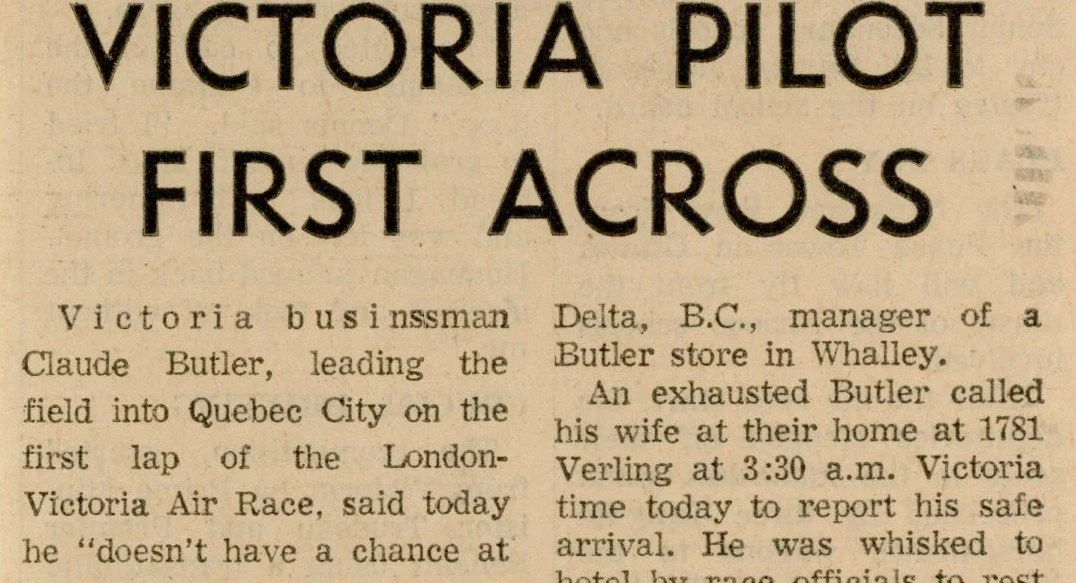
Claude Butler, who financed his own plane in the race, was a local favourite. —Author’s Collection
On the morning of June 18, Claude Butler and co-pilot Harold Assen were off, despite a last-minute jamming of his starboard hydraulic brakes. Planning to be “on oxygen” throughout the race, Butler had a final bite of his favourite dessert, lemon pie. He thought the race “a good cause—I believe in strengthening the ties between us and the old Country.”
By this time, there were 69 entries in the race which would involve 15 hours to cross the Atlantic, but total seven days with the programmed stops in six Canadian cities. A spokesman for the Pacific Rescue Station in Victoria reminded all that, “If any go down, they are going to have a tough time because it is a big hunk of water and a small plane is damned difficult to find.”
And Mae West life preservers “are of little use to anybody down in the North Atlantic because of the low water temperatures.”
Details for the official start of the race had been finalized. After a symbolic cabinet meeting in the legislative buildings and Lieutenant-Governor John Nicholson read a proclamation, Premier Bennett and Prime Minister Trudeau would make short speeches then announce Take-off via a trans-Atlantic telephone hookup.
It was then announced that Central Saanich’s Claude Butler would be the first pilot off the mark in London.
Finally, after a year of publicity and preparation, they were off!
Within hours, two aircraft were out of the race. One had to crash land on a Greenland ice floe, the other, out of fuel, was forced down near Goose Bay, Nfld. Fortunately, there were no injuries and both crews were rescued by helicopters.
But their misadventures paled alongside that which occurred at Prestwick, Scotland.
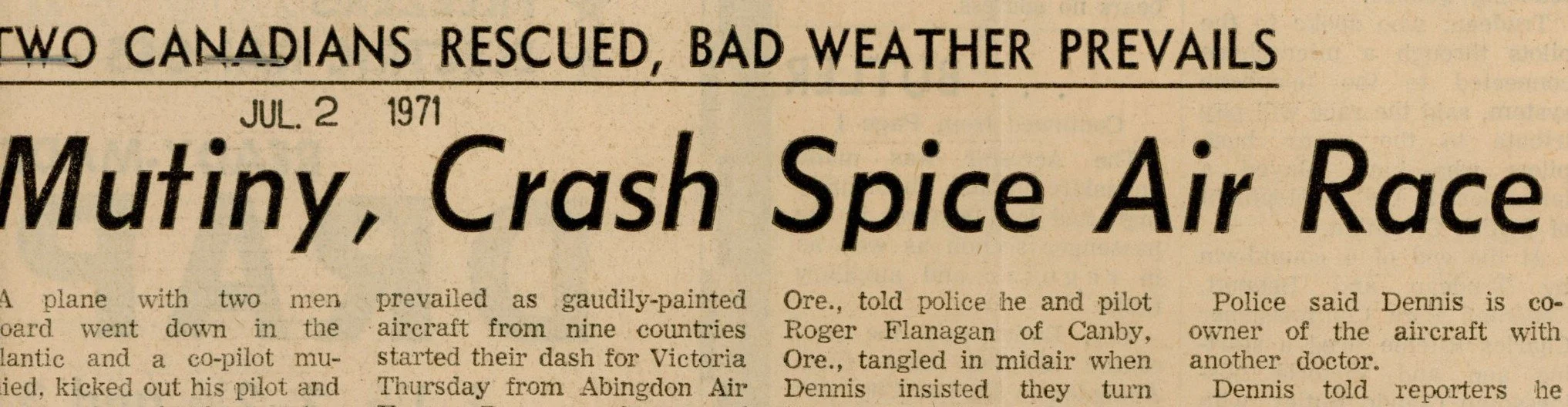
Race organizers wanted international publicity—but not this! —Author’s Collection
(Next week, the conclusion to the Great Centennial Air Race.)
