
The 1971 Centennial Air Race
(Conclusion)
“Any way you look at it, we just shouldn’t be here.
“We should be a little cloud of smoke somewhere between Thunder Bay and Winnipeg...”

The Canadian Armed Forces entry raced in style, in a Falcon jet. —Wikipedia
Race participant Timothy Philips was telling reporters how close he and co-pilot Vyrell Mitchell had come to disaster. It was nothing less than a miracle, he said, that their plane hadn’t blown up.
His tale made hardly a blip in the news. Neither did the aircraft that was forced down on a Greenland ice floe, its crew having to be rescued by Danish helicopters. How could they compete with real drama, a fight between two pilots that left one of them bloodied on a Scottish tarmac while the victor, thumbing his nose at being disqualified, calmly took to the air, bound for Victoria, as if nothing had happened?
* * * * *
MD ‘Went Completely Haywire’ As Plane Was Over Prestwick, reported the Victoria Daily Times, July 3, 1971, two days into the week-long Centennial Air Race.
“Dr. Lawrence Dennis, [the] Portland, Ore., doctor who was involved in a fight during a trans-Atlantic air race to Victoria, was released from a Scottish hospital today and reunited with his wife. She made a trans-Atlantic dash to Prestwick via London to be with her husband after she heard he had been involved in a mid-air struggle with his pilot, Roger Hannagan...”
Although they’d have denied it, for the Centennial Air Race organizers who’d been dogged by criticism that their expensive event wasn’t generating the international buzz that they’d promised, they must have thought this was almost too good to be true as, much to their disappointment, of the 75 aircraft that were to participate, only 58 had qualified, diminishing the race in the eyes of many.
Osteopath Dennis, 56, and Hannagan, 22, were flying a two-seat aircraft owned partially owned by Dennis, with Hannagan as pilot. But, shortly after refuelling at Prestwick, they’d discovered that a door wasn’t properly latched. When Hannagan’s attempt to repair the broken hinge failed, Dennis suggested they turn back. Hannagan reluctantly agreed but, once on the tarmac, Dennis said he wanted a mechanic to look at the door.
This, of course, would mean more lost time—they were in a race, after all—and Hannagan balked. “I tried to grab the aircraft keys,” Dennis said. “Instead, I took a hammering.”
Despite its being dark by this time, airport officials could make out what appeared to be a scuffle in the middle of a runway, and aborted landings by two incoming aircraft. Several more minutes passed before officials received a terse call from the Dennis/Hannagan plane: “The fault is fixed.”
Minutes after they cleared the plane for takeoff on its flight to Greenland, airport workers found Dennis “sprawled in the grass beside the runway, his face bruised and bleeding and his glasses broken”. They rushed him to a hospital, as officials radioed Icelandic authorities to question Hannagan about hijacking the plane. he wasn’t answering his radio and, instead of landing in Iceland, overflew the island and headed straight for Greenland.
There was no denying, this was great press!
Alas, like so much about the Great Race, it wasn’t altogether what it seemed, was even anti-climatic. That Dennis “ended up lying on the tarmac” with a bruised eye while Hannagan again took to the sky, was accurate enough. But it was Dennis’ fault, Hannagan would later tell reporters, for having kicked him, and his “natural reaction” was to punch him back.
At which, he declared, Dennis had given him his blessing to continue the flight alone!
All this had overshadowed the drama of Australians Ron Bennett and Brian Float who’d run out of fuel and been forced down in heavy rain and fog near Goose Bay, Nfld. On a happier note, all but two of the remaining contestants (said to be resting overnight because of pilot fatigue) had arrived safely at Quebec City, with Victorian Claude Butler leading the pack in his twin-turboprop Aerostar.
Based upon the complicated handicap system devised for the race, J. Blumschein, 42, of Meinerzhagen, an aircraft machinery executive from West Germany, was in first place in the first leg of the race with 1,147.74 points in his Swearingen Merlin II. Second place was held by W.J. Bright of Bristol, Eng., in his Jetstream 200; followed closely by T.D. Phillips of Wicklow, Ireland, in his twin-engine Piper-Twin Comanche. Mrs. Louise Sacchi, in eighth place, was leading the women in the race, favoured Margaret Mead having had to make a detour because of fog like “soup”.
The leading Canadian, in ninth place, was Coquitlam’s R.J. Rutlege in a twin Piper. There was no mention of Victorian Rick Cockburn and his Harvard trainer, a matter of concern because most of the aircraft had reported having “two, three, five minutes” of fuel left while trying to find the airport in thick fog.
Professional airline pilot Doug Ireland of Mission, BC, had had a particularly close call in his prewar Howard DGA-15 because he “zigged when he should have zagged in one of the Greenland fjords”. No details were given.
Ironically, BC’s official entry, R.B. Dixon of Vancouver, a professional pilot, had been scratched when he failed to make it to the starting line at Abingdon, Eng., after being delayed by bad weather en route to England.
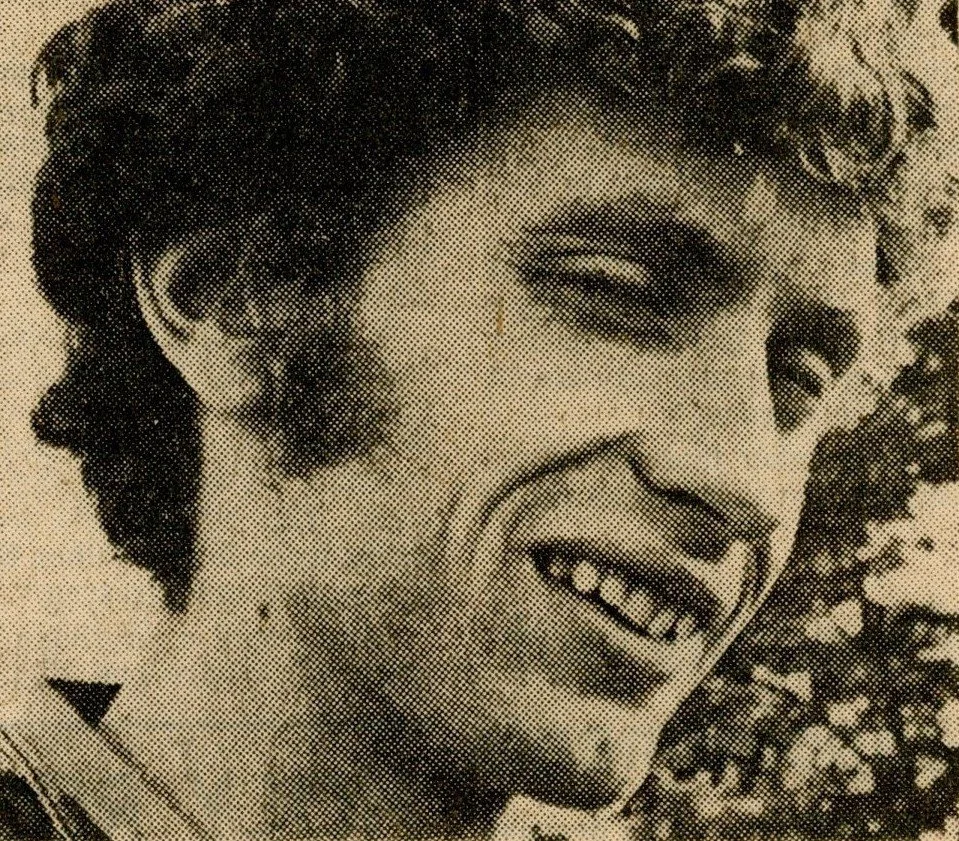
‘Punch” Hannagan was bitterly denounced by some of the race contestants for having, in effect, stolen their show with his fists. —Vancouver Sun
In the same July 4th news account, it was reported in a single sentence that Roger Hannagan, who’d landed in Quebec, had been declared ineligible to “participate in the last four days of the race”.
Disqualified because he and his flying partner had come to blows? No, because he’d “changed the composition of the crew without giving race organizers one hour’s prior notice!” Hannagan’s explanation for the crew change was that Dennis had stayed behind in Prestwick “because of sickness”. A slight sign of official displeasure did creep into one official’s comment that “under no circumstances” would Hannagan be reinstated. “He has clearly violated one of the regulations of the event.” (Not to mention that his taking a plane that wasn’t his could be viewed as theft.)
But Hannagan held in, unwilling to “bag it halfway through”. As for his new co-pilot, “she’s doing quite well, really. She’s one of the best chart-readers I’ve ever had experience with.” As for the chances of a petition drawn up in Montreal for his reinstatement, he shrugged, “It was a decision of the judges and at least we’ve been luckier than some. We’re not in the drink at Goose Bay or Greenland.”
In Ottawa, he’d borrowed enough money to complete the race, even though he was doing so unofficially. While attending a party given for race entrants, he met pretty blond Francine Johnson, 22, of Montreal, and invited her to accompany him to Victoria as his teammate. Asked her age, the office worker who had no flying experience replied with a smile, “old enough to know what I’m doing”.
By this time, some 3,000 miles later, some of the entrants were complaining that the handicap system was unfair as it was based on a plane’s performance in relation to its known cruising speed. Complainants cited husband-and-wife team Grad and Jill Davidson from Toronto who were the first to land in Ottawa in their Canadian-built turbo-Canadian Beaver which had been handicapped at a speed at least 30 miles an hour slower than it could actually attain.
Victoria’s Rick Cockburn who’d flown the route both ways, a total just shy of 12,000 miles, thought the opposite was the case, that his plane had been rated at a speed it couldn’t possibly attain. Meaning that he couldn’t qualify for any of the prizes.
But a race official defended the handicap system as the best that could be devised given the differences in the aircraft: “You can’t take up every aircraft and test fly it under numerous conditions to determine its exact cruising speed.” This was later expanded upon by a judge: “Race authorities used the best advice they could get, including instructions from the Royal Aeronautical Establishment, and the handicaps are essentially the same as those used in the successful Britain-Australia air race in 1969.
“It is important to remember that the complainers are very few. We must assume that the handicapping is satisfactory so far as the vast majority of the competitors is concerned.”
So J.H. Blumschein remained in the lead with his near-perfect 295 points.
As if to prove how complicated the system was, Claude Butler who’d been the first to take off from England and the first to land in Canada, was actually in last place. He explained with a grin that he and co-pilot Harold Aasen were required to fly at 26,000 feet. It took them three-quarters of an hour to achieve that altitude, and the same amount of time to descend in their twin-engine plane.
“That’s what’s killing us,” he said. But it’s a wonderful event. We don’t care if we wind up last or not. We’ve had our money’s worth.”
—The Daily Colonist
All of the aircraft had had to battle heavy headwinds before they put down in Winnipeg, by which time Blumschein, for all his points, was in third place. He said that at 300mph, the turbulence had been so fierce that his hands were still shaking.
For the Tutor jet acting as race pathfinder, Winnipeg was the end of the game after an attendant’s handkerchief was sucked into the engine. “A 10-cent handkerchief blew out an $85,000 engine,” grumbled an official. “He [the attendant] picked a hell of a time to have a cold.”
Just Regina and Calgary stood between the “53 magnificent men in their flying machines” and Victoria. But, with just two days to go, they were advised that they could expect “really poor” weather conditions as far west as Penticton and would have to rely upon their instruments until they got past the Kootenays.
As it happened, weather was so bad—thunderclouds, hailstones, rain, fog and icing—that the final lap of the race was postponed for 12 hours. Officials expressed concern that the planes would arrive in Victoria after dark. In a curious twist, “Joe” Blumschein, who’d actually increased his lead by flying above the turbulence, temporarily lost it to a computer error that dropped him to fifth place.
Victoria, of course, was experiencing sunshine and light northwest winds.
Then Roger Hannagan hogged the news again, it being reported that he’d had to make a forced landing on a dirt road in Saskatchewan. His door—the one that provoked fisticuffs between him and Dennis—had come loose again. From a nearby farmhouse, he borrowed some tape, secured the hinge and resumed his flight to Calgary where he was able to make more permanent repairs.
Australians R.P. Bennett and Brian Floate, who’d run out of gas and had to crash land in the Newfoundland bush, were continuing the race to the Victoria finish line, courtesy of the BC Government.
Barely making the news was a report that Dennis Dalton and co-pilot Allan Ramsay of Australia had averted disaster “by about a foot” when about 15 inches of a propeller blade broke off on one engine of their Beechcraft Travelair. “We were very lucky,” said Dalton, a former airline pilot. “If another foot had broken off the whole engine would have been shaken off.
“The vibrations were pretty severe...but we feathered the engine and landed okay.”
First across the Victoria finish line, two hours and 40 minutes from Calgary, were Jill and Grant Davidson of Toronto in their Turbo Beaver. He praised his Canadian designed and built plane. “About the only thing not Canadian in the plane was my wife who was born in Glasgow, Scotland,” he joked.
To no one’s surprise, Joe Blumschein and his co-pilot Fritz Kohlgruber had the highest points. Soft-spoken, portly, and immaculately dressed in a brown sports jacket and knife-edged slacks, Blumschein gave no impression that he’d just completed almost 6,000 miles in a week under often gruelling conditions and modestly attributed winning to “a bit of skill and a lot of luck”.
His plane showed what it had been through, however, battered as it was by one-inch hailstones. It was like being machine-gunned, he said. But their Texas-built Swearingen Merlin III had withstood all: “We didn’t even have to tighten a screw all through the race.” He was looking forward to going home to his wife and two children.
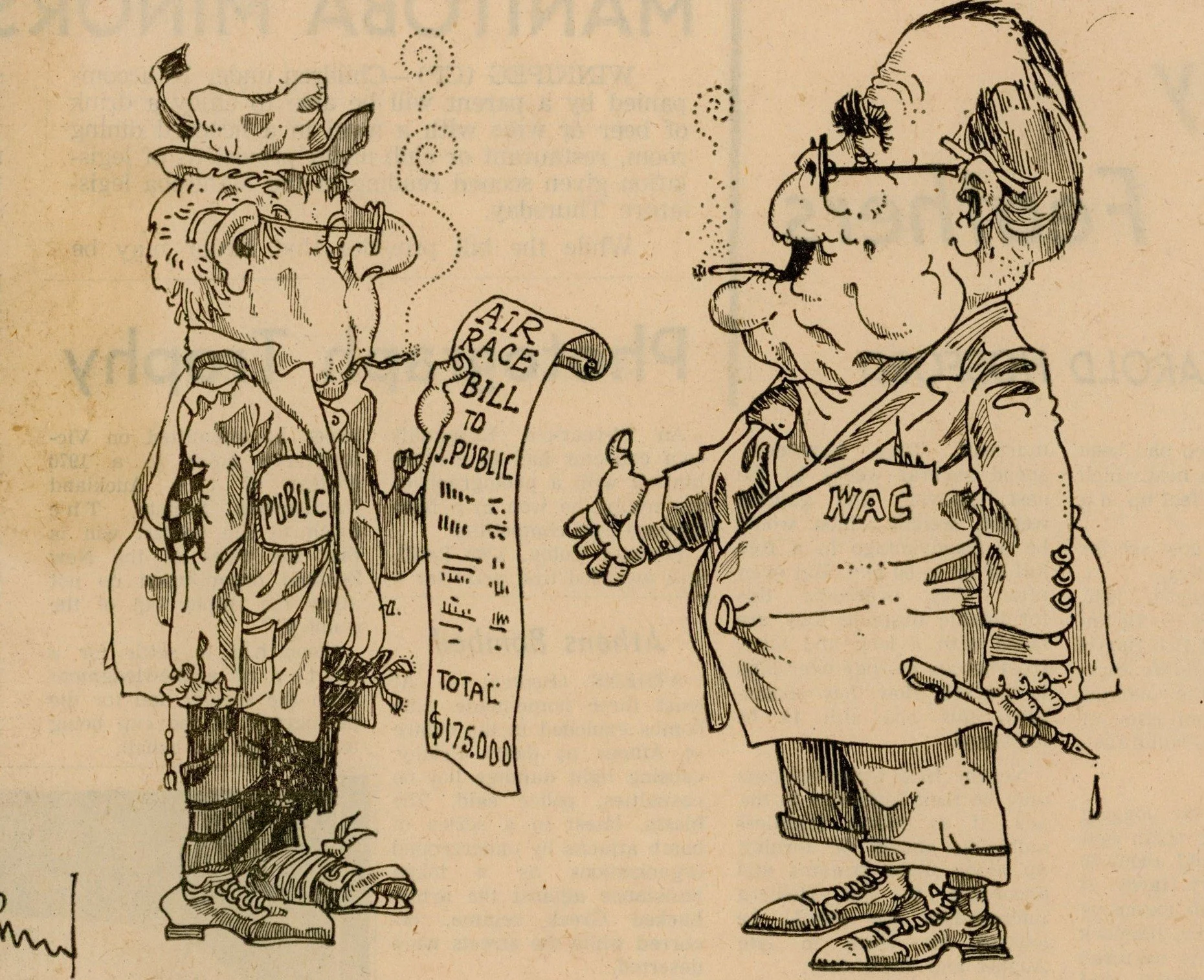
Presenting a bill for the Centennial Air Race to a taxpayer, Premier W.A.C. Bennett says, “Now...in all fairness...wasn’t it fun?” —Victoria Daily Times
Among the estimated 1,000 well wishers who greeted incoming aircraft was Roger Hannagan’s regular girlfriend, Toots Johnson. Coincidentally, she shared both her six-foot-six boyfriend and her surname with his Montreal navigator, Francine Johnson. Asked if she were jealous, she said, “not insanely,” because she knew he liked girls. She also knew he had a quick temper, saying she wasn’t surprised that he’d decked Dr. Dennis.
As a final flourish, the disqualified Hannagan “made a low pass over the [Victoria] airport...at 200 miles per hour to show off a little bit”.
But he wasn’t quite finished. Still arguing over his disqualification, he presented organizers with a letter, purportedly signed by a bruised and bleeding Dennis on the Prestwick airstrip, which read: “This is to certify that I give my complete approval for Roger Hannagan to complete the race in my aircraft.” This, he hoped, would deflect his being charged with stealing the plane.
“It wasn’t until I reached Goose Bay that I knew the police were after me.”
Earlier, Victorians by the 1000s had thronged to the Beacon Hill Park waterfront to watch the incoming aircraft cross the finish line between Gonzales Point and Trial Island. To their disappointment, not all of the contestants made the flypast, although some of whose who did thrilled the crowds by skimming just inches—so it seemed—over their heads.
While officials calculated points to confirm the awarding of prizes, there was more grumbling about how the race had been handicapped: hints that some aircraft had been modified, and complaints that turbo-prop aircraft had an unfair advantage whereas jets suffered the reverse.
Media favourite Margaret Mead who’d won several air races in the U.S., expressed mild disappointment in her placing in the trans-Atlantic contest. “If we get another chance at a race like this I think it would be a different story.”
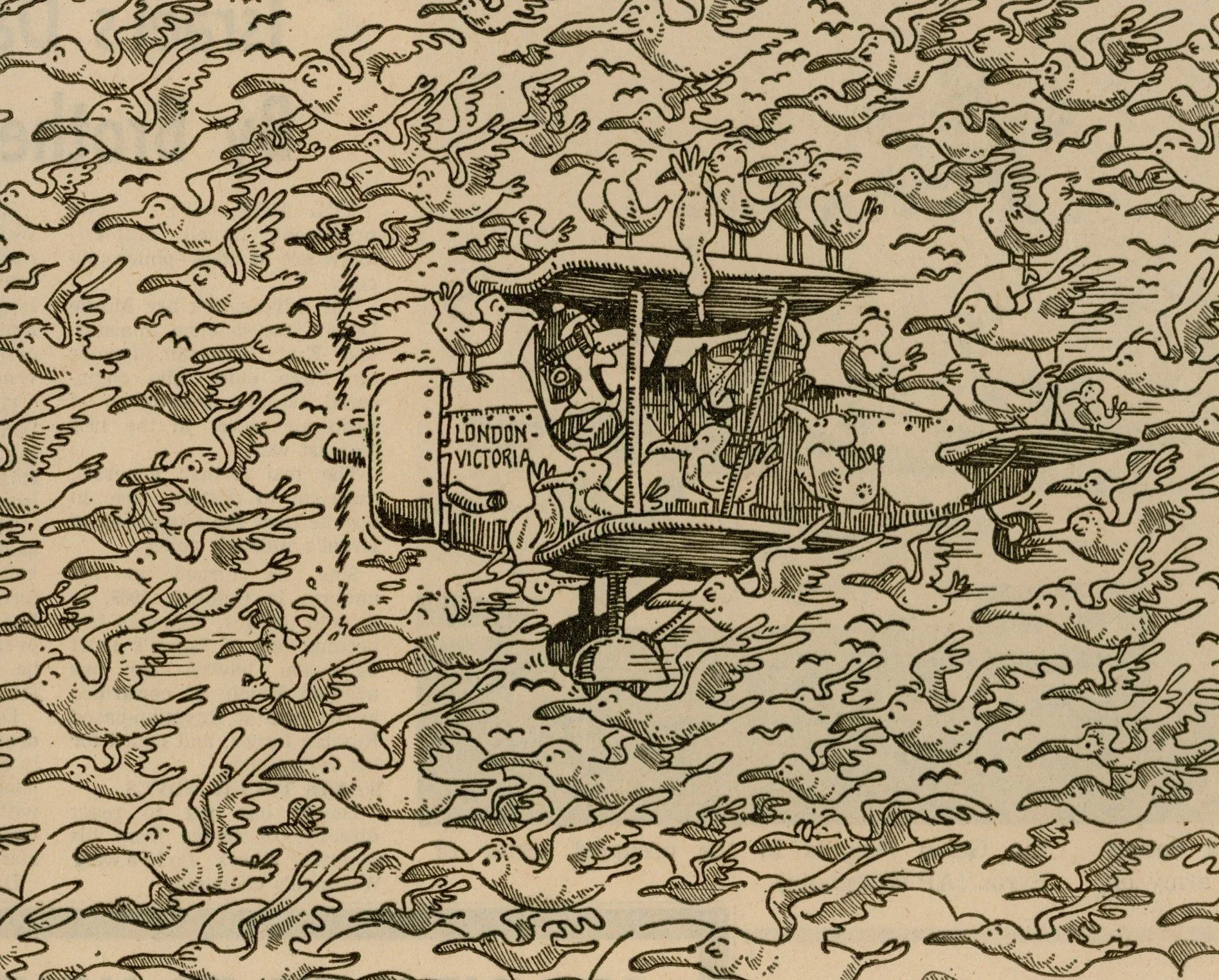
“...We must be getting close to Victoria,” a city known for its seagull population. —Victoria Daily Times
When the points were officially tallied, Blumschein and his co-pilot were the first-place winners, followed by Irish chicken farmer Tim Phillips who’d been sponsored by the Irish Hospital Sweepstakes, and Dr. J.R. Reames, U.S.A., in his twin-engine Cessna 310. Top Canadian entry was Edmonton’s J.P. Germain in a twin-engine Beech.
Grey-haired grandmother Louise Sacchi, the only female pilot flying solo who’d ferried aircraft to England during the war, received $5,000 as runner-up in the single-engine class.
On the home front, Victoria Mayor Courtney Haddock suggested that Rick Cockburn, who’d place 24th, receive the city’s highest honour for having set a world record by flying a vintage Harvard across the Atlantic. “He should be made a freeman of the city,” Haddock said. “That is an honour the city doesn’t give away lightly.”
Race winner Blumschein said that Cockburn was the man he most admired in the race for his achievement, courage and personality. “If he ever wants to work for our company, I’d hire him right away... He was one of the finest boys in the race.”
For his part, Cockburn merely remarked that he’d had propeller trouble.
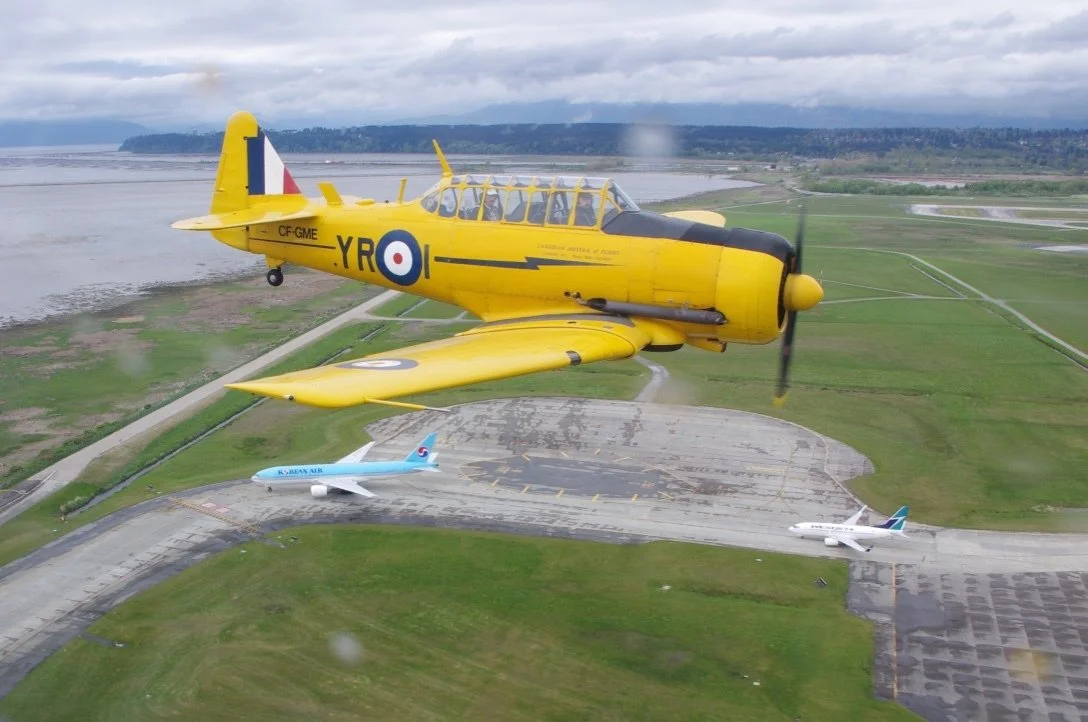
Single-handed, Rick Cockburn flew the race both ways—12,000 miles—in a Second World War Harvard such as this one. —Canadian Museum of Flight
Although he’d finished out of the money, he thought the race was fantastic despite his having had to “listen to the noise of the engine for 22 1/2 hours” while crossing the Atlantic. Others pointed out that a Harvard required a pilot’s constant attention and “has one of the toughest cockpits to work in. If you drop anything it lands at least eight feet beneath your feet”.
Central Saanich Mayor Archibald Galbraith said his municipality was going to honour its own Claude Butler, who’d received a rousing reception upon his landing at Pat Bay.
* * * * *
Months before, the Vancouver Sun had condemned the proposed Centennial Air Race as dumb, silly and wasteful.
Two days after the fanfare subsided, the Victoria Daily Times expressed its own misgivings: “...To a large number of Victorians and other British Columbians...the race failed to attain the elements of the ‘spectacular’ anticipated for it by its planners. It came too late in the rapid advance of aviation...
“This factor alone leaves much of our population wondering if the public money involved might not have been better spent on other centennial features organized and carried out with high success by local organizations...events tied directly into the centennial theme and reflecting the local consciousness of growth from pioneering days into the current era.
