
BC Train Wreck was a Casualty of the Korean War
(Part 1)
To railway history buffs British Columbia's second worst railway disaster is known as the Canoe River train wreck; to lawyers studying Canadian legal precedent, it's the Canoe River case.
Neither term even hints at the fact that it was the Korean War, then raging, that precipitated this tragedy...
* * * * *
November 1950. For the third time in less than half a century, Canada was at war, this time in Korea. This time, it was different only in that it was called a police action; but all the inevitable horrors of human conflict were in full play, and all the resources of the Canadian government were called upon to meet our commitments to the UN.
Caught almost flat-footed in peacetime with only a rump of a professional army left from the Second World War, just five years earlier, a call was put out for volunteers. Thousands responded and began training at Camp Shilo, Manitoba, Wainwright, Alberta, and Fort Lewis, Wash.
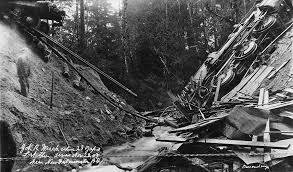
This graphic photo captures the force of the impact between the two locomotives. But it wasn’t the crash itself that killed and maimed, it was the escaping steam from both engines. At least, for the four crewmen their deaths were instantaneous. —Wikipedia
Nov. 21, 1950, 23 officers and 315 men of the 2nd Regiment of the Royal Canadian Horse Artillery were heading from the Prairies to the coast to embark for Korea, all packed into 17-car, west-bound Passenger Extra 3538. At mid-morning, having crossed into British Columbia on the CNR transcontinental mainline, it approached Canoe River, near Valemont in the Rockies and began to ascend a long, winding curve—as, from the opposite direction, the 11-car Vancouver-Montreal Continental Limited entered same the loop, on a downward grade.
As fate would have it, this 180-mile-long stretch of mountainous track was the only part of the CNR mainline in that region not protected by automatic block signals.
One of the best accounts of the Canoe River disaster took up almost all of the front page of the next day’s Vancouver Province, Nov. 22, 1950, and I’m going to let it speak for itself:
* * * * *
Rail Wreck Fatal To 20
Missing Order Blamed For Mountain Crash
(More Pictures Pages 21 and 32)
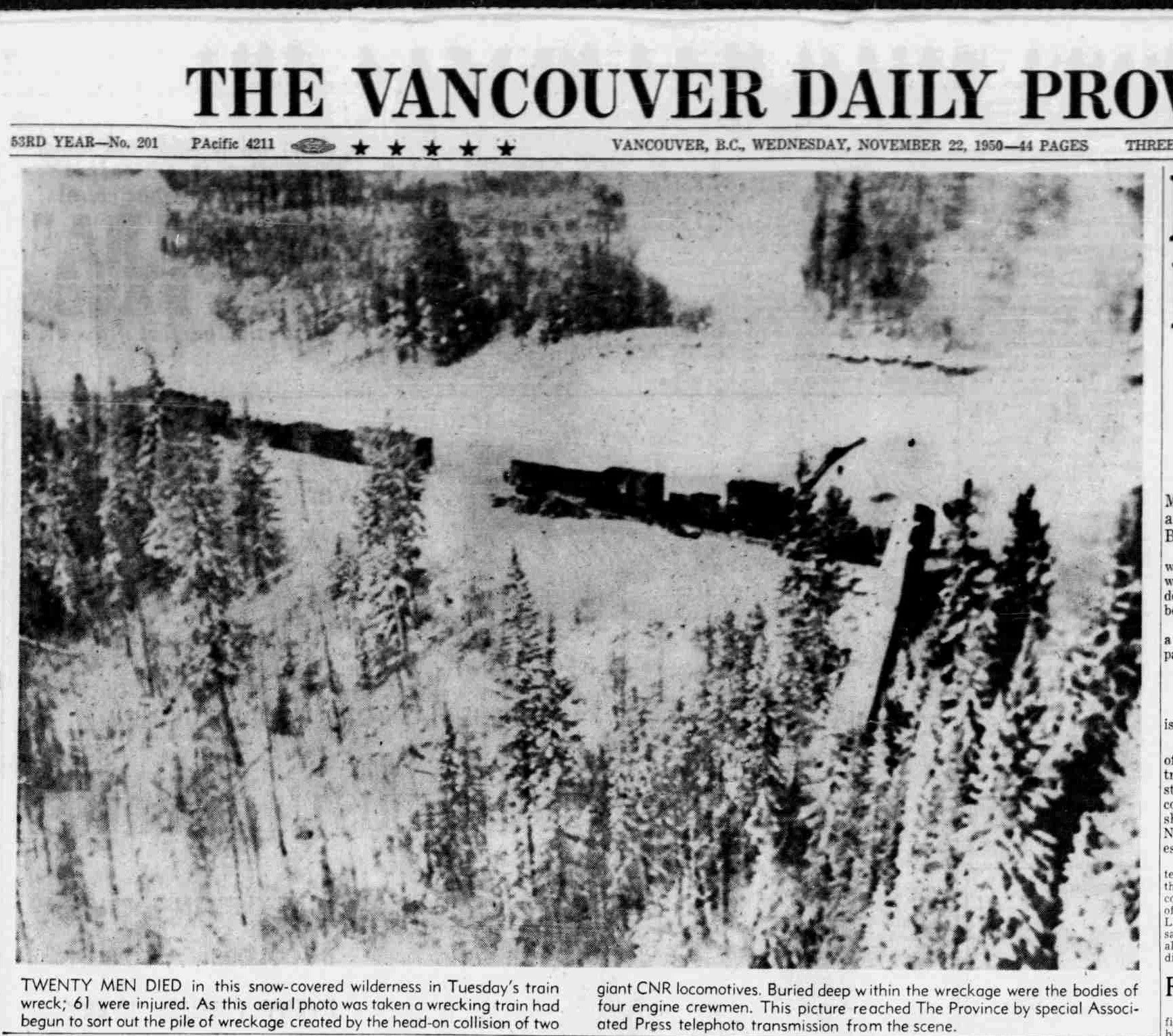
Toll of dead and missing: in Tuesday's Rocky Mountain train crash mounted to 20 today as army and railway officials pieced together the story of B.C.'s worst railway disaster. At least 61 persons were injured, 22 seriously. A doctor who supervised rescue operations at the wrecks scene, just west of Canoe River, 450 miles east of Vancouver, on a desolate mountain slope, said he feared the death toll would be higher.
The trains, eastbound Continental Limited No. 2 and a westbound trooper, rammed each other only half a mile past a 500-foot canyon.
Failure to deliver an order to the troop train's conductor, was blamed for the disaster.
J. R. McMillan, vice-president, western region CNR, issued this statement in Winnipeg: “It has been established that the accident was a result of the failure to deliver to the Passenger Extra West (troop train) instructions to meet Train No. 2 at Cedarside, the station approximately five miles east of the point where the collision occurred, where it was the intention the trains should meet. These instructions had been delivered to Train No. 2. Further investigation is continuing, but full details establishing responsibility must await official inquiry.”
A statement by an army lieutenant, survivor of the wreck, that the troop train had wooden coaches, was denied by a CNR official in Winnipeg. The officer, Lieut. Paul Cullen of Montreal, said in Edmonton, “Our coaches, all of wooden construction, just disintegrated.”
The railway official said, “All passenger coaches on the troop train were steel cars. They were regular standard and tourist sleepers.”
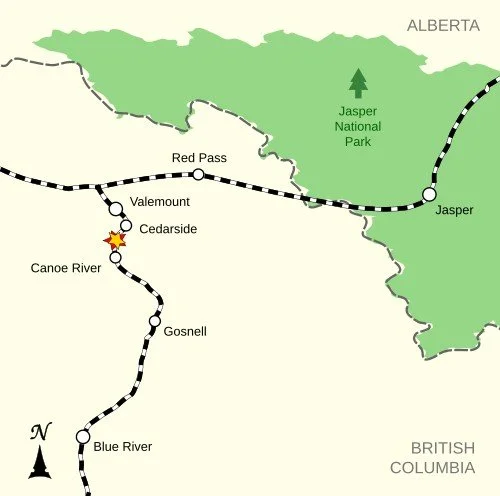
Map showing site of deadly collision between the eastbound passenger express and the westbound troop train. —Wikipedia
Fire Breaks Out In Wreckage
Mr. McMillan disclosed for the first time this afternoon that fire broke out in the wreckage of the troop train and burned through two of the smashed coaches.
Fourteen soldiers, members of the Canadian Army Special Force, bound for Fort Lewis, Wash., and perhaps Korea, now are known to be dead as result of the collision. The unit was the 2nd Field Regiment, Royal Canadian Horse Artillery. There were 340 aboard.
The bodies of 12 soldiers were found in the wreckage. Two others died aboard a hospital train en route to Edmonton. A list of 12 dead has been issued. The remaining two are being withheld pending notification of next-of-kin. In addition to the 14 dead, the army has two soldiers listed as missing and believed dead. Their names have not been issued.
The four men of the two engines are missing and presumed dead. Their bodies are believed buried in the wreckage of the engines.
The emergency train—remnants of the 17-car troop train—arrived in Edmonton today. It was coated with ice and many of the windows were broken. The injured were rushed to civilian and military hospitals. Two injured passengers from the eastbound Continental Limited were taken back to Kamloops.
Railway officials said the 17-car trooper was slightly late as it pounded through Canoe River siding and upgrade along a wooded hillside.
Soldiers Organize Aid
As it rounded a bend it ground headlong into the locomotive of the flyer. The baggage car and the three sleepers were flung off the rails. Two sleepers were shattered, the front of the third badly damaged. Baggage and express cars of the flyer were derailed. The soldiers quickly organized aid for the injured. Two dining cars on the troop train were cleared for use as a hospital.
Dr. P. S. Kimmett of Edson, Alta., a passenger on the Continental took charge. His wife acted as nurse. They were assisted by Jack Cook, CNR regional first aid officer from Vancouver from Vancouver, and a Mrs. Lennie of Edmonton.
An emergency telephone was rigged to communication lines damaged in the wreck, and a report of the crash brought wrecking trains and medical aid from Jasper, Alta., and Kamloops. It took three hours for the first train from Jasper to reach the scene, and passengers not busy helping the injured huddled in the heatless coaches awaiting help. Six hours after the wreck an emergency train made up of undamaged coaches of the trooper moved down the mountainside.
Residents of Jasper had organized accommodation for the inured in the small town hospital and in the school auditorium. Officials decided to continue to Edmonton after some ice was removed from the running gear of the coaches.
As the train rolled east today, a one-car special from Edmonton carrying army doctors, nursing sisters and medical orderlies from Western Army Command went west to meet it at Edson, halfway to Jasper The train was loaded with medical supplies and first aid equipment.
Aboard the hospital train were the 42 soldiers listed as stretcher cases—22 in serious condition from scalding by steam, 11 injured who were able to walk, and the bodies of 22 of their comrades recovered from the wreck. There were six back injuries, five head injuries, 10 fractures and one possible pelvis fracture.
Engineer on the troop train was Harvey Church, fireman, P.D. Prosinuk; engineer of the other train was J.J. Stinson, and fireman, Adam Oleschuk. Known injured on the troop train were two Winnipeg porters, W. Walsh and W.W. Worrall, P. Goedein, pantryman, and C. Clauseau, news agent.
The dead and approximately 54 injured soldiers returning to Edmonton aboard the hospital train were met here by a fleet of service and civilian ambulances. The stretcher cases were taken to the University Hospital. About a dozen walking cases received medical attention at a service hospital.
The dead will come under RCMP jurisdiction. A coroner will review the remains before they are sent to funeral parlours.
An army official said he could not estimate when the uninjured soldiers would resume their journey to Fort Lewis, Wash. He said a lot of their kit, stored in the baggage cars of the wrecked troop train, may have been lost. “We may have to scrounge more kit from all across western Canada to outfit them again,” he said.
The officer said the army took over from the CNR all care and evacuation of the wounded at the wreck scene. Fifteen men were left behind to assist in salvage operations and care for army stores on the troop train.
Dr. A.C. McGugan, superintendent of University Hospital, said beds were ready for injured soldiers. Steam burns generally were more serious than fire burns because they were more penetrating, he said.
Nurses who would normally have gone off shift late last night were kept on duty. Doctors and X-ray staffs were picked up by taxis and taken to the hospital shortly before the hospital train arrived.
The troops were in an angry mood when they arrived in Edmonton aboard a hospital train from the wreck. They did not want pictures taken of the injured on stretchers and one officer threatened to smash any news cameras used at the unloading platform. Many refused to talk about the crash. “We can’t tolerate any interference with this unloading,” one officer said. “There are some guys in there who may not make it alive to the hospital.”
The bodies of 11 dead soldiers were among the last to be removed from the hospital train. They were rolled in blankets and bound by rope.
Seconds after the train pulled in the uninjured aboard it began smashing out windows so that stretchers could be guided out to the waiting 13 ambulances, all that were available in the city. Even the Police Station wagon was used as an ambulance. A greenhouse truck was among the vehicles which took away the dead.
Soldier’s Dog Tag Grim Souvenir
By PAT PROWD
Dally Province Staff Writer
KAMLOOPS—The soldier was young. His face was streaked with fatigue. He held out his hand. A "dog tag," glistening with the sweat from his palm, told a mute story.
“This is all I've got left of my buddy," he said. Early this morning, sitting in a Kamloops cafe, Mrs. F. Bieler of Kelowna still shuddered with horror as she recalled those first terrible hours following the worst wreck in Rocky Mountain railway history.
“We couldn't even get that soldier to take a cup of coffee, he was so broken up.”
With her sister, Mrs. J. M. McHarg, and her daughter, Enid, Mrs. Bieler was en route to Watson, Sask., to attend her father’s funeral. They were sitting in the first day-coach behind the baggage car of the passenger train when the crash came.
“It was just about the worst thing you could ever imagine. Around 11 o’clock there was sudden jar of brakes. Our main front wheels went off the tracks. It was just an act of God that everyone in the car wasn’t killed. Instead, we were bruised and shaken up. You wouldn’t believe two engines could hit hit up like that. They looked just like bits of twisted wire.”
As a howling gale whipped the scene, Mrs. Bieler and her fellow passengers tried to bring comfort to the survivors.
“We weren’t registered nurses so we couldn’t help that way,” she said. “But we did have some rolls with us, and the newsies at the other end of the train made coffee, so we handed out what what we had to these poor lads. I can’t figure out how they made that coffee, either. The heat was off, and you can imagine how cold it was. It wasn’t snowing very hard when we crashed, but right afterward[s] it seemed all the elements turned against us. I’ve never known anything like it.
“It just seemed like we were out in the middle of nowhere. Those poor trainmen and soldiers were up to their hips in snow. They had to struggle up a hillside in a raging blizzard to reach the wounded and dead.
“Everyone was trying to do his best. They came and gathered all the towels and the linens they could to make bandages. They even took the white covers from the backs of the seats.”
Her blue eyes wide with excitement, even small Enid could not forget the nightmare of death and destruction which passed her small life by. “All the men were calling for flashlights,” she lisped in her childish tempo.
“Thank God she’s young and will forget it,” said her mother as she clasped her daughter to her. “But coming back to Kamloops on the train every time it bumped or stopped, she screamed.”
With Enid and Mrs. McHarg, Mrs. Biekler returned to Kelowna this morning.
“We can’t go to the funeral now,” she said simply. “We came so close to death ourselves.”
* * * * *
How, it was immediately asked, did two passenger trains find themselves on the same stretch of track at the same time? Obviously, someone had made a terrible mistake.
Indeed, someone had, and CNR officials were quick to point the blame at a lowly telegrapher.
But, as it turned out, the truth wasn’t quite as simple as that—the real blame went much higher up.
The fascinating conclusion to the Canoe River train disaster in next week’s BC Chronicles.
(To be continued)
