
The ‘Real’ Sea Wolf McLean
(Conclusion)
This week, the conclusion to Noel Robinson’s 1922 profile of Capt. Alex McLean, the “real” Sea Wolf of literary fame in Macleans magazine:
While Captain Alexander McLean never owned or sailed the Casco—a boat always associated with Robert Louis Stevenson because the novelist sailed in her and wrote at least one of his novels aboard her—McLean had a strong desire to possess her and at one time tried to buy her.
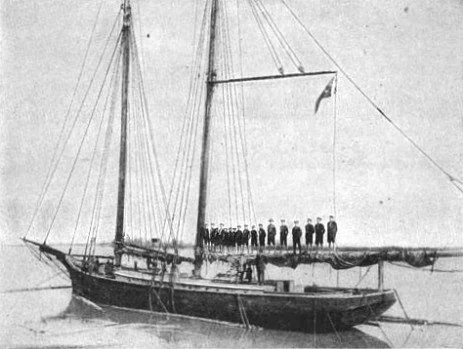
The fleet schooner Casco would earn undying fame of her own. —Author’s Collection
He regarded her as a particularly fine sea-going boat—as indeed she was.
Built as a yacht by a San Francisco doctor, a present for R.L. [Stevenson], the author sailed in her for sometime and took her to the South Seas. McConville remembers meeting Stevenson casually in San Francisco and again when he was aboard the Casco off the Marqúese Islands, near the Society Group.
In ’92 this 75-ton yacht was brought to Victoria and converted into a sealing schooner and she followed this calling for a long time, until she was tied up with the old sealing fleet at Victoria and left alone for years. She came into the hands of a Captain Buckholtz who almost worshipped her and he brought her to Vancouver in recent years and she was completely overhauled.
Then she passed into the hands of a firm which did its best to sell her to admirers of Robert Louis Stevenson. They communicated with many people, both out here and in Scotland, but they were unable to arouse any enthusiasm.
The final stage of the Casco’s career was quite in keeping with the spirit of romance which always enveloped her, even in her sealing days, for she was bought by a party of adventurers and prospectors from San Francisco who engined her for the first time and took her into the Far North.
There they left her bones. In a storm she went ashore upon a very rugged part of the Alaskan coast where she was dashed to pieces, her crew being marooned for weeks.
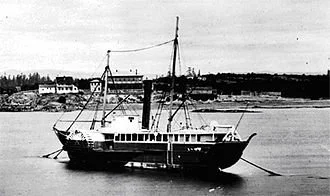
For a time after he finished with sealing, Alex McLean skippered the most famous Pacific Northwest ship of all time, the pioneer Hudson’s Bay Co. steamship, Beaver. —https://commons.wikimedia.org/w/index.php?curid=5302048
For a short time in 1884 Alec McLean was master of the historic Beaver.... the first steamship to plough the Pacific. That was in the days before old Captain George Marchant, who...skippered her for the last 20 years of her life. Captain George is a survivor of the old navy at Esquimalt having come out aboard a frigate more than half a century ago.
He was one of the skippers who acted as pallbearer when ‘The Sea Wolf’ was carried to his last resting place.
There is not space here to more than refer in passing to that chequered, but very interesting, part of McLean’s career in the course of which he had many exciting poaching adventures in the northern sealing grounds, and particularly off the Pribilof Islands, at the expense of the American revenue cutters. In various official documents on the other side of the line he is referred to as “the British pirate McLean”.
One such report was published in a Seattle newspaper about eight years ago. It records at three or four columns’ length the depredations of this poacher.
One of the most exciting of his sealing adventures occurred as recently as 1905.
He left San Francisco aboard the Carmencita, a three-masted sealing schooner, and proceeded into Mexican waters, intending to put his vessel under the Mexican flag. The Mexican authorities would not let him do this, so he sailed for Victoria.
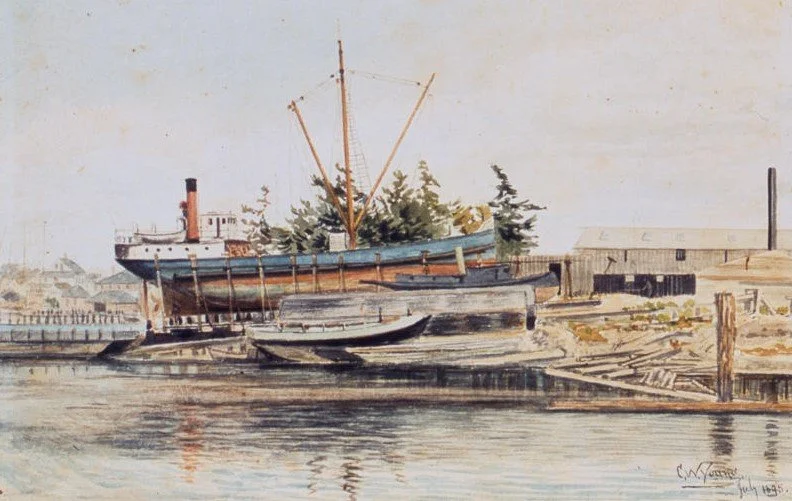
While in command of the Carmencita, McLean had to elude both Canadian and American revenue cutters. —BC Archives
At Victoria the authorities wanted to seize his vessel because of a libel on her, or something of the sort. McLean made a “getaway” and sailed up the West Coast of Vancouver Island, and there ensued months of chasing by both American and Canadian revenue cutters. But “The Sea Wolf” was too alert for his pursuers and British Columbia marine men consider that he accomplished some astonishingly clever manoeuvres with the Carmencita.
He knew every nook and cranny of that wild and rugged coast like a book.
He had many very close calls, but managed at the end of the sealing season to make Victoria, sell his catch, and clear off to the mainland, leaving the Carmencita as spoils to the victors.
For years before his death McLean could only set foot in the United States at the sacrifice of his liberty.
Before recording the last-—as far as this article is concerned—and by far the most remarkable of this daring skipper’s varied experiences, it will be of interest to recall a fact or two about his early life. He was a Canadian, born in Sydney, Cape Breton, in 1859.
Taking to the sea as a boy, he sailed the Atlantic for nine years. He knew Liverpool like a book and more than once told me that it was his favourite port. In 1879 he sailed from New York for the Pacific Coast as second mate of the Santa Clara and in 1880 came to Victoria and went into the steamboat business, running up the Fraser.
Early in his career on this coast he accomplished some very useful work in a category very different from that which subsequently engaged his attention. He superintended in 1881 the laying of the first cable from Vancouver Island to Point Grey on the mainland, was chief officer aboard the government cutter Sir James Douglas—named after the first governor of British Columbia.
He had served a number of years assisting in cable laying on the Atlantic seaboard and was the only man on the job with practical experience of cable laying. At the time F. N. Gisborne was general superintendent of cables for the Dominion Government. Subsequently he helped to lay a cable from Victoria to the American side.
On the second day of the cable-laying McLean accomplished a feat for which he was afterwards complimented in writing by the authorities.
The cable, being unwound from a drum placed in a large tank, kinked and began flying in all directions. In such circumstances the only way to save the situation was for a man with sufficient nerve to run round inside the tank at the risk of his life, endeavouring to fix the cable in position hand over hand. The two men in the tank had jumped out, but McLean jumped in and accomplished this feat.
Needless to say, when the Klondyke gold rush arrived in ’98, ‘The Sea Wolf’ was into it. He was master of two steamers on the Yukon River, one of them being called The Gold Run. But this part of his life, full as it was of unusual happenings, I must pass over, and come to that adventure which may sound to the reader to have too much of the ‘Treasure Island’ flavor, but which nevertheless, is absolutely true in every detail.
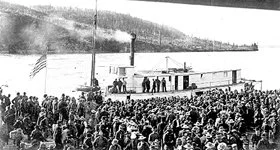
Steamboat day in Dawson, 1898. The Sea Wolf appears to have been equally at home in the pilot house of a riverboat as he was of a schooner on the high seas. Here, the S.S. May West has just arrived in Dawson from St. Michael's, in 1898. —Vancouver Public Library
Confirmation may be found in the files of newspapers of that day, both in New York—where the case of a certain adventurer was tried, McLean being the principal witness—and in Canada.
McLean was not a man to talk much, unless he had a little liquor.
I had the story from him in detail as we sat in a room in his home on Burrard Street, Vancouver, some eight years ago. He was enjoying one of those brief periods of home life that he allowed himself now and again with his wife and daughter. But even in that quiet home he was surrounded by many a relic of his adventurous career.
I remember that spears, crisscrossed, decorated the walls; a carefully finished wooden trough in which the cannibals of the South Sea Islands had been in the habit of placing portions of their unsavoury human feasts reposed in one corner of the room; a huge club of hard wood, one edge as sharp as a razor and once the property of a South Sea Islander, stood in another. A paddle, beautifully inlaid with mother of pearl, also attracted my attention.
Twelve or 14 years before the time of which I am speaking, a rather unusual type of adventurer named Sorensen, desirous of promoting a treasure-seeking expedition to the South Seas, and learning that McLean was the sort of man who might tackle such a job, got in touch with him.
Although McLean did not know it at the time it was afterwards proved that Sorensen had already served 10 years for piracy off the coast of Australia.
Sorensen promoted this expedition which, after much discussion and preparation, McLean led. McLean’s story to me was:
“After we reached the islands where Sorensen said the treasure was to be found, I found out—I need not tell you how—that Sorensen had deceived me and that he intended to do to me what he had previously done to another captain in Australian waters. He planned to dispose of me and get my crew to let him take command. But he did not realize the sort of man or the sort of crew he was dealing with—though I will say he was a daring fellow. He had entirely misrepresented the conditions.
“When I found out what he intended I marooned him on an uninhabited island, intending that should be the end of him and believing he should have no further chance of doing harm.”
The quiet, matter-of-fact way in which McLean confessed to this marooning was illuminative. He continued: “Then, on our return voyage, my crew developed yellow fever badly and we buried 18 of them—all except one—at sea. This one survivor also had the fever so badly that he could be of no use to me and lay ill for the rest of the voyage.
“I contracted it, also, but fought very hard against it and it never got a real hold of me. It was terribly hot at the time and almost immediately a man died it was necessary to bury him. I never expected to reach port— 2,000 miles away—alive, but I determined to make a big effort.
“I was alone aboard that large three-masted schooner for six weeks, the sick man being of no use at all, and I did my best to navigate her, and finally brought her safely into Apia, [a] port of one of the Samoan Islands.
I was far out of my course and when a squall struck her, as it did several times, I could not shorten sail and just had to run before it. I was right off the track of ships and never sighted a sail or a smoke stack. Later I got the schooner safely back to ’Frisco.”
Thus simply did ‘The Sea Wolf’ tell me the story of one of the most remarkable happenings in the annals of the sea.
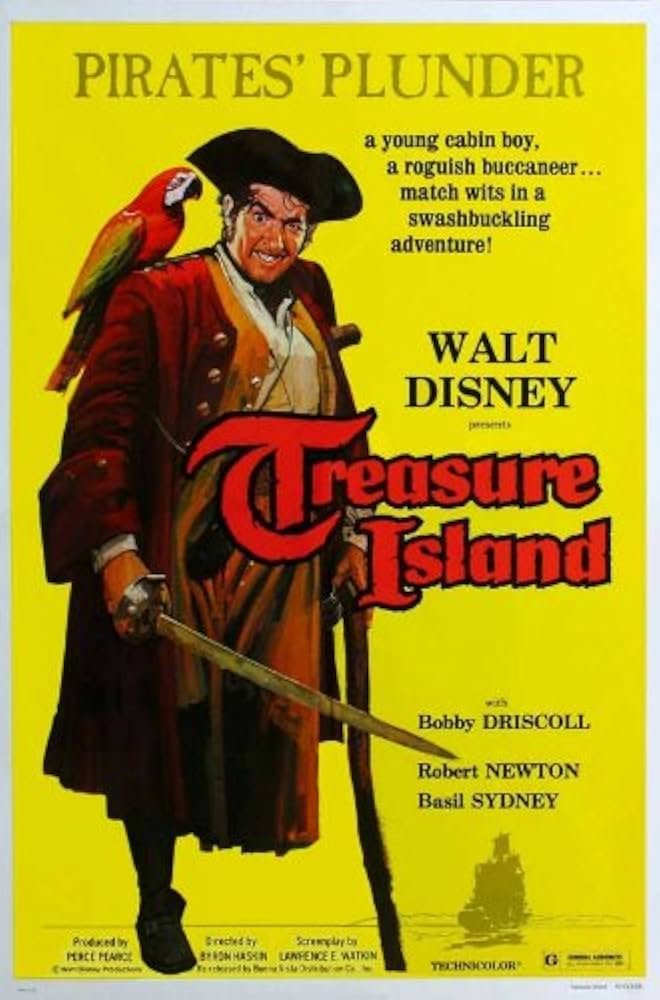
Robert Louis Stevenson’s classic tale of Treasure Island still captures the imaginations of youngsters and, in 1950, made it to the silver screen, as advertised by this poster. Capt. Alex McLean’s own treasure hunting adventures were even more exciting. —Wikipedia
Picture to yourselves the marooning; then the schooner, a veritable death ship, sailing through those tropical southern seas, her crew sickening and dying one by one in that great heat, until only [its] skipper and one man were left.
Then consider the iron will and powerful physique of the man at the helm who defied death by sickness or by the sea for six weeks and finally brought his vessel 2,000 miles into port. That was in ’98, the year of the great gold rush.
But that is by no means the end of the story. It has a remarkable sequel.
Sorensen was rescued by a passing vessel from the island upon which he had been marooned. Only a few years before I had the talk with McLean which I have just recorded, he appeared in New York and formed a company there to go to Australia in order to discover traces of a treasure ship which he alleged had been sunk off that coast. He succeeded in getting a number of well-known New Yorkers interested in the scheme.
Now, by a remarkable coincidence, the editor of the New York Sun at the time, a Mr. Churchill, happened to be the same man who had been American consul at Apia when Sorensen was brought there after his rescue and when McLean sailed into that port with his three-masted schooner after his remarkable voyage. Churchill had a suspicion, though it was many years since those happenings, that this man who was launching the treasure scheme in New York was acting under an assumed name and was in reality...Sorensen himself.
He determined at once by attacking the scheme to try and save the investors.
He made every effort to get into touch with McLean, but for sometime without success as Alec was away. Finally he located him in Vancouver, and, as a result, the skipper acted as principal witness against Sorensen by telling the story of the latter’s deception, and the adventurer was defeated and sentenced.
Sorensen had sued the Sun for defamatory libel as a result of the statements the paper had made about him and had the editor of the paper not been able to get in touch with McLean the proprietors probably would have had to pay heavily for their public-spirited action in exposing the fraud.
McLean gave his evidence by proxy at Montreal as, for reasons I have stated earlier, it would not have been wise for him to cross the border.
In this series of incidents I have little more than hinted at the remarkable career of the man who, perhaps without thinking, Jack London libelled in his graphic story, The Sea-Wolf.
No effort has been made to put McLean on a pedestal, that—in addition to his tremendous daring and love of adventure for adventures’ sake— he was a most generous man, his shipmates all aver.
Wolf Larsen in the story is made to appear a veritable human devil and, in real life, would in all probability have been disposed of by one or other of his crews and given his deserts.
McLean was always cheerful and, though not naturally humorous, enjoyed a joke and was a past master in dancing the Highland Fling. Though he was, as one of his shipmates remarked, “full of hellery when drunk,” drink did not make him cruel or savage—it simply added to his desire for dare-deviltry.
He was a man who thought seriously upon many topics and could converse and argue clearly and interestingly. He was not the swashbuckling type.
But, when all is said and done, he should have lived in the days of Drake, the spacious days of Good Queen Bess, for he was cut out for the half patriotic, half piratical life led by those gallant “dogs of Devon” who went singeing the King of Spain’s beard and, at the same time, capturing much rich booty.
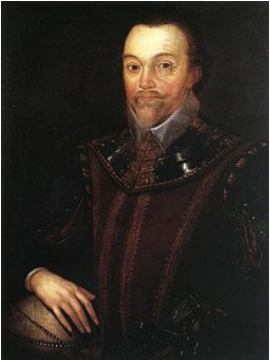
Sir Francis Drake and Sea Wolf McLean were cut from the same cloth, according to Macleans writer Robinson. —Wikipedia
Had he been alive when the Great War came there is little doubt that Alexander McLean would have been in the thick of things on the sea, ‘doing his bit’ despite his years.
His picturesque figure, surmounted by the sort of Southern Colonel’s broad brimmed type of hat which he always wore, and the tremendous mustachios and heavy eyebrows, will long remain a memory of the Vancouver, Seattle, Victoria and San Francisco waterfronts.
