
The ‘Real’ Sea Wolf McLean
Four years ago, I told the story of the amazing Capt. Alex McLean who was made immortal—and infamous—by novelist Jack London. The source for my Chronicle was an author much closer to home, Tom MacInnes, in his 1920s book Chinook Days.
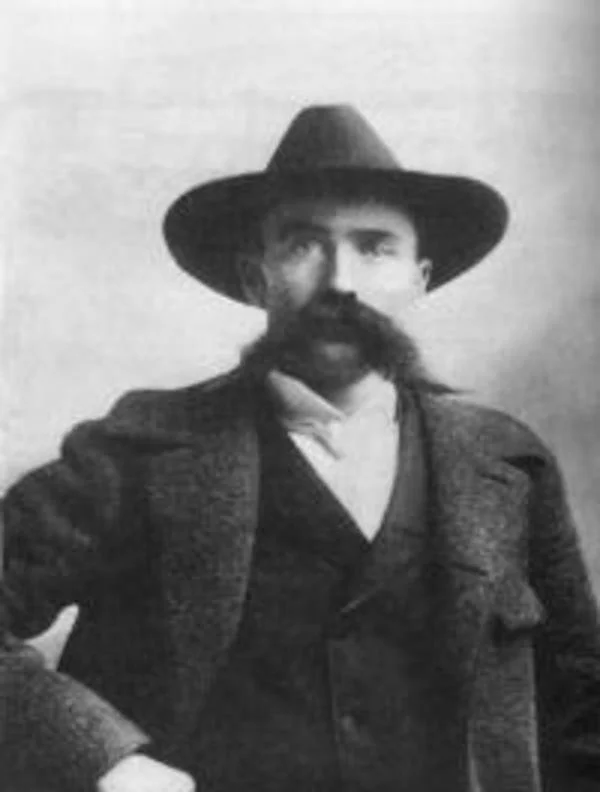
McLean looks more like a cowboy than a mariner in his stetson which, apparently, he wore afloat and ashore. Note the famous walrus moustache. —Canadian Encyclopedia
Well, MacInnes wasn’t the only journalist to claim a firsthand insight into the swashbuckling mariner who inspired novelist Jack London to write his classic psychological—but fictional—sea story, The Sea-Wolf.
In the January 1922 issue of Macleans magazine, Noel Robinson offered up a fresh look at the legendary Sea Wolf McLean, mariner, sealer and pearl poacher extraordinaire who successfully thumbed his nose at the Russian, American and French navies.
Robinson entitled his lengthy article the ‘real” Sea Wolf McLean, noting that London’s work of fiction had done irreparable harm to McLean’s reputation as a serious mariner. Robinson also touched upon aspects of McLean’s maritime career in B.C. and Yukon waters that I’ve not read elsewhere.
As a bonus for lovers of high adventure and sea stories that surpass fiction, here’s the “real” Sea Wolf McLean in the words of Noel Robinson:
* * * * *
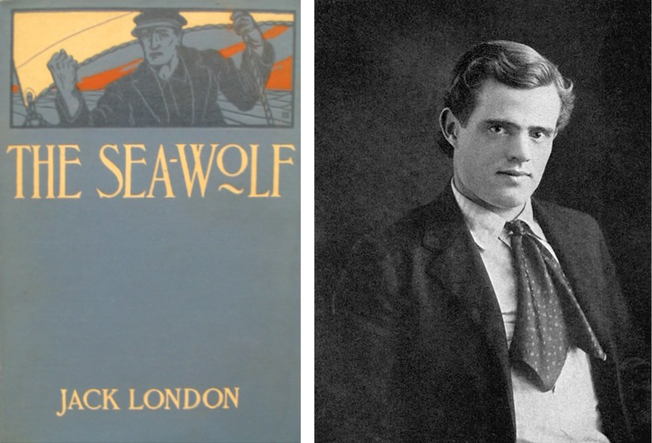
Left: The book that immortalized Capt. Alex McLean, whose real life exploits were more exciting than anything that author Jack London, right, could conjure up. —Author’s Collection, Wikipedia
One morning about 14 years ago a well-set-up, rough-and-tumble type of man—open-faced and clear-eyed— wended his way down to one of the marine stores on the San Francisco waterfront. It was a junk store of a type familiar to most seaports—full of romance for those who have eyes and ears for the romantic in life.
A certain skipper was standing in the store, a spare, broad-shouldered, blue-eyed man with tremendous brown mustachios, the ends of which almost reached the lapels of his coat and seemed quite in keeping with his exceptionally shaggy brown eyebrows. The store, full of a hotch-potch of seafaring flotsam and jetsam, constituted just the right setting for these two men.
“Here, Alec, take these smokes with you; they’ll help some up North. Good luck and a good catch. Can’t wait; got to hustle this morning,” breezed the visitor as they gripped hands.
Then he vanished from the store—only to return a moment later with: “By the way, there’s a book in with the cigars. Don’t open the box till you’re way up on the sealing grounds—I’ve got a reason."
“Right y’are, Jack.” And Jack London—for the visitor was the famous novelist—disappeared.
Not many weeks later the skipper with the heavy mustachios foregathered in the Behring Seas with the master of another sealing schooner and invited him aboard. Thinking of London’s cigars, he hospitably opened the box and found therein, comfortably ensconced amongst the Havanas, a volume entitled The Sea Wolf. The title conveyed nothing to him at the time and he put the book aside for future perusal.
A week later he picked it up and, as it was a novel about sealing, he read it through at one sitting.
I have related this incident of the novel manner in which Jack London broke to Captain Alexander McLean the delicate information that he had taken the liberty of introducing him to fame—on the Pacific coast at any rate—as the original of the principal character in his sealing story, exactly as Captain McLean told it to me seven or eight years ago.
“I read the book with such mixed feelings that perhaps it was as well, Jack wasn’t there when I finished it,” McLean commented. Those of you who have read The Sea-Wolf and recall the character of the hard-shell devil of a sealing skipper, Wolf Larsen, will be surprised at the moderation of Alec McLean’s language.
From the publication of the novel until the day when he met his death by falling from his tug and being drowned in False Creek, Vancouver, a few years ago, Alexander McLean was known from San Francisco to Alaska as “The Sea Wolf.”
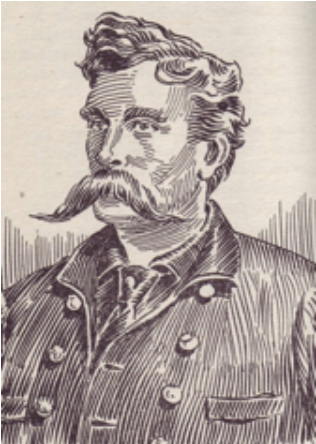
The Sea Wolf’s famous moustaches are clearly shown in this artist’s depiction of Alex McLean which appeared in Tom MacInnes’s book, Chinook Days.
I have it on the good authority of his personal friends who esteemed him highly, that, from the year when the book was published until the day of his death, he suffered severely financially from having his name linked with that of Wolf Larsen—for obvious reasons. There was hesitation in employing a man whose reputation for deviltry and sealing piracy, after the publication of the book became a by-word on this Pacific coast.
The strange feature about the whole thing is this: McLean, although admittedly a remarkable man and often a veritable dare-devil—as the reader will realize later on in this story—was quite unlike Wolf Larsen in type and was certainly never responsible for such villainies as he is made to commit in The Sea Wolf.
Yet there must have been certain resemblances or the sobriquet would never have clung to McLean as it did.
The explanation would appear to be found in the fact that McLean, by general consent, appears to have been the most daredevil sealing skipper who ever poached seal in the Behring Seas. There are more stories told of his utter fearlessness and recklessness, his positive enjoyment of danger, his delight in finding himself in an emergency and then making a dramatic way out, than there are told about any other half dozen adventurous skippers on this coast.
Only the other day one of his former shipmates, John McConville, said to me: “I never knew the beat of Alec for fearlessness.” And McConville who is now mining for gold on Texada Island, sailed with McLean, boy and man, for many years, out of San Francisco, Vancouver, Victoria and other ports into the northern sealing grounds, and into the South Seas, too, where they fell in with Robert Louis Stevenson aboard his yacht the Casco.
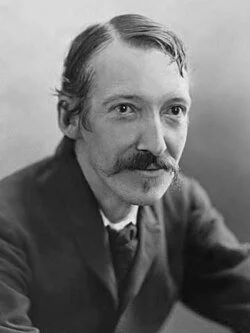
For health reasons, the tubercular author Robert Louis Stevenson chartered the schooner Casco. Years later, Alex McLean would experience his own version of Treasure Island. —Wikipedia
McConville and an ex-sealing skipper who is now head of a well known marine salvaging company in Vancouver, but who does not wish his name mentioned, were both shipmates of “The Sea Wolf,” and they are anxious that their former skipper’s name should be cleared of a certain opprobrium which hangs about it because of its association in the public mind with the character of Wolf Larsen.
I am indebted to them and several others for a true estimate of his character and for the relation of some vivid incidents—several of which received wide publicity at the time of their happening—in his remarkable career. One or two would not be out of place in the pages of Treasure Island. I will only recall one shore incident.
“Alec was always ready to fight—especially when he had had liquor—at the drop of the hat,” recalled McConville as we chatted over our pipes in a certain marine rendezvous in Vancouver, “and on one occasion, many years ago, I was with him in a saloon at the back of Meiggs’ Wharf in ’Frisco—the old wharf is there yet—when an argument arose as to the performance of certain horses. A rather blustering Yankee customs officer was there and he told Alec that he (Alec) knew more about driving men than about horses.
“Alec had had a drop and the discussion became warm. The customs officer pulled a gun and said he would ‘fix him’. Alec was unarmed, but he was on the man like a flash, threw him into the air until his head hit the ceiling; he fell in a heap on the floor and we thought he was dead. His revolver went spinning into a corner.
“The saloon was full of ‘stiffs’ and hoboes, for it was a pretty low place.
The customs officer recovered, jumped to his feet, and called upon the men to help him take Alec into custody and he would reward them. Alec just stood with his back against the counter, facing them, his elbows resting on the rail, perfectly calm, with that curious look in those keen blue eyes of his, and defied them to touch him.
“He was not too well liked there, but not a single man would lay a finger on him. He always had that curious power over other men. It was just the same on the sealing schooners of which he was skipper. I never knew a man keep such discipline. He never said much; he could keep discipline with a look.
“In my experience he was altogether different from other sealing skippers.
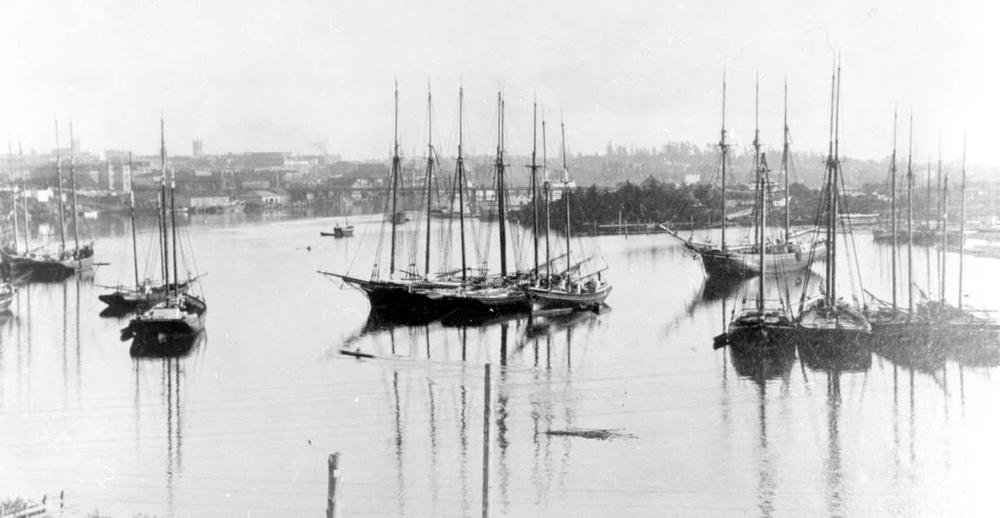
The historic sealing fleet tied up in Victoria Harbour. Some of them are said to be still there, having sunk at their mooring lines when abandoned after the close of Pelagic sealing by international treaty. —BC Archives
“He wasn’t standoffish, but he never mixed with his crews, never played cards with the men and, strange though it may seem, never swore. Another singular thing about him, which you scarcely ever find aboard a sealer, he always looked smart, even when we were up on the sealing grounds engaged in work of a dirty nature. And you remember how smart he looked when ashore?”
“In a way McLean was proud of that remarkable moustache of his and I have known him [to], for fun, tie it at the back of his neck. Although not a big man, and spare, he was powerfully knit, and stories are told of his feats of strength. Wonderfully well preserved, when he died, though he was approaching the 60s, he did not look more than 45. His singular pale blue eyes were as clear as a boy’s.
“Here is a striking instance of his devil-may-care spirit.
“Do you mind that wild night in March when we were about 90 miles off Flattery and he put off in a boat for Victoria?” It was an occasion when both shipmates to whom I have referred were with him. McConville nodded, smiling at the recollection. I asked for particulars.
“Alec was full of the devil that night.
“We had two pipers aboard and they played him and Arthur Pennell—who was afterwards lost when he was one of the crew of the Casco while she was fishing off Flattery in ’94—right along the deck before they took to the little 18-foot boat and left the Mary Ellen for Victoria. It was a rough night and some of the schooners were hove-to.
“Alec and Pennell had only oars and a sail—and 90 miles to travel. But they would go because Alec, for certain reasons, did not want to put into Victoria with the Mary Ellen. We were very doubtful if we would see them alive again because of the sea that was running, but they made Victoria and rejoined us later.
“It was one of the foolhardiest things I ever remember, but it was just like Alec.”
Perhaps this will be an appropriate place to tell of McLean’s notorious and daring exploit in connection with a small Russian cruiser off the Copper Islands.
It was first told to me by Captain Harvey Copp, though I have heard it in some detail from others. Captain Copp, who is a member of one of several well-known families of that name from the shores of the Bay of Fundy, is an astonishing old man of 78, still hale and hearty after having been no less than 31 times round the world, in sailing vessels and steamships. He never skippered a vessel, in sail or steam, that he did not plan and superintend the building of her.
I mentioned him because he, like “The Sea Wolf,” was captured by the Russians when sealing and taken a prisoner to Vladivostok. Though he was not poaching—his vessel, the Vancouver Belle, which he built himself in Vancouver, was confiscated. The matter was ultimately taken before the Hague Tribunal and 16 years later he received substantial damages.
There was never any doubt that McLean was poaching within the 60 miles of restricted water off the Siberian coast.
He was skipper, at the time, of a sealer named the James Hamilton Lewis. The Zabeika, as the small Russian cruiser was called, discovered the James Hamilton Lewis at her illegal work and promptly put a shot across her bows.
McLean, instead of heaving to, attempted to make a getaway. He soon saw that he could not make it. The Zabeika was immediately under his lea at a distance of 90 or 100 feet, McLean was standing aft by the wheel, perfectly calm, with determined face, and quite aware of the possible consequences of what he was about to do.
Without warning he let go the schooner’s main sheet, letting it run out to the bitter end, put his helm hard up and in a few minutes changed his course 90 degrees.
The James Hamilton Lewis swung partly round and struck the Zabeika at the main rigging. Fortunately for the Russian cruiser, the bow of the sealing schooner struck her a little diagonally on account of the speed at which she was travelling or there is little doubt that the Zabeika would have gone to the bottom. As it was the sealing schooner went right along the weather side of the Russian vessel, ripping off her hammock netting and rigging and boats, stripping her along the side. The James Hamilton Lewis lost her own headgear and was partially dis-masted.
As the two boats crashed together it looked as if they might both sink, through the smashing of a fairly heavy sea.
Then the James Hamilton Lewis dropped astern, badly disabled, and the Russian commander came aboard and took possession of her. Her daring skipper and her crew were taken to Petropaulovski [Petropavlovsk-Kamchatsky on the Pacific coast of the Kamchatka Peninsula] and, later, as in the case of Captain Copp, to Vladivostok...
McLean, it is clear from all accounts of the affair, was absolutely reckless and fully determined to sink the Russian, regardless of consequences to himself and his crew.
In giving me his impression of his several months’ imprisonment among the Russians, he once said: “I had the finest time of all my life. We were not allowed out of the country and that is about all the imprisonment there was to it. I found the Russians very kindly and hospitable people. The naval officers were especially good to us. Almost every day I was aboard one or other of the men o’ war having a pleasant time.
“For exercise there were always horses at my disposal. We had lots of target practice and, as I had among my crew several good shots, we generally came out on top in our matches with the Russians.”
The incident recorded just now when McLean and another man put off from the schooner Mary Ellen and made for Victoria 90 miles away in a small boat recalls another incident connected with the same schooner—a sailing feat which sailors on this coast regard as among the most remarkable accomplished on this side of the Pacific.
“We were running down from Cape Cook, Vancouver Island, to Drake’s Bay, 30 miles from San Francisco, in the old 85-foot Mary Ellen," one of Alec’s shipmates told me—and he was corroborated by the salvage expert in Vancouver who was also on the trip.
“There was a gale of wind at the time. We were ‘winged-out.’ Alec would only trust one or two of us with the wheel. We made the run, 750 miles, in 60 hours, which is almost steamer time. Of course it was a great risk, as any seaman will understand, but Alec was determined to make a record.
“‘Did you ever know Dan carry such sail as this?’ he would say, turning to B-, and the latter would reply: ‘No, he wasn’t such a damned fool.’
But we were all proud of the performance. Dan, to whom this reference was made was Alec’s brother, a man strikingly similar in appearance, even down to the big mustachios, and a daring sailor, but quite a different type of man otherwise. He made a trip from Halifax to Victoria in 116 days—being 22 days off the Horn—which constituted a record.
The two McLeans skippered some of the earliest sealing schooners with white hunters engaged in sealing in Alaska waters. Both were born at Sydney, Cape Breton, Dan being eight years the senior. They came out to the Pacific coast, within a few years of each other. It was largely as a result of Dan McLean’s observations when prospecting in his seven-ton sloop Flyaway in Alaskan waters that sealing in those waters became a recognized thing.
Alec McLean took out the San Diego from San Francisco in 1883, his brother Dan being with him, with the first crew of white hunters. The following season Dan took out the schooner Mary Ellen, securing 2,400 skins, 2,700 in 1885, and in 1886 broke the record with 4,268.
(To be continued)
