How a Good Samaritan Saved Christmas
Another Christmas, and time to reach into my archives for another Yuletide BC Chronicle.
This year, I’m sharing from a book that I found years ago in my travels, an original printing (it’s now available online as a reprint) of F.A. Robinson’s book Trail-Tales of Western Canada, published in 1914.
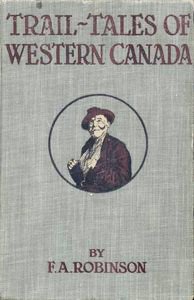
Let’s begin with the Introduction written by Charles W. Gordon (1860-1937), Canada’s first bestselling novelist. Best known by his pen name Ralph Connor, the former Methodist missionary was a likely candidate to introduce Robinson’s new book to prospective readers.
His was heady endorsement, ‘Connor’ having sold an astounding 5 million-plus copies of his first three fictional books, followed by 20 more titles over the balance of his career. An output and popularity that, for a time, rivalled those of Zane Grey. He has fallen out of favour over the years because of changing values, his works being cruelly dismissed by at least one reviewer as being “patriarchal, imperialist, and ethnocentric assumptions [that] render them worse than irrelevant today”.
But I’m supposed to be writing about F.A. Robinson whose own book Trail-Tales is so much like the “moral tales” of Gordon/Connor. Here, then, in the latter’s warm Introduction:
“This book has this virtue among others, that it is a true rescript of events that have happened in the author's personal experience. It is made up of human documents that deal with matters of surpassing interest. The book tells in simple and vivid style the story, always fascinating and thrilling, of the Triumph of the Gospel in the souls of men.
“It is a heartening book... It will bring courage and hope to those who read it, and awaken in their hearts a deeper passion to share in God's Great mission to men.
“The new West is full of the broken driftwood of humanity, showing the marks of the attrition of time and conflict and defeat—good stuff it is, but waste and loss. This book tells us its salvage to the infinite joy of man, and to the glory of god. The author has the further distinction of having seen himself a large part of the events he describes.
“The book will do good wherever it goes.” Charles W. Gordon.(Ralph Connor), Winnipeg, Canada, October 5th, 1914 “
* * * * *
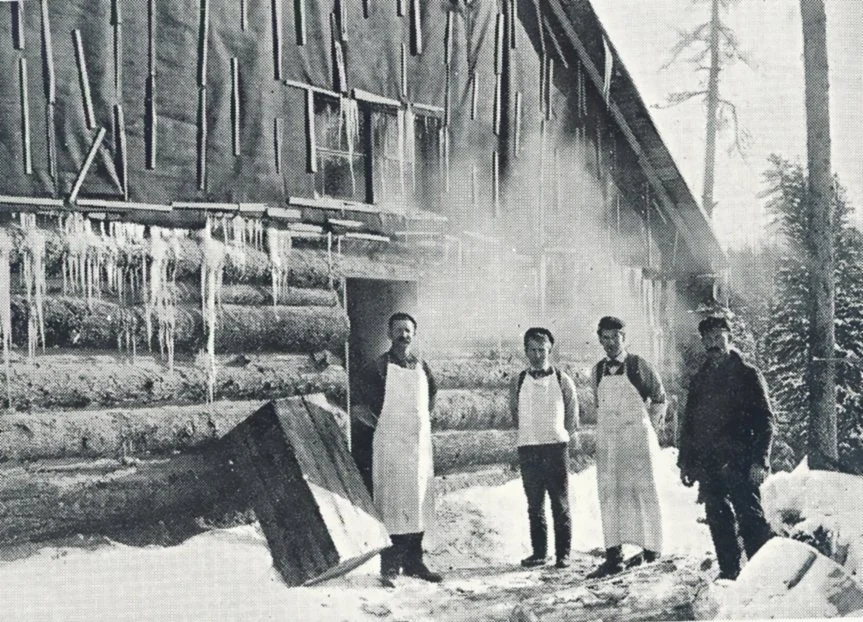
Frontier scenes from Trail-Tales of Western Canada. —Author’s Collection
Over to F.W. Robinson: If the prose seems somewhat purplish and cloying by today’s standards, so be it, it’s a story worth the retelling:
Jack Roande was on one of his periodical sprees. For eight years he had been going the pace. They had been long, weary years to the one whom Jack had vowed to love and cherish. Night after night, through these long years, she had listened for the awful home-coming. There were few in the little mining town but had often seen her eyes reddened by weeping, and all knew of the Eastern home she had left.
Among those who had joined in the “send-off,” nearly 15 years ago, were two men whose names are still honoured household words throughout the Dominion. There was no note of sadness that day, for Jack was a “model young man," and everyone agreed that there was “no finer girl than Nell.”
Jack blamed his downfall to dabbling in politics. “Politics are rotten in this province,” said he, as he endeavoured to excuse his condition; but perhaps, as a chum of Jack’s said, he only blamed politics “’cause a fellow generally tries to find a soft place to fall”.”
Whatever the cause...the fact was playing to all in the town that Jack was “down and out”.
The businessmen said so, and agreed with the authorities that Jack was a nuisance to the town. Some of those who had assisted in his downfall spoke of him as a “dirty loafer,” and even the bar rooms, where he had “spent all,” tolerated his presence only when the cruel pity of some patrons called him in for a treat, or when he could exhibit some coin.
It was through the “tender mercies of the wicked" to Jack that there were three empty stockings in the Roande home on the recent Christmas Eve. "For the children’s sake,” there had been a tearful plea that the husband would be home Christmas Eve and Christmas Day.
Resources of the pantry were combed by loving hands to give the nearest possible approach to a feast. From the nearby woods the children had brought cedar and pine for decorative purposes and these, with stray bits of brightly-coloured tissue paper, had done much to give the home a Christmas appearance.
The usual notes have been written to Santa Claus, and the mother-heart had lovingly suggested a curtailment of such requests as Santa might find it difficult to grant. The little ones had thrown their letters into the fire, and watched some of the gauzy ashes carried up the chimney to the mysterious but generous friend of the children, who would soon be loading his sleigh somewhere in the far north.
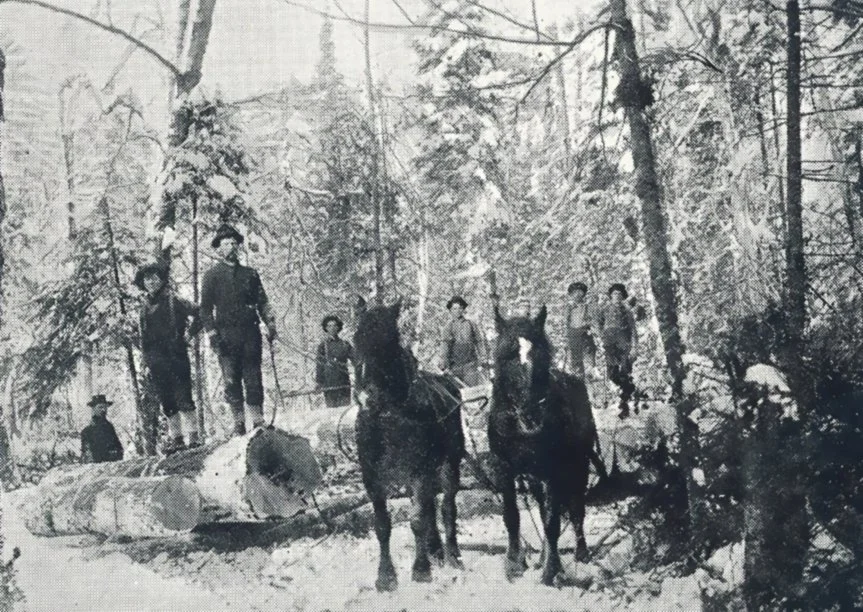
Life was hard on the Canadian frontier and not everyone was up to the challenges as these men shown in Robinson’s book likely were. —Author’s Collection
Jack appeared to respond to his wife's pleadings, and so on account of her many home duties she confided to him some of the requests the children had made, and how the much-coveted toys were parcelled and waiting to be called for at one of the down-town stores.
No word was spoken of the sacrifice the purchases had involved, nor of the sting love had endured when for the children’s sake she began to take in sewing. It was therefor agreed that Jack should bring the parcel home shortly before tea on Christmas Eve, and in the darkness it could be hidden away until the little ones were asleep
Jack was true to his word, and started for home with the precious toys under his arm, and ample time for the evening meal. “Merry Christmas, Jack," called a voice as Jack was rounding the saloon corner; “come on in and have one.”
“Guess I'd better get home,” was the hesitating reply. It needed little persuasion, however, to get Jack inside, and after a second treat he lost all anxiety to reach home, and was ready for a night’s debauch.
During the tea-hour the bar patrons became fewer, and Jack's chances for further drinks were far apart. In response to a request to “chalk up a couple of whiskys,”he received an emphatic, “not on your life,” from the bartender.
There was a momentary conflict within Jack, and then the beast became lord over the man. Going to the corner he brought his parcel from the bench and placed it on the bar. “How much can I draw on for that?” There was a wild determination in the voice. Unwrapping the parcel beneath the bar, the bartender at once knew what the contents meant.
“I don't want ‘em, Jack; you better get home to your kids."
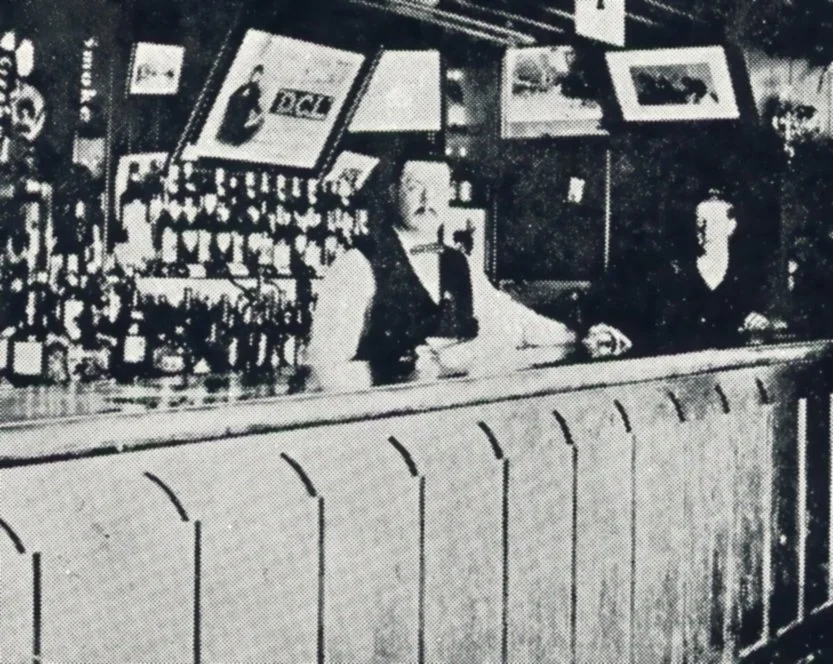
Once Jack had his first free drink, “the beast became lord over the man”. —Author’s Collection
But Jack was insistent, and gradually the other weakened. “It's your property, and if you're going to sell ‘em I guess I may as well buy ‘em as anybody else. I'll chalk you 50 cents.” The articles were worth three times the amount offered, but Jack was being consumed with that hellish thirst that he had developed through many years, and he at once started to use up his credit.
A mile away an anxious wife awaited Jack's return. Cheerfully, she had gone about her work until the hour for the evening meal, but with the passing moments the husband's absence caused her fears to increase. With forced smiles she did her best to bring into the house the gladness that belongs to Christmas Eve, but the heart was heavy, and the little ones saw more now and again the tears that could not be suppressed.
That time was prolonged to two hours beyond the customary time, but still there was no sign of the father.
Once the mother expressed the fears that were in her heart when she suggested that sometimes Santa Claus did not get to homes when the father was away, at which suggestion there were tearful little eyes and oft-expressed wishes that “daddy” would come home.
Bravely the mother gathered the three children around her chair for their goodnight sing. Favourite hymns of the Sabbath School were sung, and all the time four pairs of ears were alert for the sound of Jack's return.
“It was while Grace’s favourite hymn, I am so glad that our Father in Heaven, was being sung, that footsteps were heard at the door. Instantly, the little ones ceased their singing, as Grace joyously shouted, “It's daddy; Santa Claus will come now, won’t he, Mother?”
Santa Claus delivering his gifts—but not to the eagerly waiting Roande children. —Amazon.ca
For a minute or two before Grace’s glad shout two men had stood in the darkness outside the Roande home.
After he had been turned out of the “Kelby House," Jack had staggered and stumbled around the streets for some time, and at last lay prostrate in the snow not far from the home of one who had often befriended him.
A woman hurrying along the street suddenly saw the dark form on the snow, and with a cry of fear ran to the nearby house.
The minister who resided there, at once recognizing poor Jack, dragged him into the house, and after securing a neighbour's sleigh and a driver, started for Jack's home. From the sleigh to the house he managed to conduct Jack safely, but when the strains of I am so glad from childish voices reached his ears, he stood still for a moment.
How could he take such a father home at such a time!
Yet it was impossible for him to remain long outside with Jack as he was, and so he guided the poor drunken father onward. Jack stumbled and fell heavily against the door just as Grace’s glad shout silenced the hymn-singing. The minister was dragged almost to the floor as the door sprung open and Jack lurched into the room. Few words were spoken, for all hearts were sad as the stupefied man almost immediately fell asleep on the floor of the sitting-room, and filled the air with the drunkard stench.
The little ones were tenderly told to go to their beds.
“Had he a parcel when you found him?” whispered the mother as soon as she could control her voice. Then followed the narration of her plans to fill the three stockings that had already been hung up at the back of the stove. And now it was too late to find out what had happened to the parcel. The minister looked into the mother's face, and then at the three empty stockings with their mute appeal for a visit for Santa Claus.
“I could bear this, hard as it is," she continued, glancing at the drunken sleeper, “but the poor children—" The head dropped on her arms which were resting on the table, and quietly she wept over the bitter disappointment the little ones must bear on Christmas morning.
“Mrs. Roande,” a hand touched her shoulder lightly, “if you are not too worried to wait up I'll do my best to locate the parcel."
The look from the grateful mother was all that was needed to send the minister forth on his errand of love. The store from which the toys were secured was closed, but the proprietor had not yet retired, and was able to reassure the midnight visitor that Jack had procured the parcel shortly before suppertime.
It was not long before the clue led the minister to the home of the bartender. Worried, but with mingled sorrow and anger, he rang the doorbell.
The man he was looking for came downstairs partly disrobed, and was manifestly surprised at a pastoral call, especially at such an hour. The minister stepped unasked into the hall. "Mr. Klint, I apologize for disturbing you, but Mr. Roande left a parcel somewhere that I must find tonight, and I understand he was in your barroom. Do you know anything about it?”
The answer not being satisfactory, a further question was put.
“No, sir, he left nothing; we had a square deal, but that's nobody's business but mine and his."
“May I then ask if a parcel containing toys had any place in that deal?”
No answer being given, the minister said with quiet firmness, “I must have an answer to that question before I leave this house. Mr. Klint, this is Christmas Eve! There are three empty stockings hanging in the room where Jack Roande lies drunk, and the things intended for those stockings must be there before morning."
“I'm not obliged to tell you or anybody else anything about my business," answered Klint surlily; “but if you are so anxious to know, then I can tell you that I bought that parcel to oblige jack, and it was his deal, not yours."
“This is not the time for much talking. Be good enough to tell me where the parcel is now, and what you paid for it."
Again there was was hesitancy, and again there was pressure. At last information was elicited that the toys were beneath the roof that sheltered them, and that the price paid was 50 cents.
“Be good enough for the children sake, if not for your own, to take back your 50 cents and let me take the parcel."
Eventually the deal was consummated. When the toys were safely in his possession the minister said, " Mr. Klint, if you were dealt with as you deserve, you would spend Christmas Day, not in your own comfortable home, but in the hospital or in jail; I only hope you are not as contemptible as your deed. I shall see you again, some other day."
The hand-clasp from the thankful mother was ample repayment for the midnight search, and in the early morning the exclamations of delight from her little ones in turn lifted something of the burden from her trouble-worn life.
* * * * *
Here it is, Christmas 2025. I can’t possibly leave you on such a sad note—not when there really is a happy if belated ending.
Some time later, Jack Roande renounced his self-destructive lifestyle and, with the help of family and friends, overcame his dependence on alcohol. By the time F.A. Robinson went to press with his book Trail-Tales of Western Canada in 1914, Jack had long been walking the straight and narrow as father, husband and citizen.