
Doomed - Premier Duff Pattullo’s Namesake
Like dominoes, they keep falling—traditional geographical, so-called place names, long rooted on our maps which have come to be challenged by today’s moral and ideological standards.
Places and topographical features which were named to honour pioneers who played pivotal roles in BC history but who now find themselves under the glass for their beliefs, in particular their publicly expressed or demonstrated stands on racial issues. Sometimes, too, and more and more often lately, not for reasons of moral judgment but to belatedly acknowledge First Nations precedents.
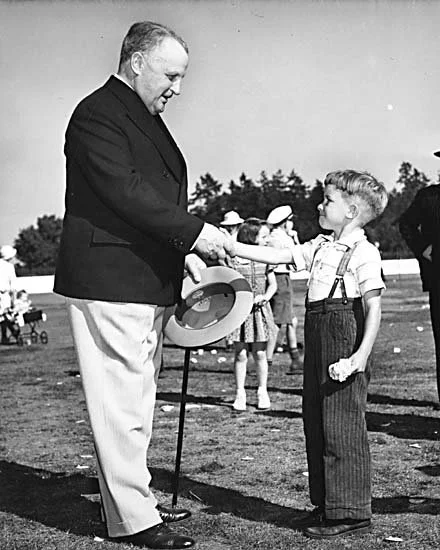
Onetime BC Premier Thomas Dufferin “Duff” Pattullo is the latest politician of earlier days to be excised from our maps. —Wikipedia
Hence this week’s BC Chronicles takes another look at today’s continuing campaign to revise the past by altering our landscape.
* * * * *
Let’s begin with Mr. Pattullo, B.C.’s 22nd premier, 1933-1941, and the latest to be toppled from his geographical pedestal.
As of now, the new Fraser River crossing between New Westminster and Surrey, which replaces the to-be-demolished Pattullo Bridge alongside, will be known in the Halkomelem tongue as Stal̕əw̓asəm—“a space where you can view the river”—Bridge. This is in recognition of, according to a Ministry of Transportation and Transit press release,”First Nations’ deep historical and current connections to the area”.
When what’s now the “old” Pattullo Bridge was officially opened Nov. 15, 1937, it was one of the province’s few real highlights during the decade-long Great Depression. Built over two years and two months, it cost $4 million—more than $84 million in today’s values. (At last report, the new four-lane bridge is expected to open this month once paving is completed.)
The Pattullo bridge was, in fact, so expensive that the Province charged a toll for 15 years.
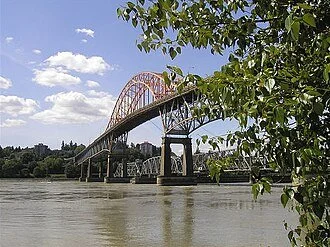
Now doomed to demolition, the 90-year-old Pattullo Bridge spanning the Fraser River between New Westminster and Surrey. —Wikipedia
But back to Mr. Pattullo (1873-1956). Born of Scottish descent in Woodstock, Ont., he started his career in the 1890s as a journalist and came to B.C. in 1908 after serving as secretary to the commissioner of the Yukon, and as acting assistant gold commissioner before turning to real estate and insurance while serving on Dawson City Council. He launched himself provincially as mayor of Prince Rupert before being elected to the Legislature in 1916.
Obviously a man of promise, he served as minister of lands until the Liberal government’s defeat in 1928 when he became party leader and leader of the opposition and, in the election of 1933, led his party to victory.
If ever there was an inauspicious time to become premier, this was it—mid Depression, with 10s of 1000s of unemployed labourers, many of them First World War veterans, who’d taken to riding the rails cross-country seeking work, then to the streets in protest.
The Pattullo government chose to address this gargantuan social sore and growing threat to public order by extending government services and relief to the unemployed. The most outstanding program was that of work camps for unemployed men who laboured on civic projects such as roads and bridges in return for room, board and 20 cents a day.
Ironically, instead of solving the problem, or at the very least buying time, it became one of the greatest sore points of this contentious period in B.C. history, and one of the most memorable aspects of Duff Pattullo’s time as premier.
He achieved another niche in provincial history in 1937 when he and the federal government agreed in principle to B.C.’s taking Yukon Territory into the provincial fold!
This extraordinary move even caught the attention of Time Magazine, which reported, “BC Premier Duff Pattullo announced last week that British Columbia had closed a deal with the Government of Canada to take over Yukon Territory. As soon as British Columbia’s Legislature signs on the dotted line, that province will become, next to Quebec, the largest in Canada.”
Mrs. George Black, Yukon’s sole representative in the Dominion Parliament, was dumbfounded and reportedly exploded in anger because neither Parliament nor the prime minister had issued a statement.
It was easy to understand Ottawa’s willingness to shed itself of Yukon Territory which, Time continued, “has cost it nearly [$11 million] for its development with almost no direct return to Ottawa”.
We all know that went nowhere.
A political jack-of-all-trades, besides being leader of the opposition and premier, during his years in office Pattullo also served in various cabinet positions: Minister of Lands, 1916-1928; Provincial Secretary, 1927-1928; Minister of Railways, 1933-1937; Attorney-General, 1937 and 1941; Minister of Public Works, 1939; Minister of Education, 1941; Minister of Finance, 1941
Come the election of 1937, when many Canadian electors seemed to equate socialism with communism, Pattullo and party dared to go to the polls with a policy of “socialized capitalism,” a case of extraordinary measures in extraordinary times if ever there was one.
Ironically, it was the growing influence of the socialistic Co-operative Commonwealth Federation (CCF) that cost the Liberals their majority in 1941.
It also cost Pattullo his job; when he chose to run a minority government, byrefusing to ally with the Conservatives against the CCF. When several of his leading cabinet ministers resigned in protest, he was all but forced to take over the education, finance ministries and appoint himself attorney general. But his ouster quickly followed and the Liberals then entered into a coalition government with the Conservative Party over his strenuous objections.
Viewing him in historical perspective, Pattullo, like many of his generation and background, was, to quote Wikipedia, “vocal in his opposition to extending franchise to to minority groups, both during and after his tenure as premier. The concern raised was that if Chinese Canadians or Japanese-Canadians [served militarily] on behalf of Canada in WWII, these Canadians would return home and demand equal rights of citizenship.”
Horrors! To think that, in Pattullos’ and Attorney General Gordon Wismer’s words, “the oriental vote would be the deciding factors in a great many constituencies and you would face the possibility of having Orientals in Parliament”. Pattullo was convinced that Canada, even in time of great national emergency, would “never tolerate” giving them the vote.
As we know, the Second World War brought about the internment of all Japanese-Canadians but in the years immediately following the return of peacetime, both nationalities were awarded full citizenship with voting rights.
By then, Pattullo was gone from the provincial legislature, having lost his Prince Rupert seat in 1945 when, shunned by former fellow Liberals, he ran as an independent. He died in 1956 and is interred in Victoria’s Ross Bay Cemetery.
The Canadian Encyclopedia offers some kind words: “Faced with the tremendous economic and social problems of the Great Depression, Pattullo was innovative in extending the role of government. His frustration with the limitations of provincial power led to a battle with Ottawa that resulted in a reappraisal of Canadian federalism.”
The website britishcolumbiahistory.ca credits him with having fought the Depression by developing infrastructure and promoting economic growth with public works projects such as highways and bridge construction so as to create jobs and stimulate economic activity. (It worked for the American Democrats under Frank D. Roosevelt.—Ed. ) His government also provided social services such as public health insurance and expanded old age coverage while encouraging industrial development through the exploitation of natural resources throughout the province.
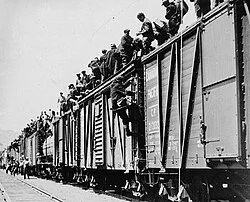
Unemployed B.C. labourers “riding the rails” on their On-To-Ottawa Trek that ended in bloodshed in Winnipeg streets. —Wikipedia
Somewhat ironically, his ministry’s attempt to shelter and feed 1000s of unemployed with relief camps during the Depression exploded in a strike in February 1938 that was broken up by police acting on his government’s order. He’s also blamed by some for setting the stage for the tragic On-To-Ottawa Trek that ended tragically in Winnipeg.
Besides building the bridge named for him, the Pattullo government opened the Lion’s Gate Bridge built with provincial funding in 1938, and the Dease Lake-Meziadin Lake Highway two years later.
Overall, again quoting bchistory.ca, “Pattullo’s tenure as Premier of British Columbia was marked by significant events...as well as important infrastructure projects...” Certainly, it was a time of incredible economic and social stress over which no level of Canadian government achieved any real influence; it took the outbreak of war in 1939 to reignite the national economy.
* * * * *
Pattullo’s fondness for the Yukon where he’d begun his career seems to have remained with him. In his Yukon Nuggets: Facts, Photos and News Radio, CBC broadcaster Les McLaughlin tells how Pattullo, then in his early 20s, was hired by Sir Wilfred Laurier’s government to serve as former NWMP Superintendent James M. Walsh’s secretary. The ex-Mountie had been appointed Commissioner of the Yukon Territory then at the height of international euphoria because of its gold strikes.
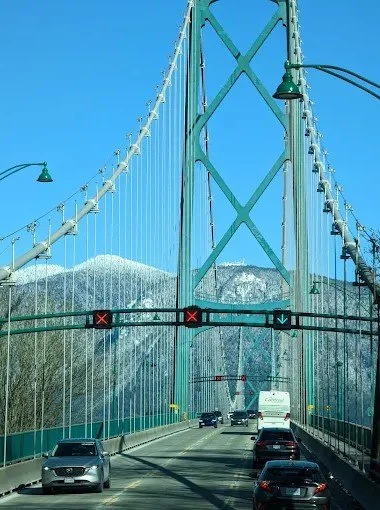
The Lionsgate Bridge was another of the very few major achievements during the aptly-named “Dirty 30’s”. —lionsgatebridgewebsite
To get there, the 50-man government party crossed the country by train then sailed north on the government tender S.S. Quadra to the Alaskan port of Skagway. From Dyea they begin the brutal ascent of the Chilkoot Pass. It was October 1897, windy, wet and freezing when they began their climb.
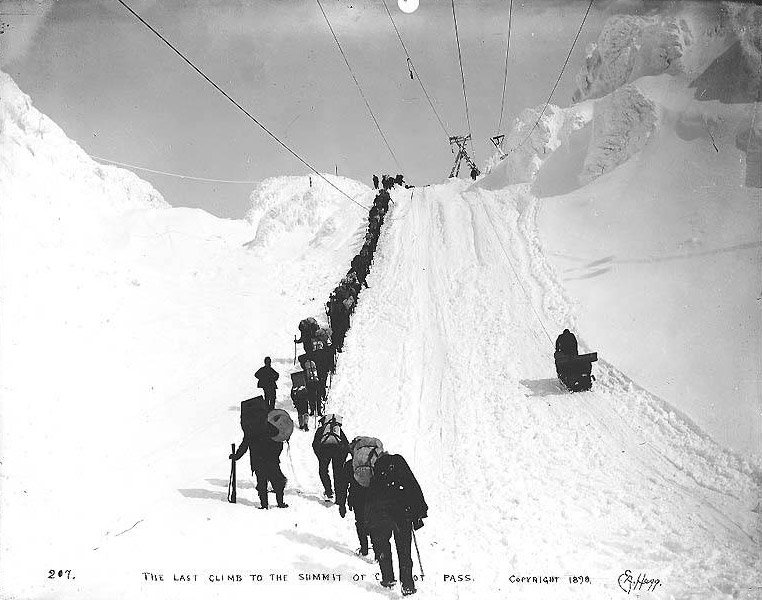
How many hopeful prospectors would be willing to ascend the Chilkoot Pass today? —Wikipedia
The Chilkoot Pass, with its winding streams of men back-packing their supplies over the snowbound summit in almost white-out conditions: it’s one of the most enduring ordeals of gold rushes of all time, having been captured for posterity by photographers who obviously were as hardy as the gold seekers themselves.
By then it was November, one of the worst times to hike overland in the Klondike, and the ordeal didn’t end with successfully scaling Chilkoot Pass; there were still the hardships of the trail and navigating the rapids of the Yukon River.
As it happened, the government was so late in the season they had to winter over in a Native camp, midway between what became Whitehorse and Dawson City. This, after Pattullo and his travelling companion J.J. Freeman upset their canoe in frigid water—Pattullo made it safely to shore but his companion didn’t. They finally arrived in Dawson in May 1898, eight months after leaving Ottawa.
It was a harsh life’s lesson for the young Pattullo who later wrote: “Every man who comes here must be willing to withstand every imaginable hardship.”
Mind you, he’d found his own way of enduring the hardships of the Klondike—his “drinking and rebellious” spirit almost costing him his job when Commissioner Walsh resigned under a cloud and was replaced by a less tolerant William Ogilvie. (Ironically, Ogilvie’s meddling with what had become accepted bureaucratic practice in the gold fields later cost him his own job.)
Although Pattullo took his duties as acting assistant Gold Commissioner seriously, when Ogilvie, too, fell out of favour with Ottawa and he was denied the post that he felt he knew best and had earned, he resigned from the public and went into real estate. Alas, as McLaughlin pointed out, Dawson’s boom days were over and he almost starved.
It was time to hone his political skills.
Elected to the executive committee of the Dawson Liberal Club, he ran for civic election and, in 1904, finished third of a slate of 24 candidates, securing him one of the six seats on city council. There followed a feud with the new territorial Commissioner whom he accused of being “unreliable, unpolitical, weak and wholly lacking in ordinary judgment”.
Pattullo felt so strongly on the issue that he abandoned the Liberal candidate and publicly aligned himself with the opposing Conservatives who won in a landslide in what broadcaster McLaughlin calls the most bitter election victory in Yukon history.
It also was the end of Pattullo’s tenure in the Yukon and he moved to Prince Rupert shortly after. Had he burned his bridges, politically and personally, in the gold country? Whatever the case, he resumed selling real estate and insurance and soon began his ascent to the B.C. premiership, the highest office in the province.
* * * * *
The famous bridge bearing Pattulllo’s name has long outlived him but now it, too, is coming to an end. Should we care? Or simply accept the fact that Thomas Dufferin “Duff” Pattullo, whatever his accomplishments and whatever his foibles, enjoyed a free ride of posthumous fame for 69 years?
He won’t disappear from B.C. maps altogether: Prince Rupert has Pattullo Park, there’s Mount Pattullo and the Pattullo Range in North Tweedsmuir Provincial Park, also the Pattullo Glaciers in the same range.
* * * * *
Did naming the New Westminster-Surrey crossing after himself in 1937 inspire Premier W.A.C. Bennett to later christen what was then the province’s largest dam after himself, and another dam and a bridge after favoured cabinet ministers?
