
The Mystery of Savary Island
Conclusion
So who killed Old Man Green and his assistant, Tom Taylor?
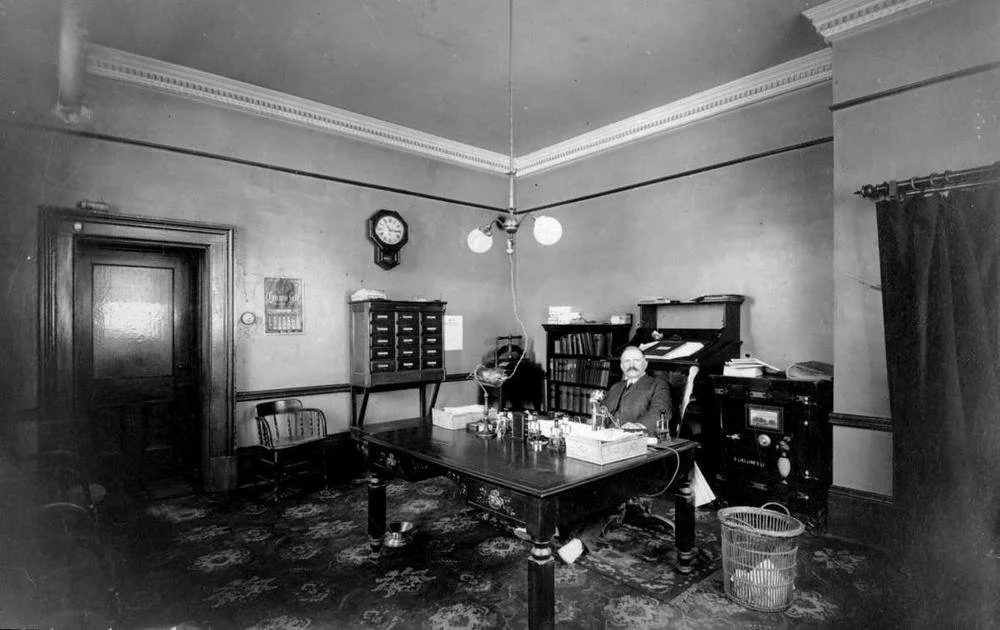
From his office in Victoria, BC Police Supt. Fred Hussey directed one of the most intensive manhunts for a killer in early B.C. history. —BC Archives
That was the mystery that puzzled BC Provincial Police Constable Walter Anderson, late in October 1893. But he was determined to find out, even if he had to sail every inch of the BC coastline in his small boat and question everyone he met.
As we’ve seen, it began with the discovery of the bodies of John (Jack) Green and his assistant, Tom Taylor. Savary Island’s first settler, 76-year-old Green was reputed to have amassed a fortune by selling trade goods, fresh meat, eggs (and, it was alleged, illicit booze) from the store adjoining his cabin on Green (Mace) Point.
Business was good; many had seen him flashing a billfold crammed with 10- and 20-dollar bills.
All that ended, savagely and suddenly, with a volley of shots from a Winchester—so obvious to Anderson and Justice of the Peace and Coroner Mike Manson of Cortes Island, who’d responded to a message of murder on Savary Island.
Their point-by-point reconstruction of the double slaying made the killer’s attempt at disguising the crime almost comical. Although both men lay on or clutched shotguns, suggesting that they’d shot it out, they’d been killed by a rifle, probably a .44 Winchester. Same for the holes in the walls. Not to mention the fact that both shotguns in question hadn’t been fired in months—were, in fact, still loaded! The killer had also neglected to retrieve his spent cartridges—for the Winchester.
Topping it all off, Green’s right hand still clutched his pipe!
* * * * *
All that Constable Anderson had to go on was a Lund saloon keeper’s tip that a drifter named Hugh Lynn had told him of going to work for Green when he bought six bottles of whisky, just days before the murders. But, despite weeks of cruising the Inside Passage and questioning everyone he met, Anderson had learned nothing more about Lynn beyond the fact that he travelled with his common-law wife and her young son in a distinctive red rowboat.
Not so, thought John F. Bledsoe, the “big, jovial, keen, grey-eyed” reporter for the Vancouver Province.

Years later, B.A. ‘Pinky” McKelvie, having known fellow newspaper reporter John Bledsoe personally, told the story of the Savary Island murders. —Author’s Collection
As fellow journalist B.A. 'Pinkie' McKelvie recalled years later, in a typescript in the possession of his family, “It was late in November 1893 when Bledsoe arrived back in Victoria from gathering material for a series of articles [on] the mining regions on the Mainland. He found that everyone was talking about the vicious murdering of two men in a lonely spot on Savary Island... Hugh Lynn, a man of good parentage, the Indian woman with whom he was living and her son were missing. They had completely vanished...”
Bledsoe began following the case and as more weeks passed and police became more convinced that Lynn and his companions had also been slaughtered by the assassin or assassins unknown, his hunch that this was not so grew stronger. The police weren’t going about it the right way, he argued to British Columbia Police Superintendent Fred Hussey.
Hussey wasn’t amused. If you’re so smart, he taunted Bledsoe, why not go after Lynn yourself; Hussey would even appoint him special constable.
Bledsoe apparently jumped at the chance and, armed with a report that Lynn's rowboat had been sighted headed north towards Seymour Narrows, he decided to kill two birds with one stone by visiting the Savary Island murder scene before taking up the scent.
As it happened, the boat sighting was incorrect and, noting that police had focused their investigation on Lynn, Bledsoe chose to concentrate on his consort, Jennie. Learning that she came from Bella Coola, he set out for that northern outpost in a bitterly cold and stormy January 1894. So bad was the weather that he was stranded for five weeks at Bella Bella before he could get a party of surveyors to take him the rest of the way.
An old woman told him that Jenny often stayed with her children at a Port Townsend area ranch she’d inherited from a deceased paramour. Bledsoe raced back to Victoria.
In the meantime, as Constable Anderson continued to press his own search ever farther afield without success, Fate took a hand in the manhunt. Loggers near Comox found a skiff washed up on the beach; a skiff positively identified as belonging to Hugh Lynn. Hurrying to the scene in a horse and buggy, Anderson made an interesting discovery: bird shot in the bilge. The tiny grains of lead corresponded with those he’d recovered from the grass beside Green’s store.
The boat also contained oars and fishing gear, although its mast and sail were missing. The skiff could have floated in from anywhere, but Anderson had found a woman at Bella Coola who knew Lynn’s girl friend. Her full name, she said, was Jennie Bokito, from her marriage to an Italian at Port Townsend.)
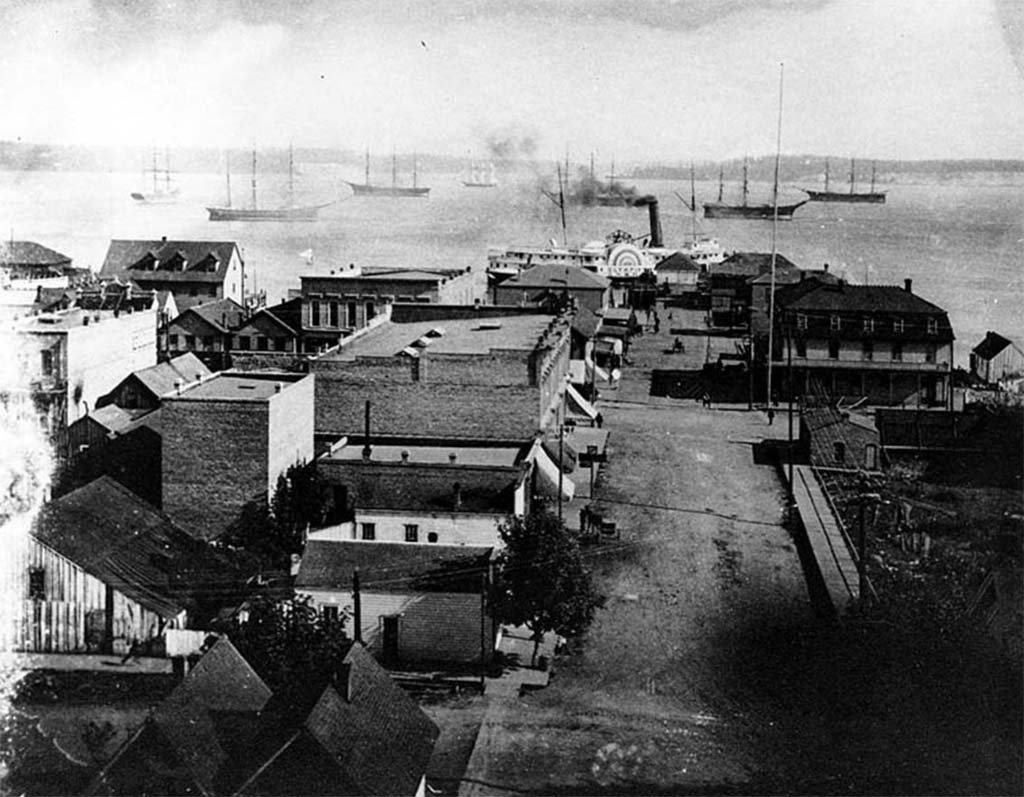
Port Townsend, ca. 1890. —Courtesy UW Special Collections (WAS0669)
Based on this information, Supt. Hussey immediately wired the latest information to Port Townsend. The sheriff of the bustling lumber town couldn’t find Jennie but he learned that she and an unidentified white man had gone to her rancherie in the Juan Islands. Supt. Hussey and Special Constable Bledsoe hurried to Townsend to hire a steam launch, pick up the Friday Harbor sheriff and his deputy, then pay a visit to Shaw Island.
Finding a cabin, the lawmen hid until dawn, then paired off, two officers taking each door. In position, Hussey hammered on the front door. As the officers waited tensely, they could hear someone beginning to stir inside.
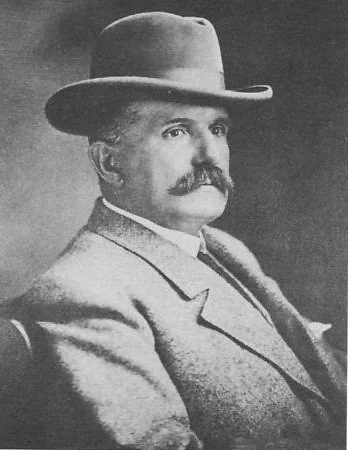
When Police Supt. Hussey banged on the door, a scruffy white man identified himself as Gallagher then quickly changed his mind. —BC Archives
When the door creaked open, Hussey found himself facing a tall, gaunt white man. Asked his name, he grunted “Gallagher” as he shook his head sleepily. Suddenly wide awake, he identified himself as “Newton.” Before Hussey could reply, the suspect wheeled desperately for his loaded rifle behind the door—to find himself clutching instead at Sheriff Thomas who’d sneaked in the back way.
The long manhunt was ended.
Months later, Hugh Lynn stood in the dock at Vancouver Assize court. It took five days for the Crown to present its mass of evidence that proved beyond a shadow of a doubt that he had cold bloodedly murdered Green and Taylor for the storekeeper’s rumoured fortune. Besides the damning facts uncovered by Anderson and Manson, Lynn’s weak claim of self-defence was shattered by Jennie’s testimony that he’d threatened to kill her and little Louis if she breathed a word of that October night on lonely Savary Island.
In earlier testimony, seven-year-old Louis had testified to having witnessed the murders but when he became confused under intense cross-examination his testimony was disallowed.
During the three hours it took the jury to render its verdict, the courtroom was described as having been “packed with a swaying mass of humanity,” so keen were the public to follow the trial. Sentenced to death, Lynn whiled away his last days conversing with his mother and his spiritual advisers. The day before his execution he was reported to be resigned to his fate, bearing up well and appeared to be “thoroughly repentant”.
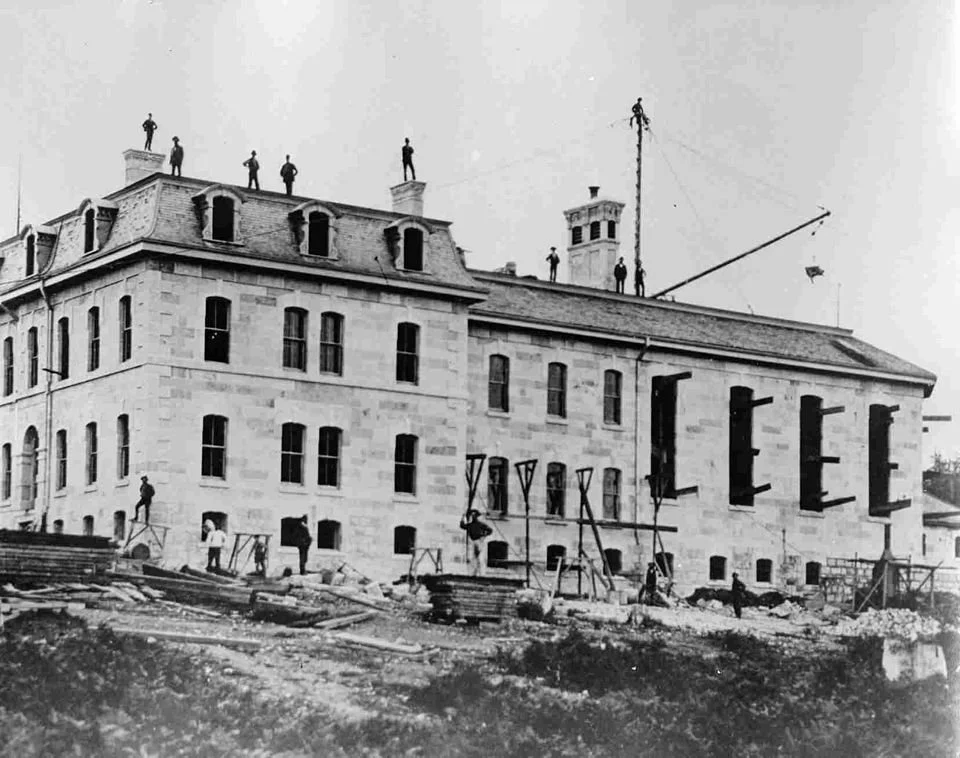
The BC Penitentiary under construction in 1877; here, Hugh Lynn went to the gallows for the murders of Green and Taylor. —Wikiwand
On his final morning, Aug. 25, 1894, he faced the end calmly in the New Westminster Provincial Jail. After a breakfast of steak, eggs, potatoes, toast and coffee, he strode to the gallows. According to the reporter for the Vancouver World, Lynn was the coolest man in the whole crowd, the Colonist noting that only an occasional facial twitch revealed the stress he was feeling.
His last words on the scaffold were, “I deserve all I am going to get, and a great deal more.”
When the hangman placed the noose around his neck, he apparently found it to be uncomfortable and moved it slightly with his hands. Seconds later, the executioner jerked the trap open and Lynn dropped into oblivion. Death from a broken neck was said to be instantaneous but, to be sure, he was left suspended for 35 minutes.
The stories of “Old Man Green’s” treasure had already begun to travel the length of the B.C. coast, thanks to the Colonist which had placed Green's savings at no less than $10,000. This seems to be an extreme figure when we remember that the purchase power of a dollar in 1893 was 20-25 times that of today. Green's fat wallet of 10s and 20s, the strongbox in his store, sound reasonable enough—but $10,000? Even if this were so, was the treasure in bills?
Remember, too, that he’d paid the government to preempt most of Savary Island. How much money could he, realistically speaking, have amassed, no matter how successful his store and his alleged bootlegging?
Did Lynn get his savings? Lund saloon keeper Thulin said that when Green last visited his establishment, his pocketbook had been crammed with $10 bills; as much as $500, he guessed. Yet Jennie swore that Lynn had found no more then $50 after looting the store of three guns and cash. She’d watched him count the crumpled bills.
Which brings us up to date.
*****

Today, Savary Island is a summer vacationer’s dream destination. — www.bcseakayak.com/savary-island/
Today Savary Island’s sparkling white sand beaches are enjoyed by 100s of tourists each summer. Besides swimming and sunbathing, vacationers relax with fishing, boating, golfing, beachcombing, clam and oyster digging…and, perhaps, looking for Old Man Green’s treasure, which most researchers agree to be about $1,000. (If in bills, of course, it likely has long rotted away. But if in coins...)
Although Green’s store is long gone, the general site of the structure is still there. Most visitors land at the government wharf, within a short walk of the spot on Green’s Point. Years ago, for some reason, Savary’s handful of residents apparently believed the money to be buried on Indian Point, at the opposite end of the island.
Treasure hunters will find digging in Savary’s sandy soil to be reasonably light work. Best of all, they know they don’t have to go deeper than eight feet. That’s the level where you hit fresh water, as Savary Island sits on a subterranean lake.
For the treasure hunter who likes to mix 'business”' with pleasure, British Columbia’s “jewel of the Pacific” is the ideal solution. No lovelier ‘X’ has ever marked the spot on a British Columbia map of hidden wealth. (Actually, if you were to find a map purporting to show Savary’s lost loot, you could consider yourself extraordinarily lucky–or fleeced.)
