
The Mystery of Savary Island
Part 1
To Englishman John (Jack) Green goes the honour of being Savary Island's first permanent resident. After years as a placer miner in the American Southwest, followed by some successful real estate ventures on Vancouver Island, he first set eyes on the island in the Strait of Georgia, northwest of Powell River, as a seagoing trader.

Today, Savary Island is a summer vacationer’s dream destination. — www.bcseakayak.com/savary-island/
He was 69 when he preempted 160 acres, built a one-room cabin with an equally humble store attached, and erected outbuildings and a cottage on the beach for his First Nations clientele.
He sold the usual goods and foodstuffs, and fresh pork and mutton from the 300-odd animals he let roam loose on the island. Not to mention, (so police suspected) illicit liquid refreshment on the side.
By the age of 76 he’d visibly prospered, many having seen the cash-box in his store, and a wallet choked with 10-20 dollar bills.
One of those who saw old Man Green’s treasure resolved to make it his own.
Hence this week’s BC Chronicle, The Mystery of Savary Island, a fascinating tale of murder and lost treasure.
* * * * *
By the time Green settled on what became known as Green (now Mace) Point, he was old and arthritic. But that didn’t stop him from prospering as a storekeeper and suspected bootlegger. He began buying up more of Savary Island (almost 800 acres in total), paying the Crown in cash, and he hired an assistant, Tom Taylor. By all appearances, they got along well together.
The tragedy began to unfold on the grey morning of Oct. 30, 1893, when loggers Dick Lewis, Norman Smith and Albert Hanson called at Green’s trading post. When the jovial trio stomped noisily up the path of crushed shells to the store, to their surprise, although it was after 10, the door was locked. Then they noticed that no smoke came from the chimney of the store or cabin, connected by a breezeway. In fact, the place was deathly quiet.
Marching to the cabin door, the loggers pounded on the rough planks. “Hey, John, customers! How’s about some service?” When no answer came they tried the latch and the door creaked slowly inward to reveal a scene of horror.
Green’s spartan one-room quarters were even messier than usual. Besides the crude furniture, household items and empty liquor bottles, the cramped shack now contained two bodies and pools of congealing blood. The startled loggers wasted no time in beating a hasty retreat; Green and a companion had been dead several days; the stench and blood-spattered scene were overpowering.
Back on the beach, the men held brief council, deciding that Lewis and Smith camp there while Hansen sailed their sloop across to the little mainland settlement of Lund for help.
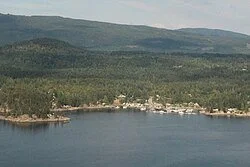
Lund (klah ah men), B.C. where Old Man Green foolishly flashed his wallet stuffed with 10 and 20 dollar bills. —Wikipedia
Word of the tragedy was relayed to Justice of the Peace and Coroner Mike Manson of Cortes Island, who immediately steamed northward in his little launch Stella, as British Columbia Provincial Police Constable Walter B. Anderson brought a doctor from Comox; each arrived the evening after discovery of the bodies.
En route, Manson had recalled the little he knew about storekeeper Green, or “Old Man Green,” as he was commonly known along the coast, other than that he’d become Savary’s first settler when he preempted 160 acres at the southeast end;. And how, even though almost crippled by arthritis and able to move about only by using two saplings as canes, he’d managed to axe a clearing and erect a cabin and store.
He scratched out a simple existence by selling staples and hardware to passing Indians and whites. Sometimes he traded an odd fur. His most popular line was fresh meat; there were always customers for his sheep, pigs and chickens. Not to mention, thought Manson with a wry grin, liquid refreshment for anyone, White or otherwise, with enough money to buy liquor.
He knew, too, that Old Man Green did more than just get by.
More than once, wide eyes had eagerly scanned his wallet. Whenever he visited the saloon at Lund, he unabashedly displayed a thick roll of bills; bills which seldom were less than 10s and 20s. And, as hungrier spectators had whispered, there were no banks nearer than Vancouver or Nanaimo.
These thoughts had run through Manson’s mind as he had chugged northward. Now, with Constable Anderson and the doctor, he set to work.
At first glance the cause of death seemed obvious: Green and his companion in death, identified as 50-year-old Tom Taylor, had quarrelled and shot it out, their duel ending in a bloody draw. Old Green sat behind the door, a shotgun at his side, a gaping hole in his chest. Taylor, his assistant of a few weeks, lay face down in the middle of the room, also atop a shotgun. The log walls were peppered with shot.
But it didn’t take long for veterans like Manson and Anderson to realize what had really happened: Both men had been murdered by a third party, probably with robbery as the motive.
Within an hour of their arrival, both officers were shaking their heads in wonder at the incredible ineptitude of the murderer. At the trial, months later, the defence counsel would describe his client as having an “immature mind.” Just how immature, the investigators could scarcely believe.
Their point-by-point reconstruction of the double slaying made his attempt at hiding the crime almost comical. For a start, although both men lay on or clutched shotguns, they’d been killed by a rifle, probably a .44 Winchester. Same for the holes in the walls. Not to mention the fact that both shotguns in question hadn’t been fired in months—were, in fact, still loaded! The killer had also neglected to retrieve his spent cartridges—for the Winchester.
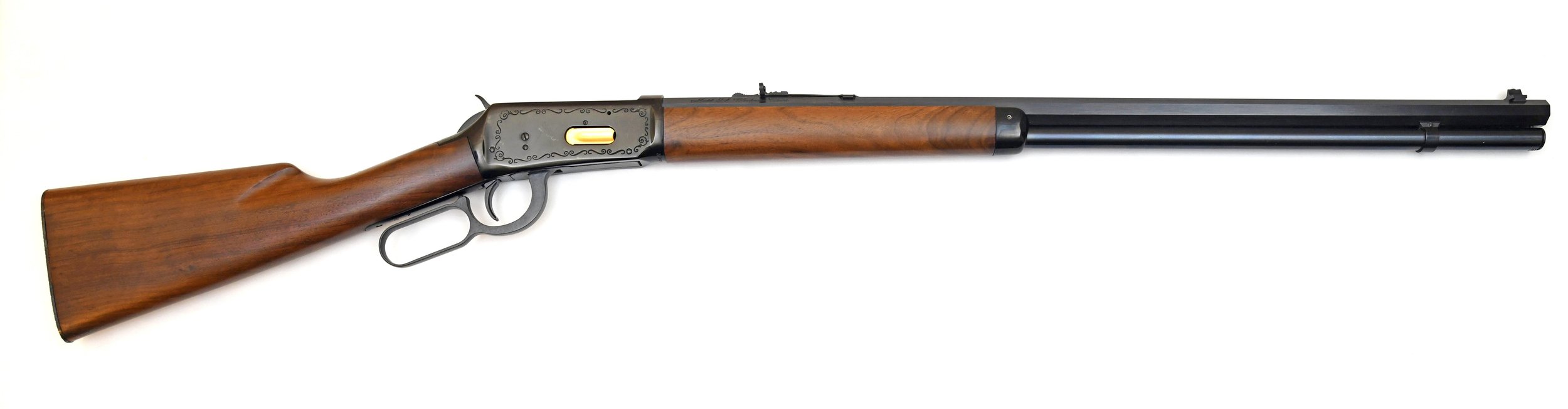
How could the murderer have been so stupid as to think that police couldn’t tell the difference between wounds from a shotgun and a rifle, likely in this case a .44 Winchester? —www.bradfordsauction.com
Final evidence that it couldn’t have been a duel was the fact that Taylor’s right hand still clutched his pipe!
Split cedar canes poked into the bullet holes dotting the walls indicated that the killer had fired from the centre of the room. He’d been standing, as his shots had taken a slightly downward track. Green probably had been the first to be shot. He’d been sitting by the door when struck and, as he slid to the floor, the old man had clawed desperately at the chair, then the china doorknob.
Bloody fingerprints showed his last, feeble efforts.
Taylor had been in bed, perhaps asleep, when aroused by the blast. As he sprang up, a second shot caught him point-blank in the chest, knocking him to the floor. The killer had then ransacked the cabin, emptying Green’s wallet, although in his haste he overlooked a small cash box in a trunk which contained several gold and silver coins.
The doctor deduced they’d been killed four days earlier, about October 26th. One of the shots had smashed a clock, stopping it at 10 minutes past 10. Whether it had been 10 in the morning or evening, he couldn’t determine.
Examination of the cabin completed, Constable Anderson moved to the store. The door was still locked, as the loggers had reported. But a side window had been forced, a muddy footprint on the sill confirming how the killer gained entry. Kneeling, the observant lawman combed the grass with his fingers and retrieved several grains of bird shot. More obvious had been a plug of tobacco which the slayer must have dropped when leaving.
Anderson pocketed the articles, then entered the store. It, too, had been looted, although he had no way of knowing just what had been taken.
When the police left Savary Island to continue their investigation at Lund, they knew one fact about the murderer. Considering the number of empty bottles littering the cabin, there’d been a drunken party. It was safe to assume that the killer had been one of the merry-makers, that, up until the last, lethal moments, Green and Taylor had thought him a friend.
But if uncovering the bumbling slayer’s attempt at hiding his crime had been easy, Manson and Anderson were to find that catching him was something else altogether. When provincial police officers finally did snap handcuffs on the murderer, they’d chalked up one of the most intensive manhunts in B.C. history.
As Manson’s steam launch thumped loudly across the Strait to Lund, he and Anderson discussed the bizarre case. Their first thought was that it must be the work of Natives as they’d found a freshly-emptied whisky bottle in a shack on the beach where Green allowed his Indigenous clientele to camp overnight.
But Lund hotelkeeper Charlie Thulin provided a fresh lead. He’d last seen Green about 10 days before the murders, when the old trader had paid his bar bill from a wallet crammed with large bills. One evening a week later, a drifter named Hugh Lynn had swaggered into his saloon with a written order from Green for another six bottles of whisky. As Thulin had helped him carry the precious load to his boat, garrulous Lynn had announced he was the storekeeper’s new assistant.
And on that tantalizing clue, the trail seemed to end.
Weeks passed without trace of the mystery man. When Manson had to turn his attention to other pressing matters, Anderson assumed the lonely hunt. But before Manson left the case, he and the constable had learned something about the missing 35-year-old drifter.
The son of one of the original Royal Engineers assigned to the infant colony in 1858 (Vancouver area's Lynn Canyon and Lynn Canal are named for the father), he’d early strayed from his family. While they were content with carving out a homestead from the wilderness, young Hugh preferred the easier life of living off the land—and unsuspecting settlers. With a common-law wife named Jennie and her six-year-old son, Louis, he roamed up and down the coast, fishing, hunting and trapping.
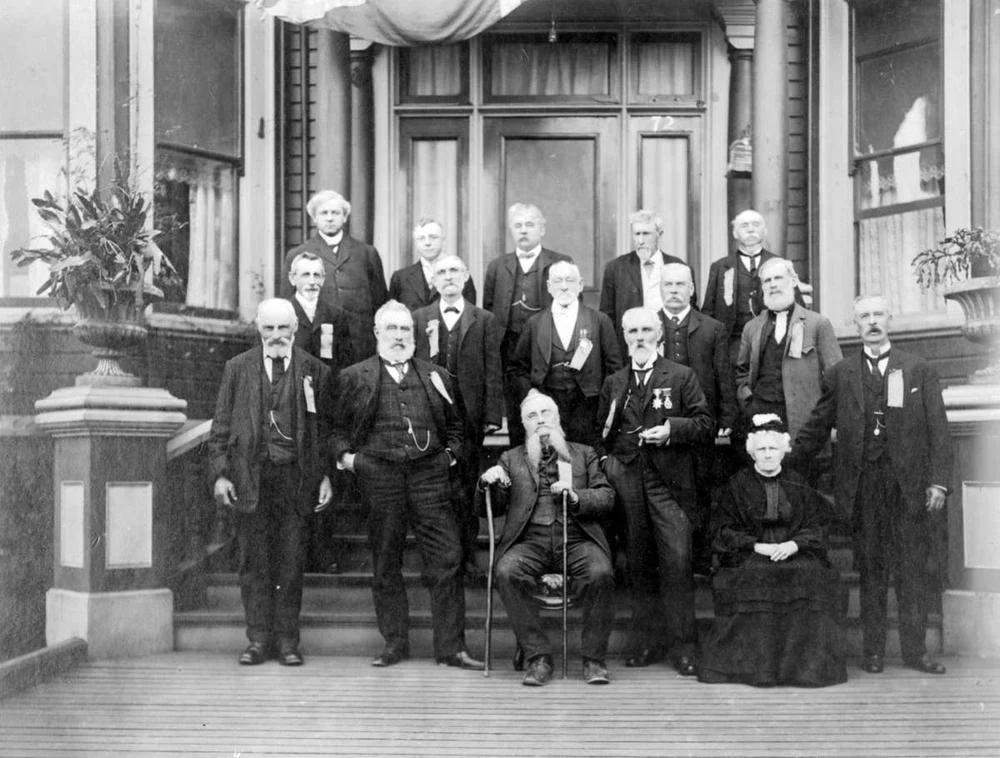
A group of former Royal Engineers who helped tame the B.C. wilderness pose with BC Premier Sir Richard McBride in October 1909. Hugh Lynn, alas, was no chip off the old block. —BC Archives
This somewhat precarious life was supplemented by the occasional pilfering of unwatched property and stock. Because of this bad reputation, Victoria’s British Colonist had no hesitation in naming him as the chief suspect in the Savary Island murders.
Weeks became months, Anderson continuing alone. His determined search was by means of a small sailboat, with which the persistent officer poked into every isolated camp, quiet inlet and settlement to be found for 100s of wearying, sometimes stormy miles of rugged northern British Columbia shoreline.
Always, he received the same answer: No one had seen Lynn nor his “family” since a week before the murder.
(To be continued)
