
Plunged to Death!
An Awful Accident to a Railway Train on the Union Colliery Line
Six Men Reported to Have Met Instant Death– the Wires Down
Such were the headlines of the Victoria Daily Times, Aug. 17 1898:

The impact from plunging almost eight storeys shows graphically in this photo of the Trent River train wreck. —BC Archives
“The startling news was received in this city about noon to-day that a terrible catastrophe had occurred on the Union Colliery railway line early this morning, whereby at least six people had lost their lives.
“The news spread like wildfire, and the greatest interest prevailed throughout the day. The Times at once set the telegraph wires in operation to ascertain the full particulars of the accident, but owing to the fact that the wires are grounded only the most meagre particulars could be obtained...”
Well, the telegraph wires aren’t grounded now, so here’s the full story of Vancouver Island’s worst train wreck.
* * * * *
Both Victoria newspapers, the Times and the Colonist, scrambled to go to press with the latest news but the Colonist, a morning paper, had already published that day, meaning that the Times was first up at bat “with only the meagre particulars” because of the telegraph being down.
“As far as can be learned, the accident took place when the regular work train, with a passenger coach attached, was on her run down early this morning. The trestle is about 80 feet high, and the train plunged through the structure. Six people at least have been killed, but the names are, of course, unknown.
“A special train left the E.&N. station about 3 o’clock, having on board [Union Colliery owner] James Dunsmuir, Superintendent of the E.&N. Jos. Hunter, engineers of the road and other officials. A gang has been placed at work in restoring the line, and it is probable that communication will soon be restored.”
The collapsed trestle spanned the Trent River, about midway between Union [Cumberland] and the shipping wharves at Union Bay. Erroneously reported to be from 125 to 130 feet high and 400 or 500 feet long, it had been built 10 years before. Already, with hardly any hard facts to go on, the Times was pointing fingers:
“Although considered reasonably safe for light locomotives, it was, it is said, altogether unequal to sustaining the weight of an 88-ton engine and tender”.
As far as could be determined, a work train with a passenger car, southbound from Cumberland to Union Bay, had crashed through the Trent River trestle and at least six persons had been killed. Armed with these few, frustrating details, colliery and railway owner James Dunsmuir rushed from Victoria at the head of an emergency relief expedition of engineers and workmen at 3:00 that afternoon.
With the telegraph lines still down, although crews were hard at work repairing the damage, further particulars still weren’t available the next day when the afternoon daily again published. This time, it reported that the accident had occurred the previous morning as the first loaded train of the day, bound from Cumberland to Union Bay, was crossing the Trent River with 20 cars, most of them loaded with coal.
When the bridge collapsed, the entire train—locomotive, tender, passenger car, and coal cars—plunged 90 feet into the rocky riverbed with its hapless humanity, “the majority of those on board...meeting death or receiving injuries so serious as to make their recovery problematical”.
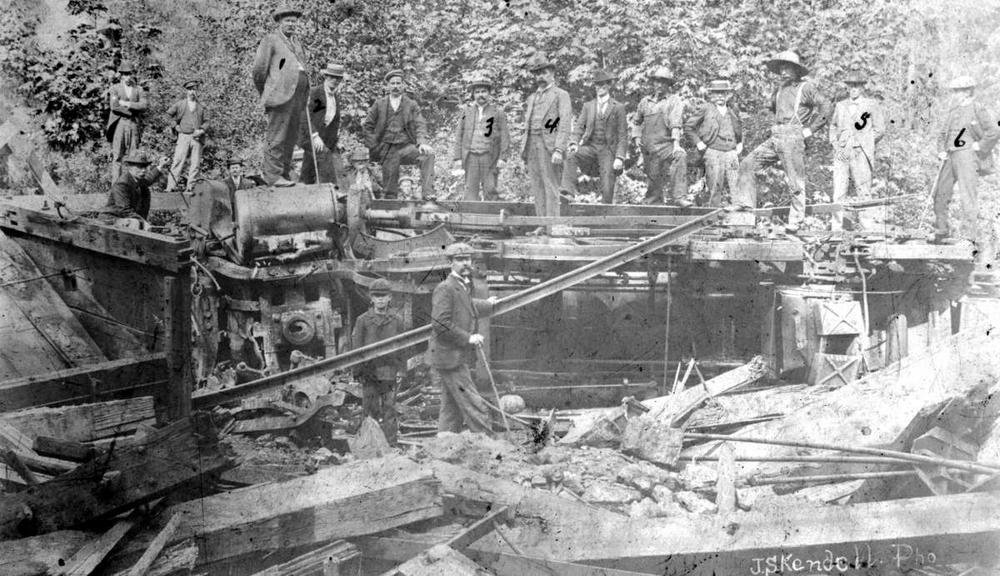
Lookee-loos pose for posterity atop the No. 4 locomotive. Almost incredibly, the Baldwin 10-wheeler, originally written off as a total loss, was rebuilt and went on to serve until the railways shut down in 1955. —BC Archives
Killed instantly in the crash was the train’s engineer, Alfred Walker, who left a wife and five children, his terrible injuries being described in gory detail. Like Walker, Alexander Mellado, brakeman, who also left a wife and infant child, had been horribly mutilated. It was initially reported that Richard Nightingale, aboard as a passenger, was returning from Cumberland on business when the accident cost him his life.
A second contractor, Walter Work, erroneously identified as William Work, who died of a broken neck, was a bachelor, the marital status, as well as the names, of the two Japanese workmen killed, not being immediately known.
Others had escaped immediate death, although their injuries were thought to be so severe as to make fatality inevitable. In critical condition were fireman Hugh Grant, who suffered two broken legs and a broken arm, and Miss Frances Horne, of Union Bay. Although she was badly scalded, it was hoped that she’d recover, Medical attendants also expressing hope of saving the life of Miss Lavilla Grieve, who’d been cut and burned.
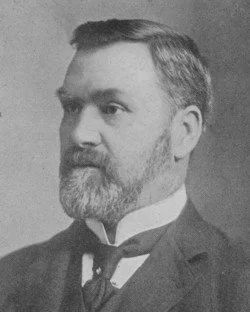
Union Colliery owner James Dunsmuir rushed north to oversee rescue and recovery operations. —Wikipedia
The train’s second fireman, Matt Piercy, had not only escaped sure death, but serious injury. Asked us to the events leading up to the crash, he replied that it was all over in a moment, that he’d had no time to even appreciate what was happening. As the trestle began to buckle, he’d instinctively leapt from the locomotive, just as it began its death plunge.
Landing on the bridge, he clutched the timbers for dear life as the trestle swung and pitched in its agony. With “a grinding and splintering of timbers, a crash, a plunge of heavy bodies, a sound of rushing steam, and a chorus of shrieks... men were hurried into eternity.”
For several, horror-filled moments, the appalled fireman stared into the chasm below as smoke and dust billowed upward and about him. Peering into the gloom, Piercy called again and again for his comrades. But there was no answer beyond the death groans of the work train.
“When the first rescue party reached the scene, the engine lay on its side—a mass of tangled iron spread over a pile of boulders, and surrounded by the debris of the bridge. On the other side were heaps of coal and coal cars while twisted rails, pipes from the engine, tangled timbers, and beams were strung everywhere.”
Incredibly, two men had not only witnessed the accident but had narrowly escaped death themselves. Workmen Nicholas Walker and William Hall had been waiting under the bridge for contractor Nightingale—who was due to inspect the structure “and make repairs where they were found [to be] necessary”.
Just seconds before the train would have stopped to permit Nightingale to disembark, it had begun its plunge!
Even before the steam and dust had cleared, Bell scrambled to the right-of-way and began the seven-mile run to Union Bay for help. Upon his breathless, near-exhausted arrival, “hundreds of willing hands” rushed to the scene to begin the gruesome job of extricating the dead, dying and injured from the debris.
As word of the disaster spread, the region was plunged into “deepest sorrow;” once again, tragedy had befallen the tight-knit coal mining community whose members closed ranks in sympathy with the bereaved.
In the meantime, the special E&N relief train carrying Dunsmuir and company executives had reached the site. As for the injured locomotive and cars, the official verdict was an immediate, damaged beyond repair.
Late that afternoon, Victorians learned a little more about the " Union horror " when the Times again published. Sadly, engineer Walker’s widow had learned of his death while in Victoria with one of their young daughters who was about to undergo an appendectomy. Brakeman Melldado, the son of the head carpenter at the colliery, left a young wife and child, as previously reported. As with Walker, his injuries were described in the greatest detail, readers of a century and a-quarter ago apparently sharing the same fascination for gore as many movie watchers of today.
Fortunately for the parents of 18-year-old Walter Work, his injuries had been confined to a broken neck, meaning he died instantly; details were brief. For the widow of contractor Nightingale, the former Nanaimo alderman's death came as a double blow, the funeral of her only brother taking place the day after her husband was lost in the Trent River bridge collapse.
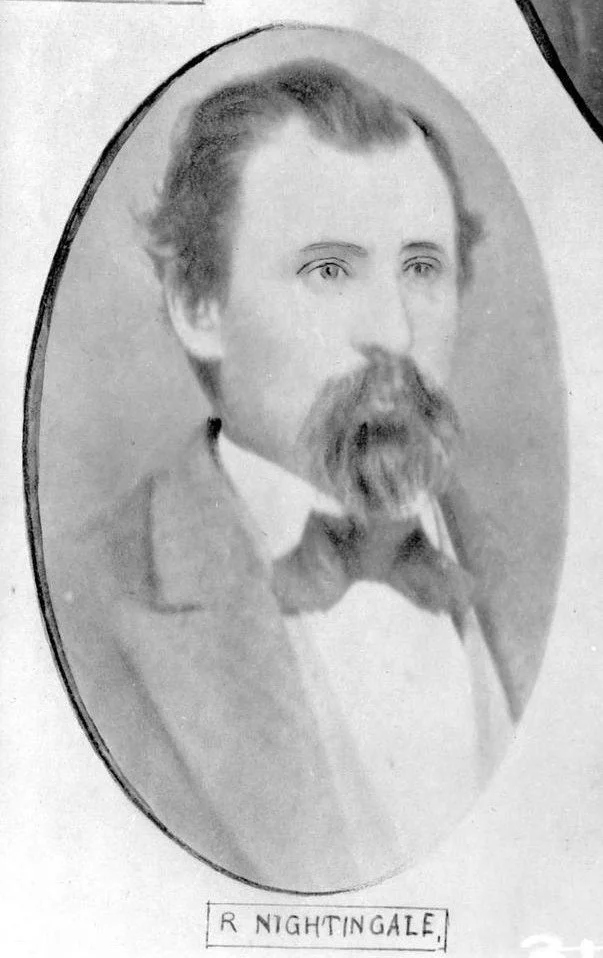
Richard Nightingale, working as a contractor in August 1898, served five terms on Nanaimo City Council. Just minutes before he was to leave the train to examine the Trent River bridge, it collapsed; he was among the six instantly killed. —BC Archives
As Miss Horne and Miss Grieve remained in critical condition, workers continued to probe the wreckage amid the ruins of the trestle and in the rocky confines of Trent River.
The doomed locomotive, it was reported, lay on its side, “smashed into a mass of twisted, battered metal, with the bridge timbers piled around;” the wrecked cars, 500 tons of coal and the indescribable mass of debris making up a scene “of awful disorder”.
By the afternoon of the 18th, the day after the wreck, all bodies had been recovered from the rubble and the funeral of engineer Walker took place the same day as the remains of Richard Nightingale and Walter Work were taken to Nanaimo. As for Miss Horne, doctors had despaired of her recovery, stating that death was expected momentarily. Happily for Miss Grieve, she appeared to be recovering, As was firemen Hugh Grant.
Yet another victim of the tragedy, the Cumberland-Union Bay right-of-way, was also expected to recover, although convalescence was expected to take the better part of a month while the bridge was rebuilt, more than 100 feet of timbering having been destroyed.
That evening, Frances Horne became the disaster’s seventh fatality as feared.
Despite earlier optimism, the conditions of Miss Grieve and Hugh Grant were also reported to be “giving cause for great anxiety”. In Nanaimo, contractor Nightingale's remains were taken to Hilbert's undertaking parlours, the funeral to be held the following day at 4 o’clock. A member of the Court Nanaimo Foresters’ Home, Nanaimo Lodge of Workmen, and the volunteer fire department, Nightingale had been a popular resident of the Hub city. The remains of Miss Horne and Walter Work also were brought to Nanaimo by steamer, August 20th.
Both Miss Grieve and Hugh Grant continued to improve, Dunsmuir and party of officials had returned to Victoria and, in Cumberland, Coroner Abraham prepared to open an official inquiry into the mishap. Three days later, “a party of bridge builders” sailed north on the Dunsmuir steamer Joan to rebuild the ill-fated span.
Remarkably, No. 4, the locomotive which crashed into the river bottom with the loss of seven lives in the worst train wreck in Vancouver Island history, lived to work again, despite having being written off as a total loss.
In his book Vancouver Island Railroads, railway historian Robert Turner notes that No. 4, an almost new Baldwin “10-wheeler," survived the 90-foot plunge, being rebuilt and restored to service. The powerful engine worked a remarkable 60 years more, not being retired until the company ended its railway operations.
The fatal Trent River bridge was also rebuilt but, unlike its victim, the No. 4, was returned to service only until a new, lower and safer grade and trestle could be built to span the river. Today, the Trent River is best known for its waterfall, trout fishing and fossils.
* * * * *
Inevitably, there were legal complications. Was the collapse of the trestle an Act of God, unavoidable and unforeseeable, or, as hinted at right at the start by the Victoria Times, was it common knowledge that the trestle couldn’t hold heavier locomotives?
Obviously, in response to the rumours floating about as to the condition of the bridge, within a week of the disaster, it was reported that the government would head the inquiry into the circumstances: “”No effort will be spared to probe the matter to the bottom and to place the blame where it ought to be placed.
“The government are now only awaiting the report of the coroner, which is expected to be received this afternoon or evening. This is perhaps the first time that a government of British Columbia has taken an active part in an enquiry affecting public safety, and has determined to see that the examination is conducted with thoroughness.”
It took years but Mrs. Nightingale finally won a settlement from the Union Colliery Co. for what then was the sizable amount of $9500. Previously, at the 1899 Fall Assizes, a jury had convicted the company of “neglecting to use reasonable care in maintaining the bridge so that it became unsafe, ran a train carrying passengers across, which train broke through owing to the rotten stat of the timbers, causing the death of six [six] persons...”
The case was appealed to the Supreme Court of Canada, the company attempting to avoid responsibility on the grounds that, according to the laws of the day, a corporation couldn’t be held criminally responsible for manslaughter, as was the case of individuals.
In October 1900, that court ruled that the Colliery was guilty of “criminal negligence in the discharge of duty,” and upheld the $5000 fine imposed by the lower court.
I've referred to the Trent River bridge collapse as Vancouver Island's worst train wreck. I'm splitting hairs: it involved a train- and locomotive as opposed to a streetcar/trolley such as that which plunged through the Point Ellice bridge in Victoria n 1896, killing 55..
