
Turning ‘Tails’ on the Game Warden
One of the benefits of being a regularly published writer is that one automatically becomes a ‘destination’. By this I mean, I rarely know who my readers are but they know me, and how to contact me.
And when they reach out it sometimes becomes a gift—more grist for my mill.
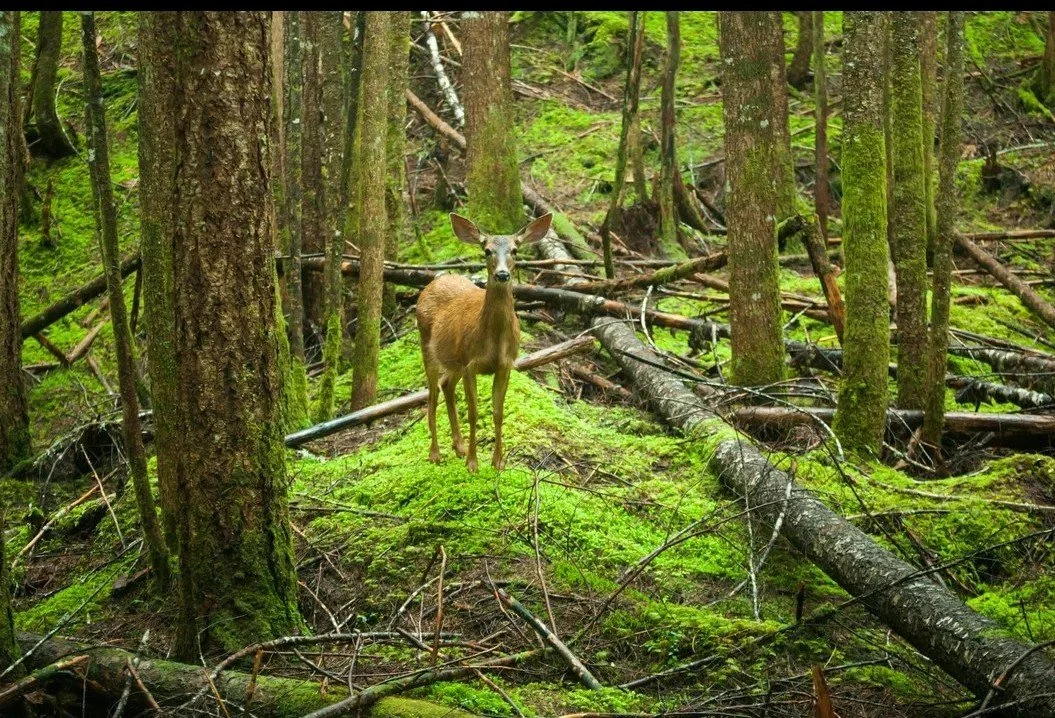
A blacktail doe innocently poses for the camera. Does can only be hunted during posted hunting seasons. —www.blacktaildeer.org/about
Years ago, I came upon a story identified as an unpublished manuscript by the late Peter Cheeke of Cobble Hill, in his day a rural community between Victoria and Duncan.
Mr. Cheeke was way ahead of his time; he liked to write about the paranormal, the kind of scripts later favoured by One Step Beyond and TV’s Rod Serling, host of The Twilight Zone.
Readers, TV viewers and movie-goers love that stuff today but, in the 1920s and possibly the 1930s when Mr. Cheeke was putting pen to paper (okay, the three manuscripts in my possession, courtesy of his son Peter Robert and grandson Ryan) are typewritten, he was avant garde.
But one manuscript, untitled and courtesy of Cheeke descendants, son Peter and grandson Ryan, is purely down-to-earth, the story of a hunter’s encounter with many a backwoodsman’s nemesis, the Game Warden.
Here’s Mr. Cheeke’s interview of a retired game warden...
* * * * *
I was lucky to find my old friend Frank Roberts, the retired game warden, at home. It had been my practice to drop in when passing by to pry out of him some amusing anecdote of earlier days. Frank was getting up in years but his memory was still good, and he liked nothing better than to recount to some fascinated listener his recollections of southern Vancouver Island at the turn of the century.
Today, as I found him pottering around his garden, I remarked aloud that his benign appearance belied his austere reputation; for, like others of his calling, Frank had been a strict upholder of the law; and it it had ever been his boast that he would, if need be, pinch his own father.
“Yes,” he replied, “we had to be plenty tough in those days, but I guess my bark was worse than my bite. We had more game to protect, and a larger territory to cover. Why,” he snorted, “d’ya know I worked out of Victoria clear up in Nanaimo, and patrolled the area on a push bike."
“How did you ever manage to get around a district that size?” I asked.
“Well, I'd make my headquarters in the more settled areas—Shawnigan Lake for example—put up at the hotel for a week or so, cover the district with my bike, and then push off for the next centre. Of course, there were fewer settlers and more bush country at that time; there were also fewer roads and the bulk of the hunters travelled up by the E&N Railway, dropping off at way points to hunt over their favourite hillside.
“The birds were well protected by the heavy bush, but with the deer it was different. For some years past large numbers had been slaughtered for the value of their hides—15 to 25 cents apiece. These were bailed and shipped to the States. While this practice was tailing off by, say, 1906, there were still some areas, particularly through the Jordan Meadows to the West Coast that needed close watching.
“The culprits were of course itinerant Hunters—sealers and the like, and not settlers.
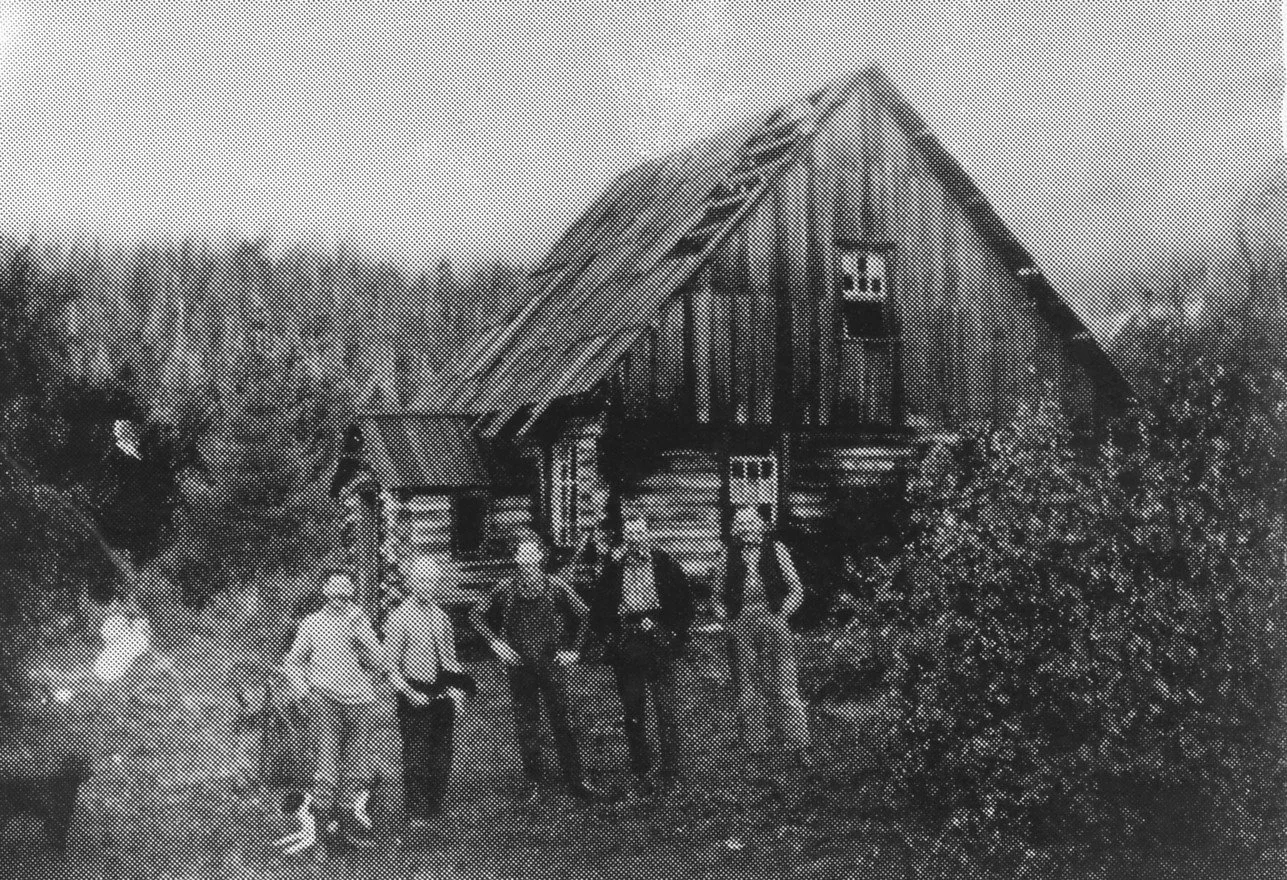
Once home to the Weeks family in the Jordan Meadows, in the Leech River area, this substantial cabin withstood the elements and vandalism for years. —Author’s Collection
“There were several well-constructed cabins on the Jordan Meadows Trail—one I remember had a fine stone fireplace that had been built by the late Mr. Weeks on the approaches to his homestead at the meadows. Built for the convenience of bon-afide travellers, these cabins made ideal headquarters for the hide collectors and I was obliged to burn them down, much to the builders’ annoyance."
“What sort of bunch were the legitimate hunters of those days?” I inquired.
“Pretty good on the whole, but one had to keep on one's toes. I mind one time in particular. I was off duty on sick leave at the time and the relieving Warden had a kind of fast one pulled on him near Shawnigan Lake. Personally, it hurt me as much as it must have hurt him. But, looking back, one can see the funny side. It happened this way:
Many years ago a hunter, bent on getting himself a deer in the Burnt Bridge region, found the Silver Mine Trail blocked by a fallen tree near Raymond's Crossing. Leaving his car at the block he reluctantly proceeded on foot—reluctantly as the day was hot and the way was long.
Reaching his hunting ground, he spied a fine buck and scarcely had the echo of his third shot died away when the bushes behind him parted and out stepped the local game warden.
“Your hunting license, please," requested that worthy. Our hunter slowly lay down his rifle and put his hand in his pocket. With a puzzled expression he rapidly emptied all his pockets in turn—but, alas, no license. “See here, I must have left it in my other pants when I changed."
“Oh, no you don't!” snapped the warden, “I've heard that yarn too many times before. Pick up that deer and bring it out." The hunter looked at the warden. “I seems to me it's your word against mine. If you want this deer as evidence against me, you can pack it out yourself.”
Today’s game wardens are known as Conservation officers. —Wikipedia
The game warden looked at the hunter. The justice of the remark was becoming painfully apparent.
With a baleful glance and a muttered “This is going to cost you plenty," the warden reluctantly heaved the carcass onto his shoulder and staggered off down the trail, followed by the hunter.
As I have said before, the way was long –it was in fact all of five miles—and the day was an undoubtedly hot; and the warden’s faltering footsteps were only encouraged by the sweet thoughts of ultimate revenge. The hunter, on the other hand, tripped lightly along, quite unabashed by the warden’s irritated suggestion that the latter might perhaps carry the rifle as well.
Following this pleasantry, the conversation had not unnaturally languished.
“Finally, the car was reached. The perspiring warden dumped the deer in the vehicle and ordered his companion to start off for the police station.
As if in further search of his license, the hunter again fingered his pockets. Suddenly, with a triumphant yell, he flushed from the depths of a watch fob pocket a slip of white paper..
“Thanks a lot, old pal, old pal. D’ya know that my first thought on dropping that buck was how in hell I was going to pack it out? And now, if you will kindly remove your bicycle from the back of my car, we will go on our respective ways."
“A few weeks later," Frank continued, "another hunter in the same area had shot a buck and a doe. Aware of the fact that the game warden would likely be encamped at the foot of the trail to check outgoing cars, our hero, not wishing to abandon the doe, elected to try a bit of subterfuge.
“First, he removed the doe’s head and threw it away. Next, he removed the buck’s head and cunningly rearranged it on the doe’s torso—taking particular care, in the absence of thread, in the overlapping of the folds of skin. Next, and most important to the success of the plan, came the skilful arrangement of the carcasses in the back of the car.
Surveying his handiwork, our hunter decided that with reasonable luck and without too much handling, the skin might work—as in fact, and to his extreme gratification—it did.
And thus it came to pass to this day that game wardens, acting on the theory that two heads are better than one, patrol the headwaters of the Koksilah in pairs.
* * * * *
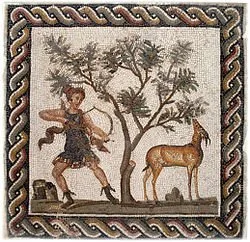
Deer hunting is as old as time; here, the Roman goddess Diana is about to shoot her dinner with bow and arrow. We can guess she didn’t have to concern herself with game wardens.—Wikipedia
Grandson Ryan Cheeke informed me that his father Peter “would love for you to use any of the stories that I sent to you. My dad grew up in Cobble Hill and came to Oregon as a grad student. He continued to work and teach at OSU until 2005, I think it was, when he retired.
“He taught Animal Science, Animal Nutrition, Animal Toxicology. He did a lot of research with rabbits in the 80's and early 90's. I am #3 of 4 kids. We all grew up on a small farm in Corvallis Oregon, as siblings [and] we all went different ways in life. I have a large farm with hundreds of cattle. My siblings are all vegan and my older brother used to be the #1 vegan bodybuilder in the World: Robert Cheeke.
“Dad just turned 84 last week. He has trouble seeing his Ipad and figuring out his email. My older brother is in town for a few months and I am hoping that he can work with my Dad on his laptop and my Dad will be able to communicate with you directly.
Thank you! Ryan.”
Actually, it’s thank you Ryan, your dad and your grandfather—TW.
