
The Shoppers’ ‘Bible’
For months now we’ve been watching the drawn-out demise of Canada’s oldest corporation, the Hudson’s Bay Co.
Major department stores have been failing in recent years; companies we grew up with, trusted and patronized while eagerly awaiting the latest catalogue in the mail from Eaton’s, Woodward’s, Sears and the Bay, to name the four biggest.
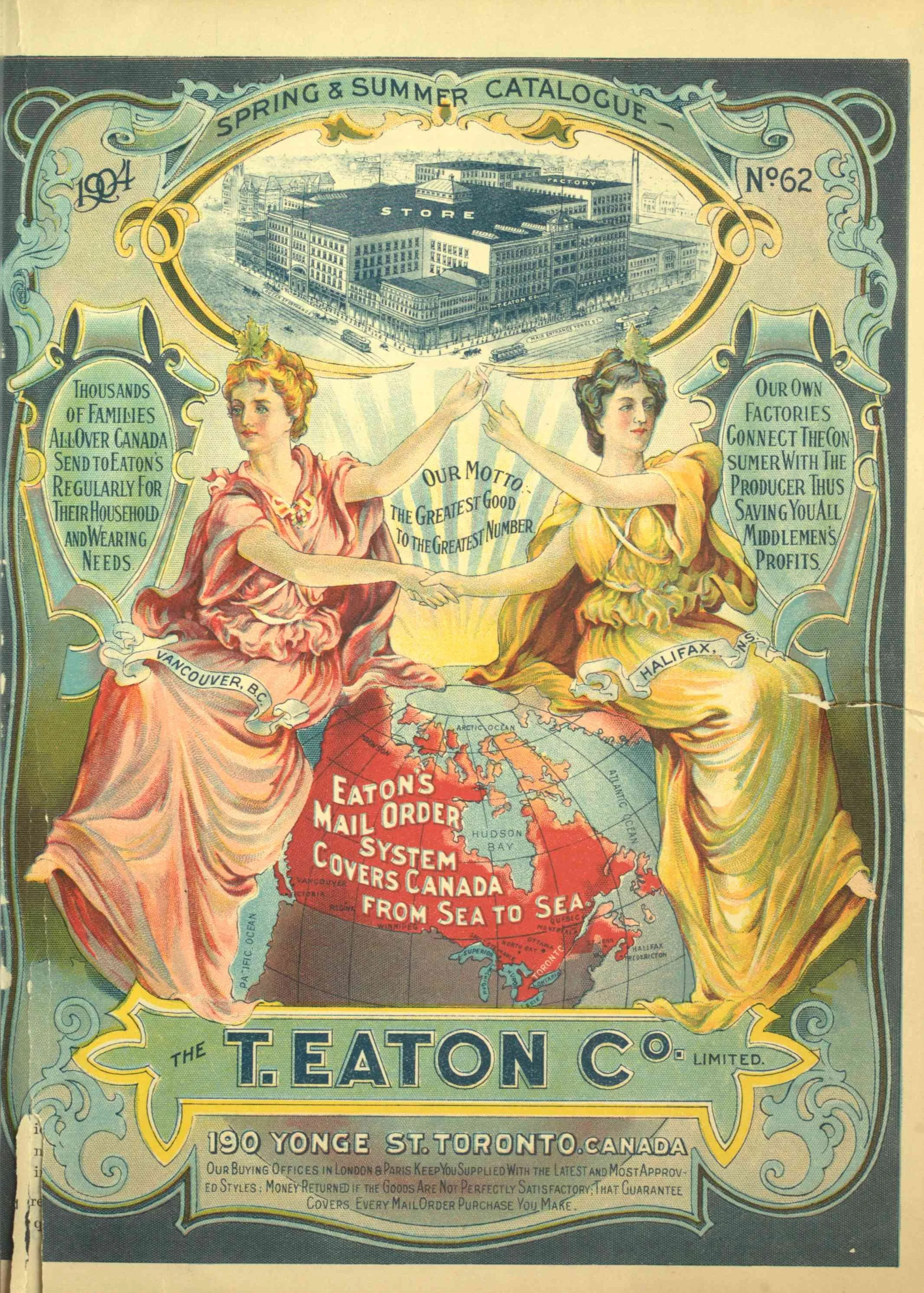
An early T. Eaton Co. Catalogue. —https://www.thecanadianencyclopedia.ca
Heaven forbid that I should jump the gun on Christmas. But I’m sure that I’m not the only one old enough to have lived in that golden age when “the catalogue” and approaching Yuletide were inextricably entwined, particularly for youngsters.
Department store catalogues were published quarterly (Spring, Summer, Fall and Winter) but the Winter issue, which arrived early in September when leaves were still on the trees and summer was dragging its heels, was to most kids, I’m sure, the unofficial launch pad for Christmas shopping.
I mean, seriously, how was a kid to know what he or she really wanted without mouth-watering temptations from the big department stores? On the flip side, it meant three months of forewarning to budget-conscious parents. Sometimes, some compromising, too—instead of that expensive 3-speed Raleigh bike, how about a (much cheaper)—?
My parents received all four company catalogues but, in our house, T. Eaton Co. was the hands-down favourite. I’m sure my parents had accounts—this was before credit cards, you understand—at all four stores but, as I say, Eaton’s seemed to win out. When it came to poring over the images of toys and other kids’ stuff, of course, I wasn’t so parochial but easy to please—I bet I was heading for teen-hood before I gave up cap guns.
But today’s Chronicle isn’t about Christmas, it’s about catalogue shopping which was as much a British Columbia custom as it was Canadian.
For a brief time, when Dad was away in the navy, my mother and I lived in Parksville. No department stores there, but I remember the Woodward’s man coming each week in his panel truck with whatever Mom had ordered the week before. By then, of course, she’d drawn up a new order, and so it went. Mostly groceries, as I recall.
We were living in Victoria when I visited my first department stores, Eaton’s (of course) and the Bay.
But having access to the real thing didn’t mean foregoing their catalogues. Those telephone book-size quarterlies allowed consumers to shop from home.
* * * * *
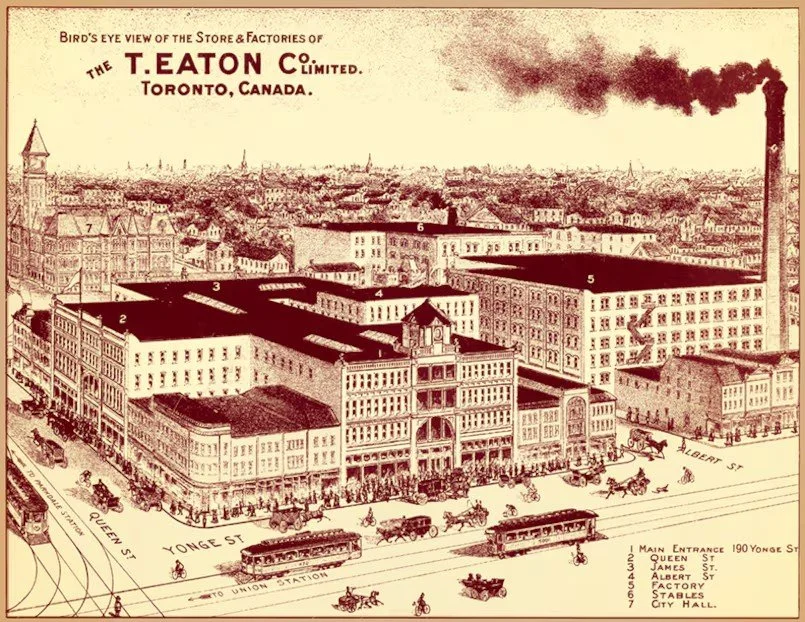
Long before “e-commerce” forever transformed shopping habits, the Eaton’s catalogue dominated the Canadian marketplace—and prompted three months of salivating anticipation among its young devotees, the author among them. —Wikipedia
Canadian department store catalogues, which would become an institution for most of a century, began in the 1880s. Timothy Eaton, who’d made his start in rustic Kirkton, Ont., published his first–-all of 32 pages—in 1884. Not having gotten to the point of mail order yet, he handed out his glorified pamphlets at the Industrial Exhibition (precursor to the Canadian National Exhibition).
His rationale was obvious: “Eaton’s,” by this time headquartered in Toronto, was small but Canada was vast—just think of all the potential customers across the country! Sure, Canada was sprawling, but even then it was well served by railways and Her Majesty’s mail.
(Simpson’s soon followed Eaton’s lead and prospered with its own catalogue, but today’s Chronicle is going to take my family’s precedent in favouring Eaton’s.)
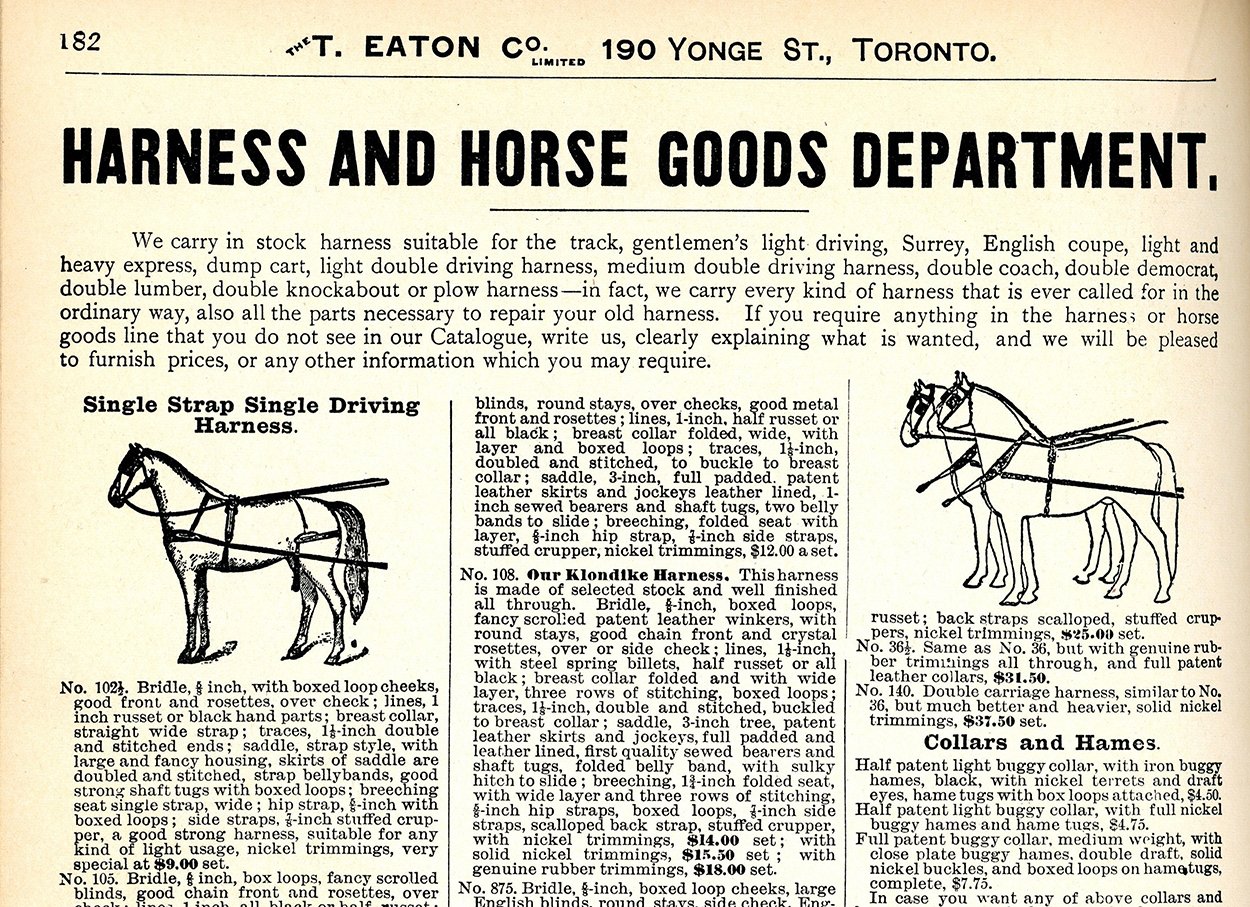
Canada was mostly rural in so it’s no surprise that much of the 1901 catalogue offers a good selection of farming implements and horse accessories. --Author’s Collection
So popular did the Eaton’s catalogue become that, in isolated western Canada, particularly on the Prairies, it was dubbed the Homesteader’s Bible—while also providing one of the first examples of universal recycling. Expired catalogues did double-duty for such useful purposes as wall insulation and toilet paper, among other uses.
(I actually saw a torn-up catalogue put to that use in a hunting cabin’s outhouse.—TW)
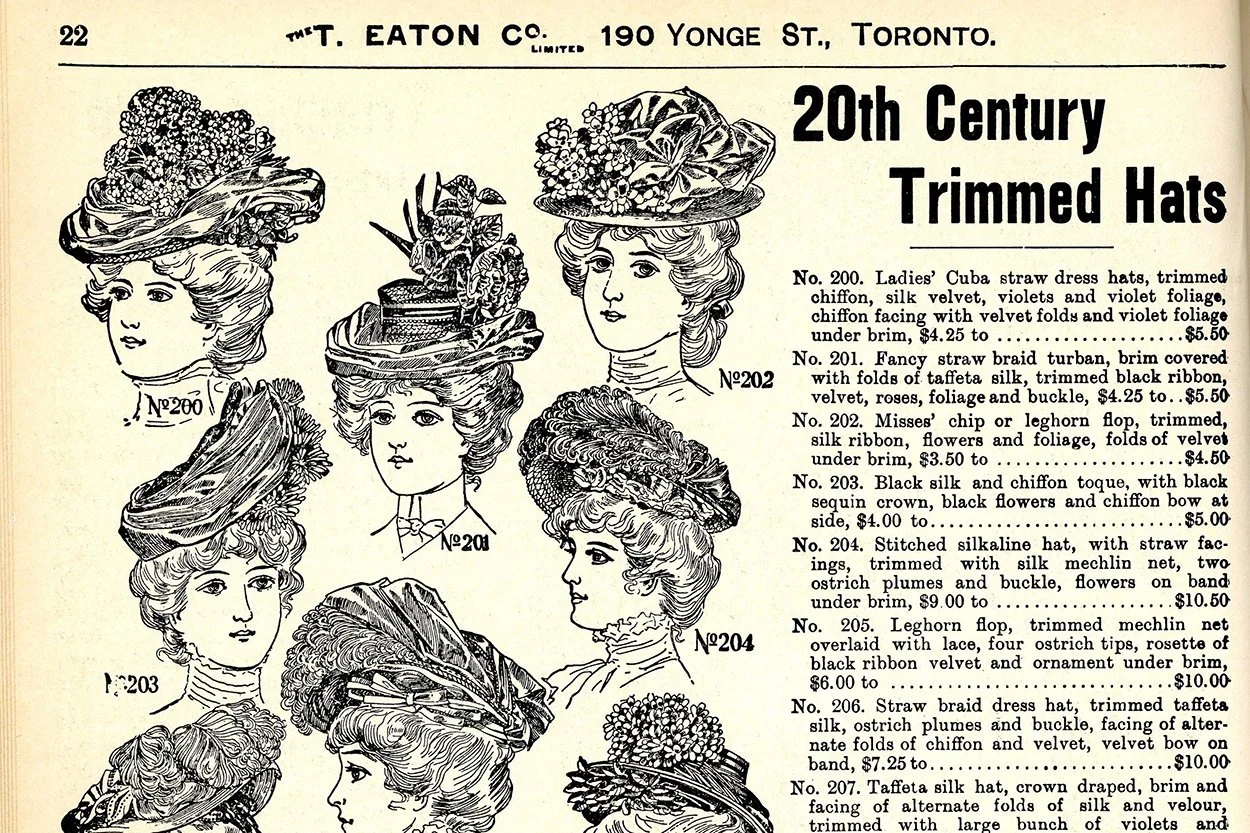
For the ladies and just in time for the 20th century—trimmed hats! —Author’s Collection
On a higher note, it’s said that catalogues also served as teaching aids in some rural schoolhouses lacking textbooks and real teaching aids.
Back to Eaton’s. The catalogue (printed for the first 35 years in English only) was an immediate “best seller’. It was distributed for free, of course, and within 12 years the store was processing 200,000 orders per year through its Toronto store, the catalogue’s popularity having been enhanced by the offer of gifts for referrals from existing customers. Originally printed in black and white and, for the first three years, in plain text, colour illustrations were introduced in 1915, photographs four years later.
As business boomed, goods were distributed across Canada from Toronto and the company’s two satellite locations in Winnipeg and Moncton.
As sales grew, so did the selection offered. No longer were customers restricted to ordering clothing, but now could choose furniture, china, books, farm implements, pharmaceuticals—even prefabricated houses. (I know of one here in Duncan.—TWP)
Indeed, Eaton’s had competition from Sears and the Bay, but, thanks to its catalogue sales, became Canada’s largest department store. Then began a long decline in a changing world—the same affliction that would claim Woodward’s, Sears and, latterly, the Bay. The last Eaton’s catalogue was published in January 1976, eight years short of the century mark, and 23 years before T. Eaton Co. folded forever.
Leaving us, today, with Amazon and the like—fast, efficient, usually cheaper, but totally impersonal “e-commerce”. What some, sigh, insist upon calling progress.
But not to despair! You can rekindle your days of childhood by ordering (digitally, of course), the 1975 Fall and Winter Eaton’s catalogue for a mere $41.99C plus shipping. You can also access other, older years, and reprints online.
All well and good, but I’m glad I have my memories of yesteryear, thanks.
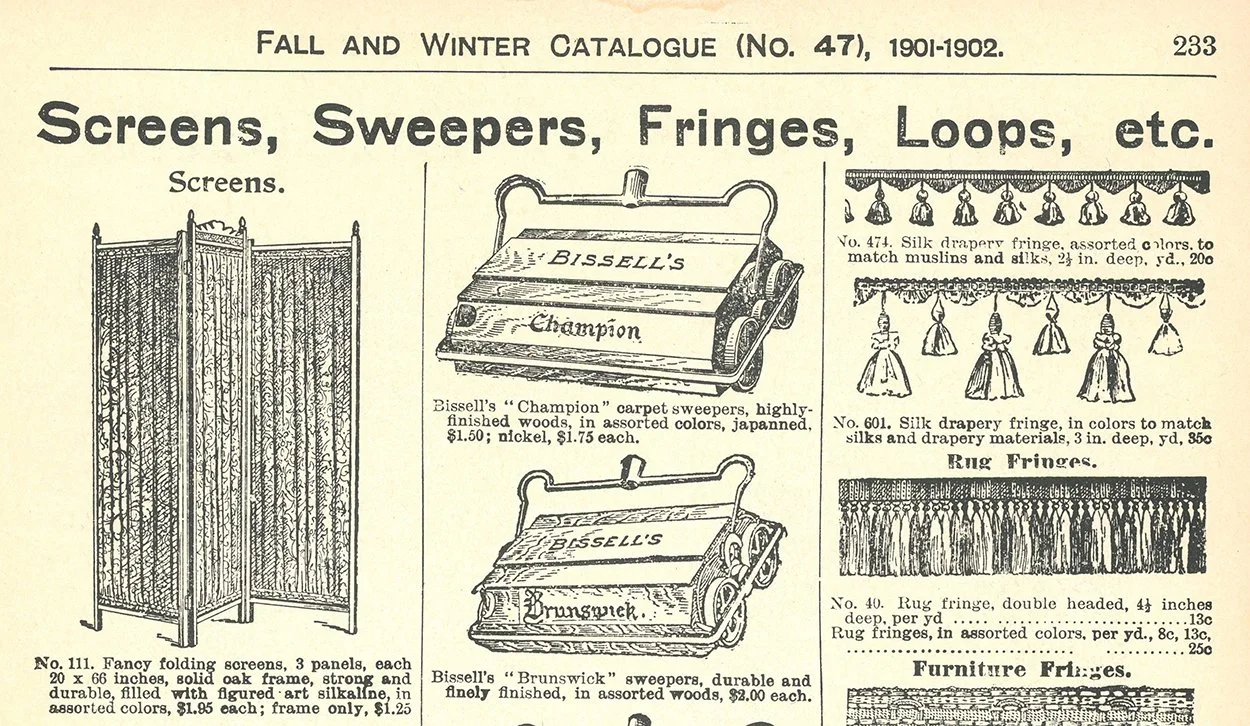
Almost amazingly, a name we still recognize—Bissell. —Author’s Collection
