
SPECIAL REMEMBRANCE 2025 EDITION - John Cannon’s Christmas, 1944
(I originally wrote this touching wartime reminiscence for the Cowichan Valley Citizen in 2005, the Year of the Veteran, with the help of the late Jean Phillips of the Royal Canadian Legion, Cowichan Branch 53.)
The BC Chronicles rarely strays beyond our geographic borders but I believe Remembrance to be universal. Speaking is the late John Cannon of Duncan, B.C.:
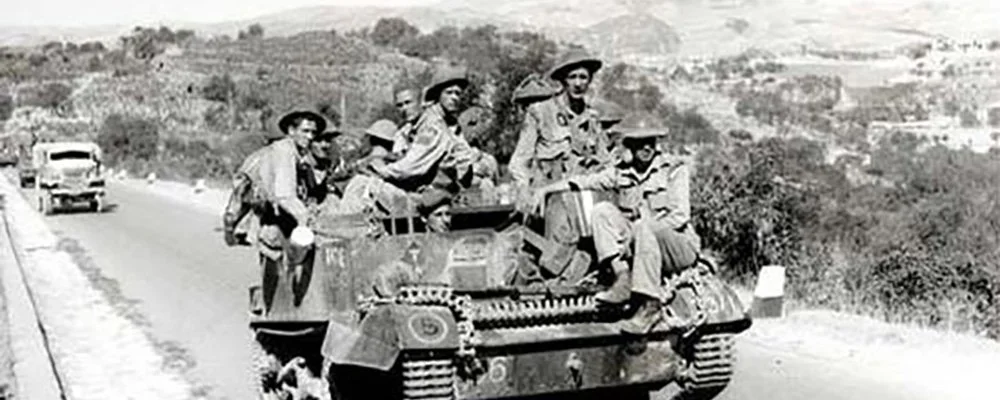
Operation Husky, the Canadian Army’s contribution to the conquest of Italy during the Second World War has been overshadowed by the D-Day invasion and push through France, Belgium and the Netherlands. —https://www.veterans.gc.ca/en/military-history/second-world-war/italian-campaign
I was standing in the doorway of a house somewhere in Northern Italy. We were using the house for our Command Post of “B” Troop, 19th Battery, 3rd Field Regiment, Royal Canadian Artillery. It was Dec. 26, 1944. We had been taken out of action for 24 hours to celebrate Christmas. It had been raining for days, so all around us was mud and more mud. Finally, the rain let up to a light drizzle.
The house was at a ‘Y’ in the rod. There were a group of Canadian Seaforth Highlanders, over on the point of land where the road branched off. The army had established a makeshift cemetery there. They and their padre were burying three of their comrades.
There was a lot of activity behind me as the officers and a senior sergeant began to set up the tables. It is tradition in the army for the officers to serve the men their Christmas dinner. There was lots of chatter going on but my mind was on the gravesite, the Seaforths and their padre, digging graves in the drizzle and having a very sombre ceremony. I was thinking of home and my last Christmas in Canada. I felt sad and lonely.
I had joined the regiment on August 12th. I was just 19 years old and very immature. I’d only been in the army 18 months and it had been a whirlwind year and a half. They had trained me to be an artillery signalman. Basic training was in Vernon, B.C., Vimy Barracks in Kingston, Ont., Petawawa for artillery training, and Vimy again for further signal training.
Then it was on to Camp Debert, N.S., for winter training before going over to Camp Borden in England for advanced training. I was there for four months and sent off to the No.1 Canadian Artillery Reinforcement Unit in the town of Eboli in the southern part of Italy for two months.
On August 10th, I took a two-day trip up through Rome to join the men with whom I would spend the rest of the war. I was met by Sgt. Grindley at a camp just south of Perugia. I was then taken to join a little group called “The FOO,” which stood for Forward Observation Officer. They are the group that, when the unit is in action, goes up with the infantry to observe where the guns should fire.
I was replacing a fellow named Johnny Kitching who was sent out sick. I am sure that these battle-worn guys were wondering if they were getting that close to the cradle. I was told to lay my bedroll under the grapevines and that supper would be in a couple of hours. They asked if I’d brought up any new cooks with me and appeared dismayed that I hadn’t. They obviously were tired of the ones they had.
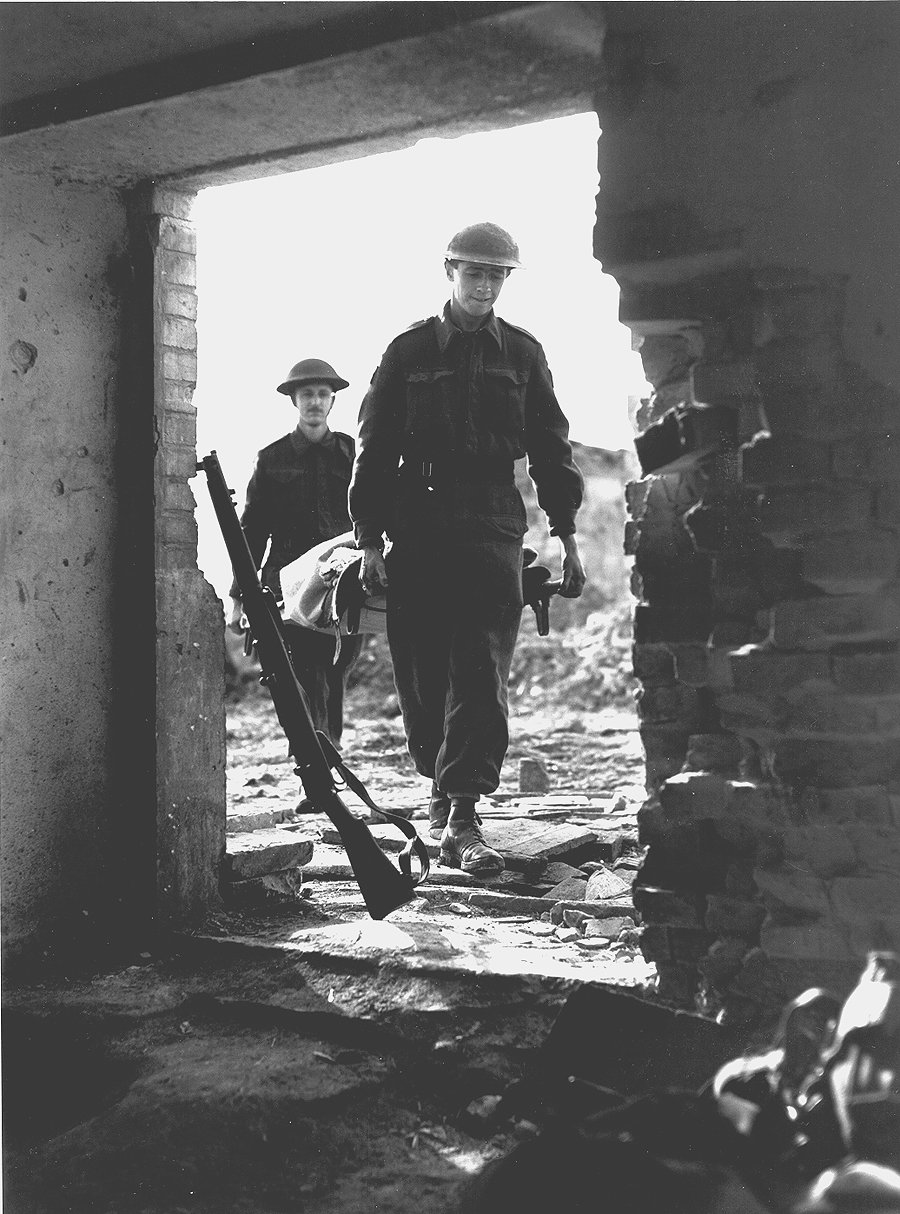
Canadian soldiers evacuate wounded comrades during the Battle of Ortona, Italy in 1943 during the Second World War. —Photo by Alexander M. Stirton, courtesy Department of National Defence/PA-112945)
There were a million questions I would have liked to ask.
I thought it would be better to be quiet and listen and learn. The fellows talked a lot about the place they had trained at in England and spent many hours arguing over whether what they were talking about was in the Salisbury Plains or up in the Midlands. They talked about what was going on in northern Europe. They asked if I’d seen any newspapers of the latest goings-on. The breakout had not taken place from the Normandy beachhead yet and the war picture was still fuzzy.
Then they started talking about the rumours they had heard about what was going to happen to the Regiment next. I was to learn that this was to be the greatest preoccupation I would have to live with for some time. It seemed that there was always a group chewing the fat over the latest rumour. The Regiment had just come from a 48-hour position around Florence to let the Germans think that the Canadians were going to go into battle. Now here we were, on the other side of Italy.
Four days later, we were given the news that we were to pack up and be ready to move; they didn’t tell us where we were going.
We moved to a staging area on the banks of the Metauro River. It was something I’d never seen before, an army getting into position to go into battle. Every road was bumper to bumper. All the fields were filled with pup tents. They were all grouped around a 60-hundredweight truck. I realized that it was the mess truck and every unit had their mess truck handy.
The army was usually pretty spit and polish but not this one. The trucks were dusty by now and there were lots of shrapnel holes showing. The men’s beards had grown and I found it difficult to pick out the officers. The men were sitting around looking like products from a hobo jungle. There did not seem to be any order. The rumours were flying about what, where or when anything would happen.
The Greek Brigade had not yet taken the town of Pesaro, which was crucial to the operation.
When they did, the orders came again that we were going to move. Our outfit fell in behind Gen. Alexander’s 8th Army, all the way from El Alamein, across North Africa, Sicily, Southern Italy and Ortona. The Hitler Line crossed the Metauro River on August 28th. We were to attack the German army of Gen. [Kesselring] in the Gothic Line in northeastern Italy. There would be vicious fighting for the next seven weeks and many men would not live to tell about it.
Our battery crossed the river and set up our gun positions on the southern slope of a hill on the north side of the river. We moved at night, crossing the river around midnight. We got to our position about first light. I was told I was to help dig the command post. They had to be dug in to protect the crew from shell and mortar fire. I was on the working end of a pick and it was very hard work, but wanting to get below ground away from the shelling was a great motivator.
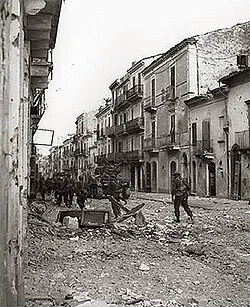
The battle saw house-to-house combat between the German 1st Parachute Division and the Canadian First Infantry Division. —Wikipedia
When I finished, I returned to the crew who were getting ready for bed. You put your bedroll down anywhere and climbed in. We awoke the next morning to finish a few last-minute things to get the guns ready and then were free to get ourselves in order.
This was my first day in battle. I did not know what to do and would not ask, so I decided to watch a couple of the veterans. When one of them said, “I think I’ll dig a slit trench,” I waited for what I thought was a reasonable amount of time so that I didn’t appear to be copying him, and then dug mine. I saw him put his bedroll beside his slit trench so that’s what I did. When he said he was going to turn in, I was not long to follow.
No sooner had I climbed into bed than a German shell followed with its distinguishing sound. All hell broke loose. I heard myself say, “What do I do now?” as I hit the bottom of my slit trench. I heard all the fellows laughing at me and I was known as, “What Do I Do Now Canone” (the Italian word for my name) for many days.
For the next 12 days we moved gun positions frequently. I dug up a lot of Italy to make safe command posts for the crews.
When I was not on duty in the command post answering the phones and taking down coordinates for the guns, I was wandering around, watching the crews fire the guns. The coordination they had was mind-boggling. The guns were fired so quickly I was stunned. It was neat to watch the shells leave on their journey of death, but not so neat when you heard one coming in.
I know what they meant when they say that fear “loosens the bowels”.
The days and nights went by. We fired and were fired upon. Then we reached a position below a group of houses that were on the top of Mount Corriano. We were under observation and were only allowed to move around in two’s. We had been attacked on the way in the night before by some German planes, dropping anti-personnel grenades, which blew out the tires and put holes in the radiators. A few of the boys got some shrapnel. It was a close call.
There were snipers around our new position. I was sent out with others to look for a sniper but we didn’t find him.
It was lunchtime and two of the boys from the truck mechanics were walking to the kitchen when a medium-sized German shell landed about 800 yards away. The base plate of the shell blew off and came our way, catching one of the fellows on the shoulder and cutting him in half. We buried him that afternoon under an olive tree, while watching the Hastings and Prince Edward Islanders, accompanied by tanks, push the Germans off the top of Mount Corriano ridge.
After burying our comrade, Sgt. Singleton told me I was going out with The FOO to support the Princess Patricia Light Infantry in their assault on the Rimini Line.
The taste of war I’d had that day would not hold a candle to what I was going to see in the next eight days.
We left in the early evening for the town of Cattolica where we were to join up with The Pats next day. We spent the night in a building to which we planned to return after our assault on the Rimini Line. After we joined The Pats battalion headquarters group I watched as some British cruisers shelled Rimini, the town we would be passing through the next day. This route would take us to the front line for the assault of San Fortunato Ridge (the Rimini Line).
We went through the town with our heads down, as there were lots of snipers around. We found a German command post and took possession of it for a few hours. It was very elaborately laid-out and very safe. I was sorry to leave it as my fear was building.
Capt. Morrow said he wanted to go with Rhodsey and take the truck around on the road to the Casa, a building where the Princess Patricia Infantry Regiment had their battalion tactical headquarters. Everyone else would go up the back way, which was safer. On our route, we would drive down a stretch of road that was exposed to the Germans.
The only thing on my mind was, “Why me?” but you can’t ask that kind of question.
When we arrived at the Casa we saw the broad valley we would pass through and the very formidable ridge that would be assaulted by the 1st Canadian Division, including the FOO I was assigned to. It was described by Lt.-Col. Nicholson in his history of the Canadians in Italy as the most vicious fighting of the whole Italian campaign.
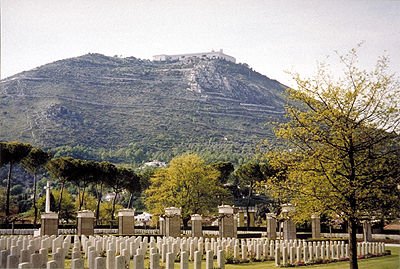
Cassino war cemetery, Italy. —Photo by Jacqueline Hucker, courtesy of Commonwealth War Graves Commission
It was now September 20th and after leaving the Cassia, we took up position as the tactical headquarters of The Pats in a house on the Usa River. We were there all day. Just before dark, I was on duty on the radio and was forced to stay with the scout car. The Germans really started shelling us. The rest of the crew took refuge in a house that was not so vulnerable.
I didn’t know where Capt. Morrow was and he hadn’t told me what to do. Nobody told me what to do. The shelling intensified as I lay on the floor of the scout car. The only thing I remembered was wondering if I would see morning and feeling the shaking of the ground when the shells exploded. I finally had enough and vacated the scout car. Just as I did, another shell landed very close by and I dove for a drainage ditch by the grapevines.
Finally, after many hours, the shelling stopped.
I got up and started to run toward the others and I felt a wetness between my legs. I thought I must be wounded. I took down my pants to see and my underwear was brown to the knees. I took them off and used the dry parts to wipe myself and carried on toward the others. Lou gave me the rest of his bottle of wine; he said I probably needed it.
We waited out the night with some sleep and started out early on the 21st to climb San Fortunato. As we started up the slope we were stopped by a Churchill tank that had lost its track. Capt. Morrow saw another way we could make it up the ridge so we took it. When we got to the top we put the radio sets on pack boards to go with the infantry down the North Slope after the Germans and to put a bridgehead across the Marrachi River. We went down through the olive groves and the Germans were after us with mortars.
We made it to some houses where there was a little protection. There were three Tiger tanks in the area but when we noticed they were using armour-piercing ammunition we knew they had used up nearly all their supply and soon they took off.
It was still discomforting to hear the rounds go through the walls. We went across a sunken road where the Seaforths had caught a company of the 1st Paratrooper Division and had machine-gunned them all down. It was horrible walking through the killing ground. Men were thrown on the banks, sometimes three deep. Later that day, the Pats established the bridgehead.
Our part was over. I have since discovered that our FOO of Capt. Morrow, Rhodsey, Lou, Lucky and myself were the first artillery personnel of the Allied army on the Lombardy Plains in the Second World War. This piece of history has meaning only for me.
The fighting carried on in the Romagna through October, November and right up to December 26th, when I was standing in the doorway watching the Seaforths bury their comrades. I turned around in the command post and turned on the radio to listen to the BBC. Christmas music came on and I became totally engrossed in the beauty of the carols. My eyes lighted on the microphone of the Tannoy, the loudspeaker system we used to give firing orders to the guns.
I thought for a moment and then reached for a roll of tape. I taped the button of the mike into the open position so that the music would be broadcast to the guns. I went outside to see if my idea was working. Everyone was scurrying to the bivouacs where the loudspeakers were.
When I looked, all the men were sitting around the speakers. No one was talking. There was total peace in the gun position.
I let the music play for about 45 minutes until the gun position officer felt the amplifier and said it was getting too warm. We would need the system for the war tomorrow. I stopped the music, told the men why and then wished them a Merry Christmas. The call came out that Christmas dinner was ready for the first setting. A grizzled old gunner named Sgt. Gilles put his arm around my shoulder as we walked to dinner. He’d been in the fight since Sicily and had been wounded twice. He said, “Canone! You surely made yourself one of us today.”
I had just turned 20 and I felt I was walking 10 feet high.
