
Father Pat, ‘Hero of the Far West’
(Conclusion)
He was barely middle-aged, this man of iron will, stamina and religious zeal. But he’d challenged his health so many times and now he was weighed down by sorrow. His closest friends noticed that he seemed to have aged perceptibly, and at least one of them expressed fear for his life.
None could foresee that, after all he’d done for others, Henry Irwin was already running out of time. His premature passing remains one of the sadder ironies of our history.
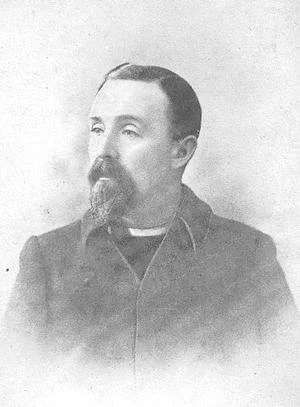
Rev. Henry ‘Father Pat’ Irwin. —BC Archives
* * * * *
As we can imagine, the death of his wife and baby struck Henry hard. To quote biographer Anne Mercier, “A line of black was, as it were, drawn across Henry Irwin's life at this time; and though his friends tell us that the zest of life was still abundant in him, and that in his work he was ever more and more brave and bright, yet we can note an underlying secret sorrow gnawing at his heart.
“It showed itself in a restless desire of motion, of hard work; a longing to throw himself heart and soul, and body too, into the roughest, meanest toil for his brethren. He covered his grief from strangers with utter shrinking from observation, even with simulated indifference. When one who had not yet heard of his loss asked him, "How is Mrs. Irwin?" he replied with a sort of laugh, "Oh! did you not know, she died last week?" and turned away.
“Can we not catch an echo of that laugh, sadder than any tears?”
Pouring himself into his work could go just so far; in 1891, soon after his loss, Bishop Sillitoe convinced him to return home to Ireland for a rest. Everyone noted his continuing to speak of his beloved Fanny as though “he expected her to come into the room at any moment,” how he ever referred to her as if she were alive.
Supposedly, he returned from this short visit home, “refreshed and ready” to resume work as secretary to Bishop Sillitoe. But the blows kept coming. First Sillitoe, his friend and mentor, developed influenza followed by a relapse from which he couldn’t quite recover, then, from Ireland, came word that Henry’s father had suffered a severe heart attack and he hurried home in January 1894.
Still there in July, he learned of Bishop Sillitoe’s passing and “mourned for him as a son”. Four months later, Rev. Henry Irwin Sr. was gone; in four years Father Pat had lost his wife, his baby, his best friend and now his father.
Anne Mercier: “Those who saw him at Rugby, and had known him there as...a bright, young fellow, fresh from Oxford, somewhat fastidious in dress and habits, felt that they were in the presence of another being. Even on his first visit in 1888 a change was noticed. His brother says: ‘He left home in 1885, a smooth-faced, youthful-looking priest...he arrived home, two years and eight months later, looking [20] years older, with whiskers and moustache, and sallow hardened skin, speaking with a somewhat nasal twang,’ and with a pointed beard...’
“Now, in addition, there were the results of the blow that had fallen upon him in his wife's death. Although that loss was always present to him, and he carried always with him a copy of In Memoriam...yet he did his best to set his grief aside” by concentrating on parish work for the local church, Saint Matthias'. In the first week of January 1896 he returned to B.C. after a two-year absence.
Rev. John Dart who’d been appointed the new Bishop in New Westminster assigned Henry to the new mining camp of Rossland, whose mines, shacks and ore dumps were described as blots before the eye. Not that that mattered to Henry who asked not for beauty but “for work, and he got it. He settled down among his people only bent on their good, absolutely forgetful and negligent of his own welfare”.
Raw as was Rossland, rough and tumble as were its residents of mixed races and nationalities, the gentle-born Irwin fitted in easily, attending to those in need of sympathy or a helping hand.

The Father Pat Memorial Ambulance. —Tourism Rossland/Dan Conway
His room beneath the church he converted to a reading library. Readers didn’t have to attend church to peruse the books and magazines on offer, or to relax while reading in comfortable chairs, all were there for, in Henry’s words, “young men and others who have no places and no homes to go to”.
Given a warm overcoat to replace his which had become threadbare from use, he wore it just a few days before giving it to “a poor fellow who had no overcoat at all. I couldn't let him go without one in this bitter weather, and I couldn't give him my old one, could I?"
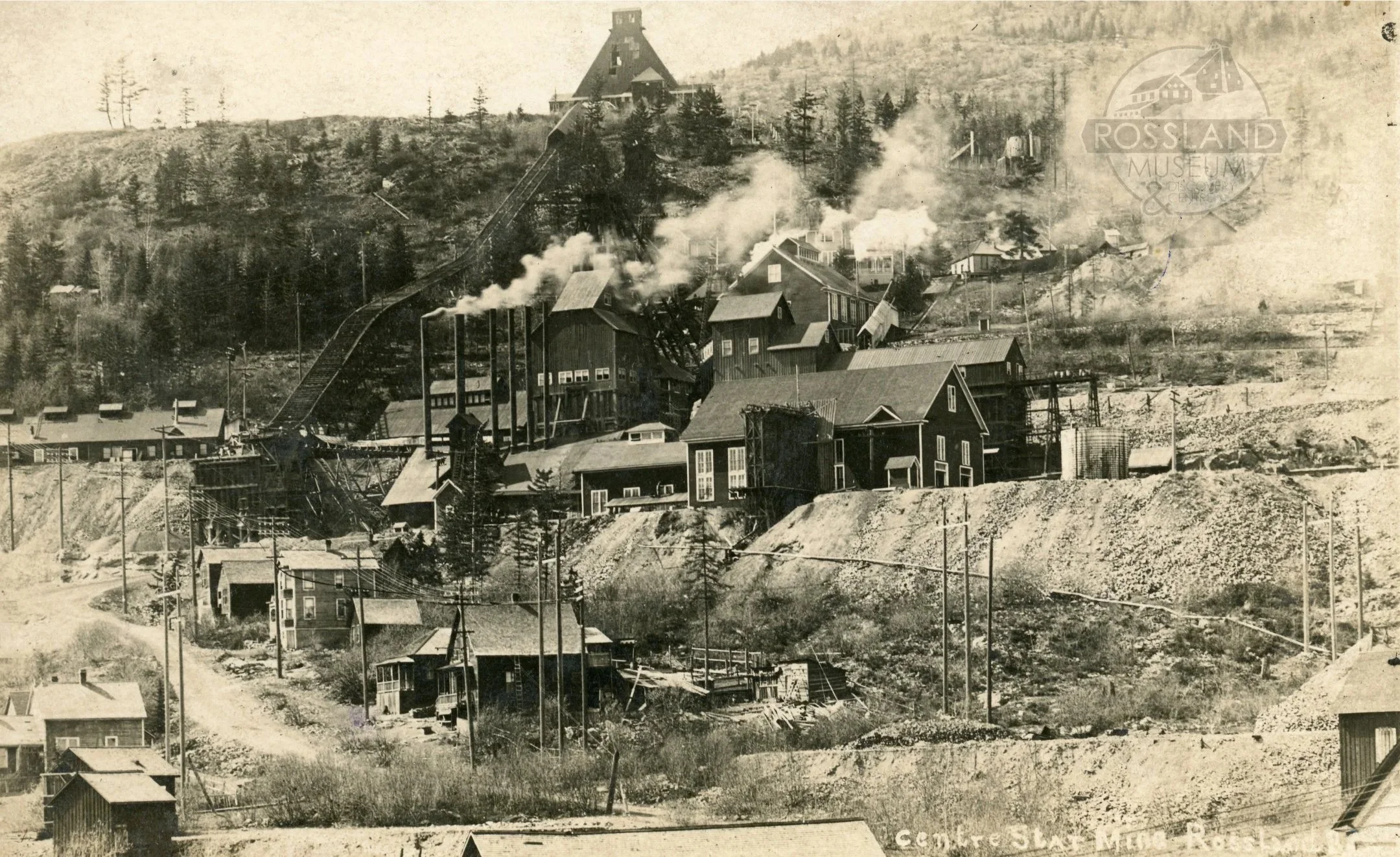
The Rossland mines. —www.rosslandmuseum.ca
During those three years at Rossland he barely rested: “He was all over the country, holding services and laying the foundations of a church at Trail...and at Grand Forks and other points in the Boundary [Country], the nearest point being 40 miles over the mountains west of Rossland; two days' journey for most men up and down steep trails, but only one day's for Father Pat, whether on foot or in the saddle.
"His journeys over the mountains were phenomenal; he seemed to be tireless, and he loved the wilds where he was in close touch with Nature; and sometimes to intimate friends he spoke of his frequent sense of the nearness of the Spirit world, with which he seemed in closest touch out on the trails at night."
* * * * *
I could go on and on with Father Pat’s documented acts of charity and tales of his bottomless Christian zeal, relating more of the long cherished memories of those who loved this man who sometimes preached with his fists and who once gave a sermon while sporting two black eyes.
Everyone could see that he was working too hard and denying himself “every comfort, almost every necessary. To and fro he rode on his well-known Indian pony, ‘Tom,’ covering more ground than one would think possible; keeping down by incessant labour the ever-gnawing regret for a lost love and a lost life.”
Concerned by tales of his self-denial and overwork, Bishop Dart offered him a lighter post but, driven by a need for perpetual motion—“no day was too long, no ride too hard for him”—Henry implored to be sent out as a “pioneer.” In 1900, he finally convinced Dart to transfer him to Fairview, 30 miles south of Penticton in the Okanagan district, and then known as B.C.’s leading free milling gold camp.
Here again he was called upon to use his boxing skills, this time against a miner much larger than he.
Henry ignored the insults, but when the man insulted God, his fists flew and soon laid him out on the ground. Immediately remorseful, Henry checked his injuries then looked skyward and asked for forgiveness for not “telling this poor man that I was a champion boxer at Oxford”.
In one of his last letters, this one from Fairview, Aug. 14, 1900, he mentions having ridden eight days on “the camel...an old crock of a horse,” including 40 miles between an afternoon and evening service, followed by 40 miles up the Kettle River the next day. Then 30 miles in “one of those awful rainfalls we have in summer, cold as charity, even colder, and one's light gum coat is no protection; nor would tarpaulin keep out the soak one gets from the brush as you fight your way in and out of deer-trail windings, cutting with your axe a tree here and a big branch there, to give the horse a hole to crawl through.
“How one could ever find one's way back except for the 'blazes' on the trees would puzzle a Quaker; but on a horse here you need never think of how to get back, as the horse does all the thinking in such case.
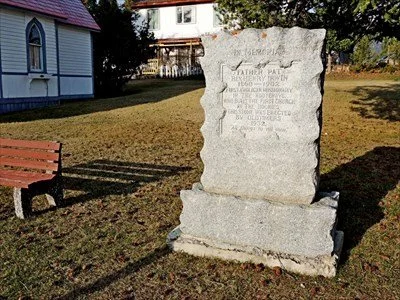
One of the memorials to ‘Father Pat’ Irwin.
“Three to four miles away through the very depth of a thick pine forest, in and out of the thickets of underbrushed deer coverts, and lots of deer too to look at on a wet day, with a shirt and pants and socks and boots and straw hat and nothing more on, will give you my feelings.
“With nothing to eat but some chocolate and a lump of cheese from Wednesday 7 A.M. till Thursday 9 A.M., in the saddle the whole time, then into camp where the tents were the only dry places, as fires have no roofs, so had to roll up in a saddle blanket and rig a gum coat over one's things in front of the fire so as to get 'em dry. There's a bit of a trip for you!
“I think the one thing that makes it so 'winsome' is the fact that away there in the forests you are alone in places seldom trodden by the foot of man... Next night found me out on the heights of the summits, on a vile bad trail, tracking back to this place, some [60] miles...
“Then up at 3 A.M. to hunt for the horses, which had to huddle together under some thick brush of willows, so that it took an hour to track them, as the bears in these parts scare the life out of horses at nights, and mountain lions lie for them, so that a rock or black stump is a bete noire. Off then and away at 4 A.M. and [20] miles to breakfast... Then another day of [40] miles and back here to get to a bed again.... Yours in love, ‘PAT.’
Absolutely incredible! But this is meant to be the concluding Chronicle of this truly gentle and generous man so I must cut to the quick.
Things were bad in Fairview, business “black,” November 1900 frigidly cold and Father Pat barely able to support himself on his $25 monthly stipend—“I just manage to live, and that's all, on what collections I can get”—from a congregation of 10. Bishop Dart, now fearing for Henry’s mental health, urged another visit home. Finally, late the following year, Henry agreed and headed east.
Anne Mercier: “It seemed to many that the fine gold of his mind was become dim, and that there was a partial clouding of the intellect... It is surmised that he got out of the train some distance before reaching Montreal, resolving to walk on; or as is said in Dr. Kingston's letter, ‘he resolved to go for a long country walk’.
But the Henry Irwin who’d withstood all that B.C. weather could throw at him, was no match for January cold in Montreal: “Had he been in full possession of his faculties [he] would have known this; but he seems to have lain down under the stars, half unconscious, and thus the bitter cold did its sad work.”
Early next morning, a passing farmer spotted him walking with difficulty on the frozen ice. Seeing that he was pushing his feet on, rather than lifting them up, the farmer asked if he were ill, or if his feet were frozen. The stranger replied that he didn’t feel any pain, just a numbness in the legs.
The farmer drove him in his sleigh to a neighbouring doctor who administered a cordial and told the farmer to drive him as quickly as possible to a hospital in Montreal. The stranger, who refused to give his name, begged that it might be Notre Dame, famous for its nursing.
There, he identified himself only as William Henry. His shoes, frozen solid, had to be cut away, his feet then soaked in preparation for the excruciating thawing that must follow, while his joking reduced some of the Sisters to tears.
For several days, although mortification had begun, Henry felt little pain and didn’t seem to realize the implication: “His appetite was good, his mind clear and admirable; there seemed to be a magnetic current attracting to him all those who had access to his room.”
He still didn’t give his full name, not even to the Mother Superior, but did entrust the papers and letters he’d carried in his hat to Dr. Kingston; these were sealed and addressed to a friend in Ireland. All the while, he chatted lightly with those attending him, “sometimes talking of the West, but...never pronounc[ing] the name of any place, nor would he give any clue to his name or calling”.
By the third day he had trouble swallowing and speaking and for the first time, appearing to realize his fate, he adopted a long, sad look. His real identity now known, he was visited by the Rev. Canon Wood, Vicar of St. John’s, Montreal, who began a three-day bedside vigil.
A few hours before death, Father Pat became delirious.
His remains were conveyed to Sapperton, New Westminster, to be laid beside those of his wife and child. So ended the life of the man who, even in the agony of death, wouldn’t disturb an attendant for a glass of water.
Why Henry’s secrecy about his identity? He didn’t want family and friends to be informed of his condition and made anxious, surmised Dr. Kingston, who concluded, “I have never seen so much strength and so much gentleness combined."
In New Westminster, crowds passed his coffin and attended his interment.
Already, a subscription for a memorial had started, miners vying with one another in their desire to honour the best friend and benefactor they’d ever had. Among the tributes was the purchase of an ambulance in his memory in Rossland, that Father Pat might “yet speaketh in the cure of sickness and the relief of suffering”.
A monument erected to his memory in Rossland’s main street combines the uses of a lamp and a drinking fountain so as to “speak...to the people mutely of the Light that their friend humbly followed, and of the Water of Life from which he strove to give them to drink”.
It bears this inscription:
In loving memory of
REV. HENRY IRWIN, M.A. (OXON),
First Rector of S. George's Church, Rossland.
Affectionately known as Father Pat.
Obiit, January 13th, 1902,
Whose life was unselfishly devoted to the welfare of his
fellowmen irrespective of creed or class.
And, on the reverse:
"A man he was to all the country dear."
A second memorial was erected of specimens of rich ores from the mines of Rossland, each labelled with the name of the mine.
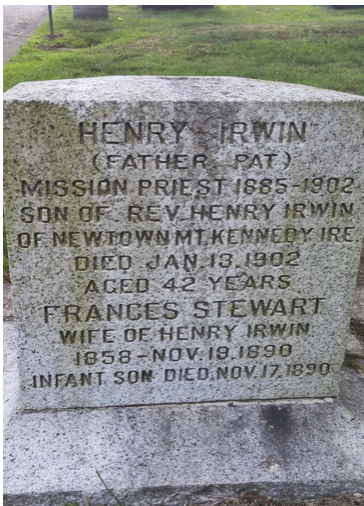
One of the memorials to ‘Father Pat’ Irwin—rosslandmuseum.ca
