
Father Pat, ‘Hero of the Far West’
(Part 3)
Was there ever a bigger heart than that of pioneer missionary Henry “Father Pat” Irwin?
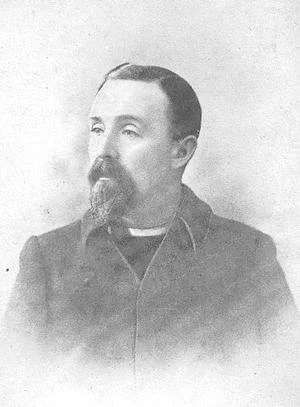
Father Pat Irwin was as remarkable as they come. —www.anglicanhistory.org/canada
A man who did nothing by halves—he only gave his all.
What bitter irony that, at the moment of his greatest joy, he should be struck by double tragedy.
* * * * *
How Irwin ever found time to fall in love, court and marry is a mystery, so much of his time was spent attending to the spiritual and often worldly needs of others. As it was, his courtship to the extremely shy and “timid” Frances Stuart Innes, sister-in-law of the Rev. A. Shildrick, lasted four years.
In introducing Frances, Henry’s biographer Anne Mercier set the stage for what soon followed: “Spiritually minded, of strong religious principle, she was yet so shy that it was hard to persuade her to go into the world alone, even for necessary business...
Merry and bright at home, the life of the family, there yet was a pathos in her look which seems natural now to us who know how soon that lovable personality was to be removed from this world....”
But tragedy was yet in Henry Irwin’s future.
Earlier, his health had interfered; two years of never-ending toil in Donald, 1000s of miles on horseback and camping out in all kinds of weather had worn down even a constitution as strong as his. Physical and mental exhaustion compounded by an attack of tick-borne mountain fever did the rest. After four months’ rest with his family in Ireland, he returned to the B.C. frontier to resume his work, to marry and to become an expectant father.
Last week, I left him in the middle of a letter to “Dear B.” in Ireland in which he told of his spiritual rounds on the B.C. frontier. Who better to describe his life on horseback than Father Pat himself. When we broke off, he was overnighting at a road stop when a posse of armed cowboys rode in, on the hunt for a murderer.
Irwin: “A rowdy lot were riding madly about the camp and had been drinking, etc., when as one of the men was swinging his revolver round his head and going about, he happened to point it at the head of a friend of mine who was on a visit to the mines; the ball struck him above the left eye, and it was the nearest chance he wasn't killed on the spot...
“Well! the three boys who had come down from the mines reported the man dead, and they had started off amid a shower of bullets after the murderer.
“They rode the 12 miles up and down hill in half an hour, they say. Then in our presence they were sworn in as constables, and sent off to hunt down the shooter. All night they rode, but could not get him, until late in the day they ran into him up at a farm in the hills, and he made off on a good horse, but under threats of being shot he came back and gave himself up, and was run in here just before I left for the mines.
“He's a cowboy and a rough one. Joke is that the three constables are also cowboys, so you see how good they are on a case of this kind. He was committed, and is to go down to New Westminster to-morrow. They are going to take this letter down with them, so you see it will be quite romantic.
“You can guess how very sad I was to think that my friend had been shot, especially as he has a wife and family; and I should have gone up at once to see him if I had known the trail, but I had to put it off till next day. So on Thursday I started, and got upon a wretched beastly old screw of a horse that I was lent, and which I dragged up the hills and made him carry me down.
“Bah! I never was so sick in my life.
“However, we got into the camp at last, and there I was glad to see N. was all right and walking about. He had a terrible shave, and only escaped by a miracle; he was talking to some friends of mine as they were eating their supper, and had been laughing a minute before at the cook because he was afraid of the shooting, and next minute he was lying on his face on the ground.
“The cowboy at once made off whooping and yelling and was pursued by the others as you have heard.”
Other than that, he “had a nice time in the mining camp; lots of friends there, and had quite a number of visits to supper, etc.,” and held a service the next morning. “...Of course everything is terribly rough and ready; but it is not a bad place... The tents are comfortable but a bit rough; no houses yet built, but some building; a whole forest was round about there, but now there are no trees hardly...all having been felled to make mining implements, etc.
“The gold is plenty and I have seen lots of it; little wee pieces, as a rule, of all shapes, flat and bright; other big bits worth [$78] or so, and others something less. Men get cracked on the subject, and no wonder; you could make your fortune in a morning if you had luck.”
Most of the men he encountered “seem very nice as a rule,” but he wished “the whiskey was not in there; it is playing the fool with most of them” as well as the Indigenous inhabitants. "I must shut up now as I am hungry and it is lunch time, and this jobation is enough for at least four meals. Yours, ‘HARRY.’”
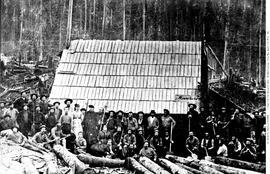
Most miners, Henry wrote, were nice—but he regretted their abuse of whisky, the ruin of many. —BC Archives
In another letter home, this one to Dearest M. and addressed from Quilshanna, Nicola, April 1886, he graphically describes life on the trail: “I had some fairly rough days at the mines... It was by no means the best of roads or trails I had to travel over there. In fact, the very worst sort of walking for one whose feet are likely to be tender, as mine are still. Crawling along trails and sliding down ice slopes and scrambling up the steepest of precipices, and all this in big top boots, you can fancy the state my feet were in. The skin was off most of them and the heels were all raw.
“On Sunday last I had morning service in camp, and then made a sharp walk to Otter Flat (six miles) and had afternoon service at three o'clock.
“Next morning I started on a bit longer tramp, as I could get no horse, shouldering my saddle bags, which were by no means light. I started about 8 A.M. for a big 30 mile tramp. People assured me at the start I could not possibly get over the creeks and rivers, which were swollen very high and even took the horses to swim them.
“However, my Irish nature won't give in, and I started. You can fancy me trudging along a good trail through the most lovely lake and forest scenery, up and down heavy hills, with saddle bags so arranged that one was on my chest and the other on my back, by slipping my head through the hole which fits on to the back of the saddle. I can tell you it was no easy pack I had.’
But, even with ice on the lakes and snow on the mountains, it was a fine spring morning and, relishing the bracing air, he set out with a stout pilgrim’s staff, enjoying the scenery and the abundant wildlife as he went. Then he came to his first swollen creek: “This I crossed on a log, taking special pains to keep upright across the deepest part of the river, knowing that if I went in I should have fine times with the saddle bags round my neck!
“Well, then, I crossed a couple more creeks, successfully walking the logs, and that is no easy matter, as you have to balance yourself with your pole, which you can get to the upper side of the log, and the force of the current keeps it jammed to the log, and gives you a good support.
“But you would have seen, no doubt, a woeful expression on my face when I came to the next river, a perfect torrent boiling and fussing away in grand style, no log or tree to be seen anywhere. Well, off I went up stream to search for something, and at last came to a good stout tree; but it was three feet under water and a big rush going over it.
“This was my only chance; so I got on to it, and by dint of a little balancing, I astonished myself by getting safely across. You would have laughed to have seen me going inch by inch across the stream, taking just about five minutes to get across the thirty yards. I then walked on hard to the house of one of my friends, and there had lunch on beans and bacon, cooked out in a tent on a couple of logs, Indian fashion...
“How you would have laughed to see me by the end of that 30 mile walk.”
His arrival at the road house on foot, he said, was “the best time on record for a pedestrian. A good night's sleep set me up, and yesterday morning I started with a German to walk right through here! That is, to finish up with 35 miles; we marched along from 7 to 6, with one and a half hour's rest in the middle of the day, and I got in here fairly beat last evening, but none the worse for the tramp, except that my feet are sadly in want of skin.
“I am taking it easy to-day, and hope to have a nice little ride this afternoon to the foot of the Nicola lake (about ten miles), which will set me up again.”
People intrigued Irwin: “They are certainly the hardest, roughest, and yet best-hearted fellows alive. It has never been my lot to rub up against such an utterly fearless class of men. They go through the wildest countries in search of their darling gold, and no dangers daunt them. I could yarn for hours on their doings.? Yours, H. I.”
* * * * *
Here we are, only halfway through Anne Mercier’s biography of Father Pat. But these are the BC Chronicles and we must think about moving on. By now, my admiration for Henry Irwin must show; I hope that readers are also convinced at this point of his nobleness of heart and spirit—such rare qualities, alas, in this jaded world of ours.
1890 would be the year of Henry’s greatest joy and his greatest sorrow.
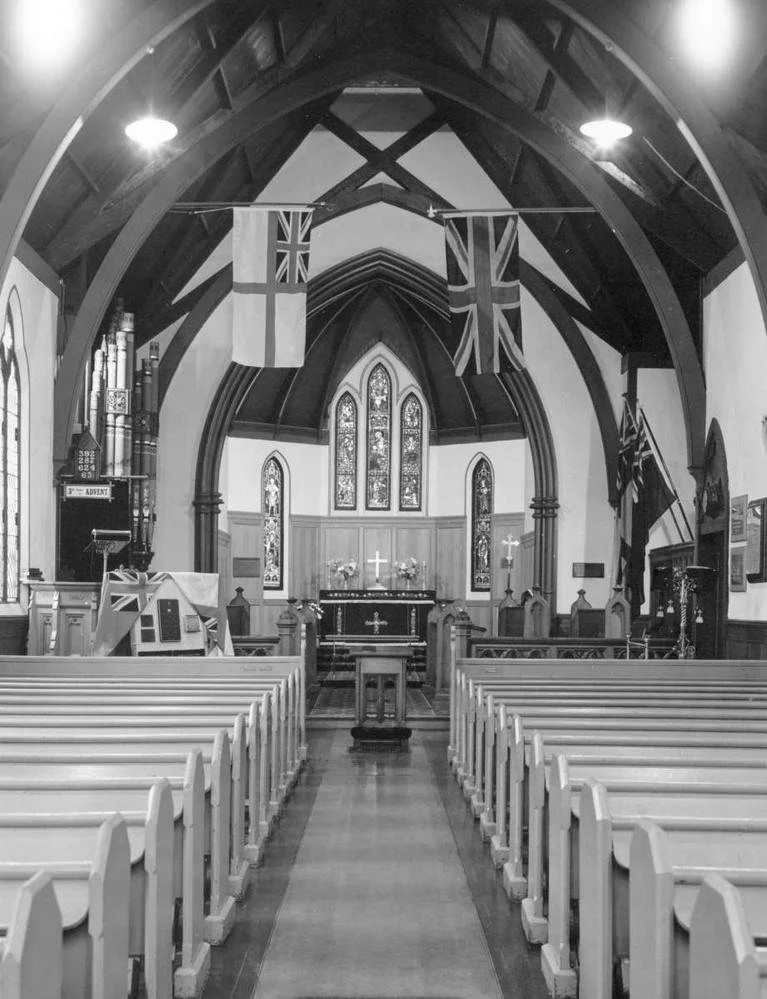
St. Paul’s Garrison Church, Esquimalt, where Henry wed Frances in 1890. —BC Archives
He and Frances Innes, daughter of the superintendent of the Esquimalt naval base, were married in St. Paul’s Garrison Church, Father Pat having—almost unbelievably—forsaken the Mainland frontier to serve as domestic chaplain to Bishop Sillitoe in civilized New Westminster, and as assistant priest at Holy Trinity Cathedral. The happy couple settled into a cottage formerly used as a girls’ school beside the Fraser River.
Among those who marvelled at Irwin’s marriage was a Mrs. Williams who wrote, “Mr. Irwin was essentially an Irishman. His impulsive disposition and love of adventure were genuinely Irish, and that is the key to his character. I have heard him say he came to Canada fully resolved to remain a celibate and devote himself entirely to missionary work.
“But he met Miss Innes, and the ideals of his life somewhat changed, though a missionary he remained to the end. All who knew him in New Westminster knew also his intense devotion to his wife...”
Recalled Mrs. Sillitoe: “Father Pat and his wife were like two children in the delight they took in everything, in the pride they took in each other and their cosy little home... This I say from observation and from what Mr. Irwin has since told me, for he loved to talk to me of his wife and of their happiness, telling me all sorts of little anecdotes of their life...”
Soon Frances was expecting and the young couple’s happiness can be imagined. But it ended quickly with a baby stillborn and Frances’s own death three days later, the shock said to be all the more crushing as she was thought to be recovering.
Henry was again alone.
For four years he remained in the Royal City, perhaps having lost, as Mrs. Williams put it, “his impulsive disposition and love of adventure” for the first time in his life. He seems to have contented himself with “the humdrum everyday drudgery, the writing and copying of letters, interviews, parochial work (for he was curate of the Cathedral), and numberless other things too insignificant to mention”.
Incredibly, he retained his sunny disposition as he worked with the poor. In 1894, he returned to Ireland because of his father’s severe illness, but he was soon back in B.C., this time the mining town of Rossland.
But, although barely middle-aged, he wasn’t the Father Pat of old. He’d challenged his health too many times in the past and, likely, weighed down by sorrow, he was already living on borrowed time. His closest friends noticed that he seemed to have aged, at least one of them even feared for his life.
But none could foresee how close he was to death. After all he’d done for others, his premature passing in cruel circumstances remains one of the sadder ironies of our history.
(Next week: Conclusion)
