
BC’s First License Plate Holders
For this week’s historical ramble we’re going back to 1968 and an article written by Ainslie J. Helmcken, 1900-1987. The grandson of legendary Hudson’s Bay Co. surgeon John Sebastian Helmcken, he served as the first curator of the Victoria City Archives, 1967-1983. Here’s what he wrote, almost 60 years ago. He begins with a lengthy preamble so I’ll cut to the quick.
* * * * *
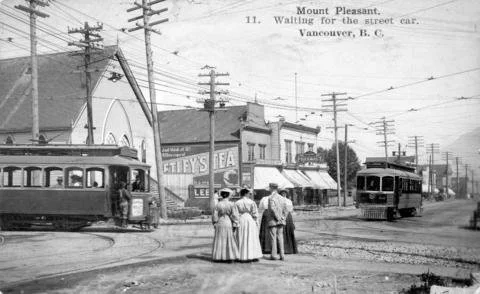
At the time of Mr. Helmcken’s story, 1904, automobiles were few and far between; most people still used horse and buggy or, if in a bigger city such as Vancouver, a streetcar. —Vancouver City Archives
...The exact date of delivery of the first automobile in Victoria, and who owned it is the subject of several claims which I, for one, don't propose to try and settle. It is quite sufficient to take the year 1904 as a starting point.
The provincial government had passed an act, entitled Motor Vehicle Speed Regulation Act, 1904, a section of which introduced licensing for the motorists. Owners were required to “have attached to or exposed upon the back of every such motor vehicle, in a conspicuous place, the number of said permit so as to be plainly visible at all times during the daylight, such numbers to be in plain figures not less than 3 inches in height".
As a general rule the numbers were riveted onto a piece of heavy leather, the whole being suspended from a bracket by means of a pair of straps.
Later on, the regulations were altered to require the side lamps on the cars to have the permit number painted across the side vents so they could be seen at night. A number of years later, when the government introduced license plates for both front and back, the wags said this front plate would brand the number onto the derriere of the pedestrian when he was hit.
Annual license fee was $2. By the end of 1904 there were 32 licensed automobiles on the road in British Columbia. Growth was not too rapid for there were still only 58 by the end of the following year.
License number one went to John Barnsley, a gunsmith of Victoria, for an Orient Buckboard, and was issued Feb. 29, 1904. The name of the manufacturer was not necessary in those days, but the car has been identified by photograph. This car had a two-speed transmission, probably slow and very slow, and was advertised in the Scientific American at the price of $425.
It was built after the style of the old buckboards, engine on rear axle, the passenger sat in a seat up front over the front wheels. Steering was by tiller.
License number two was carried on cars owned by Capt. J.W. Troup of Victoria, for many years the general superintendent of the British Columbia Coast Steamships Division of the CPR... The license to which we referred was issued Mar. 11th, 1904. This was probably a Cadillac...which was advertised as “The car that climbs and will make 30 miles an hour on good roads,” a performance that few $2,500 machines could duplicate.
This car sold for $850 with detachable tonneau, [could] carry four passengers facing forward.
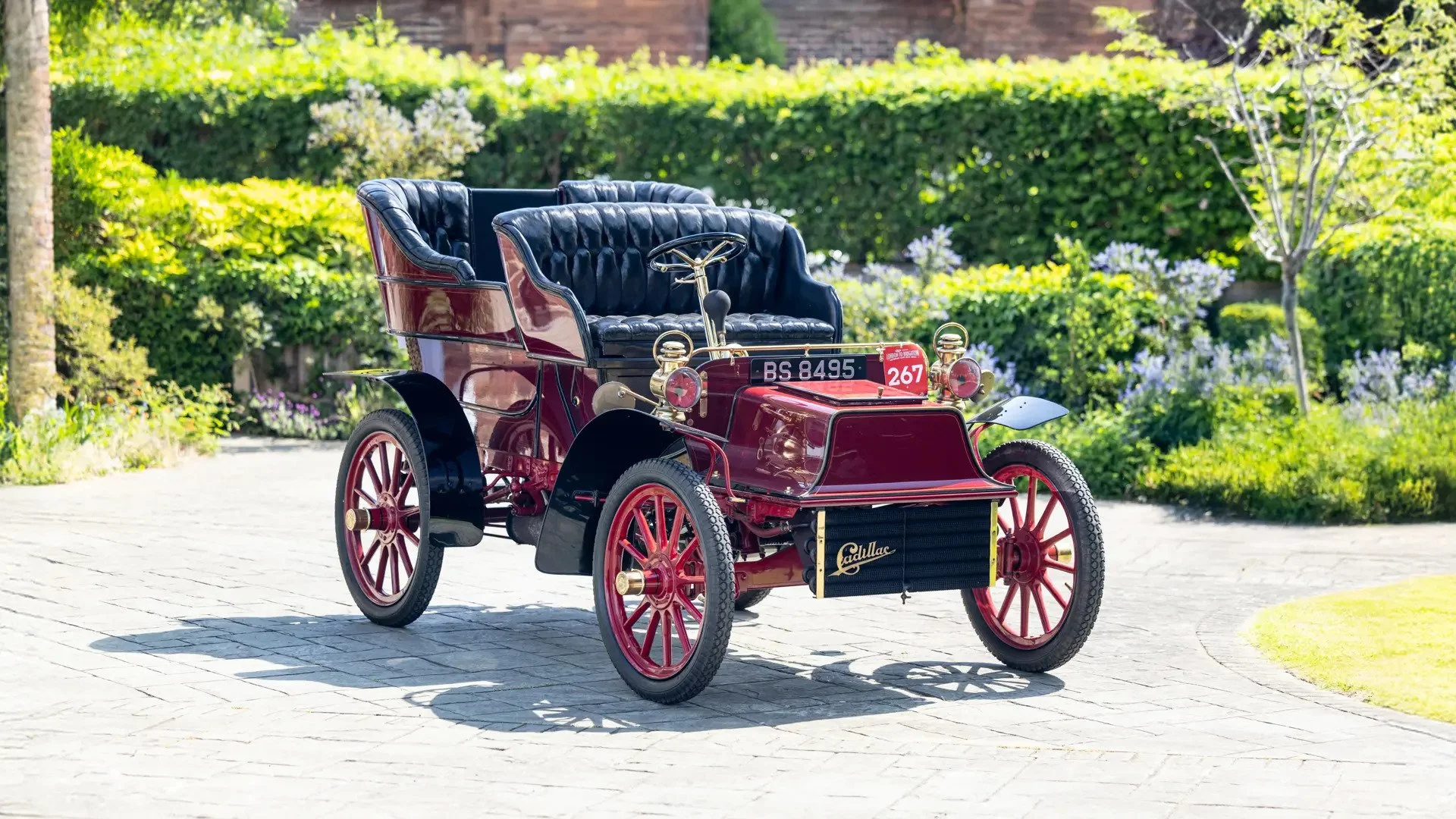
This 1904 Cadillac is on display in the Manitoba Agriculture Museum. When Sotheby’s last sold one, the model that cost Capt. Troup $850 new, sold for more than 100,000 pounds sterling. —https://mbagmuseum.ca
A gentleman by the name of W.M. LePoer Trench, whose address was known as Saanich, had license number three, issued Mar. 17th, 1904. A notation under the official entry says, “lapsed, left country (deceased), " all of which would be pretty conclusive in any man's language.
On the same day Dr. E.C. Hart, the well-known physician, and for many years later the coroner for Victoria district, obtained license number four. He drove his car for some time and then sold it to Dr. R. Ford Verrinder, a well-known dentist. This car, I believe, was a “one-lung” Rover, but of this I am not positive. The register shows that this license later lapsed.
Who remembers Mr. George Collins? He lived at 47 Henry Street in Victoria West. Well, he was the possessor of license number five. He was, I believe, a retired gentleman and later resided on Hillside Avenue.
About this time, Gastown (Oops, sorry!), Vancouver, was getting into the act. The first license listed for that place was on Mar. 31, 1904, and the owner was B.T. Rogers, managing director of the B.C. Sugar Refinery. He lived at the corner of Nicola and Davie street..
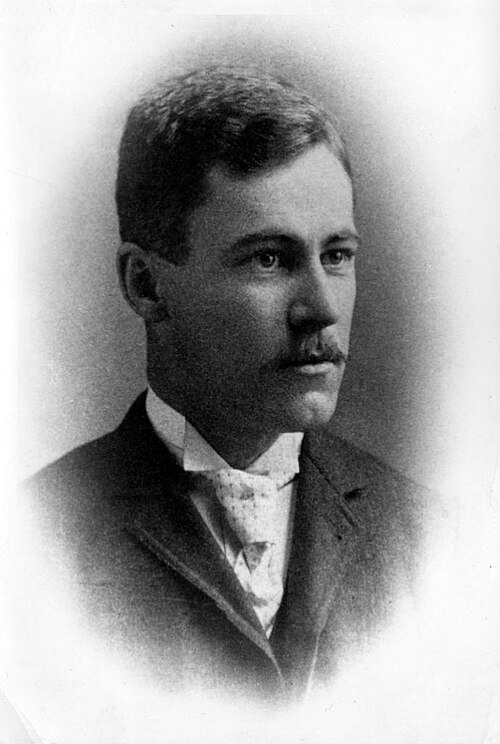
Wealthy sugar manufacturer Benjamin Tingley Rogers bought the first BC vehicle license in Vancouver. —Wikipedia
Between May 5 and 10, 1904, the man who issued the licenses must have been rushed off his feet for no less than four other cars were put on the road at that time in Vancouver. W.D. Haywood, one of the proprietors of the Commercial Hotel at 330 Cambie, obtained license number 7. This was on May 5. On that same day C. Cocking, then a bicycle dealer at 824 Pender Street, and later one of the earliest dealers for the Mitchell automobile, obtained license number eight.
Then there was a lull for eight days.
E.S. Willband, proprietor of a sheet metal and roofing business at 46 Hastings West, took out license number nine. William Ralph, a dealer in stoves and house furnishings at 126 Hastings West, applied for and received license number 10 on May 13, 1904.
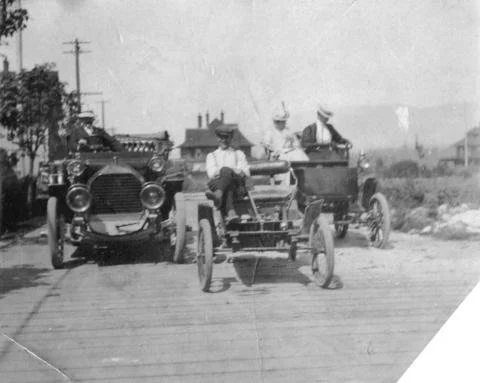
The owners of these cars, ca 1906, would have been among the first license plate holders in BC. —Vancouver City Archives
The man who left so many legends and yarns about him that it is a wonder to me that someone hasn't written a book about him, obtained license number 11 on May 14, 1904 in Victoria. He was R.P. Butchart, known now to most people as the man who helped his wife develop the famous gardens frank, but to us “old timers” he was the man who developed the wonderful cement business at Tod Inlet and then at Bamberton.
He was known as “Leadfoot” Bob when behind the controls of an automobile.
There was only one way he knew how to operate, and that was with a wide-open throttle. It might be considered significant that there is a note appended to the registration of this car which reads: “Broken up—8 May ‘07.” This was not the only car in a long career as a driver that could have been listed as “broken up”.
[Pioneer Victoria car dealer Horace Plimley] tells me of one crackup Bob had when a Packard he had been driving for about two years was practically demolished. He immediately ordered a duplicate of the car; never mind, that it was not then in production, this was the car he wanted. At one time I remember a great V-12 Packard he drove, or rather he flew.
One is sure that his Guardian Angel took into consideration all the good he and his darling wife did on earth so kept them under his protective wing.
In searching the old registrations there is an entry on Feb. 23, 1906, showing Bob Butchart had become a two-car owner. This later registration must have been for a Thomas Flyer. Horace Plimley told me of a trip to the Tod Inlet plant to take the Thomas Flyer back to Victoria for repairs. The hill to the plant was too steep and they couldn't pull it up the hill. Finally, it was just put on a barge and towed around to Victoria.
License number 12 was issued to R.D. McPhail of Vancouver.
Now we come to a gentleman whose interest in motoring, in general, better roads in particular, and absolute passion to see an all-Canadian route from Winnipeg to Victoria became an accomplishment, made him one of the most respected car owners in the West. Possessor of license number 13 was Albert Edward Todd, son of J.H.Todd and Mrs. Todd.
When readers are travelling over the beautiful highways of the West, and this includes the entire Pacific Coast as far south as San Diego, just give a thought or two to this quite remarkable man. He was dedicated to the establishment of parks, good roads by which they could be reached, and for highways which would bring about fine International communications.
First of all, we are interested in this gentleman as an early motorist. Number 13 was issued to him May 14, 1904, and under the entry we find: “Lapsed—not used by A.E. Todd—new No. A.E. Todd received new number 72." As there is no date to this entry, one thinks he did not retain his number 13 when he purchased the car later on.
Maybe a little superstitious? Who knows?
In any event he became a two-car owner when he obtained license number 41, April 10, 1905. I can remember one of his early cars, The make I don't remember, but the door to the rear tonneau opened in the middle of the back seat. Ladies swathed in great and voluminous scarves over their hats. Bert Todd in a dust coat. Motoring cap with peak and goggles. No windshield!
You have already gathered he was a dedicated man. He retired from the Todd Wholesale grocery business in 1910 to devote himself to public service. He was elected to City Council in 1914 and re-elected in 1915 and 1916. He was defeated in the polls by Robert Porter in 1919, but he again entered the council in 1920 and served through 1925.
The Pacific Highway Association, which now closely relates itself to Highway 101, was formed chiefly as a result of a tour taken by Mr. Todd and his wife as far south as San Diego. At each stop he spread the gospel of good roads and good communications. As a result he became one of the most widely known motorists in the West and Victoria became more than just the dot on the map of Canada.
He became one of the leaders of the Canadian Highway Association and lived to see the day when a medal offered by himself was presented to A.F. Bennett and Captain Evans, of the Lincoln Highway Association, for the first journey from Winnipeg to Vancouver over an all-Canadian route.
The presentation was made in front of the legislative buildings by Premier McLean before a distinguished audience. Horace hastened to tell me that the car in which the trip was made was a Packard.
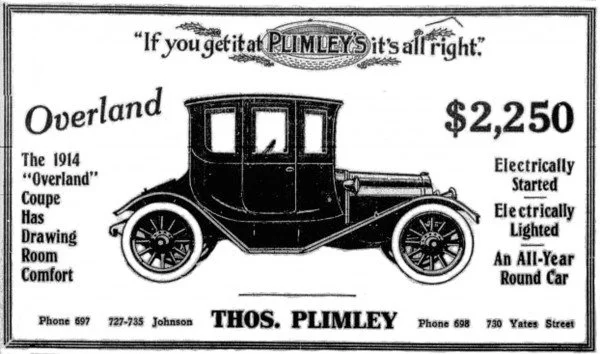
Horace and Thomas Plimley were pioneer auto dealers in Victoria. Don’t be fooled by the price of $2250; that was a fortune in 1914, which explains why there were so few car owners. — https://www.victoriaonlinesightseeing.com
One wonders if it was just coincidence, but the fact remains that on the same May 17, 1904, W. (Will) C. Todd, a son of C.F. Todd and nephew of Albert Edward Todd, became the holder of license number 14. Maybe they had a little wholesale deal going for them?
In the margin of the entry there is a notation I, for one, do not understand, neither can I find any provision in the act of that day for such. “Capital inspected, May 17, 1904, W.J. Goepel, Inspector." Mr. Goepel was inspector of offices for the provincial government and this makes the entry even more mystifying. Maybe I am completely off the track and this might just be the notation that the register had been inspected to that date.
Let's go back to Bill Todd. At this time, he was a very young man, active with his father in learning the business of the Todd empire. With it all, he learned of the responsibility which wealth imposes, and the generosity was great, but completely anonymous.
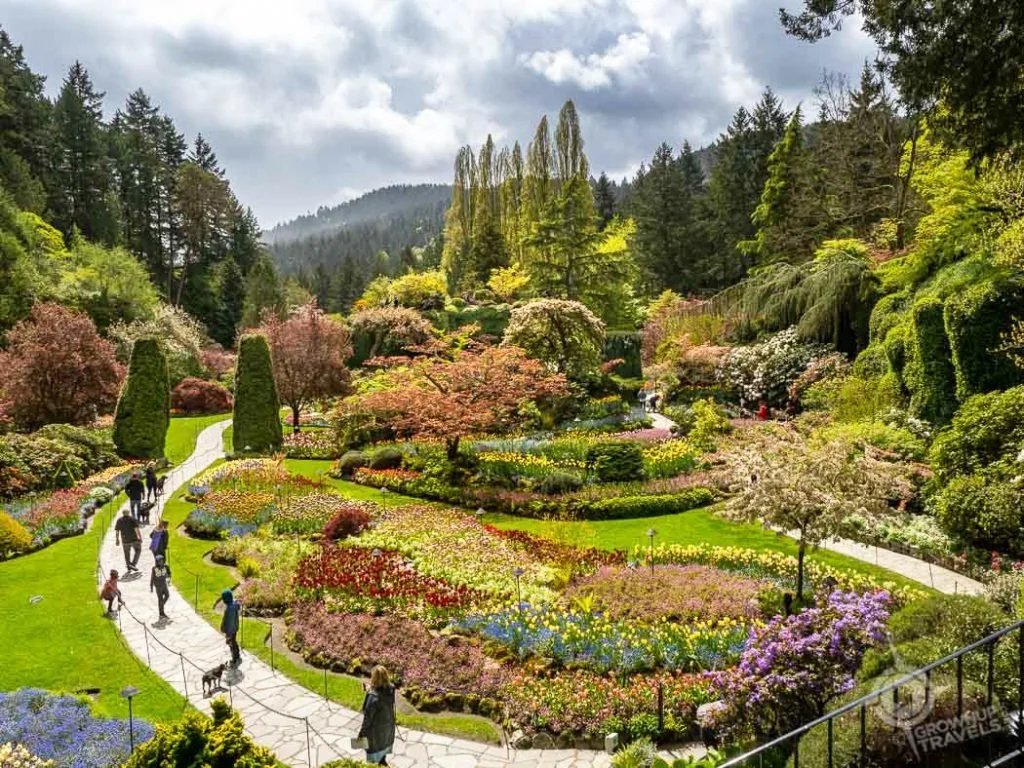
World-famous Butchart Gardens, the work of Jenny Butchart. Her husband R.P. Butchart made his name as a pioneering manufacturer of Portland cement—and his reputation for driving with the pedal to the metal.—https://www.grownuptravels.com
Will Todd had a weakness for automobiles, however. They usually became his hobby. He acquired his second car April 17. 1905, just one week after Uncle Bert had purchased his second car. They held license numbers 41 and 42 respectively. I am told that he was so interested in automobiles that he had an understanding at Plimley’s that he would have the first chance to drive the new cars as they arrived.
Another entry under the registration of Will Todd's number 14: “Sold to a Mr. Bale, but does not know if he owns vehicle at present—W. Todd, 12 of June, 1906."
The Mr. Bale must have been David H. Bale, well-known contractor of Victoria for many years... The automobile mentioned would be the same featured in the following yarn.
Mr. Bale had demolished an old home in order to use the site for his new house. He took two beautiful Venetian glass chandeliers from the old home, selling one to Capt. Troup, and which hung in his home...and the other was the consideration in a deal with Tom Plimley.
The terms of the deal were simple. Tom Plimley would give him credit for so many dollars and pay for the chandelier through repairs to Mr. Bale's car when necessary. Having completed their business, Mr. Bale went to his car which was parked...in front of the garage, on the left hand side of the street.
Plimley started the car. The chain and sprocket broke in the timing gears, breaking off the case and a large chunk of the crankcase as well. Who got the best of that deal?
Sprinkled through the first 100 car registrations are the names of men who later became prominent in the [automotive] business. Many of them were machinists who saw the opportunity for combining their skills as mechanics to enter this new field. Quite a number succeeded and stayed with the automotive trade.
Such a name was Fenton of Vancouver, W. and A. Fenton, to be precise. They registered their first car, May 23, 1904, as license number 15 and then obtained license number 22 on July 20 in the same year. This time they had a J. McIntyre included in the permit; thereafter these names appeared quite often...The Fentons’ first car was sold by them to James Stark, the proprietor of Stark's Glasgow House, dealers in dry goods, at 170 Cordova Street, West Vancouver.
What on earth would anyone be doing with a car in Atlin, of all places, and more especially in 1904?
But there it is, as plain as anything: “May 25, 1904, license number, license 16 to O.T. Switzer, Atlin, B.C." Probably used it to take his sled dogs for a ride around the lake.
Yes, it was a most interesting period and one imagines the list of the first 100 registrations contains the names of more interesting and prominent people throughout the province than might be encountered in any other document.
—Ainslie J. Helmcken, The Islander, Jan. 14, 1968.
