
The Last Frontiersman
For most of a lifetime, pioneer of pioneers ‘Blackjack’ Ranold J. McDonnell moved with the BC frontier, always with a keen eye for opportunity.
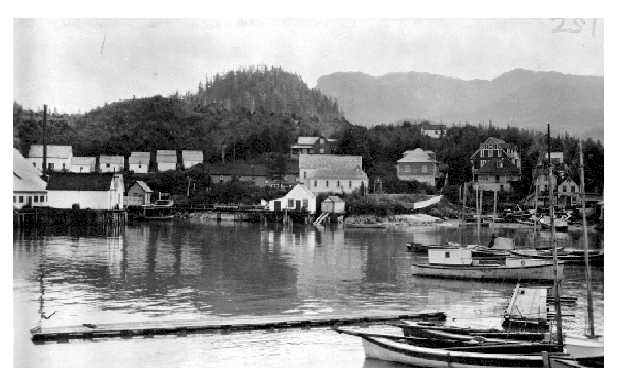
Port Essington, at the mouth of the Skeena River where Blackjack McDonell operated “the most up-to-date hotel in northern BC.” —Wikipedia
He’s one of a legion of remarkable frontiersmen who are virtually unknown to us today. Fifty years ago, the late O.J. Hutchings decided to correct this oversight by setting down ‘Blackjack’ Ranold McDonnell’s story for posterity.
* * * * *
Hardy and generous, he was born in San Francisco in 1853, the son of a former British naval officer. Soon the senior McDonell had moved his family to British Columbia, first to Westminster, then Esquimalt and, finally, Victoria in 1858. Young Jack received his schooling while his adventurous father joined the Fraser River gold stampede. His mother, Mrs. Etheridge McDonnell, had an extra large home and opened a boardinghouse on Birdcage Walk, behind today's Parliament Buildings.
Her high-class establishment [attracted] out -of-town members of the colonial legislature during their sessional residences. Here, also, came the members of parliament following Confederation in 1871. Young Jack knew them all, and, listening to their discussions on the topics of the day across the supper table, developed a keen interest in public affairs.
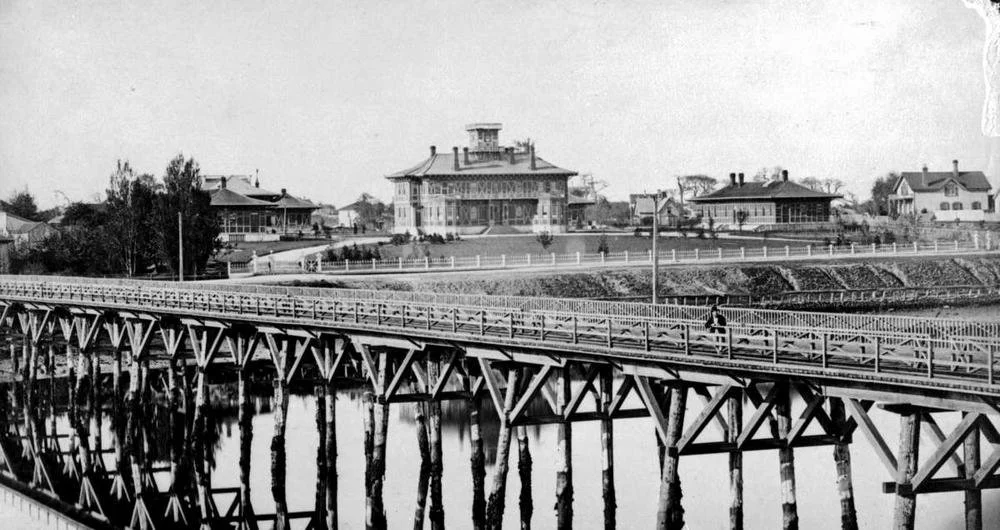
Victoria’s original legislative buildings, which looked like pagodas with their curled-up roofs, were known as the Birdcages. Blackjack’s mother’s high-class boardinghouse catered to many of the politicians from out of town. —BCA
In his youth and early manhood he obtained work with survey parties and enjoyed the outdoors and exploring much of the Island. His father got him started in the Victoria post office. But this proved to be too slow and tame for him, so Jack became a junior bartender at one of the best saloons in town. Upon returning from sea, his father found son Jack serving drinks and boasting that he could now mix almost any kind of drink as he asked his father what he would like and filled the order.
From then on, Jack made headway in the city and I guess that it was natural for him, after having been brought up in the atmosphere of a boardinghouse, that he should launch into the hotel and public entertainment business.
After several such years in Victoria he moved south to San Francisco where he and a partner were in the hotel and theatre business for some years.
Then, in the late 1880s, he moved back north and opened the Grand Hotel and Theatre on Vancouver's Water Street. Once again, however, the draw of Vancouver Island pulled him and in the 1890s he returned to Victoria where he had a colourful connection with city. Always known as a “straight-shooter,” he was a quiet-spoken man, about 5 feet 8, and weighing close to 180 pounds, and always mde lots of friends.
One of his most colourful episodes was Victoria's new amusement resort, the Savoy, which Blackjack and his latest partner, a man named Jackson, opened to the Savoy to the public, on May 22nd, 1899.
This was a first-class music hall and, that night, it played to a capacity crowd. At 9:00 p.m. there was standing room only, and they had to close the door on the crowd still outside. The subsequent performance was hailed as one of the best lower-priced shows ever given in the city.
The Savoy was Victori’s only burlesque house at a time when a man could stand at the bar and pour his own drinks from the bottle at 15 cents, or two for a quarter!
The place was noisy, as a burlesques are, but he ran a good show and kept a sharp eye on everything. In the case of trouble, he kept a staff of husky bouncers moving in and about the patrons while they tried their luck in the numerous games of chance (card games, crap games, chuck-a-luck and roulette).
As they used to say, everyone in Victoria got to the Savoy, sooner or later!
But gambling wasn't the only attraction at the Savoy. If your luck ran out you could buy your drinks and watch the show on stage. It was straight burlesque, complete with girls and skits; also jokes which, reportedly, became as raw as the law allowed. As one old timer reminisced, “Most of the skits ended in ‘blackouts.’ They left it to the customers to guess how it all ended, which never stretched the imagination very very much.”
At the Savoy, a man could have his privacy as, along each side of the theatre, and situated above the ground-floor seats, was a line of small private boxes. Each of these was curtained off and a gentleman and his lady companion could speak of love without being overheard or seen, yet, if they so desired, still watch the show going on below them.
Blackjack’s venture at the Savoy didn't last too long as his feet soon became itchy and, after seeing so many go to the goldfields of the Klondike, and having heard the wonderful stories from some of the Argonauts of that famous period, he answered the call of the North, selling his interest in the Savoy.
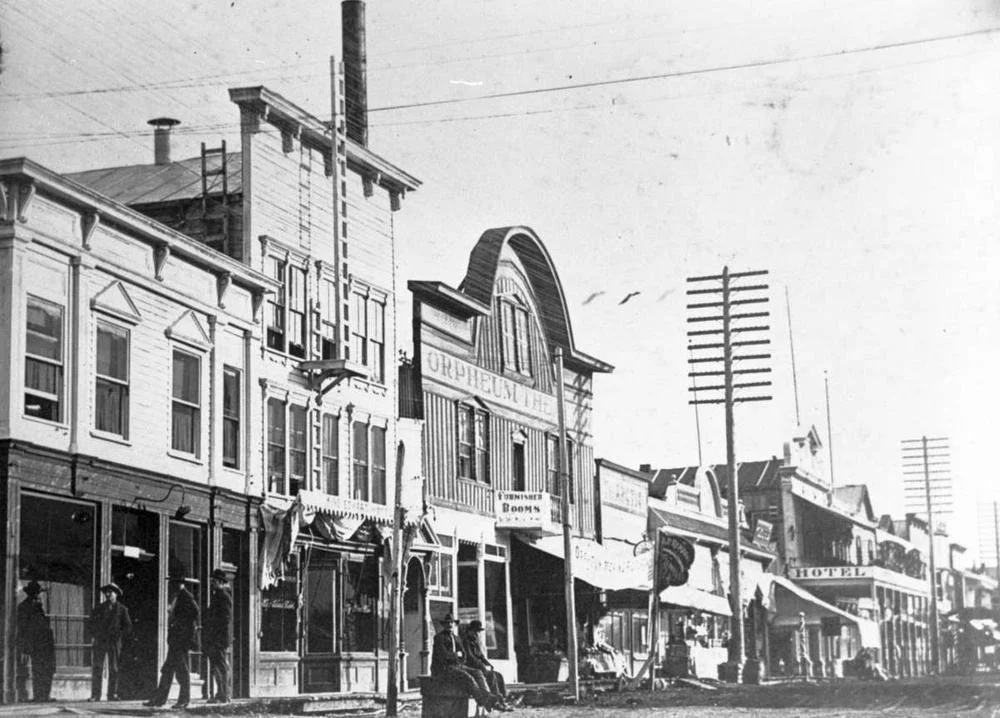
From Victoria to the Klondike was a big step for Blackjack—but not his last as he spent most of the rest of his career in northern BC. —BC Archives
He soon made his way into the thick of the new El Dorado. It wasn't long before he became one of the most popular men in the Yukon, and the way of life in the North—with everything so easy-going, businesses booming, everybody in a fancy mood and money changing hands almost constantly—soon took hold of him.
Everything about this hectic way of life suited him to a T.
But, after a number of very successful years in the Yukon, when the gold boom had begun to slacken, Blackjack answered a new call of adventure, moving south to the fresh excitement of the Skeena River where hopes were high as rumours told of a second Transcontinental Railroad which was to follow the Skeena River to a new Pacific terminus.
At this, Blackjack located first at Spokeshute, or Port Essington, at the mouth of the Skeena, where he leased the Essington Hotel and Annex from Robert Cunningham, who’d once been Hudson's Bay Company Factor at Port Simpson.
Blackjack renovated the building and it was the most up-to-date hotel in northern British Columbia, complete with modern dining room, hot baths, a large bar, card rooms and good service.
Spokeshute was a wild town in those days, but full of fun. During the boom days, the town was wide open with bootlegging, gambling and wild women at every turn. Its being the terminus for all traffic up and down the river, miners, trappers, fisherman and cannery-men of every nationality made Saturday night look like a 1st of July celebration.
The Essington Hotel had it share of the trade but Blackjack saw to it that it was kept to a somewhat higher standard. However, one afternoon and evening, back in August of 1907, a constable I will call X, well under the influence, made a laughing-stock of himself.
It seems that, according to the story, Blackjack had discharged a waitress whom the constable sought to have reinstated, but Blackjack remained firm.
Now, it was known that the constable had slept in the courthouse until, apparently tired of that abode, he’d sought a more restful bed and secured room 22 in the Essington Hotel. What happened there is of no concern; suffice it to say, the waitress was in fact dismissed and the bad limb of the law was told he couldn't occupy the room again.
About 5:00, when guests were congregating in the lobby prior to entering the dining room, the constable reappeared and, approaching the proprietor, demanded that the waitress’s reinstatement or he'd close the card room.
“Close it and be damned,” roared Blackjack, “but not you nor any other cur will make a bawdy house of my hotel!”
With this, the constable rushed through his office to the barroom where, approaching the blackjack table, he gave the dealers 10 minutes to pack up and give the cards a rest.
“I'll be back in 10 minutes," and if these games are still running I'll pull the house and drive you out of town.”
Then, followed by Blackjack, he left the room amid a volley of the most obscene language heard even in that section for many moons.
But the games closed down and the boys took a break. About 12:00 that night the constable returned and the second act was performed for the guests who were aroused by the boisterous use of profane language, which caused them to assemble in their night robes on the stairway.
The constable wanted to fight so badly that he even offered to pick out a soft spot for a reporter who’d protested against the guests being annoyed at such an unseemly hour by the would-be officer whose prime duty was to keep the peace rather than to disturb it.
He finally cooled down when a well-known citizen, Jack Collins, told him that he wasn't hired to be a government prizefighter. With this, the constable stomped through the barroom and out of the hotel.
Things finally settled down in the old town when there was an investigation which resulted in both town constables being discharged.
After three good years in Port Essington, Blackjack turned his attention to the upper Skeena where the railroad construction gangs were penetrating the wilderness. Subsequently, in 1910, he and a partner named McAfee built the Ingineka Hotel at Old Hazelton. Blackjack also opened a roadhouse at 20-Mile with others in-between. These places did a big business as things were wide-open during the years the railroaders pushed their way towards the Pacific.
In December of that year Blackjack finished building the Telkwa Hotel in addition to his chain of first-class accommodations on this Northern frontier.Those were rough, tough and hectic days and nights.
Lots of money changed hands across the saloon bars and also across the gambling tables. It was during these times that the bootleggers had a heyday and at times the police would clamp down. It was on one such occasion that six of these “blind pigs,” as they were called, were raided, brought before a magistrate where they pleaded guilty, and were fined $300 each.
At the conclusion of the trial Blackjack walked over to the court clerk, paid all the fines and walked out.
Whatever Blackjack did at the camps or road houses had no bearing on his running a first-class hotel as they were all classed family accommodation which in those days meant something.
His next move was to New Hazelton where he built the Northern Hotel in 1913 at a cost of $60,000. It had 60 bedrooms, four bathrooms on each floor, steam heating and telephones throughout—the most modern in the northern interior. He stayed there for a number of years, making lots of money and putting much of it back into circulation by grubstaking many prospector and by investing in numerous big mining ventures.
At one time he owned and operated the crown-granted Coronado group of claims on Hudson Bay Mountain which shipped considerable ore containing copper, silver and some gold. Another of his enterprises was the buying of the old Hudson Bay Ranch in the Glentanna district, North Smithers, which he operated for many years.
Here, he had a large number of cattle, sheep, pigs and saddle and work horses which gave employment to a varied crew, summer and winter.
Times were good until the declaration of the First World War on Aug. 4, 1914, when many men joined the colours and business slackened. But that was only the beginning, the next blow to Blackjack's empire being the introduction of Prohibition which became effective on Oct. 1st, 1917.
This was the last straw as it had the effect of closing most of the hotels throughout the North Country due to the fact that it had been their liquor licenses which had kept them operating throughout the long winters.
However, if nothing else, Prohibition succeeded in ending a common complaint in the north country: the two-quart cold!
Blackjack stayed another year and a-half but as a number of his mining ventures, once so promising, failed to materialize in any big way, he had to look for fresh fields to conquer. Thus, after more than 12 years on the Skeena River—some good, some not so good—he finally closed the Northern Hotel in the spring of 1919.
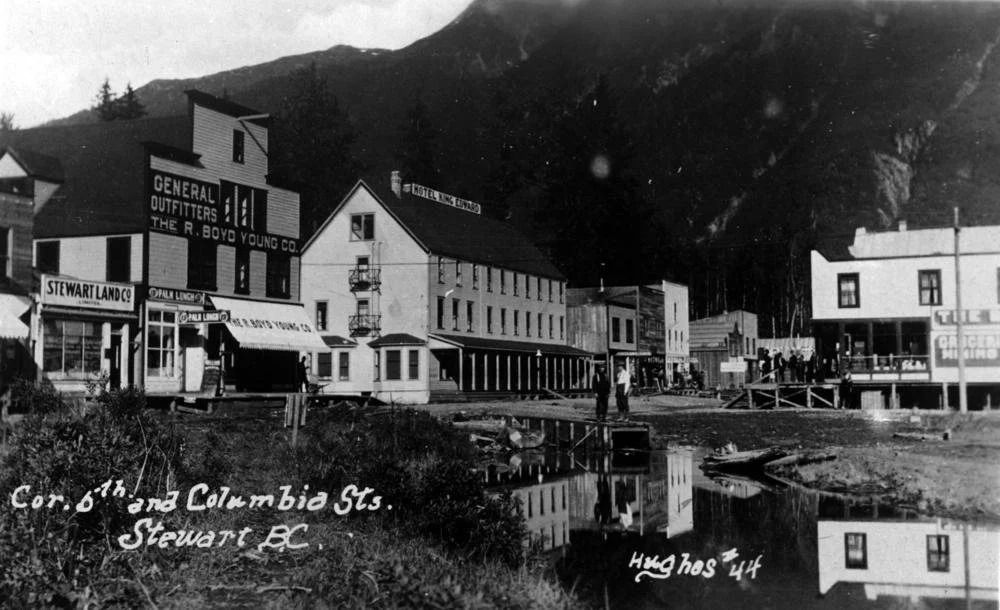
With Stewart booming as a mining town, Blackjack headed for the Portland Canal country. —BC Archives
At that time the town of Stewart at the head of Portland Canal on the Alaskan border was booming as a new mining area so he headed for this new frontier. Here he stayed for many years, engaged in mining and hotel keeping both in Stewart and in the adjoining American town of Hyder, Alaska, where he was a partner in the Alaska and Northern hotels with Bob Jameson, an old friend from his Victoria days.
He also went into partnership with Bill Reed and built the Keith Hotel in Hyder, B.C. During those boom days of the famous Premier Mine, up the Salmon River Valley, he went into partnership with Bill Tolin in the King Edward Hotel at Stewart.
As ever, Blackjack made many friends and it was there that I made his acquaintance. Numerous times, he came to my store and we would talk over the old days, I always finding him a quiet, pleasant and interesting fellow to reminisce with.
He frequently returned to Victoria only to again be filled with hopes that in some new camp on the outskirts of civilization he’d “make his pile”. He always enthusiastically entered into the sporting activities (other than gambling!) of the day, wherever he was, following all forms of athletics.
This same enthusiasm for “playing the game,” he carried into the mining camps and trading posts of the North where, in the roughness of the frontier, he was always known as “a dead game sport” and a straight-shooter—those signifying the highest form of compliment for a man who dealt fairly with his fellows and was ever ready to assist anyone or a good cause in need.
Blackjack finally retired to Smithers where he suffered a stroke in January 1932, dying in St. Paul's Hospital, Vancouver. He left four sons and a daughter and two grandchildren.
Black Jack McDonnell was buried in Victoria on September 21st, 1932, ending at 79 years a very colourful life as one of British Columbia's last frontiersmen.
