
British Columbia’s First Capital City
Victoria hasn’t always been our capital city. Even before New Westminster’s short-lived reign as the capital of the crown colony of mainland BC—Vancouver Island was a separate entity—there was another contender: Derby.
Established on the original site of Fort Langley, Derby was conceived in the summer of 1858 by a land speculator. In September the Victoria Gazette reported that James H. Ray had “pre-empted” 1,200 acres near Fort Langley and was in the process of dividing them into town lots.
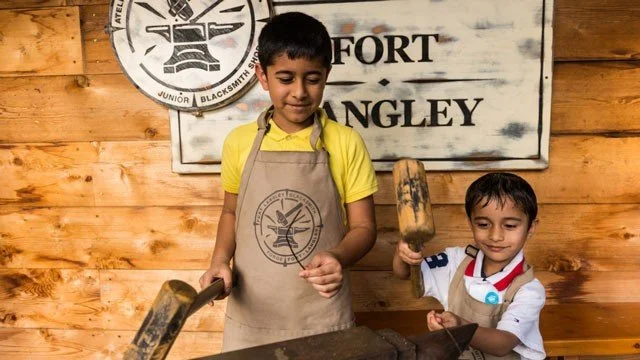
Today, Fort Langley is a National Historic Site and popular tourist attraction—but not our provincial capital, alas, alas.—parkscanada.ca
Ray certainly was a man of initiative and innovation; too bad for him that his vision was never fulfilled.
But it does make a good story.
* * * * *
“So far as we can learn,” reported the Victoria Gazette, “this action of Ray’s is done without the sanction of the government, and any title derived from this is consequently of no account. As we hear of several sales being made on the part of Ray, it would be well that the public were put on their guard.”
Ray’s initiative didn't go unnoticed. Others objected to the speculator's actions, the Gazette’s travelling correspondent sarcastically writing that the developers, “under the pretext of laying out a town, have well nigh spoiled a nice potato patch. In a bit of clearing some mile or two below the Fort, running over it in the most reprehensible and reckless manner.
“The older residents of Langley are not a little entertained with the assurance of the principals in this game in assuming to own the land that's about to be sectionalized into the city lots; and when solicited to invest therein cast the projectors a get-behind-me-Satan-sort of look, implying the utmost distrust in the enterprise.
“The site selected for this future Sacramento, or St. Louis, is by no means ineligible, being a handsome ridge off dry land to the rear, which land, as it has a good soil, were better devoted to the raising of garden ‘sass’ than mushroom cities...”
Three days later, Colonial Surveyor Joseph D. Pemberton, “by order of the governor,’ announced that the land in the vicinity of, and including the site of ‘Old Fort Langley,” was to be surveyed for a townsite. Corner posts of the blocks would be driven, the blocks numbered, and single town lots of 64x120 feet sold without reservation unless for government use, at Victoria on October 20 for $100 each.
Governor Douglas's intervention didn't please the editor of the Gazette who protested in an editorial: “...We trust His Excellency...will counteract this order, and not permit the introduction of a system of disposing of the public land that must prove ruinous to the best interests of the proposed town, as well as perpetrate a great hardship on the working and poorer classes of the residents of the two Colonies [Vancouver Island and BC].
“We are satisfied that if the lots sold in the manner indicated by the Colonial Surveyor, they will fall into the hands of capitalists, who will buy alone with the view of speculating...”
The objections of the Gazette and others were heeded by Douglas. On October 22nd, Pemberton placed an advertisement in the Victorian newspaper to the effect that the sale of town lots had been deferred, that notice of sale to be renewed as soon as the surveys and plans were complete. In fact, Douglas wanted a full report from his engineers.
At his request, Capt. John Grant, Royal Engineers, submitted the following recommendations:
“...It appears inadvisable to locate a town...so close to the American Territory [that] trade and speculation will at once give it an impetus, and tho’ perhaps not intended, it will gain such importance as must militate most seriously against any other position which may ultimately be selected for the Chief Town and caps Port of Entry, and commercially, from its proximity to the Frontier, the open trails in each country...between Fort Langley and Simihamo, an American Port distant 16 miles, it will surely...become a resort for smuggling and ruin the trade of the Fraser River...
“Whereas shipping could sail with ease to good anchorage at the entrance of the Pitt River, and moreover the position being at the confluence of two Rivers, and if the report proves correct that the country along the Pitt is Auriferous, a large influx of miners may be expected and the necessary supplies for some time at least, would be taken up to Langley, only to be carried back again, a measure detrimental to all interests.
“Under these circumstances I would recommend to your Excellency the suspension of the contemplated sale of Town [lands] and further that no buildings however temporary be commenced till such information obtained as will indicate for certain, the true site for a Chief Town....”
Despite Grant’s negative report, Douglas offered 3,284 lots for sale on behalf of the Crown; 67 feet wide and 120 feet deep, they faced level, 78-foot-wide streets and were backed by 12-foot-wide lanes. In three days, the colonial coffers grew by $66,172 from the sale of 343 lots.
On November 19th, two days after Grant wrote his report, the quiet meadow was proclaimed to be the capital of the Crown Colony of British Columbia. Two months later, the capital was christened Derby, in honour of Lord Derby, Prime Minister of Great Britain, and Colonel Richard Moody, commanding officer of the Royal Engineers was instructed to survey it accordingly.
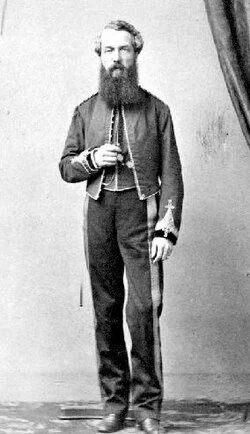
Col. Richard Moody, Royal Engineers. —Wikipedia
Moody, however, was unable to reach the townsite for some time. When he did visit Derby, his opinion of the proposed capital concurred with that of Capt. Grant. Derby, he informed Douglas, failed on two critical points: it was vulnerable to attack by Americans in the event of war, and the site was subject to flooding.
Although displeased, Governor Douglas had no choice but to accept Moody's verdict and his hopes for Derby as colonial capital were still-born. He didn't, however, forgive; until the end of his term as governor he hated the Derby’s chosen successor, New Westminster, and did nothing to advance its development.
Those who’d purchased lots at Derby were permitted to return them to the Crown and to have their payments applied to lots in the new capital. Moody did agree, despite Derby's shortcomings, to use it as a temporary headquarters for his engineers, and work was begun on the constructions of a barracks, jail, courthouse, church and parsonage.
On April 14, 1859, the steamship Eliza Anderson landed 31 women and 34 children, the wives and families of many of the engineers, at Derby, which was to be their home until work on New Westminster was well underway.
The site of the original Fort Langley had made a further significant historic contribution to the future Pacific province with the arrival, in mid-February, of the Anglican Rev. William Burton Crickmer, his wife and daughter. On February 20, he held his first service at Derby in the engineers’ barracks—“As far as I can make out the first sermon in this vast territory except perhaps the fugitive address to a few French Canadian voyageurs.
Rev. William B. Crickmer’s first address was to a congregation armed with Bowie knives and revolvers. —Vancouver City Archives
“My church was a half-finished barrack, my congregation soldiers and civilians, my pulpit a Union Jack over a box, and my text Genesis 1, 26, ‘The New Creation.’ Every garb and costume imaginable was there. In one respect only were they uniform, in that they all carried Bowie knives and revolvers. There was one gentleman connected with the Hudson's Bay Company for whom that was the first sermon heard in 40 years. Many present had not heard the Gospel for periods ranging from 20 years down to 20 months.”
Almost immediately—Col. Moody's objections as to its suitability as capital notwithstanding—private businesses began to establish at Derby. An elaborate sketch by Rev. Crickmer depicts what must have been a typical Sunday morning in Derby.
Something of a self-portrait, it shows the artist delivering a sermon from atop an upended barrel in the middle of the main street before a motley congregation of citizens, businessmen, seamen, Royal Engineers, teamsters and Indians. Some are listening to the sermon, others are smoking, dozing, whittling and gambling, as a teamster drives his oxen and wagon right through the crowd—and mother sow and her six piglets pick their way through a litter of empty bottles and playing cards.
In the background, a dog sleeps through the address and a flock of chickens scratch in the dust.
Signs on the buildings indicate the types of businesses which had established in Derby: the Miners Home; a hardware store and miners’ outfitting depot, Curtin and Petibones, proprietors; J. Edwards’s Fraser River Restaurant, which advertised meals for 30 cents; the Hi Sing Restaurant, with billiards parlour upstairs; Rodgers and Robertson’s “What Cheer!” House (which, although the narrowest building on the street, also housed a laundry); and Wells Fargo Express which announced by signboard that it “bot” gold dust.
Despite this apparent prosperity, Derby couldn't escape Moody's decree that it was just a temporary site.
As early as June 1859, Judge Matthew Begbie wrote. “It is ten thousand pities that the government buildings and church could not be floated down to the lower place [New Westminster]. The water is all over the centre of the ‘town’ of Derby...”
Besides the government buildings, he noted only two stores and a restaurant.
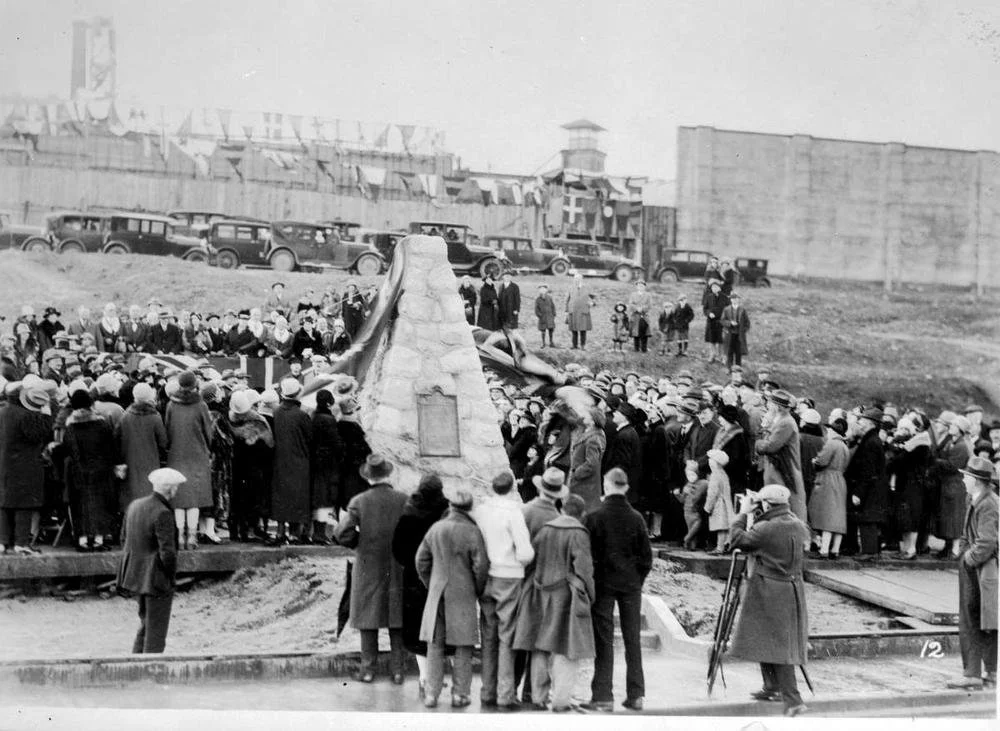
The Royal Engineers, who were honoured with the June 1927 unveiling of this cairn, made many significant contributions during BC’s formative years—including the rejection of Derby as a suitable colonial capital. —BC Archives
By this time the residents of Derby, who possibly had hoped that it would survive as a residential and business community, realized that Fort Langley, so briefly overshadowed by its upstart neighbour, was reasserting itself as the regional commercial hub.
Among those who decided that it was easier to drift with the tide were the owners of the What Cheer! House, co-proprietor Roberson and a new partner, Peter Baker, setting up shop outside the western palisade of the Fort with their British Columbia Saloon Co.
By 1866, the “town” had all but ceased to be, and when John Jolly and his father-in-law James James arrived at Fort Langley, they set up house in Rev. Crickmer’s former manse while they built their own homes. Upon their moving out another settler, William Emptage, tore down the rectory and used its California Redwood lumber in the construction of his home.
Later, the first school in the district was established in one of the abandoned government buildings at Derby but, by this time, Derby was a town in name only, the school being used by the children of Langley.
Upon Rev. Crickmer's departure for Yale, St. John the Divine was used but intermittently, sometimes by Presbyterians and Methodists. In 1876, Port Haney namesake Thomas Haney and his wife lived in the abandoned rectory for six months while he built a new home across the river.
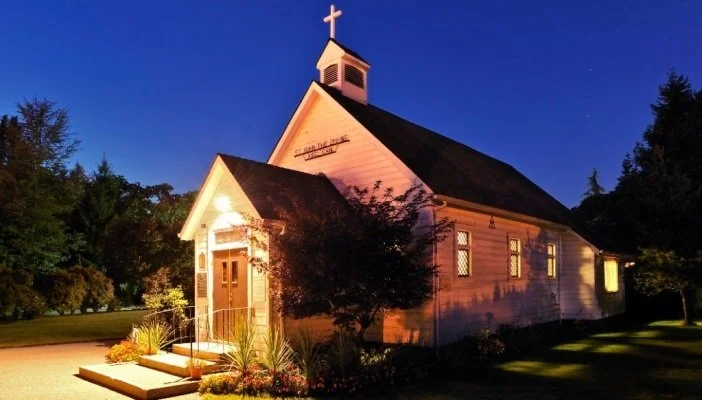
“St. John the Divine is the oldest church in mainland British Columbia. Its’ history began with the Gold Rush of 1850-52.” —www.vancouver.anglican.ca/golden-ears/st-john-the-divine
In 1882, Samuel Edge was hired by the Church of England to dismantle the historic church, float it across the river and rebuild it at Maple Ridge. There, enlarged and restored, it remains in service as the province's oldest wooden church.
