
Barkerville Fire
Fire.
This was the single greatest threat common to all BC frontier communities.
More than flood and famine, more than the threat of epidemic, fire haunted the minds of those who valued their lives and their property.
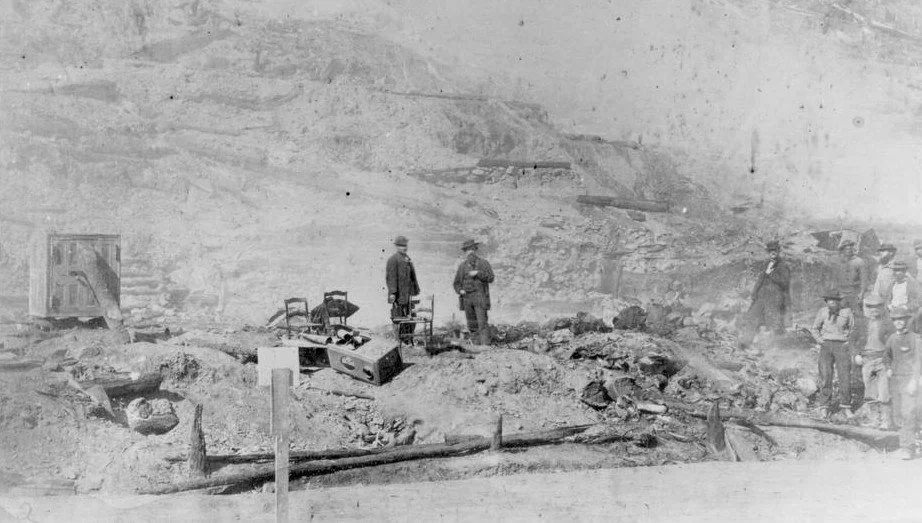
On Sept. 17, 1868, the day after the fire, Barkerville lay in ruins. —BC Archives
Nevertheless, fires occurred with deadly frequency. Open hearths, poor construction standards, inadequate to non-existent firefighting equipment—and, often, a fatalistic approach to impending calamity—meant, that sooner or later, almost every community had its day of doom.
* * * * *
Barkerville’s great fire came at 2:30 in the afternoon of Sept. 16, 1868. As was the case with so many major fires before and after, the mystery isn't that the boom town was all but wiped off the map by flames, but that the day of reckoning was so long in coming.
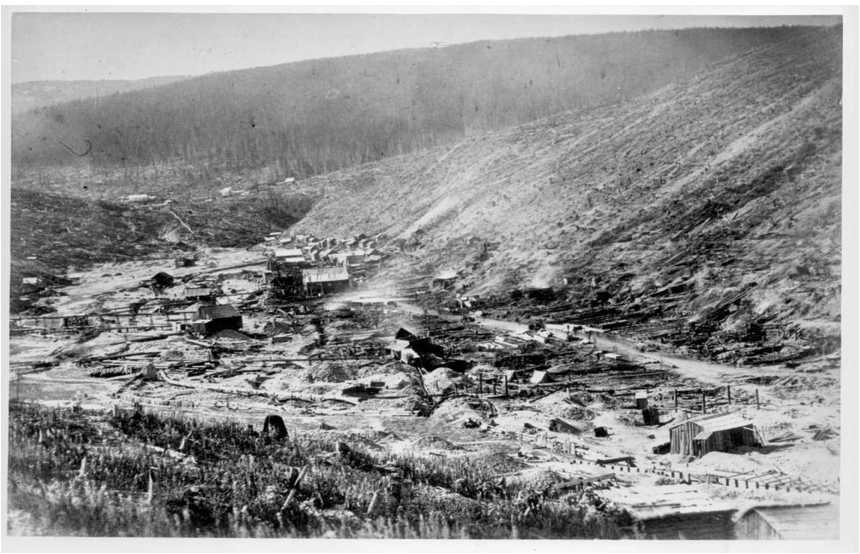
Barkerville, looking up Williams Creek in September 1868, immediately before the fire. —BC Archives
The summer of 1868 had been long and hot. For weeks, the gold fields had been idled by a blazing sun which had turned the surrounding forests into a tinder-box.
In town, the situation was worse, although few of Barkerville's citizens would face the fact. One who did with startling prophecy was photographer Frederick Dally, who’d arrived in town just weeks before:
“From the number of stovepipes very close together coming through the wooden roofs of the buildings at every height and in every direction, that were sending forth myriads of sparks, numbers of which were constantly landing on the roofs where they would remain many seconds before going out, and from the dryness of the season, I came to the conclusion that unless we shortly had rain or snow to cover the roofs, for they remain covered with snow all winter, that the town was doomed...”
Barkerville was indeed doomed.
Ironically, the fatal spark was ignited by one of the town's latest arrivals from the bright lights of San Francisco. Six months earlier, Messrs. Barry and Adler, co- proprietors of the Fashion Saloon, had imported eight German “hurdies” from the Bay City.
On the evening of the following Saturday, every lonely miner from the neighbouring creeks was in town to view the lovely ladies and to buy a dance. The girls were literally swept off their feet and around the crowded dance floor. The noise was so great that, time and again, the orchestra broke down, unable to make itself heard over the din.
According to one theory, it was one of these very popular ladies who accidentally set fire to the town while ironing a dress in the rear of the Fashion Saloon.
Another legend has it, notes Bruce Ramsey in his Barkerville guidebook, that an amorous minor bent upon stealing a kiss knocked over a stovepipe and the resulting shower of sparks and embers quickly transformed the bone-dry saloon into a torch.
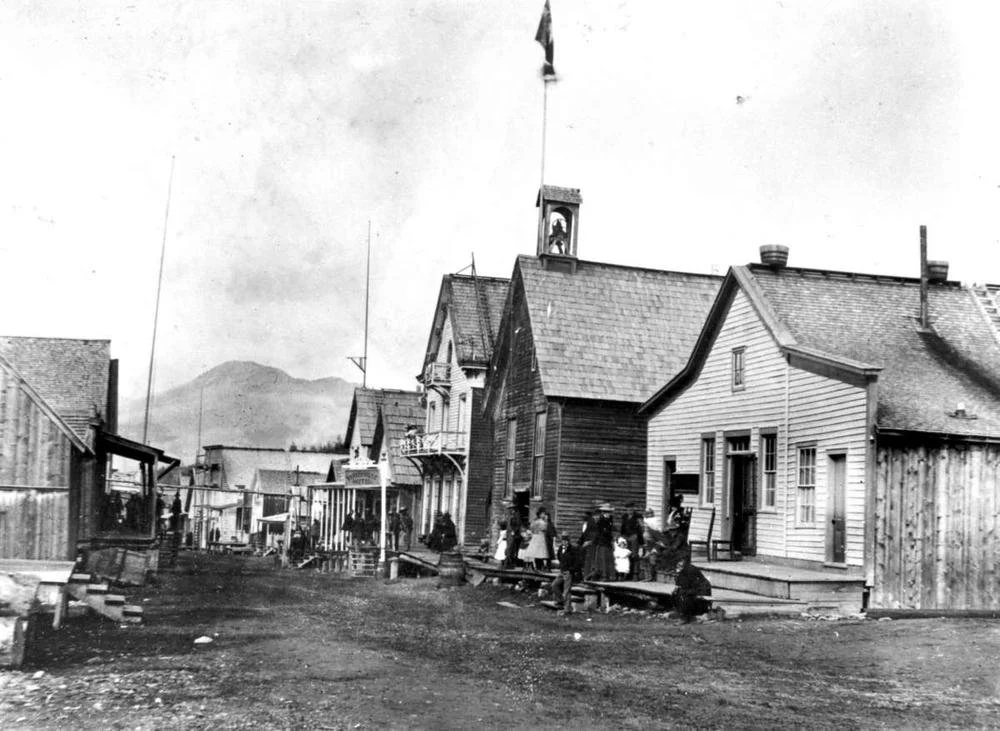
The rebuilt Barkerville main street after it was widened, and as it looked on July 1, 1900. Note the fire hall with its flag and bell tower. —BC Archives
Sept. 16, 1868 dawn bright and clear, with a heavy frost which cloaked the sluice boxes and icicles up to three feet long.
Business was slow throughout the historic morning, recorded photographer Dally, and lunch seemed to be a long time in coming. He had no way of knowing that his dire prediction of fire was about to come true—that, in less than two hours, only ruins and ashes would remain of booming Barkerville.
As the photographer waited for trade to improve, he relaxed in his chair in his studio and “again meditated on the probability of a fire, when I heard several running on the plank sidewalk and heard one explained, ‘Good God! What is up?’
“I ran instantly to see the cause of the alarm and to my astonishment beheld a column of smoke rising from the roof of the saloon...
“I saw the fire had a firm hold of the building and as there was no water to be had, I felt certain that the town would be destroyed. So I collected as much of my... goods as possible together, and hastened with them to the middle of the creek, and left them there whilst I made several journeys after other goods.”
Within minutes, the flames swept through the roof of the Fashion Saloon and began to cascade a shower of sparks on adjacent rooftops, most of which were so close together that they almost touched. The Bank of British Columbia became a mass of flames. Then the fire began a mad gallop up and down both sides of the street.
“Although my building was nearly 50 yards away from where the fire originated,” continued Dally, “in less than 20 minutes it, together with the whole lower part of town, was a sheet of fire, hissing and crackling and roaring furiously.
“There were, in a store not far from my place, 50 kegs of blasting powder and had that not been removed at the commencement of the fire and put down a dry shaft, most likely not a soul would have been left alive of the number that were present.
“Blankets and bedding were seen to be sent at least 200 feet high when a number of coal oil tins, five gallons, exploded and the top of one of the tins was sent five miles and dropped at the sawmill on Grouse Creek....”
From the beginning the townspeople had realized that any attempts to fight the monster were futile and most had turned to saving what they could. Some, unhappily, either failed to gauge the fire's reach, or, desperate to move all they could, relayed their worldly goods to the edge of town—only to have the fire sweep that far and defeat their efforts.
Others, taking no chances of having their possessions burned, carried them way out of town, then returned for more—as others looted their caches.
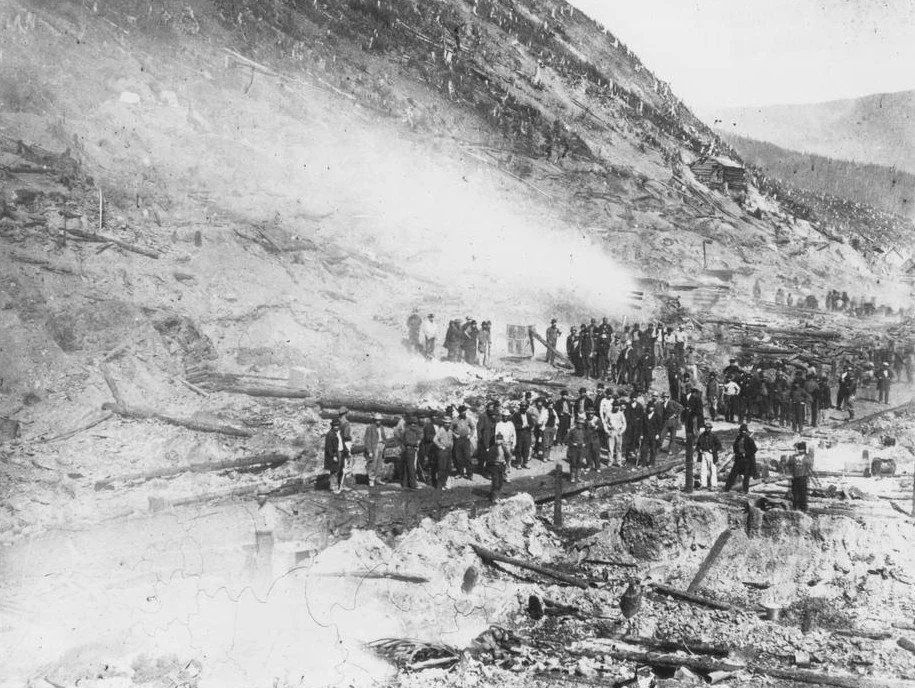
The day after. With smoke still rising from the ashes, most Barkerville merchants were already planning to rebuild. —BC Archives
Later, a stout citizen who showed “too many creases about him that did not look natural,” attracted the attention of a police officer who made him strip. Upon disrobing, the man was found to be wearing six shirts, three pairs of trousers and two pairs of drawers. Another thief was caught wearing two coats, three shirts and two pairs of pants.

This F. Dally photo of the Hotel de France shows why the fire spread so rapidly, with each building all but touching each other, and all of them using stoves, open fireplaces and coal oil lamps. —BC Archives
The search of another suspected looter’s shack revealed more than $1,000 worth of flour, rice, boots and supplies—enough merchandise to open his own store—behind a false canvas wall.
“The town was divided by the ‘Barker’ flume, crossing it at a height of about 50 feet, and as it was carrying all the water that was near, it kept the fire at bay for a short time from the upper part of the town,” Dally continued. “But the wind soon drove those that were standing on it away.
“The fire then quickly caught the other half of the buildings, also the forest on the mountain ridge at the back. And as the sun set behind the mountain, the grandeur of the snow will not be quickly forgotten by those who noticed it.”
By late afternoon the fire had burned itself out, and the 100s of dispossessed faced a second foe, a frosty wind that swept down the canyon and blew “without sympathy on the houseless and distressed sufferers, causing the iron-hearted men to raise the small collars on their coats (if they had been so fortunate as to save one) as protection against it”.
As darkness fell, Barlerville looked like a battlefield. But for two saloons, and two warehouses at the upper end of town, only blackened chimneys stood where, but hours before, had been frame buildings. Alongside the creek, piles of household furniture showed that some residents had been successful in saving a portion of their possessions. Most had saved only the clothes they were wearing when the fire started, and nightfall meant a long, uncomfortable night under the stars.
Early the next morning, Dally walked along the creek. As he passed along he “saw strong men rise from the hard, cold stones, having wrapped up in a pair of blankets, cramped with cold and in great pain, until a little exercise renewed life into their systems...”

One legacy of the great Barkerville fire of September 1868 was the formation of a volunteer fire department and a fire hall, shown here as it looked on July 1, 1871. —BC Archives
Total loss was estimated at almost three-quarters of a million dollars, the following establishments having been among the most valuable: Strauss's store, $100,000; Hudson's Bay Co. store, $65,000; N.C. Cunio Brewery, $40,000; Kwong Lee store, $40,000; F. Castagnetto store, $33,000. Cohen and Huffman store, $32,000; Lecuger and Brun hotel, $20,000.
As cold and uncomfortable as were the townspeople on the morning after the holocaust, they set to work to rebuild their boom town. In less than a week the Barkerville Sentinel, which had lost its premises, could report 30 new homes were under construction on their original sites, the foundations of others had been laid and many more would have been in the construction stage but for a shortage of carpenters and.
Like most gold camps, the original Barkerville had been built in a hurry without concessions to orderliness or beauty.
Not only would the new town “present a much more uniform and pleasant appearance,” declared the Sentinel, but, “by regulations of the local authorities, in concurrence with the people, the main street has been increased in width 15 feet and the sidewalks fixed at regular and uniform grade.”
During the initial boom, easements which had been reserved for side streets had been occupied by squatters. These were to be left vacant, “and altogether the new town will be much more convenient for business, and will be a decided improvement over the old; and we would not much wonder if in the course of a few years time many who are now heavy losers will cease to regret the conflagration of 1868.”
Several of the buildings which were rebuilt after the great fire of ‘68 have survived to this day and have been restored since the townsite was made an historic site by the provincial government. Scott's saloon, one of the four survivors of the fire, was torn down during the 1930s Depression.
On May 24, 1869, eight months after Barkerville was all but swept from the face of the earth, the Williams Creek Fire Brigade held its first drill.
* * * * *
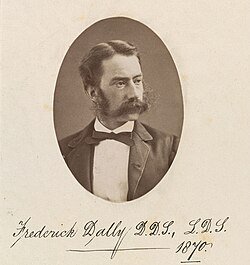
Frederick Dally (1838-1914) “is considered to have taken some of the finest Canadian photographs of the 1860s, and in particular his work in the Cariboo goldfields and Barkerville is thought to be outstanding. According to the foremost authority on Dally, Joan Schwartz, "his visual record of the beginnings of British Columbia surpassed those of his contemporaries in artistic ability, technical skill and market appeal." Many of his views were used as the basis of engravings for the pictorial press, and his photographs of wagons being pulled by ten-mule teams over the Cariboo Road have been used to illustrate books on the history of British Columbia.” —Wikipedia
Other than newspaper reports, Dally’s description of the fire is the only surviving written account of the Barkerville disaster.
