
Terror in Active Pass
“Oh, my son, I lost my son.”
Such was the heart-breaking front-page headline of the Aug. 3, 1970 Vancouver Sun, published the day after the BC ferry Queen of Victoria and the Russian freighter Sergey Yesinen met in a deadly, noon-hour crash in Active Pass.
Three ferry passengers were killed when the heavily-laden 10,400-ton, 523-foot-long freighter’s bow cut deeply into the smaller (426-foot-long) Victoria’s port side; ironically, when the ships were parted, the Yesinen appeared to have suffered only damage to her paint.
It was much worse for the broadsided ferry, however.
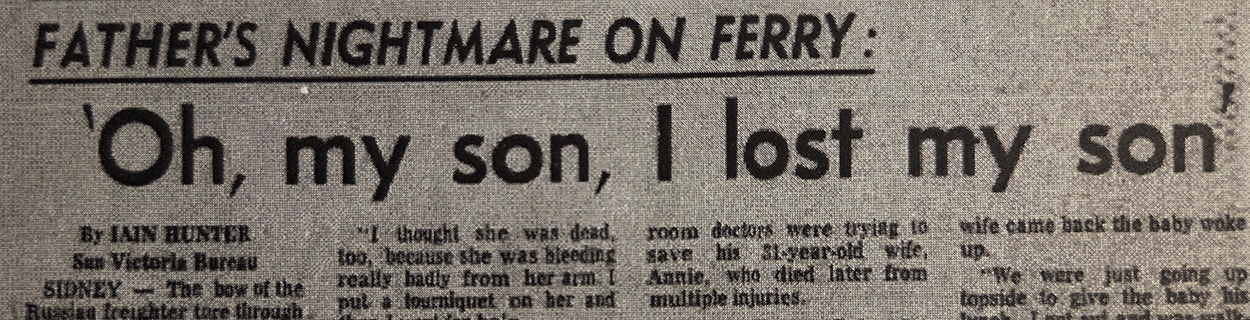
—Front page story in the Vancouver Sun—www.newspapers.com
For Victorian George Hammond, it meant the loss of his wife, 31-year-old Annie, and his 71/2-month-old son, Peter. She’d just stepped out of their vehicle on the upper car deck as he headed for a coffee. “We were on the ramp in the car deck,” he said.
“We were just going up topside to give the baby his lunch. I got out and was walking away from the car and my wife was coming around the back of the car. All of a sudden the bow of that ship came through the ferry’s side and there was this terrible tearing of metal and the cars started to be thrown around.
“The impact threw me in the other direction and I looked back and saw my wife standing there with the baby in her arms. She screamed once and disappeared under all those cars—she was jammed in tight between two cars. I leaned down and tried to pull at her and when I pulled her out, there was my little fellow, dead.
“I thought she was dead, too, because she was bleeding really badly from her arm. I put a tourniquet on her—I used my belt—and then I went for help.
“The pipes around us had burst, there was water pouring all over everything, there was gasoline leaking all over the place, and fumes and steam...”
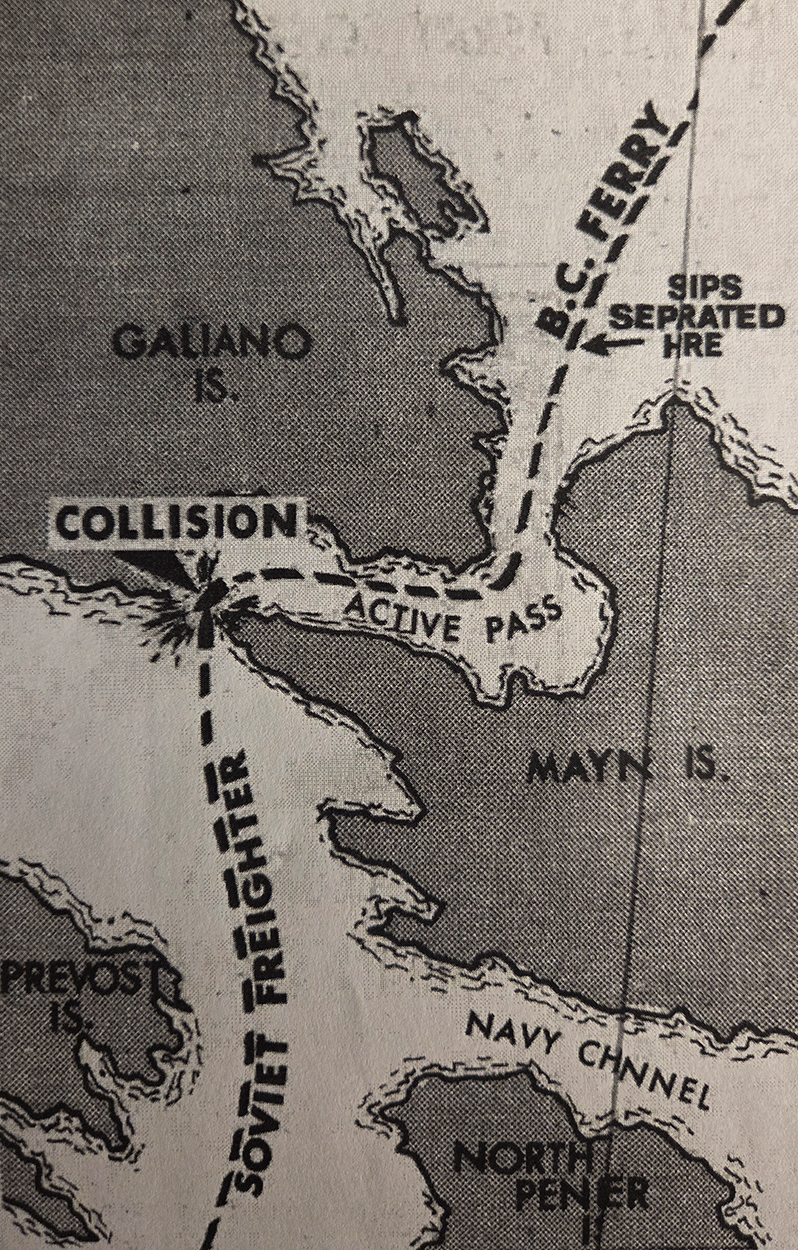
A sketch map showing where the Queen of Victoria and the Sergey Yesinen met at the western entrance to Active Pass. —Vancouver Sun
Knowing that his son was dead and that he needed to attend to his wife’s injuries, Hammond had no choice but to lay the baby down. “I ran upstairs to get help but no one I talked to would come down. I ran to the medical station but it was locked. I had to break the glass to get at a roll of bandages and then I found the crewmen at their stations and an officer sent some of them down right smartly.
“The crew on the ferry, once they found my wife was hurt, they were wonderful, they did everything possible for her.”
Mrs. Hammond and an injured girl were transferred by lifeboat to a Coast Guard hovercraft and rushed to Patricia Bay then to Rest Haven Hospital where surgery failed to save her.
Hammond, who’d served in the RCN, said he hadn’t heard any blasts from the ferry’s horn or the sudden reversal of engines that other passengers had described. “All I saw was the bow of that ship suddenly slicing through the side of the ferry.”
Tearfully, he said he’d had to “leave my little guy on the ferry because I had to bring my wife here [to the hospital]. I couldn’t go back down on that car deck because I was afraid fire would break out with all that gasoline pouring about.”
Already, a Department of Transport investigation was underway to determine how the two vessels had collided and killed three passengers, Mrs. Hammond and her infant son, and 17-year-old Sheila Taylor of New Jersey who’d been on deck outside the promenade lounge at the moment of the crash. Her body wasn’t recovered until the ships were separated, and her identity was withheld until her parents, who were away on vacation, could be contacted.
“There could still be people missing,” said a Delta police officer. “No passenger list was kept and that hole is so big a truck could have gone overboard.”
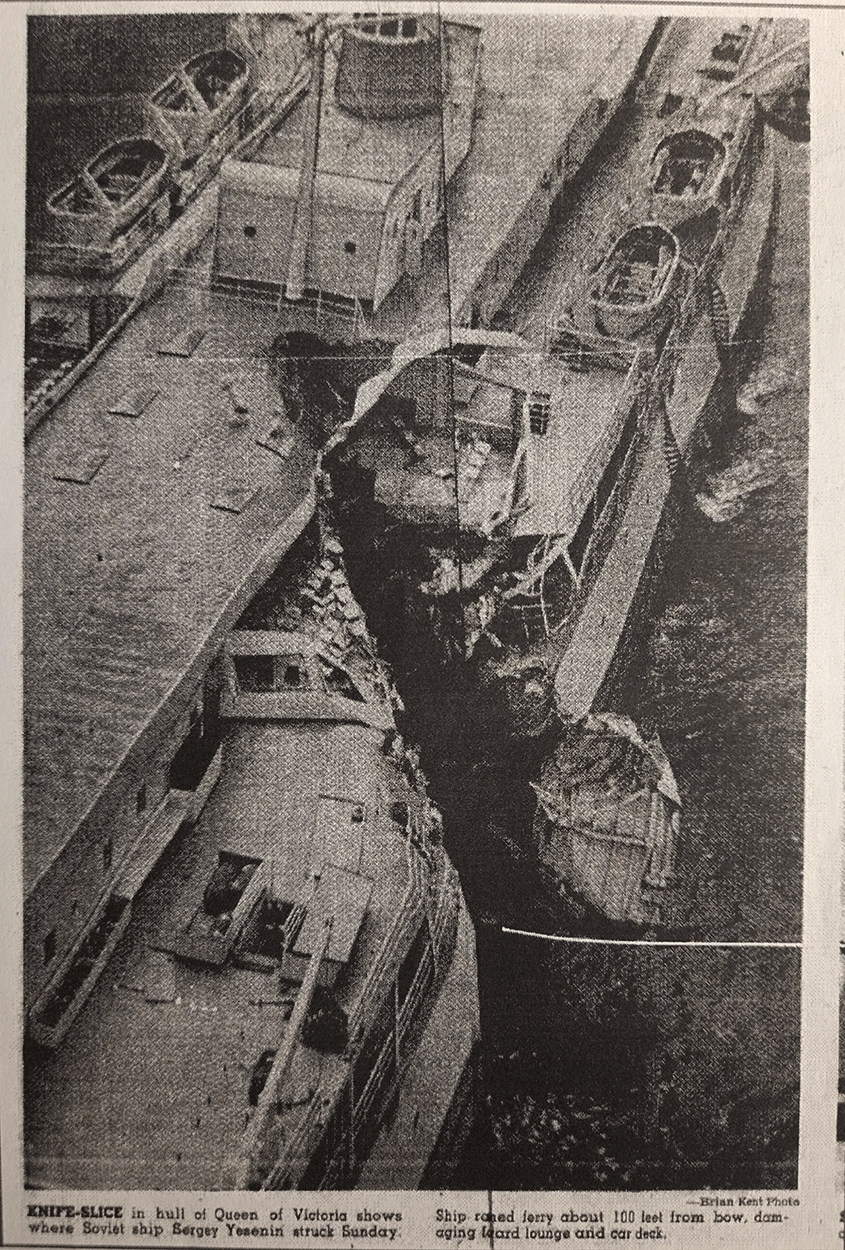
The huge cleft in the ferry’s port side after the two ships were parted. Incredibly, the Queen of Victoria didn’t sink. —Vancouver Sun
Several ferry passengers had been thrown to the decks and “some smacked into walls and bulkheads”. Four of them required hospital treatment; happily, the most seriously injured, Vancouverite Ann Durant, was reported to be in satisfactory condition.
A Victoria couple who’d been reading in their car on the car deck described the crash as sounding “like an explosion. As soon as we heard the first noise, we clambered out of our [spinning] car through the right-hand windows. If we hadn’t we wouldn’t be here.”
They “heard a girl scream. She [Sheila Taylor] landed on the back of our car, covered in blood. There was nothing we could do.”
In the immediate aftermath of the crash, which made international news, the Delta RCMP were flooded with calls from as far away as Chicago from people concerned for the safety of relatives and friends.
Considering the fact that there were more than 600 passengers aboard the Victoria, and 44 crew members aboard the Yesenin, the casualty count was almost miraculously low.
The Swartz Bay-bound ferry had cleared the Tsawassen terminal at 11:00 a.m. and was just rounding Helen Point and preparing to increase speed after navigating the tricky pass, when the steel products and auto-laden Yesinen came into view. At that point, there was a quarter of a mile between them, and both ships began “desperate evasive measures”.
Under the command of Capt. Nickolai G. Khaustov and BC Pilot David Crabbe, the Yesinen “swung wide as she rounded the point,” the Sun explained, “and ferry master Capt. Pollock swung to starboard.
“But pleasure boats and fishing vessels between the ferry and shore restricted the ship’s manoeuvring room, and the two ships collided with a terrible crash. Both vessels had engines going full astern, but could not avoid the collision.”
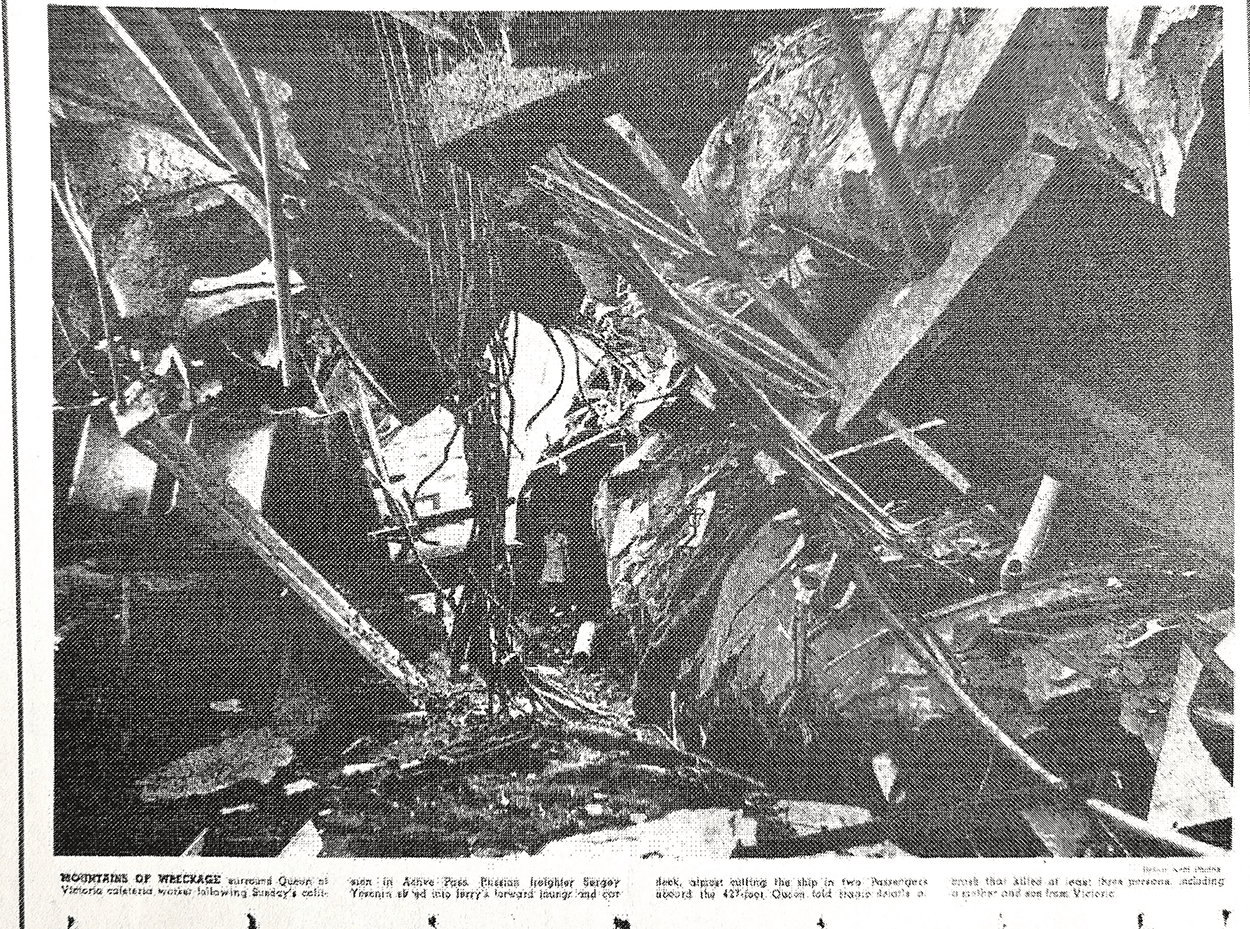
Two women and a baby died in this tangled wreckage after the Russian freighter collided with a BC ferry. —Vancouver Sun
Two minutes later, the Soviet freighter sliced 15 feet into the ferry’s port side, just forward of mid-ship, at a 45-degree angle, mangling the busy promenade deck forward lounge and book-stand area, smashing and buckling the sun deck and destroying and damaging a dozen cars parked on the car deck.
“Four of the cars were compressed by the collision into a space smaller than one parking spot.”
Capt. Pollock spoke to a CBC reporter of those seconds immediately following the vessels sighting one another. He said that, immediately upon sighting the Yesinen, he assumed command from his first officer. “I got over as far as I could to the beacon—I could not go any farther. I gave the signal that I was going to starboard; he gave a signal to starboard, but he couldn’t make her turn owing to the number of small pleasure craft around Helen Point.
“My engines were going full astern, and I assume his engines were going full astern.”
He explained that BC Ferries used an international distress frequency to inquire about any traffic entering Active Pass but had received no reply from the Russian ship which, it turned out, was using a different radio frequency.
Bound in their fatal embrace, both ships drifted in circles in the pass for 30 minutes until they were clear of Active Pass and could be separated.
As it happened, the deep-sea tug Sudbury II, escorting the damaged Alaskan ferry Taku to Seattle, was nearby and able to offer the disabled ferry immediate assistance if required.
Once it was established that the Victoria was capable of staying afloat, with the aid of another tug, the Haida Brave, the Yesinen was pulled free, and both vessels proceeded to their respective ports, Vancouver and Tsawwassen, under their own power. After Delta firefighters hosed down the Victoria’s gasoline-soaked decks, ferry passengers had to undergo interrogation by the RCMP before they could go their own way.
Passengers mostly expressed satisfaction with the ferry crew’s handling of the crisis which included assigning 25 of them to an inflatable life raft; they were later returned to the ferry by a fish boat.
Eyewitness Charles Katnich, a commercial fisherman, described how the freighter passed his vessel and gave two blasts on its whistle, signifying that it was going to port, which would have put it on the shore side of the pass. The Victoria, he said, responded with a single blast, indicating that it, too, intended to take the shore side to starboard.
But the freighter made no reply and “perhaps he should have,” Katnich opined because he thought the Victoria had no room to manoeuvre. (Other testimony at the inquiry agreed that the freighter gave two whistle blasts.) “Then I heard that big crunch,” said his crewman Sam Atelevich. “I don’t know how the hell more people didn’t get hurt,” Katnich marvelled. His two sons received rope burns to their hands when they lowered his boat’s power skiff in preparation should the ferry begin to evacuate passengers.
He’d watched, spellbound, as the stricken ships had “circled round and round as they drifted through Active Pass, carried eastward by the tide.”
To no one’s surprise, with the Victoria out of action, BC Ferries announced a change of sailing schedule by cancelling three sailings a day. But not for long. On August 31, after a $550,000 repair job (much less than originally estimated), the Queen of Victoria navigated Active pass for the first time since her collision with the Sergey Yesinen.
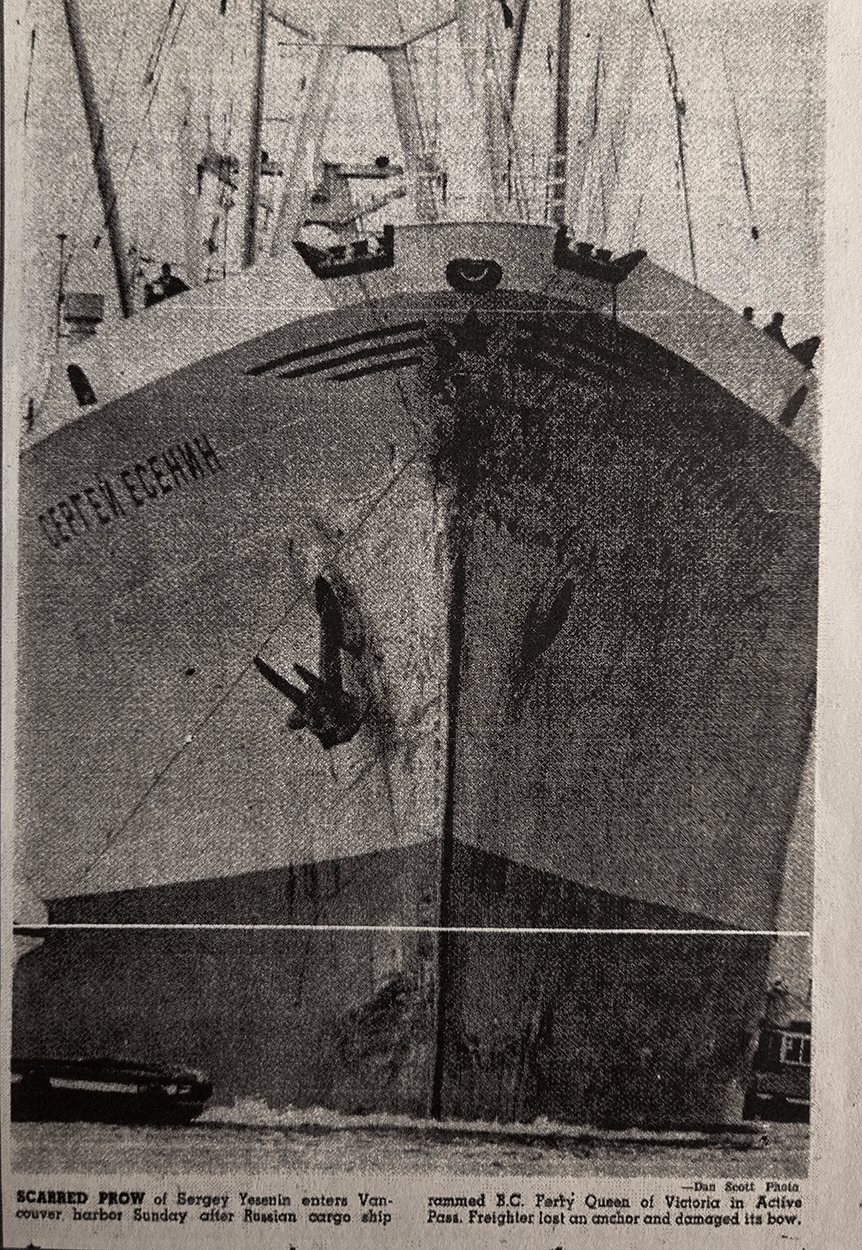
The Queen of Victoria was almost cut in half—but the Sergey Yesinen suffered little more than scratched paint on her bow. —Vancouver Sun
Because she was foreign-owned, the Yesinen had been placed under arrest until a third party posted $1.25 million bond on behalf of her owners two weeks later.
Then the freighter, only superficially damaged, had resumed her own voyage to Japan with general cargo and a load of lumber and pulp from Tahsis, on the Island’s west coast.
Five weeks later began the four-month-long formal inquiry into the circumstances leading up to the fatal crash.
According to Capt. David Crabbe, who’d been piloting the freighter, he’d seen that the ferry was “in the wrong place” from the moment she came into view.
Pointing to a marine chart, he demonstrated jpw the Yesinen, westbound to Swartz Bay, made a starboard turn around Helen Point towards Mayne Island as she entered Active Pass. This contradicted previous testimony by BC Ferries Capt. James Pollock who’d told the inquiry that the point of impact was, in fact, closer to the reef light on the Galiano Island shore.
The Russian crew stood by Capt. Crabbe, insisting that their vessel was making a starboard turn around Helen Point and the ferry was “on the wrong side of the mid-channel line”.
This, despite testimony by the crews of two seiners which were navigating the pass: the Victoria “was on her own side of the channel and the Sergey Yesinen was making a too wide turn into the pass”.
Ironically, the two ships should never have met, Capt. Crabbe having testified that he’d originally intended to use Boundary Pass instead of Active Pass but changed his mind because they could save time: “The tide was just about slack, and I believed it a safe passage.” He also was sure that there’d be no ferry traffic at that time of day —unaware that the Victoria had cleared Tsawwassen eight minutes behind schedule.
While proceeding at 13 knots, he said he knew of three ferries active in the area, having consulted their schedule, and he’d seen two of them earlier. This left the Victoria unaccounted for “somewhere between Tsawwassen and Helen Point”.
He admitted that Capt. Nickolai Khaustov had asked him to slow down but he hadn’t thought it necessary. However, when within a mile of the pass, upon spotting several fish boats, the freighter slowed to half-speed on her master’s command and Crabbe ordered a 10-degree change to starboard to avoid them.
Upon approaching Helen Point, he ordered 50 degrees of starboard helm “and we started to come around slowly on a starboard turn into the pass. I normally give about 20 degrees, but I can’t remember just what I gave because at that point who should be there, coming around the point, but the ferry.”
By his estimate the Yesinen was one and a-half cables (just over half a mile) from Helen Point. “I knew the position of the ferry was wrong. The ferry was too far over on our starboard side of the channel, and a swing to starboard [by the freighter] would be extremely dangerous.”
He said he gave two quick blasts on the whistle as warning and ordered half-astern, but Capt. Khaustov ordered full-astern.
He’d heard no whistle from the ferry which “just kept straight on,” resulting in their colliding.
As for marine charts and long-range radar, Capt. Pollock stated that he had both but seldom felt the need to consult the charts and “in normal practice you don’t use your radar on a nice, sunny day”.
The three-man federal commission found fault on both sides. Capt. Crabbe’s conduct, they ruled, bordered on reckless and they suspended his pilot’s license for 15 months. Capt. Pollock’s actions upon sighting the oncoming freighter were questionable but they recommended no disciplinary action be taken; his employers, BC Ferries, however, temporarily suspended him as master of the Queen of Victoria.
While Capt. Kaustov wasn’t censured, it was reported a year later that he’d been transferred to a desk job in Vladivostok. (At the same time, his former command was back in Vancouver with cargo from Japan.)
Both ships were at fault, ruled Judge E.J.C. Stewart, for failing to keep to starboard and observe the normal marine “rule of the road”.
The tragedy in Active Pass was the first incident of deaths in a BC Ferries accident.
* * * * *
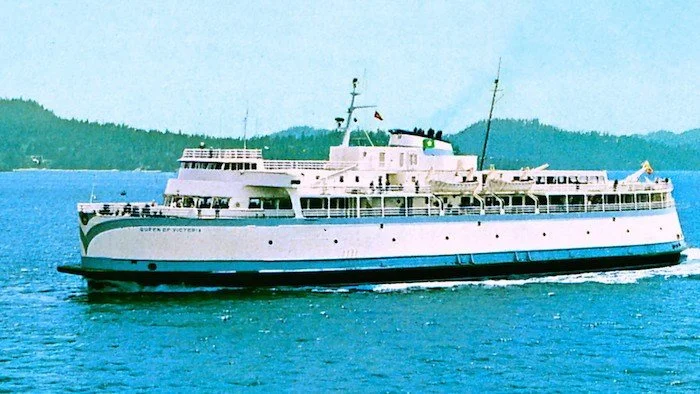
The Queen of Victoria before she was enlarged in the 1980s. Fortunately, she survived her encounter with the Russian freighter and continued to serve BC Ferries for a further 30 years. —Postcard, Author’s Collection
The Queen of Victoria, the flagship and the third of seven V-class ferries constructed between 1962 and 1965, served mostly on the Swartz Bay-Tsawwassen route. Totally rebuilt in the 1980s, she had a new deck installed that greatly increased her car carrying capacity.
Unfortunately, the Active Pass collision wasn’t her only mishap. Two years after her deadly meeting with the Sergey Yesinen in August 1970, while again navigating Active Pass—and within metres of the site of the collision—she was disabled by a fire in her engine room.
The first of her name class to be retired, she was sold in 2001 to Dominican Republic owners who renamed her Queen of Ocoa; only five years later, she was scrapped in India.
