
David Ogilvy
(Conclusion)
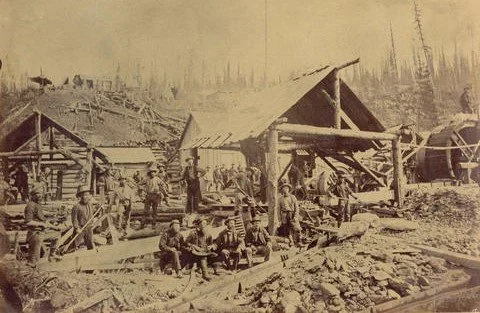
Ogilvy also tried his hand in the Cariboo gold fields. —BC Archives
After conquering Mount Baker, he’d been off to the gold fields of Cariboo. Although early accounts of his excursions to San Francisco, and his stays in Victoria’s leading hotel, the Driard, would indicate that he was successful, Ogilvy later told the Colonist that he’d never “made money.”
For that matter, he said that he had never really wanted to strike it rich; all money meant to him was giving it to charity.
By the time Ogilvy was 82-years-old, he was showing his age. His tall frame was no longer straight, his full beard was white, he wore glasses and was hard of hearing. But his mind remained as alert as ever. Despite the fact that his hands were somewhat shaky, he continued to “make things,” and told his caller of a specially carved cane which he’d presented to his friend and late BC premier, “Dick” McBride.
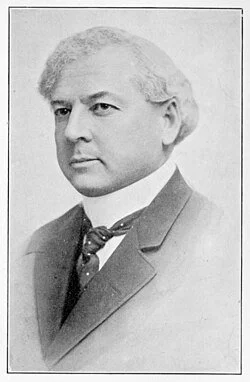
Ogilvy included BC Premier Richard McBride among his friends. —Wikipedia
Advancing age had meant another concession in the form of his moving into a small room in town. His house on David Street, at Trafalgar Bay near Point Ellice, he’d willed to a niece in Italy with the provision that, upon her death, title to the property passed to the City of Victoria.
Here, another of Ogilvy’s vanities became apparent, as he expressed the wish that the city preserve his home “as a memorial to the old days”. With the “earnestness of a child,” he told a reporter that he hoped the city would “keep the place going, for they haven’t got many such things now, what with automobiles and aeroplanes”.

David Ogilvy takes his final rest in Victoria’s Ross Bay Cemetery. —Author’s Collection
Ogilvy apparently viewed himself as a living link with the past; hence his delight in storytelling, which allowed him to “enlighten this frivolous generation regarding the early days here”.
His concern for the future was also evidenced by another eccentricity—his final resting place in Ross Bay Cemetery had long been prepared and awaited the day when he finally was called upon to show his “balance sheet up top, and quit hunting and wandering about Victoria for good”.
With the least encouragement, he’d pull out a photograph which he carried about with him and thrust it as his caller, who undoubtedly viewed the picture of his tomb with mixed emotions. On a large slab of marble, decorated only by a piece of coral, the name ‘Ogilvy’ was inscribed.
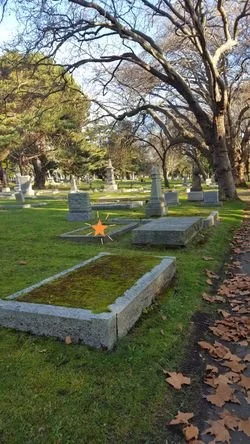
David Ogilvy’s plain grave in Victoria’s Ross Bay Cemetery. —www.findagrave.com
Yet, for all of his professed anticipation for the day when he “hung up his gun for good,” Ogilvy seemed quite content to remain with the living. In his 82nd year, he’d chuckled, “But look at me, boy. Pretty husky yet, eh? Yes, sir, David Ogilvy, first man to climb Mount Baker. I’m not as young as I used to be, but there’s an awful lot of kick left in me yet and I’ll fight ‘em to a finish.
“Fair and honourable is my motto. I never made money, and I only wanted it so that I could found some kind of charity institution. I haven’t done that yet, but it’s not too late, and anyway, maybe if a fellow’s fair and square everything will be all right in the end.”
Then he was off into the past once more, recounting, with eyes ablaze, how, after his brother had been murdered up the coast (another story in itself), he’d headed for Bella Coola with his rifle in search of the culprit. How he’d once paddled by canoe as far as Alaska; how he’d crossed the Cascades with a prospecting party; the day when smallpox epidemics regularly decimated Victoria’s Indigenous population and a tannery had to be converted to a temporary charnel house.
And that infamous occasion when, as a special constable, his jaw was broken and he’d almost died from loss of blood after he was attacked while investigating the theft of a Native woman’s shawl.
Then, opening the lower drawer of his dresser, he displayed "some of his treasures”. The most interesting was a pencil sketch of the flag-planting ceremony held atop Mount Baker so many years before.
Almost as interesting was the drawing's ingeniously executed frame: "a solid block of concrete poured into a seidlitz powder tin and covered with glass. A wire loop inserted in the frame permitted the picture [to be] hung on a wall; on its reverse were the names of the climbing party and details of that historic expedition.
Six years after, David Alexander Nelson Ogilvy—surveyor, prospector, adventurer, policeman, raconteur and character—died at the age of 88. Among those to take notice of his passing was the Vancouver Province, which termed him “one of Western Canada’s picturesque oldtimers,” and marvelled at his quirk of having carried a model of his sepulchre about with him.
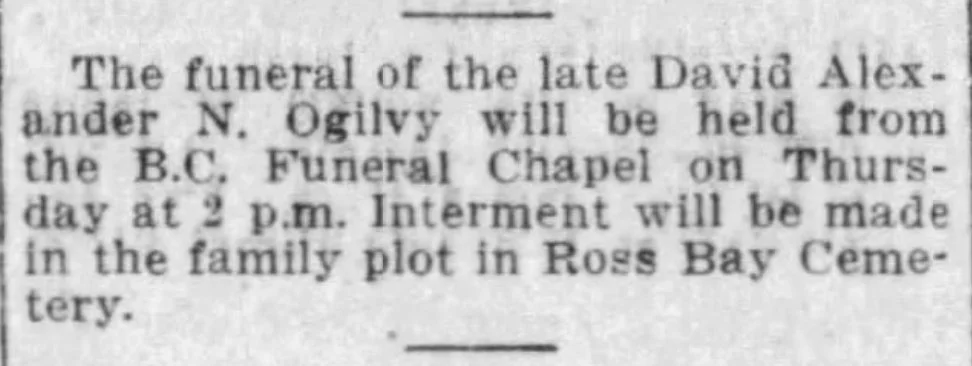
David Ogilvy’s death notice in the newspaper was short and to the point. —www.newspapers.com
The mainland daily also noted that, in final. years, Ogilvy had had a running battle with the Royal Jubilee Hospital.
For his last five years on earth, Ogilvy had professed to be ill; a condition which, more than once, the hospital disputed. Whatever the case, he successfully “squatted” in a hospital room until the end—all the while, refusing to pay his bill because of a long-ago association with the French Benevolent Society, founders of Victoria’s original hospital.
Whenever he’d been presented with a bill, Ogilvy had scrawled the words, “Blackmail, blah,” across the page and returned it to the accounting department. And there the matter had rested until the Grim Reaper finally closed the books.
For all of his penuriousness and eccentricity, the Province described Ogilvy as having been "always jovial and pleasant and liked by the large number who knew him intimately in the capital city. His beard was white and flowing and he wore a type of skull cap, and silver-framed glasses attached to his ears by golden cords."
Before being bedridden, Ogilvy had been fond of visiting the police station, to reminisce with senior members of the force about the good old days when he was a special constable.
Shortly after his death, Ogilvy’s valise was opened at City Hall. To the surprise of many, it proved to be a cornucopia of insight into the remarkable man that was David A. N Ogilvy. Inside were letters from his niece, Mary, the daughter of his murdered brother and wife of a British army officer. She lived in Italy but Mary had never forgotten “the old man living out in British Columbia all alone”.
Each and every month, she’d mailed him a cheque for $50. Thus, Ogilvy’s having left his little house on David Street in her trust.
Equally fascinating were his diaries: two ordinary scratch pads and a red-backed notebook compiled in a "rather incoherent" fashion in indelible pencil. Time and again, the old man referred to having received a letter from Mary, or to his having written her. He also had kept several of her letters, "pencilled in cheerful vein such as might make the heart of an old man lighter”.
In them, his niece—Mrs. H. Hunt Hogan—told of "her doings and how she had met various noted people..." There was mention of her work with the Red Cross during the First World War, and photographs of her lovely Villa Bolton.
As far as officials were concerned, the greatest discovery made among his effects was evidence of his having been anything but a pauper.
Entries in his records showed that he’d regularly deposited his niece’s cheques and that he owned the house on David Street. His cash estate alone amounted to more than $16,000 (a sizable fortune in those days). This fact made his financial feud with the Jubilee Hospital all the more mystifying.
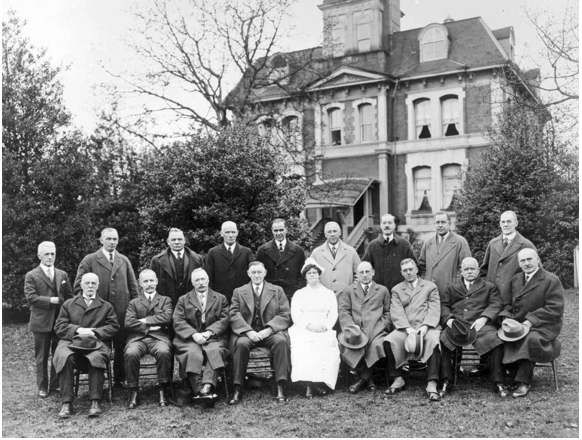
The Royal Jubilee Hospital’s board of directors, 1925. Until David Ogilvy’s death the year before, they’d regularly billed him for the room he insisted upon occuping in the hospital. Invariably, Ogilvy had scrawled the words, “Blackmail, blah,” across the page and returned it to the accounting department. Why they never forcibly evicted him is a mystery. —BC Archives
Upon recovering from the illness which had originally sent him to hospital, he’d refused to leave or to pay his bill which, over the years, had amounted to several thousand dollars. A year before his death, officials had discovered that he was receiving the monthly stipend from his niece and had arranged with Mrs. Hogan to have the cheques sent directly to the hospital.
These had been applied to the old man’s longstanding bill. Yet few had suspected him of being a relatively wealthy man.
Under the terms of his will, Mary was to receive the interest earned on his savings and the revenue from the house until her death, when the entire estate was to go to the city. In various of his rambling notes, he made the mayor of Victoria, and the “Ruler of the Universe,” joint executors of his estate; the latter, he noted, being the only one able to give title to the house on David Street.
Also in the valise was the cherished model of his tomb at Ross Bay. Written on the model was the inscription, “David, the beloved,” although the marble slab had long before been inscribed with just his last name.
Other effects were “a ring inlaid with his wife’s hair, a tie pin set with a human molar, a jack knife dated 1880, a spoon dated 1877, another spoon said to go back to the time of George I, Ogilvy’s old police whistle, a compass dated 1862, old coins, many clippings, a number of pipes, some photographs of himself, a photographic album filled with old-fashioned pictures of relatives and friends, several pairs of spectacles, and boxes containing a variety of odds and ends.”
Random jottings indicated his concern with eternity—he wanted the inside of his tomb painted—and the odd venture into the realm of philosophy: “Life is a narrow vale between the cold and barren peaks of two eternities.” And: “My friend Thomas Palmer died January 28, 1872. It was snowing. We are like the snowflakes. We are here for a short time.”
On matters more prosaic, he expressed resentment and hurt at the hospital’s wanting to discharge him: “Got very unkind letter informing me that I was discharged from hospital June 8, which was a lie, with bill for over $2,000.”
He’d also had kept careful record of the weather, his visitors—his baths—and a number of items, everything from trousers to spectacles, which he claimed to have been stolen from him over the years.
On Dec. 7, 1923, he mournfully noted: “Forty years today my wife died.”
Short months after, David Ogilvy joined her in eternity.
