
Downtown Vancouver Landmark Recalls 1914 Scandal, Tragedy
It’s almost amazing that the Dominion Building ever survived as one of Vancouver’s most iconic heritage landmarks.
If you go by the old newspaper stories and their accounts of the tragedies behind its genesis, the Dominion Trust Co., you’d almost think it was cursed!
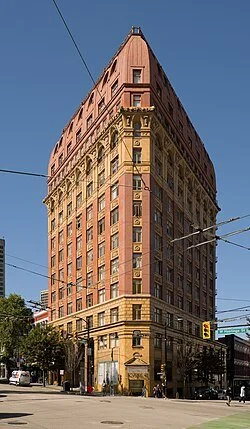
Ill-starred or no, ever so briefly, the Dominion Building was the tallest in Canada, second tallest in the British Empire. —Wikipedia
Coincidental to choosing this week’s Chronicle, Belinda and I attended an Old Cemeteries Society tour, the subject of whom was BC’s first Socialist MLA, James Hurst Hawthornthwaite. As it happened, his step-great-granddaughter Linda M. Boon was ill but, as they say in show biz, the show went on with OCS stalwart Yvonne Van Ruskenveld filling in with Linda’s script.
Better yet, Yvonne also had a single demonstration copy of Linda’s 500-page book about her firebrand forebear, A Charming Rogue: The Scandalous Life and Death of J.H. Hawthornthwaite, which I was able to buy.
What has this to do with the Dominion Trust scandal of more than a century ago? Well, MLA J.H.H. was in the thick of it—in fact, he was one of many who lost their investments when, virtually overnight, the company failed.
But I’m getting ahead of myself. Let’s back up a bit and begin with a few details about the Dominion Building, built between 1908-1910. The man behind its conception was another legendary provincial personality, German financier Alvo vo Alvensleben—a godson of Kaiser Wilhelm II and a story unto himself—one I’ve told previously in the Chronicles.
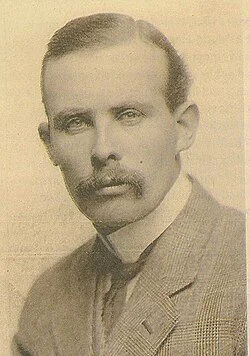
German financier Alvo von Alvensleben. —Wikipedia
It’s believed that Alvo wanted nothing less than a landmark worthy of branding Vancouver as Canada’s west coast financial capital, and what originally left the drawing boards with an estimated budget of $600,000 did so under the aegis of the Imperial Trust Co.
From 1905 on, Alvo, his brother and many others had ridden what had been BC’s greatest financial boom to date. That was the age of empire building such had never been seen in this province before—or, one can argue, since.
All who had the money, the acumen and the nerve to invest saw BC’s rich natural resources as a bottomless money pit. It was the age of the railway, with no fewer than three trans-continentals, one built and two under construction. There seemed to be no limit to the possibilities for development and the real visionaries, public and private, dreamt in nothing less than Technicolor.
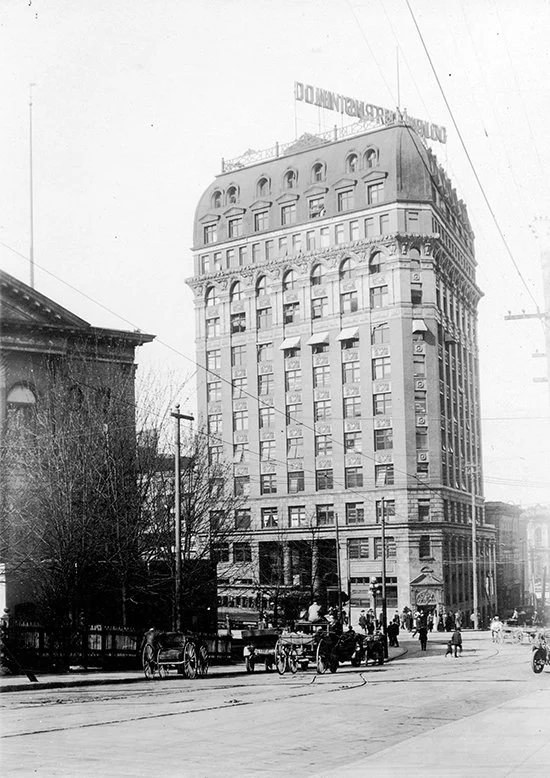
A 1920s view of the new Dominion Building. By then BC’s pre-First World War economic boom was history and the imposing landmark never attained its hoped-for glory. —Vancouver City Archives
But there were limits, of course, and Imperial Trust soon found they’d over extended themselves by half.
Needing $300,000 to finish the building, they had to float an issue of bonds and advertise for more investors in what what they promised would become an “object of pride to every loyal citizen”. But they still came up short. The solution, as they saw it in 1908, made newspaper headlines: BIG COMPANIES AMALGAMATE – Dominion Trust Absorbs Imperial and Will Now Rank as Strongest Financial Institution in Province—To Rush Work on 13 Story Skyscraper.
Weeks of negotiations, it was reported, had gone into the “largest financial amalgamation that has ever taken place in the city”. Dominion Trust had taken over the assets and business of the Imperial Trust Co., “and as a result the scope of the former company has been greatly increased.
“So also has its financial standing, for with the combination of the two companies the Dominion Trust Company is now easily the strongest organization of its kind in the province.’
The newly-combined trust company’s first order of business was completing the 13-storey behemoth on West Hastings St., and construction was resumed until completion in 1910.
An unlucky (as it soon turned out) 13 stories (53 metres/147 feet, 6 inches) tall, the Dominion was Vancouver’s first steel-framed high-rise.
It’s standout appearance is said to be Second Empire style, then favoured by banks and government buildings. Its “Beaux-Arts” flourishes include a mansard roof (Vancouver’s first), arched windows and doors, classical columns, Sullivanesque detailing; inside, besides a raised first floor, its most striking feature is its 10-storey spiral staircase.
But, upon completion, what was now known as the Dominion Building appeared to be jinxed. Among its shortcomings was that damned staircase! Forming the building’s inner core as it did, and as awe-inspiring as it was, it limited the size of office suites and rentals were slow.
Worse yet, by this time BC’s decade-long boom was running out of gas, with the threat of war in Europe prompting British, German and French investors to not only stop investing here, but try to reclaim their monies already committed. Dominion Trust, the brainchild of a former printer, William Robert Arnold, was particularly exposed to these stormy international winds, thanks in part to the building which had become a white elephant.
Ah yes, poor William Arnold. Just 31 years old in 1914, he, too, had soared to the financial heights with the pre-war BC boom, only to become entangled with Imperial Trust, then burdened with what had become the Dominion Building. As the European money flow dried up, insufficient rentals and other income failed to allay company debts and pay for the albatross’s construction.
When depositors were refused payment from monies collected on mortgage payments and Dominion Trust cheques were refused by banks, the chief justice of the B.C. Supreme Court appointed a “provisional liquidator” who found that the company had “carried [on] its business in a negligent and un-businesslike manner”.
How unprofessional? “The prevailing legal view appears to be that the Dominion Trust Company had no right to receive...deposits. They simply hung out their shingle and the public, attracted by higher rates of interest than the banks found it possible to pay flocked in.”
The company, reported the Vancouver Province, had $979,715.07 in assets—and $3 million in liabilities.
Not that it mattered to founder Arnold. In October 1914, newspaper headlines reported Dominion Trust’s managing director’s TRAGIC DEATH DUE TO ACCIDENT. According to police, he was “handling [a] gun he believed to have been emptied of shells”.
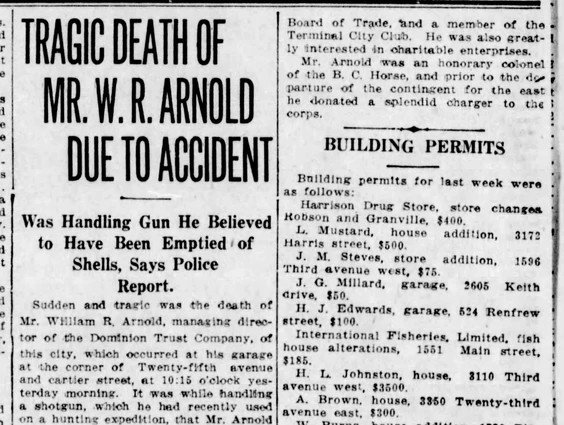
Vancouver’s financial community was shocked by the news of Arnold’s sudden death.
The deadly mishap had occurred in his garage at the corner of Twenty-fifth Avenue and Cartier Street, mid-morning of October 12th. “It was while handling a shotgun, which he had recently used on a hunting expedition, that he was struck in the heart when the gun discharged. He died within moments.”
Police reported that Arnold had “been on a hunting trip Saturday. While returning he had discharged what he thought was the last shell in his gun. Yesterday morning he brought his camping outfit to his garage, removing the gun from the house, lest the children might get hold of it.
“While putting the gun away in the garage he was shot, passing away before his chauffeur, Henry Vanderpool, and his gardener, Mr. A. Brayley, reached his side. The latter immediately summoned Dr. W.D. Brydone-Jack and Mr. W.F. Evans, but the physician saw at once that the financier was beyond human help.
“The Point Grey police were called in and Sergeant Walker had the body removed to the undertaking rooms of T. Edwards & Co., Moss Street, where an inquest will be held tomorrow morning at 10 o’clock.
“The deceased...is survived by his wife, two children [two sons and a daughter] and three brothers....”
There was no doubting that Arnold had died instantly from the 12 gauge blast which had been fired at close range to the chest, resulting in his heart having been “shot to ribbons”.
Born in London, Eng., Arnold had been a resident of Vancouver for 14 years and had earned “an enviable name for himself as a financier, acquiring in 1911 the position which he held at his death. Possibly his greatest asset in business was the hold he had on his entire staff, every man of whom held him in the highest esteem.”
His death and the crashing of his financial empire led many to suspect that they weren’t coincidental; that, rather than face financial ruin, he’d taken his own life. The fact remains, however, that the official cause of death was listed as accidental.
The Dominion Trust Co. was finished.
The years passed with the Dominion Building struggling to pay its way through office rentals. In 1943, S.J. Cohen, president of the Army and Navy Department Stores, bought the ill-starred building, intending to convert it into a department store at war’s end. But this plan never materialized; instead, a branch of the Toronto-Dominion Bank later took up residence. Today an office building with official heritage status, the Dominion has undergone major restoration and has appeared in numerous feature films in recent years.
Some believe it’s haunted between the seventh and eighth floors where the apparition of a man who has been seen on several occasions, sparks the Dominion’s most popular legend.
Meet English naval architect John Shaw Helyer. After a distinguished career in the Old Country, he arrived in Canada after switching to designing buildings in the wake of the Great San Francisco earthquake of 1906. He moved to Vancouver in 1908 where he took on his son Maurice as a junior partner. Among his surviving works are the 1909 Board of Trade Building on Homer Street, the same-year Exchange Building on West Hastings St., and the 1910-11 Metropolitan Building, also on West Hastings.
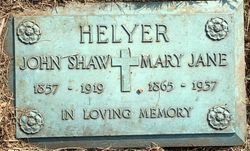
Architect John Helyer’s headstone in Burnaby’s Ocean View Cemetery. —www.findagrave.com
What was to be the Imperial Building but became the Dominion Building is his best known commission, and he later partnered with William H. Archer.
It’s Helyer who gives the Dominion Building its ghost story. And why not? Didn’t he throw himself down his great spiral staircase? It’s a great story but, alas, simply not true. His health began deteriorating in 1915 at the age of 58 and he died four years later—of a stroke while riding a streetcar.
This urban myth does have a more likely origin, however, the “horrifying plunge”—10 stories!—down the elevator shaft of construction worker John Tate in November 1909. His co-worker was able to grab a rope when their scaffold collapsed and, other than severe rope burns to his hands, escaped serious injury.
Incredibly, Tate’s fall was broken as he “struck ropes and the sides of the shaft” during his descent and when he regained consciousness, he told his rescuers, “I ain’t hurt much.”
But he was hurt, and he died the next day from internal injuries.
In October 2021, it was reported that the Dominion Building had been sold to a Toronto-based real estate investment company, Allied Properties Real Estate Investment Trust.
