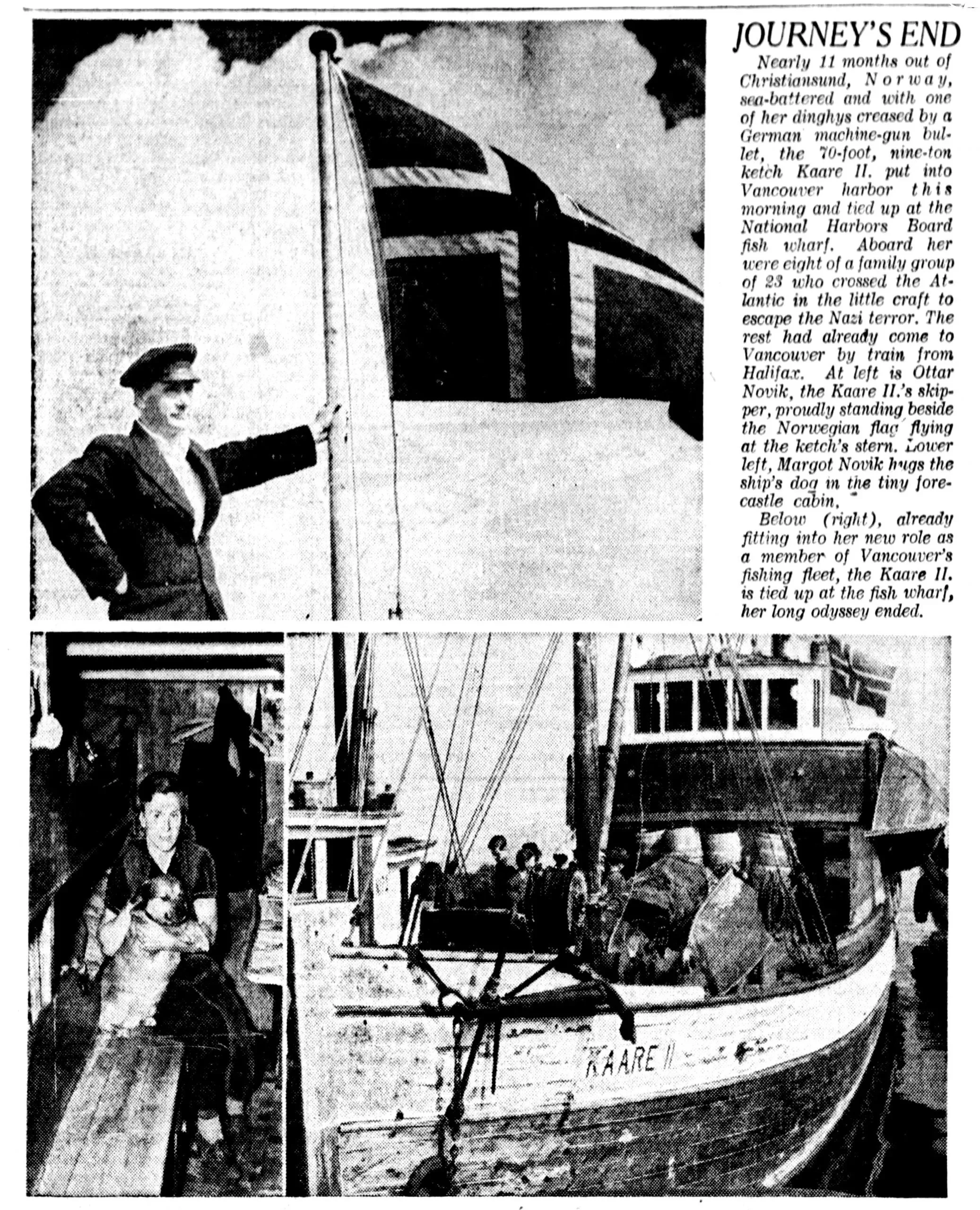
Flight of the Kaare II
After defying German guns and the stormy North Atlantic during the Second World War, a veteran halibut boat vanished off BC’s wild coast in October 1963. There were no survivors.
Five years later, the discovery of wreckage on an Alaskan shore shed new light on yet another of the province’s marine mysteries.
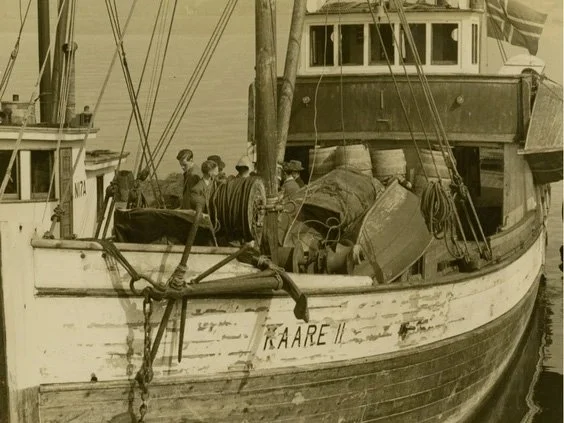
The Kaare II as she looked upon her arrival on the west coast. —Vancouver Sun
* * * * *
The 69-ft halibut boat Kaare II disappeared in October 1963 in gale-swept Hecate Strait with her six-man crew. As an armada of vessels and aircraft searched for the missing ship, newspapers recalled her courageous flight from Nazi-occupied Norway, 28 years before.
For years, Ottar Novik and brothers Hans, Alfred, Hoken, Ove and Haftan had sailed Kaare II, built in 1918, out of Christiansun, fishing in the cold waters of their homeland. But war brought an end to this arduous although satisfying existence.
With the fall of Norway, German occupation forces directed every aspect of Norwegian life. Among those to feel the invaders’ iron rule were the fishing Noviks. No longer could they harvest the fertile grounds they’d known for so long. German naval officers, perhaps for strategic or security reasons, ordered the fishing fleet “elsewhere, often to barren grounds,” wrote George Nicholson, author of Vancouver Island’s West Coast.
Like their compatriots, the Noviks catch “was frequently commandeered by German gunboats with little or no compensation and their gear was often damaged or destroyed by mines and submarines”.
Then there were searches by patrol boats after the bullion which vessels of the Norwegian Underground were smuggling out to British warships, to return with guns, ammunition and instructions of sabotage.
Ashore, it was worse. Families of fishermen lived in constant terror, aware they were constantly watched. In this manner the Germans held them, in effect, hostages for the scheduled return of the menfolk. Also, to again quote Mr. Nicholson, “trade with the outside world was almost entirely cut off; food was scarce and fear of drunken soldiers made living conditions for families intolerable. The presence of possible Quislings didn't help matters.”
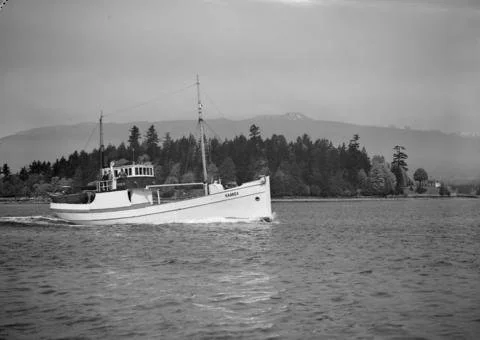
As the Kaare II appeared years later as a working fish boat in BC waters. —Ottawa Citizen
Finally came the day went Otto Novik, owner and master of Kaare II, and his brothers decided they had no choice but to take a desperate gamble. The future held the strong possibility of losing their boat, imprisonment or possibly worse. Thus it was they decided to flee to the United Kingdom.
Obviously, easier said than done. Then came weeks of clandestine meetings, planning and rehearsing while secretly gathering up 23 Noviks and in-laws: 15 adults and eight children ranging from 74 years to seven months.
In following weeks, Kaare II went about her business with an air of complete innocence. German directives were obeyed to the letter; nothing must arouse suspicion. At sea, she fished precisely where told, yielded to all orders of patrol craft and returned to port on schedule. Her men even became friendly with crews of the shore batteries guarding the harbour entrance. Where once the Norwegians passed in stony silence, eyes straight ahead, now they slowed to hail the sentries, “sometimes even calling them by name and sometimes stopping to give them a few fish”.
Finally, the fateful morning of June 9th, 1940 arrived.
As she had so many times before, with only her usual ration of fuel, Kaare II slipped her mornings and headed to sea. In the pilothouse and on deck, Otto Novik and his brothers waved gaily to the shore batteries and received the signal to leave harbour.
Little diesel purring, Kaare II left her home port forever. At their usual posts were Otto, Hans, Alfred, Hoken, Ove and Hafton. Below, in her dark, damp and supposedly empty holds were 17 frightened souls: the Novik women, brothers-in-law Ingvor and Peter Engvik, “their wives, six children ranging in age from 13 to three years, and a seven-month-old baby”.
The previous night had been one of sheer terror, “when, one by one, past unsuspecting sentries, they were smuggled aboard.
“The womenfolk were disguised as men and the children bundled into dunnage bags. Only such baggage as could be taken aboard without creating suspicion was brought along. The remainder of their household belongings were left behind. Their relatives dared not touch their abandoned possessions for fear of being implicated. Lights were left burning in their homes.”
At sea, the fear remained. German planes and submarines ruled the Norwegian Sea. They must continue the ruse as innocent fishermen. The women and children were kept below in stuffy cabins and holds, to keep them from the sight of fellow fishermen and patrol boats. Whenever a German aircraft passed overhead, the Noviks fished; as soon as the enemy flew on, they resumed course.
Then, during the second night at sea—disaster.
Kaare II was proceeding through the black, rolling sea when her helmsman suddenly spotted a huge object looming up, dead ahead. Throwing the helm hard over, Kaare barely missed the alien, a U-boat. In terror, her 23 souls awaited the inevitable challenge and search. Seconds passed. A minute. Two. Still the German didn’t challenge, seeming to be unaware of their presence.
Kaare II passed on into the night and safety. Days later, the miraculous luck seem to have ended when a German plane swept out of the clouds. Circling the little ship, the German scanned her decks, then roared down to attack, machine guns blazing. Instantly, Otto stopped his engine and Kaare wallowed in the swells. Once again, her company awaited imminent doom.
And once again her amazing fortune held. The aircraft buzzed them a last time then flew off. They were alone once more.
Five days later, amid the Faroe Islands, they encountered another ship. But there was no agonizing wait for imminent capture; this stranger was a British destroyer, which escorted her to refuel. The Noviks’ friends and the Resistance had sent word ahead of their odyssey.
But for unstated reasons, they were encouraged to make the 10-day voyage to St. John's, Newfoundland. Except for bad weather, the passage was uneventful.
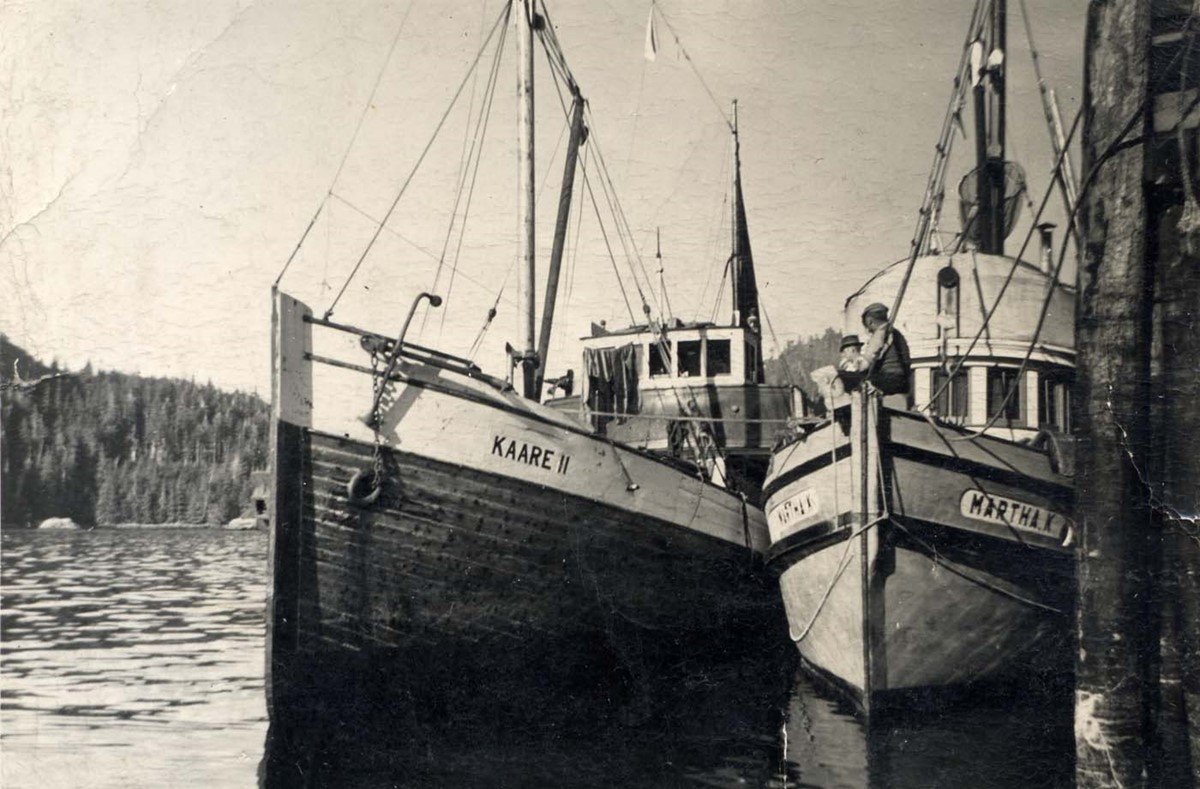
The Kaare II between sea voyages. —City of Richmond
Again, the only ships met were friendly but, again, they weren’t welcomed as refugees, so the Noviks proceeded to Sydney, Nova Scotia. Here, they were welcomed with open arms, given food and hotel rooms in which to rest up.
For a time the Narviks fished for cod on the Newfoundland Banks but found the Kaare II was unsuitable for the open Atlantic and, after several months, aware of a Norwegian commercial fishing community on the West Coast, elected to begin anew in British Columbia. Eight members of the family sailed down the east coast of the United States and through the Panama Canal (pausing in New York where they were celebrated by the press), then headed north as their families crossed Canada by train.
April 28, 1941, the battered ship moored in Vancouver, the port which was to be her home for 22 years.
When she steamed proudly into harbour, the Norwegian flag snapping at her stern, her beaming crew happily showed one and all their memento of a daring voyage which, but for a miracle, could have ended in disaster. In the keel of her port dinghy was a hole the size of a Novik fist—the only damage sustained when the Nazi plane strafed her months before in the Norwegian Sea.
After settling in, the brothers went fishing for cod and halibut, then Ottar sold out to brother Haftan. With brothers Alfred and Hans, he built the big seiner Kaare to engage in salmon, halibut and herring fishing.
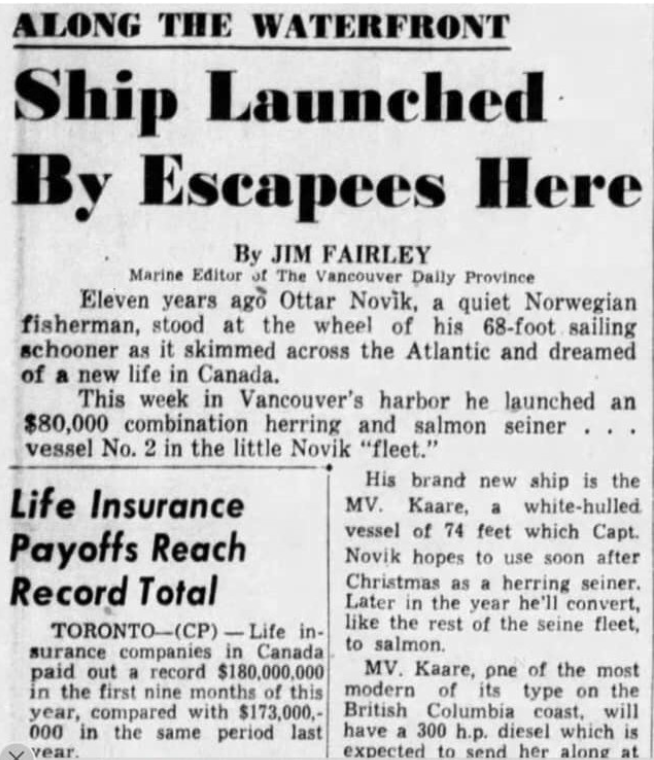
In December 1951 the Vancouver Province reported the launching of Otto Novik’s new and larger seiner, Kaare, by recalling the Kaare II’s daring wartime escape from the Germans, half a world away. —Vancouver Province
Late in October 1963, it was reported that Kaare II had been missing for a week. Days later, the Vancouver Sun reported that a hatch cover “and a strange flotation ball” had been sighted off Bonilla Island, south of Prince Rupert, and the Coast Guard cutter Ready was en route in high seas to confirm the report.
Under the command of another owner, Captain Anflet Antonsen, Jr., his younger brother John and a four-man crew, her incredible luck had finally been exhausted. At first there was hope she’d anchored in an isolated cove to escape a series of vicious gales which had lashed Hecate Strait that month.
Among those inclined to think she was safe was one of the Noviks, who said, “I can't see her having gone down in a storm. We ran a lot of weather in the years when we had her. If she's gone down, she must have have struck a reef.”
Air-Sea Rescue mounted an intensive search by ships and planes in following days. But each passing hour brought the realization that gallant Kaare II had fought her last battle. The missing captain's father, Anfelt Antonsen, Sr., remained hopeful until the end.
Finally, two plastic floats, positively identified as belonging to the missing heroine, were found on a bleak Alaskan shore.
The senior Antonsen and another son, Steinar, had been fishing in the same area that last day. “One wave could have done it,” the old fisherman surmised. “It was a very hard blow that night. I was not far from it...there was a hard blow. The sea and the wind have taken bigger and stronger boats than she was. She was taken by wind and a big sea. I figure it this way: she had no chance to send an SOS. She was well equipped with radio and two sounders.
“Even when they were in port the boys used to give us a call everyday. The wave must have hit so quickly they didn't have a chance to call."
Sadly, he concluded, “I don't believe they are alive. The search was so big. When you think of the many aircraft and boats searching...they covered everything.”
Asked if he’d continue fishing, the 62-year-old Norwegian replied: “Fishing is in my blood. It's a tough life, but when it's in your blood you love it.”
In November 1968, police investigated wreckage found 45 miles south of Prince Rupert. Three days later, Steiner Antonsen identified the shattered white and grey stern section as the remains of Kaare II. The courageous little halibut boat which had brave German guns and Atlantic gales had succumbed, a quarter of a century later, to a BC storm.
Forty years later, the Ottawa Citizen reported the passing of Astrid Skomedal, aged 96, in the Perley and Rideau Veterans’ Health Centre. The retired nurse who’d been one of the Novik family members who fled the Nazis aboard Kaare II in 1940, had returned to Europe to serve her country for the duration of the war.
In a May 2023, “This Week in History” in the Vancouver Sun, a Novik grandson explained that the Kaare II’s company was denied permission to land in the U.K., which is why they carried on to St. John’s, Nfld., then proceeded to Canso, N.S.
“Before they let them into Canada, a doctor came on board to look at them,” said Mike Ronnekeiv. “They figured everybody was suffering from scurvy or something. The kids’ faces were so rosy that the doctor ordered the nurses to wash the paint off the kids’ faces.”
The rosy cheeks weren’t the work of scurvy but of the cold, fresh air of the open Atlantic from the children having spent most of the voyage on deck!
In a recent series of Facebook posts about the Kaare II, Dean Sevold pointed out that another Norwegian fish boat, the Duen, also fled the Nazis, ended up in BC waters and was still fishing. Barbara McBryer, posted that her uncle, Donald Norberg, went down with the Kaare II in 1963, and that he and his shipmates are memorialized at Steveston’s Fisherman’s Memorial.
The bigger seiner Kaare built by the Novik brothers Otto, Alfred and Hans in 1951, went to the ship breakers just last year.
* * * * *