
Down, Down, Down Those Rabbit Holes
They’re a curse, I tell you!
I defy anyone to pore through old newspapers and documents on a daily basis as I do and not be pulled down, down, down by these unforeseen, unavoidable and irresistible sirens.
You can hardly turn a page, it seems, that there isn’t another story crying out, “Read me.”
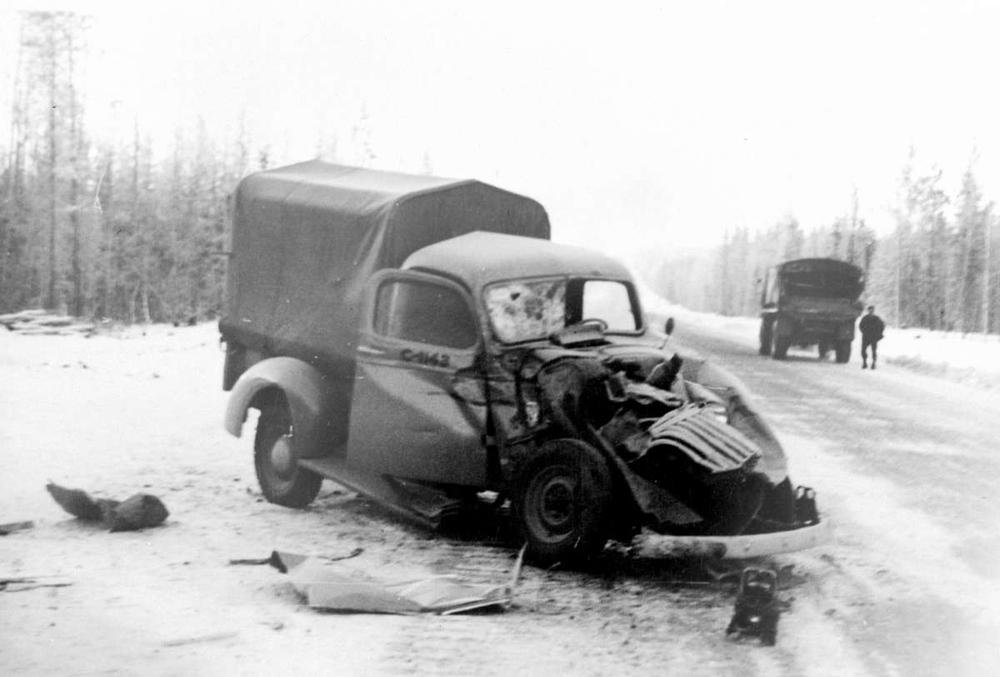
There’s a story to be sure behind this graphic photo of an accident during construction of the Alaska Highway in 1943. My point being that historical researchers are forever being lured off the track by kinky news stories and photos. —BC Archives
If you’re lucky, they’re what I’ve come to call Nuggets—shorties too small to make a regular story as appears here weekly in the BC Chronicles but too good to dismiss. So I save them and set them aside. The years go by—and the file grows...
It’s time for me to take a stand.
Here we are, hardly into another new year and I’m still sorting through 100s of clippings, manuscripts and notes. So, this week, a look at some of these unusual and often quirky events and characters that once, if only momentarily, made it onto the historical record.
* * * * *
I’ll title the first one, Victoria’s Pioneer Unfortunates.
Unkind fate has laid a heavy hand upon more than one Victoriab, as it has so many the world over.
Take likeable Ted Legg, bartender at the Oriental Hotel. A native of Hampshire County, the 57-year-old Legg had served 12 years as master carpenter aboard HMS Shah before settling n Victoria.
With hard work he’d become part owner of the Occidental Hotel, then managed the Lion Brewery Saloon. However, in later years, “his constitution being much weakened,” he’d become incapable of “steady or prolonged work, but all who know him speak highly of his honesty and reliability”.
Reading between the lines more than a century and a quarter later, the modern reader realizes that Ted Legg’s demise—“the lonely ending closes a regrettably wasted life”—wasn’t an uncommon one in the isolated Victoria of old. Often a bottle was the only companion to miners and labourers far from home and family.
Such a case was that of ‘Nevada Bob.’ No one knew his real name. Probably few cared about the sallow-faced young Welshman who “inhabited a small hovel on the vacant lot near the northeast corner of Fort and Blanchard [sic],” with a companion, William Grant.
He’d complained of not feeling well since Christmas.
Two weeks later he said he’d “spil’d” considerable blood, according to Grant’s grim testimony at the coroner’s inquest. The morning before, he’d left the shack and returned about 3 o’clock in the afternoon, saying he “felt very unwell, and laid down on his bunk and after raising a quart of blood, suddenly expired”.
The coroner’s jury promptly returned a verdict of death due to a “hemorrhage of the lungs” after noting that Bob’s habits had been intemperate.
And so it went for many more adventurers who’d journeyed from the four quarters of the globe to seek their fortunes in the El Dorado of British Columbia, only to find loneliness and sorrow in outpost Victoria.
Then there was poor Charley Davis, Victoria’s first bill poster and onetime janitor in the old Theatre Royal. Back in 1892 the ailing pioneer dropped dead “in an apoplectic fit” in his miserable View Street shanty. He’d been so poor that his two daughters were placed in St. Ann’s Convent and his funeral expenses raised by public subscription.
And so he’d passed from the provincial scene, leaving but a handful to know he’d ever been. Some recalled his having mentioned that he landed in Victoria after deserting the U.S. Army at Fort Vancouver, W.T., years before. Others noted that he’d often spoken of having lived in Illinois.
Then Charley Davis was forgotten by all but, perhaps, his daughters. That is, until a year later, when the Victoria postmaster received a letter from Iola, Illinois, inquiring as to the whereabouts of one “Chas. Davis,” who’d been named heir to a “tidy fortune”.
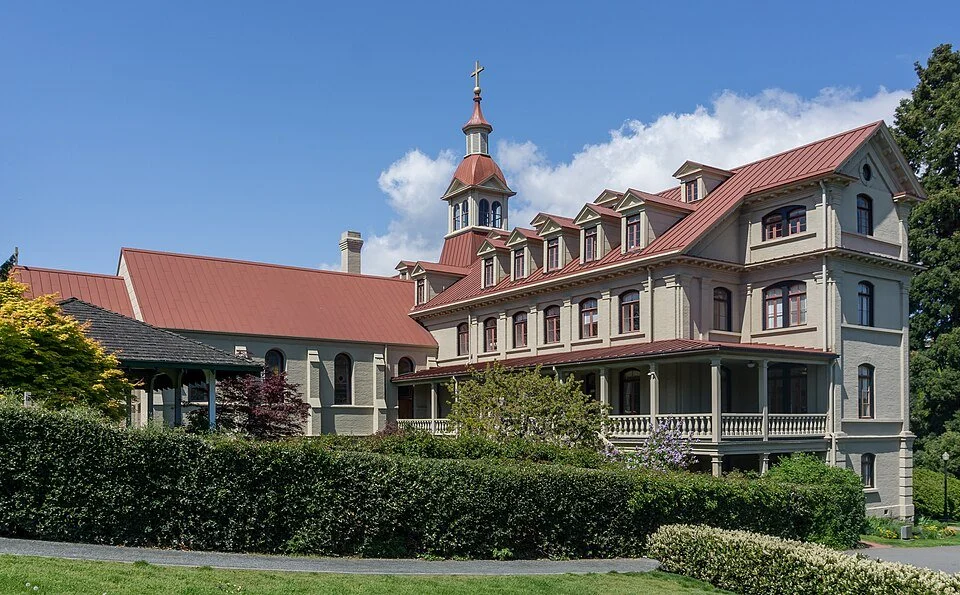
Charley’s daughters were placed in the care of St. Ann’s Academy. Was his belated legacy passed on to them? —Michal Klajban/Wikipedia
porter noted with a sigh, “The poor fellow’s legacy has come a year too late to be of service to him...and friends are interesting themselves to find out whether there will be any possibility of the money reverting to [his children]”.
Then there was the tragic woman who was found, raving and weak from hunger and exposure, in her little shanty beside the E&N Railway line near Parson’s Bridge, about the site of today’s Colwood overpass, in 1894.
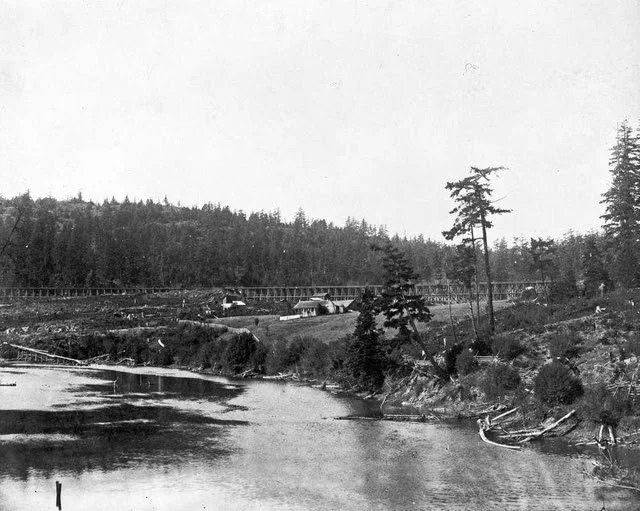
Parson’s Bridge area in the 1880s. —BC Archives
D.M. Gordon had been passing the hovel, he reported, when he “heard a terrible noise, as if from persons engaged in desperate conflict, issuing from the wretched looking cabin. Upon hastening to the spot to ascertain the cause of the tumult, Mr. Gordon was surprised to find only a woman, evidently insane, and exhibiting about her dress and person signs of dreadful neglect and poverty, raving and screaming with the wild frenzy of a maniac as she paced to and fro the floor.’
Upon entering the appalling quarters, Gordon was shocked by the “melancholy fact that there was not only a complete absence of even the coarsest food, but not a cooking utensil of any description—pot, pan, griddle or other piece of kitchen[ware]--could be found.”
He saw not a single piece of furniture—not even a “bundle of straw, shavings or rags, whereon the helpless woman could huddle to protect her gaunt and famished frame from the chilling blasts that whistled through the hundred chinks and crevices in her wretched [dwelling].”
Perhaps the most unnerving feature was the hapless woman herself; she stared vacantly, unaware of Gordon’s presence, until, suddenly, she’d erupt in violence and her eyes would blaze with the unholy fires of insanity.
Officials who investigated were outraged by the fact that she obviously had been there for some time, known to passersby. Yet none but Gordon had even troubled to report her. A reporter concluded, “If ever there was a case that loudly called for help, this is one.”
Some pioneer Victorians brought their tragedies with them. But for his “aristocratic bearing,” M. Vincent made little impression upon Victorians. Even his students at the Anglican collegiate school knew no more about the slender, bald man of medium height, and about 35 years of age, than his name, and probably gave him scant thought once out of the classroom.
As far as his principal the Venerable Archdeacon Woods knew, the “grave and melancholy” Vincent kept to himself, having but one close friend, an Englishman named Abbott, with whom he’d arrived in the colony months before. As a teacher, the quiet Frenchman had proven himself quite satisfactory.
This, plus the fact that he asked for little in the way of a salary, made him a welcome addition to the small faculty.
Thus it was with a shock that Archdeacon Woods learned of Vincent’s amazing secret.
This startling disclosure came about when Vincent requested a private audience with his superior. Once in the privacy of the principal’s office, he began his tale...
His real name, he said, was Visseux—Comte de Visseux. The reason for his alias, Vincent, was that, even at that very moment, his life was in danger. He and his English companion, Abbott, had fled halfway round the world but, at last, they’d been found. An English detective named Strong, employed by French Emperor Louis Napoleon III, was in town, having trailed them from England, the U.S. and, finally, to the little colony of Vancouver Island.
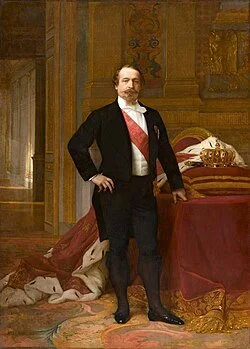
French Emperor Napoleon III, the object of a bomb attempt. —Wikipedia
Strong’s orders, he said, were to kidnap the political exiles and return them to France for trial and, undoubtedly, the guillotine.
Vincent’s—Visseaux’s—crime had been that of attempted assassination. As a young idealist he’d joined an anarchist society led by a fiery Italian nationalist, Felice Orsini, and had conspired to assassinate Napoleon. After months of planning Orsini had thrown a bomb at the emperor’s passing carriage. The missile erupted with devastating effect. Guardsmen and horses were dismembered, the carriage shattered, but, miraculously, the emperor and empress had escaped unharmed.
Most of the conspirators, including Orsini, had been arrested and, after a brief trial, some of them executed.
“I did not throw the bomb nor was I near the opera house when it was thrown,” ‘Vincent’ explained, “but my name was on the list of members and I believed the emperor deserved death.”
“I do not think so now. My feelings have changed and I await the day when I may return to my native land and reside there in peace. I had Mr. Abbott’s consent to tell you what I have, and as we cannot be extradited for a political offence, i wish to have my true name inserted in the next term’s circular.”
Thus, the following term, the name of Vincent “disappeared forever from the advertising of the school, and the name of Visseux came in its place.”
Ten years after, Emperor Napoleon was dethroned and detective Strong had long since sailed away. A fugitive no longer, Visseux, since married, returned to his homeland. Abbott, his companion in flight, visited France frequently.
Like Visseux, he’d found that the old order was gone forever and he could walk Paris streets a free man.
* * * * *
I couldn’t resist Googling Felice Orsini, the Italian patriot and would-be assassin. Here’s what Wikipedia tells us of the tragic affair that had led to Comte de Visseux’s exile in outpost Victoria:
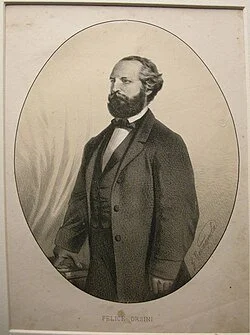
Italian nationalist Felice Orsini who attempted to assassinate Emperor Napoleon III. —Wikipedia
“On the evening of 14 January 1858, as the Emperor and Empress were on their way to the theatre in the Rue Le Peletier...Orsini and his accomplices threw three bombs at the imperial carriage. The first bomb landed among the horsemen in front of the carriage. The second bomb wounded the animals and smashed the carriage glass. The third bomb landed under the carriage and seriously wounded a policeman who was hurrying to protect the occupants. Eight people were killed and 142 wounded, though the emperor and empress were unhurt...”
History Today gives a greater sense of the real horror of that failed assassination: 156 soldiers, civilians and police wounded, of whom eight later died as a result of infection from deep wounds in which small particles of bomb and debris had embedded themselves. Three people were blinded. Not to mention the hapless horses.
Ironically, Orsini had trusted to others to test the bombs; when it was time for him to pack them with explosive he packed them too full, resulting in their being so fragmented that, while devastating to exposed human and horse flesh, they had little effect on the carriage which protected the emperor and empress from injury.
Stunned by a wound on his right temple, Orsini tended his wounds and returned to his lodgings, where police found him the next day. He was sentenced to death and went calmly to the guillotine on 13 March 1858.
One accomplice was also executed, a second sentenced to death but commuted to life imprisonment on Devil’s Island from which he escaped and went on serve with the Union Army during the American Civil War.
* * * * *
I find it hard to sympathize with Visseux and Abbott having had to flee abroad to escape justice.
As for rabbit holes, I gotta love ‘em. But they do clutter up my files, adrift as they are in the sea of archival material I’ve amassed over the decades. I’ll dig out more some time.
